When you click on links to various merchants on this site and make a purchase, this can result in this site earning a commission. Affiliate programs and affiliations include, but are not limited to, the eBay Partner Network.
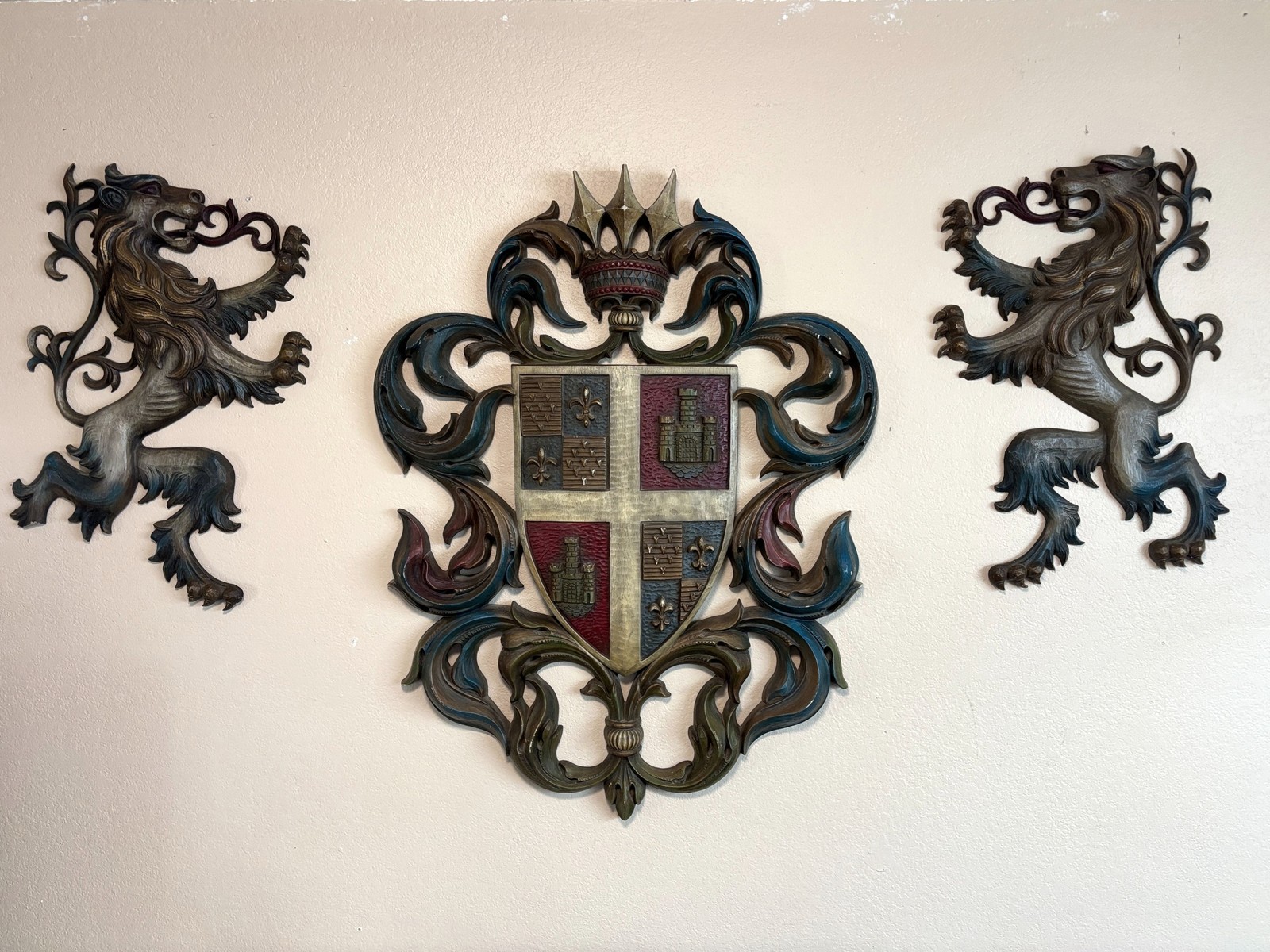
Burrwood decorative wood wall crest set of 3 featuring two lions and a central shield with a crown, ideal for classic or vintage home decor. Family crest, very large wall art.
Great for cabin decoration.
The two side lions are approximately 26 inches tall by 17 inches wide.
The Shield is 37 inches tall by 29 inches wide.
The shield has some paint wear marks. These can be retouched; it\'s not something I would be doing. Possibly a professional? The history of this
Made of carved wood with painted gold, red, blue, and brown accents.
Includes three separate pieces: two lions and one shield with crown.
Back stamped with Burrwood Products Co. U.S.A. and model number D8GW 4468.
Each piece is designed for wall for adding a regal or heraldic touch to any room.
Condition is very good, with some paint chipping and minor surface wear consistent with age and use. Please review all photos carefully for details.
If you are interested in this, it would be best to contact me to arrange shipment.
This is what Chat GPT tells me about this and the company.Burwood was an American maker of decorative wall pieces, clocks, plaques, mirrors, and similar home décor. The company began in Michigan in the late 1920s, originally as Burwood Carved Products Co., later shortening the name to Burwood Products. It became one of the better-known competitors to Syroco in molded decorative pieces. Burwood eventually went out of business in the 1990s, and its assets were acquired by Syroco around 1997.
Your set appears to be a heraldic/medieval-style wall décor set: a large central coat-of-arms plaque with two separate rampant lions. Burwood made quite a few heraldic and coat-of-arms designs, especially during the period when Medieval, Tudor, Spanish Revival, and “Old World” decorating was popular. I found other Burwood coat-of-arms pieces from the same general family of designs, including mold number 4412 and other heraldic sets.
The number molded into yours appears to be in the 446x range—I can make out something that looks like 4463 on the back. That is most likely a mold or design number, not a date.
As for age, I would put this set most likely in the late 1960s through 1970s, with the 1970s being especially plausible based on the styling, paint treatment, molded construction, and similar Burwood heraldic décor showing up from that period. I would not call it 75–100 years old. It looks more like roughly 45–60 years old.
And this is the interesting part: it is not carved wood and not solid metal, even though it feels substantial. Burwood became known for molded composite décor designed to imitate carved wood. Sources describe Burwood material as a mixture of finely ground wood material/filler combined with binders and synthetic resin, pressed or molded into detailed shapes. Later pieces increasingly used resin/plastic-type formulations. That explains exactly what you noticed before: it feels heavier and denser than ordinary plastic, but it doesn\'t feel like either solid wood or cast metal.
Your back surface is also very characteristic: dull gray-brown, rough in recessed areas, with smooth cut/molded edges and the white “BURWOOD PRODUCTS CO. U.S.A.” stamp. That is consistent with molded composite construction rather than metal casting.
One other thing: the coat of arms in the center is probably decorative heraldry rather than an authentic family crest. Burwood produced generalized European/heraldic motifs for decorating, so I wouldn\'t advertise it as belonging to a particular family unless we can match those exact quarterings to documented arms.I searched specifically for Burwood 4468, and I’m not finding a clean indexed listing for that exact number yet. What I did find is useful for dating it: Burwood design numbers in the mid-4400s show up in U.S. Copyright Office records from the mid-to-late 1960s. For example, Burwood no. 4427 was registered in 1966, no. 4431 in 1968, and no. 4465 in 1966.
That makes your 4468 set very likely a design introduced around the late 1960s, rather than something from the 1920s–40s. It could have continued to be manufactured into the 1970s, which would fit the finish and decorating style.