When you click on links to various merchants on this site and make a purchase, this can result in this site earning a commission. Affiliate programs and affiliations include, but are not limited to, the eBay Partner Network.
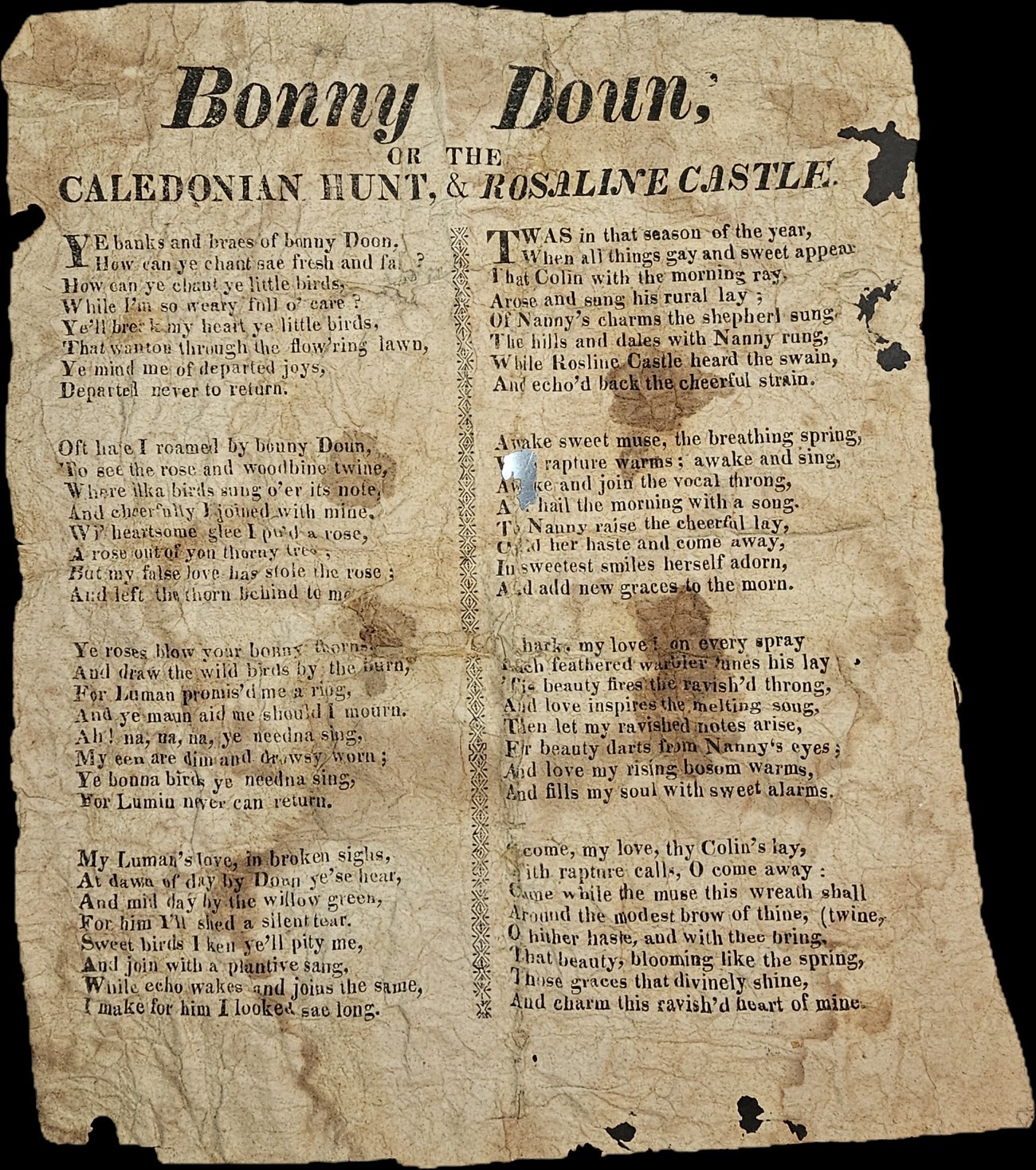
Original 19th-Century Broadside Ballad: Bonny Doon, or The Caledonian Hunt & Rosaline Castle
Printed circa 1840s–1850s, this rare and evocative broadside features a romantic Scottish ballad in two columns, typical of street literature circulated in Britain and America in the early to mid-19th century. The ballad is based on and includes portions of the beloved Scottish poem Ye Banks and Braes o’ Bonny Doon by Robert Burns, as well as verses referencing \"The Caledonian Hunt\" and \"Rosaline Castle,\" suggesting it may be a composite or adapted text printed for popular audiences.
Transcription (partial):
> Ye banks and braes of bonny Doon,
How can ye chant sae fresh and fair?
How can ye chant, ye little birds,
While I sae weary, full o’ care?
This is the opening stanza of Burns’ famous poem, which tells the story of a woman mourning lost love while observing the cheerful contrast of nature around her. The poem is deeply melancholic and has been beloved in Scottish and romantic literature for over two centuries.
The broadside continues with verses praising spring, love, and pastoral beauty, introducing fictional characters like Colin, Nanny, and Luman, offering a mix of original and possibly borrowed romantic verse typical of printed ballad culture.
---
Biographical and Cultural Context:
Robert Burns (1759–1796) is Scotland’s national poet, celebrated for his work in the Scots dialect and themes of love, nature, and social commentary. Bonny Doon is one of his best-known love songs and was set to music in the 1790s.
The Caledonian Hunt was a prestigious 18th-century Scottish social club (and fox-hunting group) that Robert Burns was closely connected to; he even dedicated the 1787 edition of his poems to them. Their inclusion here speaks to a romanticized view of Scottish nobility and tradition.
Rosaline Castle is likely a poetic invention or a symbolic romantic location, much like Castle Howard or Elfin Glen in other 19th-century verse.
---
Condition:
This broadside is fragile but complete, printed on a single sheet of laid or wove paper, showing expected wear consistent with age.
Visible staining, foxing, and some edge tears.
Appears to have been affixed to a backing at one point but is now loose.
A few small holes along fold lines, though all text remains readable.
---
Broadsides like this were printed cheaply and sold on the street, rarely surviving in good condition—making this a scarce survivor of 19th-century literary ephemera.
Combines Robert Burns’ work with lesser-known ballad material, likely appealing to the sentimental readers of the time.
A valuable addition for collectors of Scottish poetry, Burnsiana, or early American/British print culture.