When you click on links to various merchants on this site and make a purchase, this can result in this site earning a commission. Affiliate programs and affiliations include, but are not limited to, the eBay Partner Network.
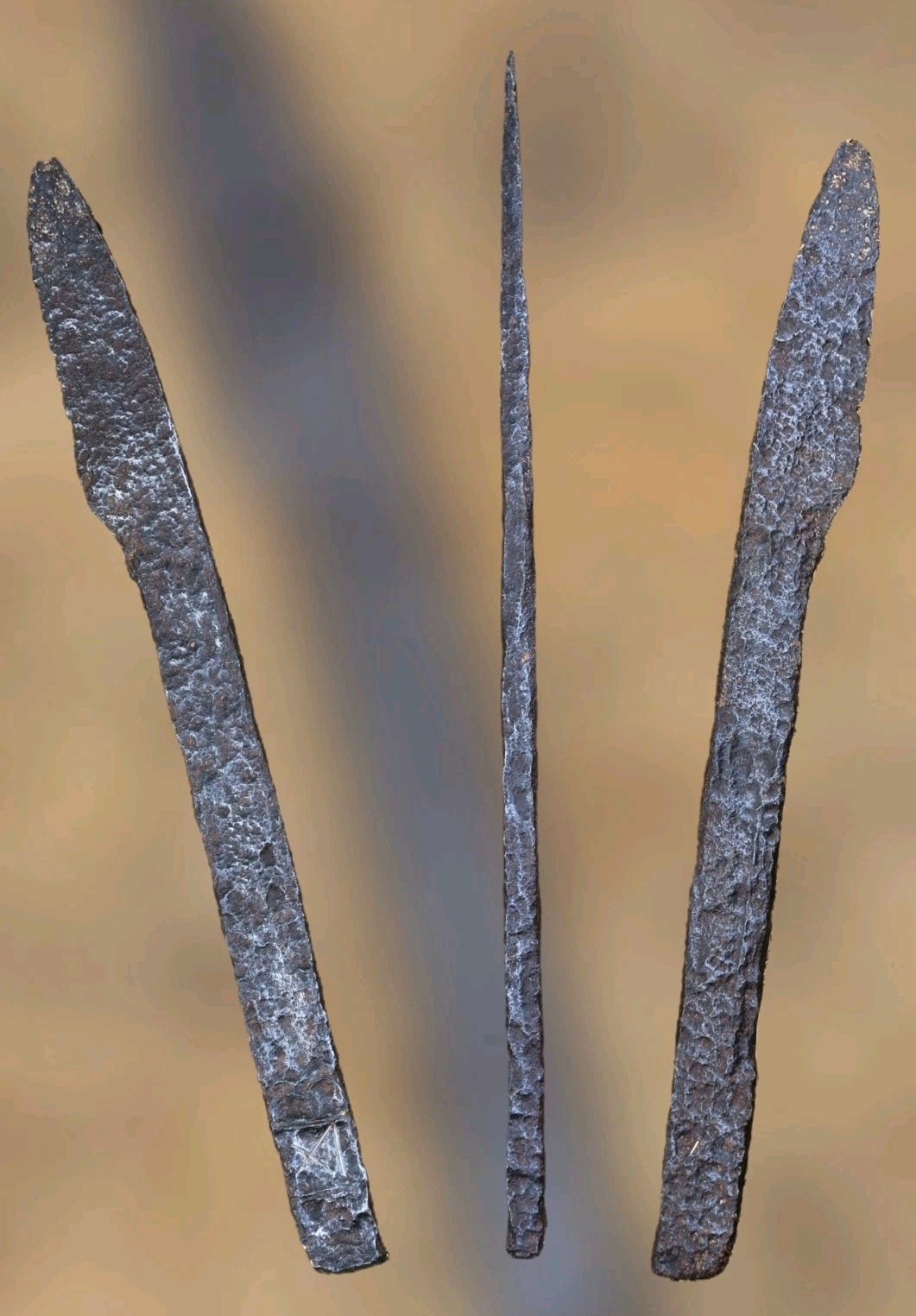
Authentic Romano-British Heavy Aratral Coulter with Inscribed Estate Tally ("XI")
Provenance: Field W, UK (Elevated Terrace Locus; Associated Villa Rustica / 4th-Century Industrial Horizon)
Period: Romano-British (c. 2nd – 4th Century AD)
Typology: Manning Type 1 Heavy Beam Coulter / Aratral Slicing Blade
Dimensions & Mass: Length: ≈ 52.5 cm (20.6 in) | Width: ≈ 3.8 cm | Mass: 1,710 g (1.71 kg)
Condition: Complete, unbroken, and museum-stabilized; original forged bloomery slag-line texture sealed under microcrystalline Renaissance Wax.
Executive Summary
An exceptionally rare, complete, and massive Romano-British hand-forged iron plough coulter (culter), recovered directly from an established villa rustica and Late Roman industrial locus ("Field W", UK). Weighing an immense 1.71 kg and measuring over half a metre in length, this heavy aratral implement represents high-capital agricultural engineering designed to slice through heavy lowland clay and dense root systems ahead of a heavy ploughshare.
Crucially, the squared terminal butt features a clear, cold-chiseled Roman numeral/estate tally mark ("XI"), preceded by a transverse set-chisel boundary groove. This epigraphic detail links the tool directly to centralized Roman estate inventory control, bloomery batch accounting, or blacksmith allocation. Fully conserved with a stable, lustrous oxide finish, it offers unparalleled integrity for academic reference, museum display, or premier antiquities collections.
Archaeological Typology & Academic Parallels
This specimen represents a classic Manning Type 1 Coulter (Catalogue of Romano-British Iron Tools in the British Museum, W.H. Manning), characterized by a long, heavy rectangular stem, unpierced butt, and an integral single-edged drop-blade.
The Silchester Roman Town Hoards (Calleva Atrebatum, Hampshire): Almost identical in mass, length, and cross-section to the heavy beam-coulters excavated from the 1890 and 1900 blacksmith/estate pits published by the Society of Antiquaries. The Silchester coulters share the same massive rectangular shank designed to absorb severe multi-ox draft torque without buckling.- The Great Chesterford Ironwork Hoard (Essex / Cambridgeshire border): Direct typological parallel to the 4th-century AD agricultural ironwork group, matching the blade drop-angle, heavy anvil planishing, and bloomery slag-fiber density.
- The Dorchester-on-Thames Rampart Hoard (Ashmolean Museum, Ref: AN1967.1240): Shares the exact asymmetrical wedge profile and transition shoulder from the upper mounting stock to the leading cutting edge.
Diagnostic Typo-Technological Details
- Massive Structural Shank (≈ 35 cm): A solid, non-tapering rectangular bloomery bar designed to be secured vertically through the timber beam of a heavy plough (aratrum / carruca) using iron or wooden wedges.
- Asymmetric Drop-Blade (≈ 17 cm): Forged with a distinct single-edged leading cutting bevel, engineered to part turf cleanly while leaving a reinforced thick spine to withstand sub-surface boulder and stone impacts.
- Incised Estate Tally / Smith Mark ("XI"): Deeply stamped/chiseled Roman numeral on the terminal head, demonstrating administrative management within a Roman rural estate (villa rustica / villicus inventory).
- Bloomery Metallurgy: Displays pronounced longitudinal slag stringers, variable hand-hammer planishing facets, and a hot-cut shoulder transition characteristic of ancient bloomery smelting and hand-anvil forging.
Condition & Conservation
The piece has been meticulously conserved to halt active corrosion while preserving its authentic ancient working surface. The stable, dark magnetite/goethite oxide crust has been consolidated and sealed with Renaissance Wax, producing a dry, stable, and protected finish ready for handling and permanent cabinet display.
Provenance & Legal Compliance
Findspot:
- Field W, UK (Single, well-documented multi-period site spanning early villa-rustica estate infrastructure to late 4th-century industrial bloomery production). Northern Cambridgeshire Fen-Edge Horizon (W Field & surrounding precinct), UK. Georeference: 52°30'17.92"N 0°16'17.46"W
- Legal Status: Fully compliant with all UK Treasure Act (1996) provisions and Portable Antiquities Scheme (PAS) guidelines for non-precious field-recovered antiquities.
- Direct Transfer: Acquired directly from the original finder.
Legal Compliance & Provenance Disclaimers
- Land Status: Recovered with full landowner consent during a controlled surface scrape on private land in Northern Cambridgeshire.
- Legal Status: Single base-metal (wrought iron) artifact; does not fall under the statutory reporting requirements of the UK Treasure Act 1996. Voluntary PAS recording is currently suspended due to regional FLO processing backlogs.
- Archive Reference: Full grid coordinates, photographic records, and stratigraphic context are permanently logged in the seller's private field register.
Further Reading Reference / Bibliography
- Manning, W. H. (1985). Catalogue of the Romano-British Iron Tools, Fittings and Weapons in the British Museum. British Museum Publications.
- Rees, S. E. (1979). Agricultural Implements in Prehistoric and Roman Britain. BAR British Series 69.
- Applebaum, S. (1972). Roman Britain. In H. P. R. Finberg (Ed.), The Agrarian History of England and Wales, Vol. I.II. Cambridge University Press.
General Reference material and further reading:
Where possible ancient artifacts may be referenced to similar material observed in the following publications within my collection:
- British Artefacts Vol.1, 2 and 3: Brett Hammond [Greenlight Publishing 2010]:
- Celtic & Roman Artefacts: Nigel Mills [Greenlight Publishing 2007]:
- SPQR: A History of Ancient Rome: Mary Beard [Profile Books 2015]:
- 50 Bronze Age Artefacts: Portable Antiquities Scheme: Dot Boughton [Amberley Publishing 2021]:
- Pottery in Britain 4000BC to AD 1900: Lloyd Laing [Greenlight Publishing 2003]:
- British Iron Age Coins In The British Museum: Richard Hobbs [British Museum 1996]:
- Swords of The Viking Age: Ian Peirce: [The Boydell Press 2003]:
- Proceedings of the Prehistoric Society Volume 85: [Cambridge University Press 2019].
- Mesolithic Europe: Geoff Bailey / Penny Spikins [Cambridge University Press 2008]
- Viking Art: James Graham-Campbell: [Thames & Hudson, London 2018]
- Roman Coins Vol. 1, 2 & 3: David R Sear: [Spink London 2000]:
- The Roman Cavalry: Karen R. Dixon: [B. . Batsford 1997]:
- Rome’s Saxon Shore: Coastal Defenses of Roman Britain AD 250 – 500: Nic Fields [Osprey Publishing 2006]:
- Amulets of Ancient Egypt: Carol Andrews: [University of Texas Press / British Museum Press 1994]:
- The Uniforms of the Roman World: Military dress, weapons, artillery, ships, siege engines and fortifications: Kevin F. Killey: [Anness Publishing 2017]:
Where possible finger rings may be referenced to similar material observed in the following publications within my collection:
- Victorian and Albert Museum CATALOGUE OF FINGER RINGS 1930: C.C.Oman [Anglia Publishing. 1991 – Now out of print]:
- Finger Rings: Diana Scarisbrick / Martin Henig: [Ashmolean Museum Oxford. 2003]:
- Ancient Rings An Illustrated Collectors Guide: T. N. Polio: [McFarland & Co Inc. 2018:
- 1000 Rings: Inspiring Adornments of the Hand: Le Van, Marthe; Ebendorf, Robert [W: Lark Books 2004]:
Copyright AncientPasts 2026 | All rights reser