When you click on links to various merchants on this site and make a purchase, this can result in this site earning a commission. Affiliate programs and affiliations include, but are not limited to, the eBay Partner Network.
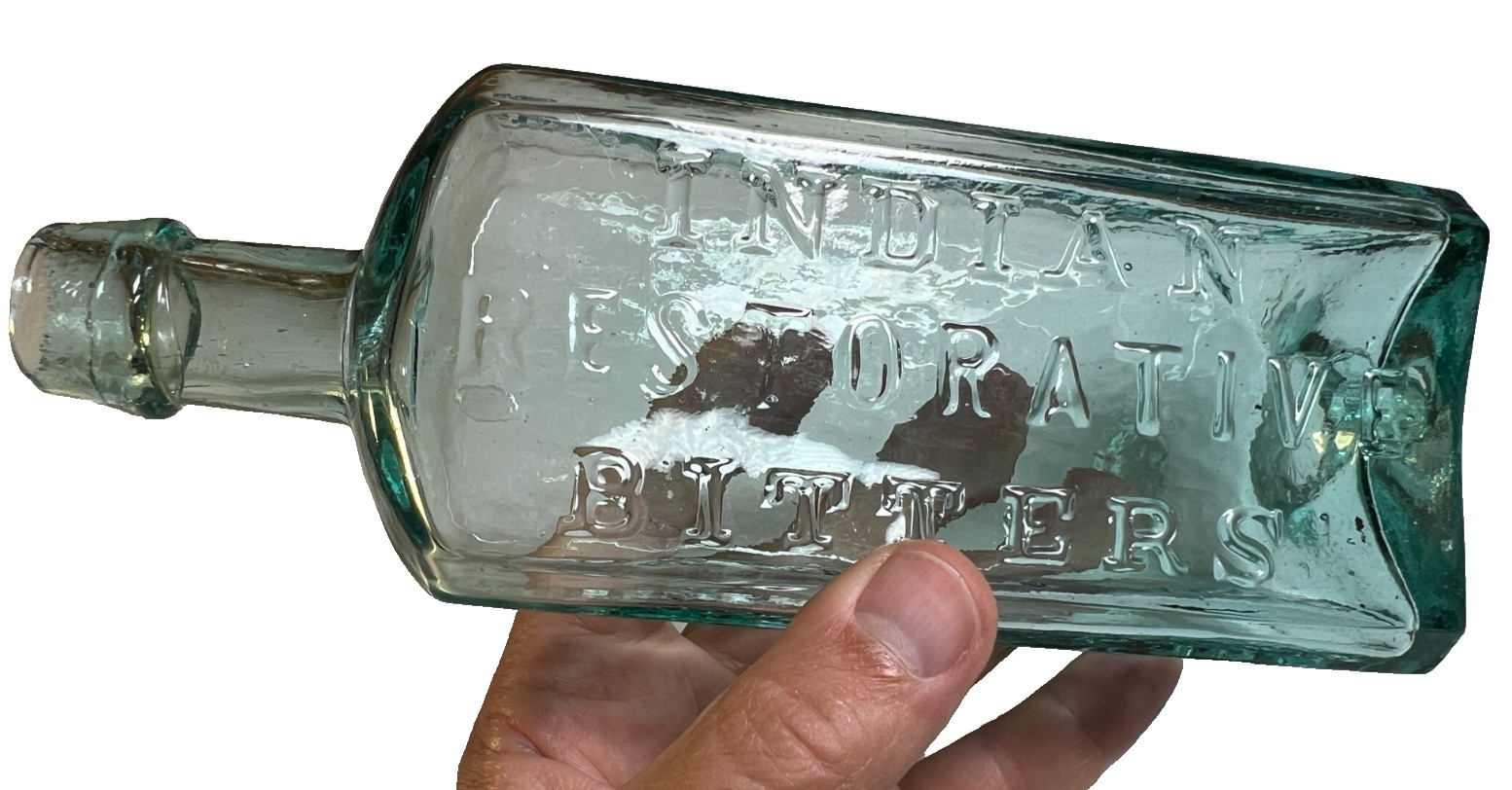
An exceptional circa 1857 Dr. Geo. Pierce's Indian Restorative Bitters from Lowell, Massachusetts—a beautifully preserved pontiled New England medicine bottle dating to the final years before the Civil War.
Embossed on three panels:
DR GEO. PIERCE'S
INDIAN / RESTORATIVE / BITTERS
LOWELL MASS.
Approximately 8 inches tall. Hand blown in a gorgeous deep bluish aquamarine glass, rectangular in form with beveled corners and strongly embossed panels.
The condition and glass character are outstanding. This bottle is sparkling clean and attic mint, with no chips, cracks, haze or cloudiness, and virtually no visible wear or scratching. The embossing is remarkably strong and the uneven, light-catching surface displays excellent period whittle throughout.
The mouth is especially appealing. It has a crudely applied tapered/sloping collar, visibly worked by hand while the glass was hot, with excess molten glass actually trailing down onto the neck. Rather than the uniform finish of a later machine-made bottle, every irregularity here records the hand of the 19th-century glassworker.
The base retains a beautiful circular blowpipe/open pontil scar, complete with a distinct central dot. The combination of the pontiled base, separately applied finish, mold-blown body and crude wavy glass is entirely characteristic of high-quality American bottle manufacture of the 1850s.
Bottle references generally place this early Dr. Pierce form in the Ring & Ham P-96 family, with closely related Pierce molds also cataloged. Major bottle-sale references date examples to approximately 1855–1860, while another specialist reference states that the product was first sold around 1857. Taken together with the construction of this bottle, circa 1857 is an excellent working date.
Dr. George Pierce & His Bitters
George Pierce was practicing as a physician in Lowell by the early 1830s and subsequently became associated with druggist Charles Osgood, remembered by bottle collectors for Osgood's India Cholagogue. Historical research indicates that Pierce and Osgood conducted a drug business in Lowell before the operation shifted toward Boston during the latter half of the 1850s.
A surviving reference to the original paper label places Dr. Pierce's Bitters on Cabot Street in Lowell and mentions directions for taking the firm's “No. 1 Bitters.”
Like many bitters of the period, Pierce's product was marketed as a restorative medicinal tonic. Such preparations commonly relied upon bitter botanical ingredients—roots, barks, herbs and aromatic substances—carried in an alcohol-based solution and promoted for digestion, weakness and general constitutional complaints.
The use of the word “Indian” was characteristic of mid-19th-century patent-medicine advertising. Manufacturers frequently invoked supposed Indigenous herbal knowledge to suggest natural, ancient or exotic healing traditions. The branding is therefore an interesting surviving example of how medicines were marketed to Americans before modern drug regulation.
Lowell, Massachusetts in the 1850s
When this bottle was made, Lowell was one of the technological wonders of America.
By 1850 the city had approximately 33,000 inhabitants and had become the country's greatest concentrated textile-manufacturing center. A sophisticated network of canals carried Merrimack River water through enormous brick mills, powering thousands of looms and hundreds of thousands of spindles.
The city was at the forefront of engineering. Water turbines perfected in Lowell, particularly the famous Francis turbine, dramatically increased the efficiency of industrial water power. Railroads connected Lowell with Boston and the other rapidly growing factory cities of New England, while gas lighting had already arrived.
It is remarkable to consider that the original owner of this bottle lived amid enormous mechanized factories and some of the most advanced industrial engineering in America—yet his medicine bottle was still individually blown, pontiled and finished by hand.
Lowell was also changing culturally. Large numbers of Irish immigrants arriving after the Great Famine were reshaping the city's neighborhoods and workforce. St. Patrick's Church and the Merrimack Street railroad depot were completed in 1853; a new jail followed in 1856 and the Varnum School in 1857.
The Hungarian revolutionary Lajos Kossuth visited Lowell in 1852, demonstrating the city's national and international importance.
Nationally, America was struggling through the slavery crisis created by the Compromise of 1850, the Fugitive Slave Act, the Kansas-Nebraska Act and the violence of “Bleeding Kansas.” The Republican Party was emerging and the country was only a few years from the Civil War.
Lowell itself embodied one of the contradictions of antebellum America: its spectacular northern industrial economy depended heavily upon cotton produced in the slaveholding South.
Medicine was also in transition. Ether and chloroform had made surgical anesthesia possible, but germ theory, antiseptic surgery, antibiotics and modern pharmaceutical regulation were still in the future. Proprietary medicines such as Pierce's Bitters flourished in this world, mixing traditional botanical remedies with increasingly sophisticated mass marketing.
Today the bottle survives as a wonderful artifact connecting early American medicine, advertising, hand-blown glassmaking and the Industrial Revolution.
This particular example is far above average aesthetically: rich bluish aqua color, bold embossing, pronounced whittle, a wonderfully crude dripping applied top, sharp pontil and exceptional attic-mint preservation.
A genuinely museum-quality display example of one of Massachusetts's classic early pontiled bitters bottles.
Condition: Attic mint. Sparkling clean and bright. No chips, no cracks, no haze or cloudiness. Virtually no visible wear or scratching.
Height: approximately 8 inches.