When you click on links to various merchants on this site and make a purchase, this can result in this site earning a commission. Affiliate programs and affiliations include, but are not limited to, the eBay Partner Network.
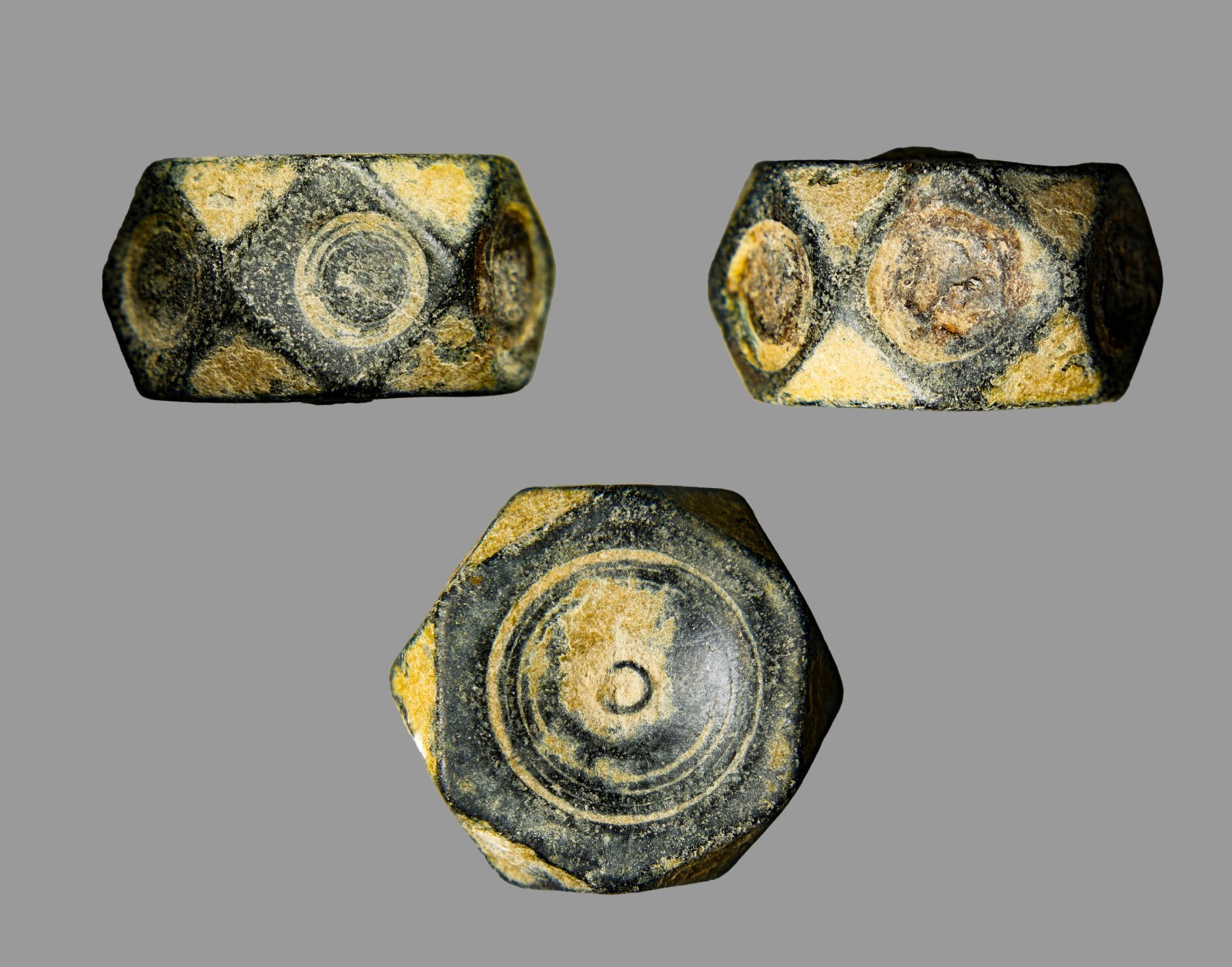
Ancient Roman Imperial / Judaean Cast Bronze Hexagonal Faceted Balance Weight — Concentric Lathed Rings & Geometric Diamond Lattice (12.07 g — c. 1st Century BC – 3rd Century AD)
Authenticity & Guarantee
Certification: Certified Authentic — includes signed Certificate of Authenticity (COA) with full provenance documentation.
Provenance: Ex-private European collection, legally acquired from international sales; Ancient Judaean / Levantine Roman Trade Sphere.
Item Specifications & Exact Dimensions
Object: Solid Cast Bronze Faceted Polygonal Balance Weight / Commercial Trade Weight (Pondus)
Culture / Period: Roman Imperial Era / Roman Judaea & Levantine Provincial Commerce
Date Range: Circa 1st Century BC – 3rd Century AD (c. 100 BC – 300 AD)
Exact Weight: 12.07 grams (12.07 g)
Material: Solid Cast Bronze (Copper Alloy)
Form & Architecture: Heavy hexagonal/octagonal barrel-shaped geometry featuring flat turned top and bottom faces engraved with concentric lathed rings surrounding a central lathe point (omphalos); side facets are deeply decorated with an intricate diamond lattice cross-hatch matrix enclosing central ring-and-dot (circuli) metrological marks
Condition: Exceptional, 100% complete ancient metrological condition. Structural copper alloy body with pristine edge geometry; preserved under a smooth charcoal-black to dark olive bronze core, filled with striking sand-yellow to desert-cream calcareous burial encrustations highlighting the lathed rings and lattice facets. Free of modern cleaning or alteration.
HISTORICAL CONTEXT & TYPOLOGICAL LORE
Roman Judaean Metrology & Market Supervision
In the urban marketplaces (macella and bazaars) of Roman Judaea—including Jerusalem, Caesarea Maritima, and Sepphoris—commercial trade in agricultural goods, oils, metals, and textiles was governed by strict metrological oversight. City inspectors (agoranomoi) and merchants utilized cast bronze balance weights decorated with distinct geometric profiles to ensure fair transactions across international trade routes connecting Rome, Egypt, and the Levant.
Faceted Hexagonal Geometry & Ring-and-Dot Symbols (12.07 g)
At 12.07 grams, this weight corresponds directly to the Levantine / Judaean trade shekel standard (~11.5g – 12.2g) as well as the Roman Imperial 3-Denarii commercial weight unit. The multi-faceted hexagonal body was intentionally engineered to prevent the weight from rolling off balance pans during active weighing. The hand-engraved concentric lathed rings and side diamond-lattice ring-and-dot stamps served as official assay marks (stigmata), certifying the weight's compliance while offering apotropaic protection against fraudulent market practices.
Typological Analysis & Exact Classification
Primary Class: Classical Antiquity Metrological Equipment & Commercial Tools / Judaean Roman Weight
Sub-Class: Hexagonal Faceted Lathed-Ring Lattice Class (Pondus)
Manufacturing Technique: Solid lost-wax cast copper alloy (cire perdue) with lathe-turned faces and hand-punched geometric dies.
Comparable Archaeological Examples & Museum Accession Numbers
Israel Museum, Jerusalem: Roman period Judaean hexagonal and polygonal bronze trade weights excavated from Jerusalem and Levantine bazaar strata.
British Museum (Accession No. 1856,0701.2228): Roman Levantine bronze faceted commercial weight with concentric ring engravings.
Rockefeller Archaeological Museum (Jerusalem): Roman Judaean bronze balance weights with geometric lattice and ring-and-dot decorations.
TRN2-2