When you click on links to various merchants on this site and make a purchase, this can result in this site earning a commission. Affiliate programs and affiliations include, but are not limited to, the eBay Partner Network.
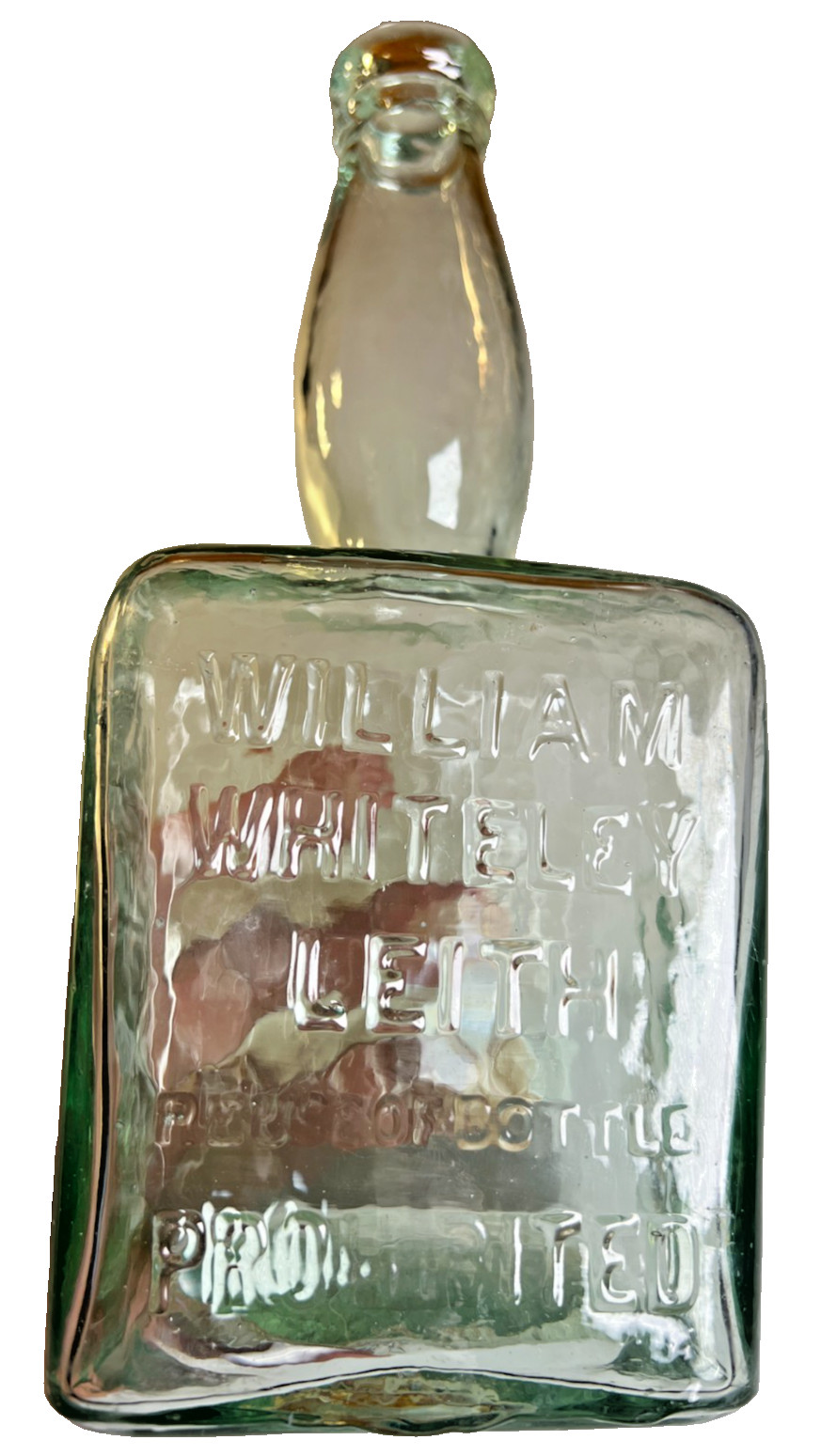
One broad panel is boldly embossed:
WHITELEY’S
LEITH
SCOTCH
WHISKY
The opposite panel reads:
WILLIAM
WHITELEY
LEITH
RE-USE OF BOTTLE
PROHIBITED
The bottle measures approximately 8 7/8\" tall × 3 1/2\" wide × 3 1/2\" deep.
Its outstanding feature is the genuinely applied and exceptionally drippy lip. The finish was separately formed and attached by hand, leaving a heavy, uneven band of glass around the neck. This early production method, combined with the extensive annealing lines, wavy panels, irregular glass distribution and optical distortion, supports a date of approximately 1908–1915, with circa 1912 being the best estimate.
Identification
This is an early export-style square Scotch whisky bottle used by William Whiteley of Leith, Scotland. Whiteley was a whisky blender, bottler and exporter—not necessarily the glassworks that physically manufactured the bottle.
The unusually crude applied lip, strong embossing, wavy aqua glass, annealing lines and deeply domed base place it well before the commonly encountered machine-made Whiteley bottles.
Precise Date
Best estimated date: circa 1912
Responsible dating range: circa 1908–1915
William Whiteley established his own concern after leaving James Munro & Sons in 1908. In 1914, he acquired the established Leith firm J. G. Turney & Son and used it as a corporate holding company. This bottle’s extremely crude construction and simple Whiteley’s Leith Scotch Whisky branding strongly suggest the formative period between those events.
The applied top is particularly persuasive:
- It was formed from a separate gather of molten glass.
- Its uneven, dripping lower edge remains clearly visible.
- The finish is substantially less uniform than later Whiteley bottles.
- The body exhibits extensive heat-related annealing lines and optical waviness.
- The side seams appear to fade beneath the applied finish rather than continuing completely through it.
British glassmakers continued hand-finishing bottles somewhat later than American factories, so the applied top alone cannot make it 1890s. Whiteley’s own business history prevents such an early date anyway. Circa 1912 is the best synthesis of the company history and manufacturing evidence.
City and Region
Leith, Midlothian, Scotland
Leith was then a separate port town adjoining Edinburgh. It was incorporated into Edinburgh in 1920 and is now a district of that city.
Rather than being primarily a distilling center, Leith specialized in the whisky trade’s “three Bs”:
Its docks and bonded warehouses allowed whisky merchants to receive casks from Scottish distilleries, mature and blend their contents, and ship the finished product around the world. At the industry’s height, Leith contained approximately 90–100 bonded whisky warehouses.
Maker
Brand owner, blender and bottler: William Whiteley, Leith, Scotland
Actual glass manufacturer: Unknown and apparently unmarked
William Whiteley was born in Yorkshire in 1861. By the early 1900s, he was handling export sales for the major Leith firm James Munro & Sons. After separating from Munro in 1908, he entered business independently.
Whiteley later became famous for:
- House of Lords
- King’s Ransom
- Whiteley’s Leith Whisky
- Ownership of the Edradour/Glenforres distillery operation
This bottle predates the familiar House of Lords and King’s Ransom packaging and represents Whiteley’s earlier, straightforward house whisky.
Original Contents
The bottle contained Whiteley’s Leith Scotch Whisky, almost certainly a blended Scotch assembled from mature malt and grain whiskies.
A surviving 1923 advertisement promoted Whiteley’s Leith Whisky:
- In distinctive square bottles
- As “absolutely pure”
- As a “liqueur Scotch whisky”
- Guaranteed ten years old
“Liqueur Scotch” was period terminology for a richer, smoother and supposedly superior whisky—not necessarily a sweetened liqueur in the modern sense.
That advertisement confirms that the unusual square bottle was an intentional and recognizable part of Whiteley’s marketing. Your crudely hand-finished example is likely an earlier version of the square package still being promoted in the 1920s.
Meaning of “Re-Use of Bottle Prohibited”
This was a proprietary warning rather than the later American federal statement commonly found on post-Prohibition liquor bottles.
Imported Scotch commanded a premium, creating an obvious opportunity for publicans, dealers or counterfeiters to refill an authentic branded bottle with cheaper spirits. Whiteley’s warning told merchants that the container remained part of the company’s protected presentation.
The heavy embossing served several purposes:
- Identified the product after its paper labels disappeared
- Discouraged substitution and refilling
- Distinguished genuine Whiteley whisky from competitors
- Turned the unusual square bottle into permanent advertising
In other words, Whiteley put the sales pitch directly into the glass.
Connection to America
Although made for a Scottish company, this belongs to the early transatlantic Scotch-export trade, which gives it a stronger American collecting angle than simply calling it a European bottle.
Whiteley had entered the industry as an export salesman and built his independent concern around foreign markets. Bottles like this traveled from Leith’s docks to Canada, Australia and potentially the United States.
Its likely circa 1912 date places it shortly before American Prohibition began in 1920. During Prohibition, genuine Scotch continued reaching American consumers through Canada, the Bahamas and other nearby markets. Scotch’s reputation for dependable quality actually increased while domestic American liquor was restricted or inconsistently produced.
Unless its excavation or discovery location is documented, I would not claim that this specific bottle was manufactured exclusively for America. The accurate, attractive wording is:
Early American-export-era Scotch whisky bottle from the historic port of Leith.
Life Around 1912
When this bottle was made, Leith was still an independent, intensely industrial port rather than merely an Edinburgh neighborhood. Its waterfront was crowded with sailing vessels, steamships, dock laborers, bonded warehouses, horse-drawn carts and increasingly common motor vehicles.
Whisky blending remained highly dependent upon the human senses. Experienced blenders selected individual malt and grain whiskies, combined them into a consistent house style and allowed the mixture to marry before bottling. Bottles were packed into wooden cases and moved through the docks by rail, cart and ship.
In America, William Howard Taft was president, a new automobile remained a conspicuous possession, most long-distance travel was by railroad, and the Titanic disaster dominated newspapers in April 1912. The temperance movement was gaining political power, but national Prohibition remained eight years away.
A bottle like this represented imported refinement. Scotch was advertised as mature, pure and genteel—the respectable drawing-room counterpart to rougher associations surrounding inexpensive domestic liquor.
Condition
Excellent antique with no chips or cracks. The bottle retains a wonderfully crude, heavily applied and visibly drippy lip, along with abundant original annealing lines, waviness and irregular glass character from manufacture. A small concentrated patch of exterior scratching is present on one panel, shown beside the thumb point pic. Several areas of faint white interior haze appear inside the neck and along portions of a few side panels, with one thicker patch of white content haze or residue beneath the upper shoulder—or “roof”—of the bottle.