When you click on links to various merchants on this site and make a purchase, this can result in this site earning a commission. Affiliate programs and affiliations include, but are not limited to, the eBay Partner Network.
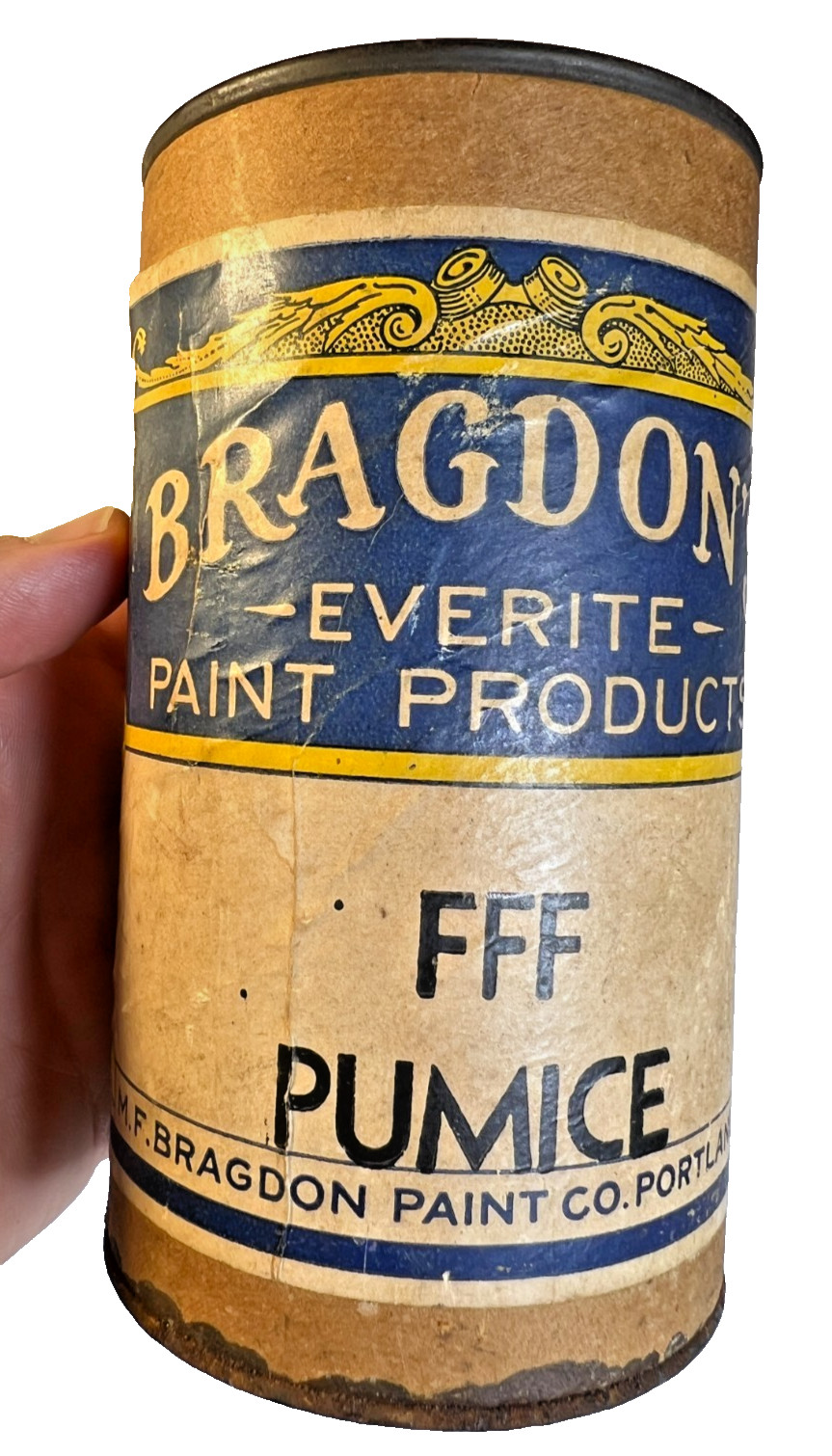
Antique Bragdon’s Everite FFF Pumice Can – Portland, Maine (c. 1915–1925)
Offered here is an original antique Bragdon’s Everite Paint Products – FFF Pumice can, manufactured by M.F. Bragdon Paint Co. of Portland, Maine, dating to approximately circa 1915–1925.
This example retains approximately 3/4 of its original pumice content, an increasingly uncommon survival for early paint and finishing supplies. The container is the correct fiberboard (pressed paper) can with crimped steel top and bottom, a format widely used by professional paint and furniture-finishing trades in the early 20th century, before fully lithographed steel cans became standard.
About the contents & safety
The product inside is natural pumice powder, a finely ground volcanic stone historically used as a gentle abrasive for smoothing wood, paint, varnish, and early automotive finishes. Pumice is chemically inert and non-toxic. When stored sealed inside its original container, it presents no fumes, no off-gassing, and no chemical hazard. As with any fine powder, it should not be inhaled if opened or disturbed, but when kept contained, it is considered safe for storage and display. The can is offered as a collectible and display piece.
Condition
The paper label remains largely intact with strong blue and yellow color, classic early-20th-century typography, and decorative scrollwork. There is honest wear, creasing, and surface patina consistent with age and professional shop use. Steel ends show oxidation appropriate for a century-old trade container. Overall, a very attractive and authentic survivor.
Size: approximately 3" W x 5.5" T
Bragdon’s & Maine’s paint industry
The M.F. Bragdon Paint Company was a respected New England manufacturer supplying paints, abrasives, and finishing materials to professionals across Maine and the Northeast. Portland, Maine at this time was a busy regional hub — a working port city supporting shipbuilding, furniture making, carriage shops, hardware wholesalers, and a growing number of early automobile garages.
Products like Bragdon’s Everite pumice were not household novelties; they were working materials, bought by craftsmen who expected reliability and consistency. Branding emphasized durability and performance rather than decoration — exactly what you see here.
Paint & finishing in the 1910s–early 1920s
This can dates to a fascinating transitional era in paint technology:
Paints were still largely oil-based, mixed from pigments, linseed oil, varnishes, and dryers
Synthetic abrasives were not yet common — natural pumice was the industry standard for fine finishing
Furniture, doors, trim, and carriage bodies were hand-finished, often through multiple sanding and polishing stages
Early automobiles were finished with hand-rubbed coatings that required abrasives like FFF pumice for final smoothing
This was the era when craftsmanship still mattered, but industrialization was accelerating.
Life when this can was made
Circa 1915–1925, America was changing fast:
Electricity was spreading, but many workshops still relied on daylight and belt-driven tools
The First World War had just reshaped industry, manufacturing, and labor
Automobiles were moving from luxury to necessity
Radios were emerging, telephones were still limited, and most work was still done by hand
Politically, the country moved from wartime mobilization into postwar optimism, followed closely by Prohibition and the early stirrings of modern consumer culture
This can would have sat on a wooden shelf in a shop that smelled of oil, varnish, sawdust, and metal — handled daily by someone whose skills mattered more than machines.