When you click on links to various merchants on this site and make a purchase, this can result in this site earning a commission. Affiliate programs and affiliations include, but are not limited to, the eBay Partner Network.
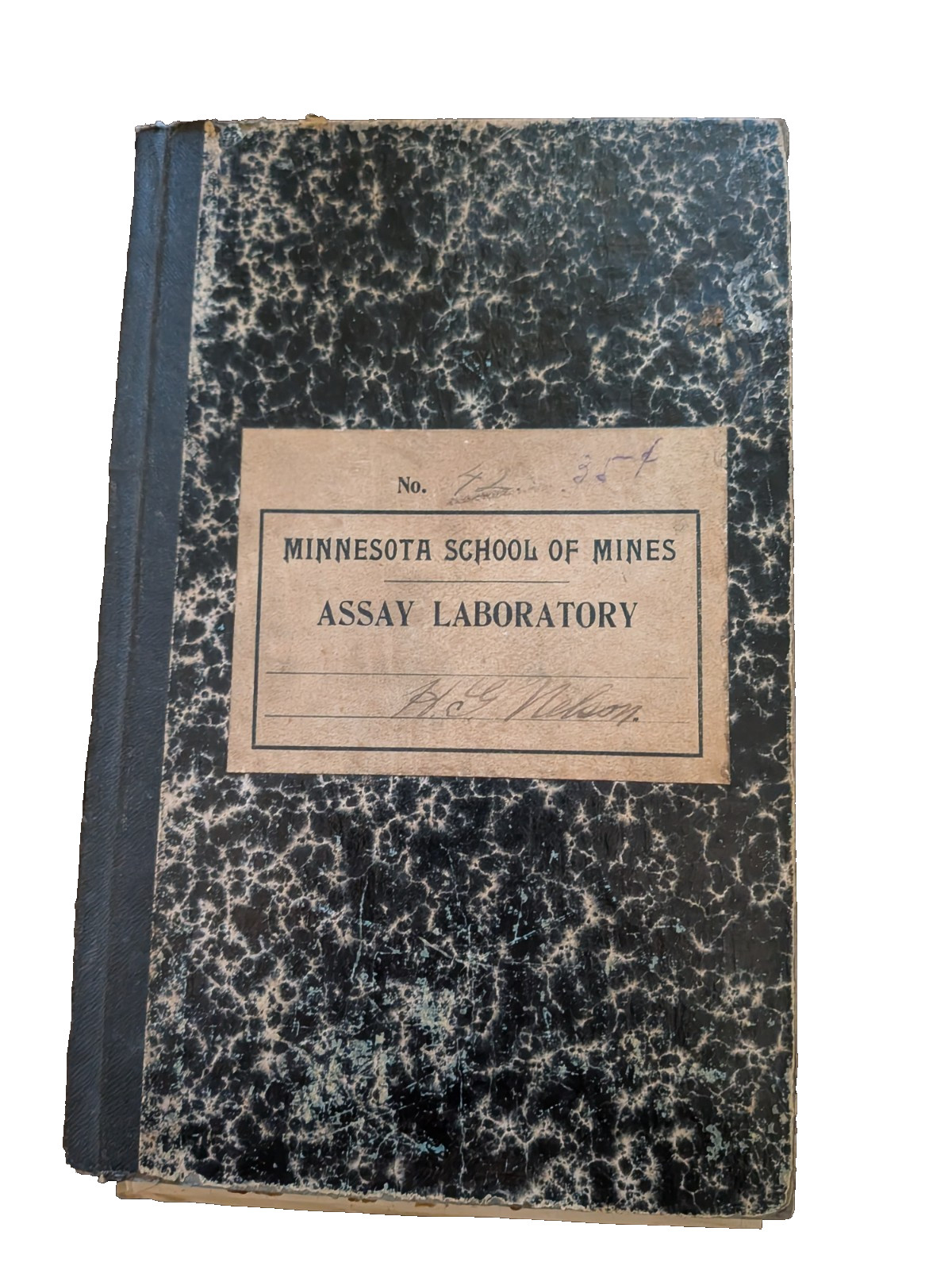
Original handwritten fire assay laboratory notebook from the University of Minnesota's School of Mines, used by a mining/metallurgical engineering student to record gold and silver ore assay results. The school operated under this name from 1892 until the1926 rename to "School of Mines and Metallurgy," which dates this notebook to the early 1900s–1910s.
The bound notebook (marbled paper boards, cloth spine, "Minnesota School of Mines Assay Laboratory" label to front cover) contains 18 pages of student entries — fire assay records with sample numbers, mineral character notes ("Free Silica," "Heavy Sulphide"), fusion charge weights (soda, litharge/PbO, argol), button and bead weights, and calculated gold/silver values in ounces per ton with dollar totals. Several entries carry an instructor's grading mark in blue pencil. Approximately half the notebook remains blank/unused.
Included with the notebook: 4 loose, one-sided formulary pages from the same source, listing standard flux recipes by ore type — lead ores (niter flux and argol flux variants), sulfide ore (FeS₂), and copper matte — a working reference for running these same assays.
Together these offer a rare, tangible look at early 20th-century assay training and fire assay/cupellation methodology as actually practiced in a university lab setting. Genuine period piece — ideal for mining history collectors, University of Minnesota / Twin Cities institutional history collectors, or anyone interested in historic metallurgical science.
Condition: Used notebook showing expected wear to boards and spine [add specifics — corner wear, foxing, etc.]; loose formulary sheets show hole-punch marks and edge wear consistent with age. All pages intact and legible. See photos for full condition detail.
Please be sure to view the images and ask any questions that you might have.