When you click on links to various merchants on this site and make a purchase, this can result in this site earning a commission. Affiliate programs and affiliations include, but are not limited to, the eBay Partner Network.
Opening ... “Put You There” Description
Picture a narrow Boston rowhouse kitchen around 1905—gaslight flickering, enamel basin half-filled, and this very bottle sitting nearby, its sharp ammonia bite cutting through grease, ink, and the stubborn realities of daily life. Before branded spray cleaners and plastic convenience, this was the real deal: strong, simple chemistry in thick glass, meant to last and to be refilled, reused, and trusted.
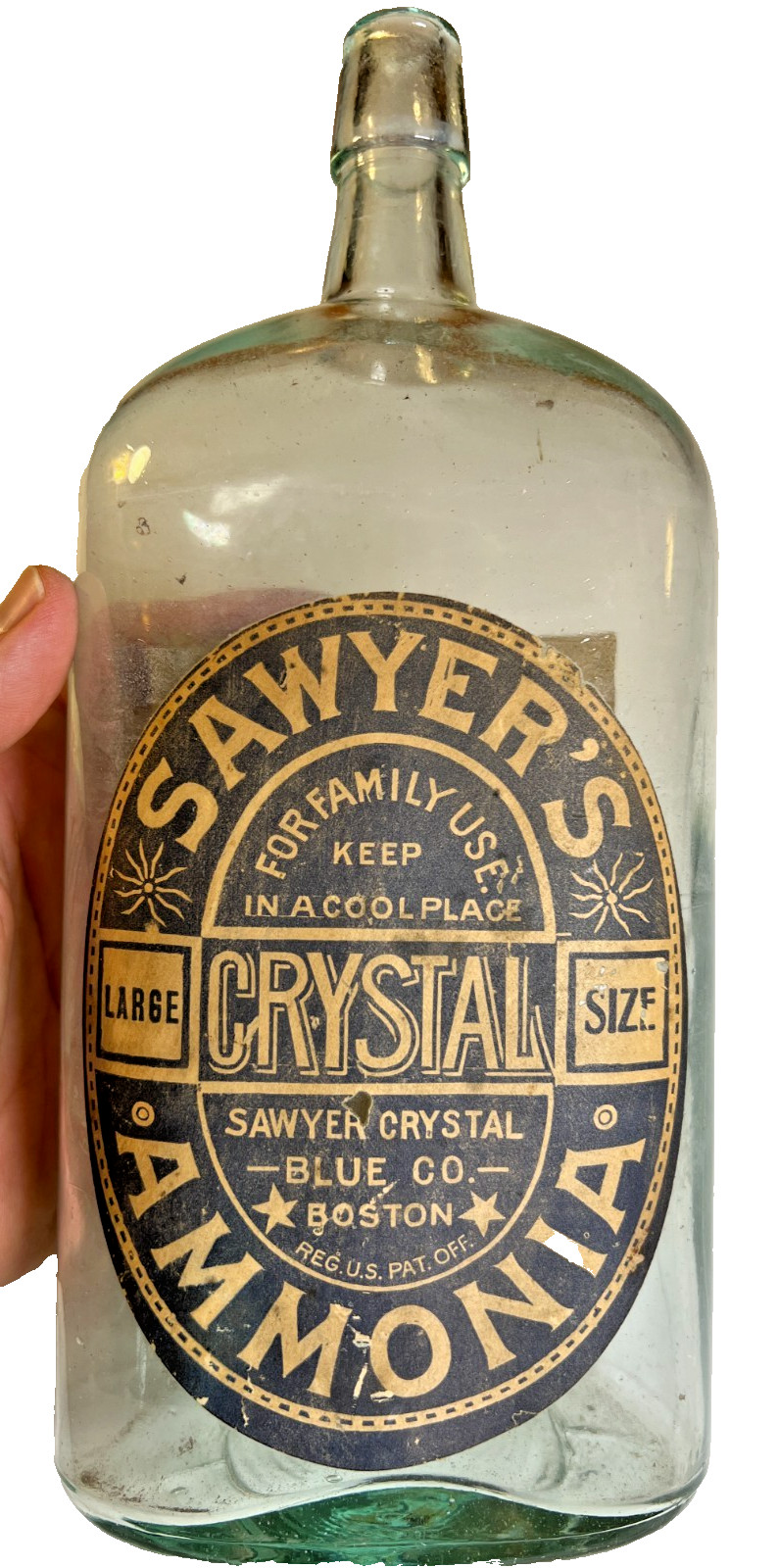
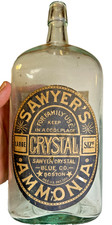
This original Sawyer’s Crystal Ammonia bottle carries that story in full—bold typography, surviving paper labels front and back, and the kind of honest wear that only comes from a century of actual use.
Label Transcription (Front)
SAWYER’S
FOR FAMILY USE – KEEP IN A COOL PLACE
LARGE CRYSTAL SIZE
SAWYER CRYSTAL BLUE CO.
BOSTON
REG. U.S. PAT. OFF.
AMMONIA
Label Transcription (Rear)
SAWYER’S CRYSTAL AMMONIA
FOR FAMILY USE
Indispensable for the Toilet, Bath and Laundry
DIRECTIONS FOR USE
(To extent legible)
- Use a few drops to a basin of water for cleansing
- For the Bath — add a tablespoonful to bath of water
- For Shampooing — a teaspoonful to a quart of water
- To remove grease and stains from silks, laces, woolens, etc.
- For cleaning gold and silver, jewelry, hair brushes, combs, etc.
- For general house cleaning, woodwork, walls (not painted), crockery, tinware
- For cleaning badly soiled clothes — add to cold water, soak and wash
- Flannels and woolens — use sparingly
- For the laundry — may be used in soaking or rubbing out spots
SAWYER’S CRYSTAL AMMONIA is absolutely pure, of uniform strength, and warranted to give satisfaction.
Prepared only by:
THE SAWYER CRYSTAL BLUE COMPANY
88 Broad Street, Boston, Mass., U.S.A.
KEEP IN A COOL PLACE
City & State
Boston, Massachusetts
About the Manufacturer
The Sawyer Crystal Blue Company of Boston was part of a wave of late 19th–early 20th century chemical and household supply firms. “Crystal Blue” refers to laundry bluing, a product used to whiten fabrics—so they were already in the business of optical and chemical cleaning agents.
Ammonia was a natural extension:
- Cheap to produce
- Extremely effective
- Sold in bulk and refillable bottles like this one
Boston, being a major port and manufacturing hub, had dozens of these small-to-mid-sized chemical companies supplying households, laundries, and even maritime trades.
How This Bottle Was Made
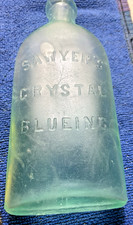
This is a turn-of-the-century machine-made bottle, likely c. 1900–1920:
- Thick aqua glass (iron impurities = that classic green tint)
- Mold-blown, likely in a two-piece mold
- Tooled lip/neck finish (you can see the transition at the top)
- Paper labels applied by hand with glue (now ghosting on the reverse side)
Condition (Clean, Honest, Sellable)
- Height: 10 1/8"
- No chips or cracks
- Strong original front label; rear label present but worn/faded
- Heavy interior mineral/calcium haze and faint water lines (typical from long-term storage/use)
- Light surface wear consistent with age
A Short History of Ammonia (and Why This Bottle Matters)
Ammonia has one of the weirdest resumes in chemistry:
- Ancient origins: Derived from soot and animal waste; the name comes from the Egyptian god Amun, near whose temple ammonium salts were collected.
- Medieval use: Alchemists used ammonium chloride (“sal ammoniac”) for metalwork and early chemistry.
- 19th century boom: Industrial ammonia came from coal gas production—making it cheap and widely available.
- Household revolution: By the late 1800s, ammonia became the go-to cleaner for:
- Glass (still true today)
- Laundry whitening
- Degreasing kitchens
Quirky, Eye-Popping Ammonia Facts
- Ammonia is one of the most produced chemicals on Earth—modern agriculture literally depends on it (fertilizer).
- The Haber-Bosch process (1909) allowed ammonia to be made from air—arguably one of the most important inventions ever (it feeds billions).
- Early households used ammonia so heavily that kitchens often smelled like a chemistry lab.
- It was once used to revive fainting people (smelling salts).
- Ammonia can clean glass without streaks better than most modern cleaners—Victorians knew what they were doing.
- In high concentrations, it’s dangerous enough to be used industrially, yet this bottle sat casually next to wash basins in homes.
Final Thought
This isn’t just a bottle—it’s a snapshot of when chemistry moved into everyday life. Before branding got soft and pastel, this was blunt, effective, and proudly labeled.
And honestly? It still looks like it could take the grease off a cast iron skillet and your dignity in one pass.