When you click on links to various merchants on this site and make a purchase, this can result in this site earning a commission. Affiliate programs and affiliations include, but are not limited to, the eBay Partner Network.
🔴 An Embossed Paper Cigar Label
Size: 1 1/4"
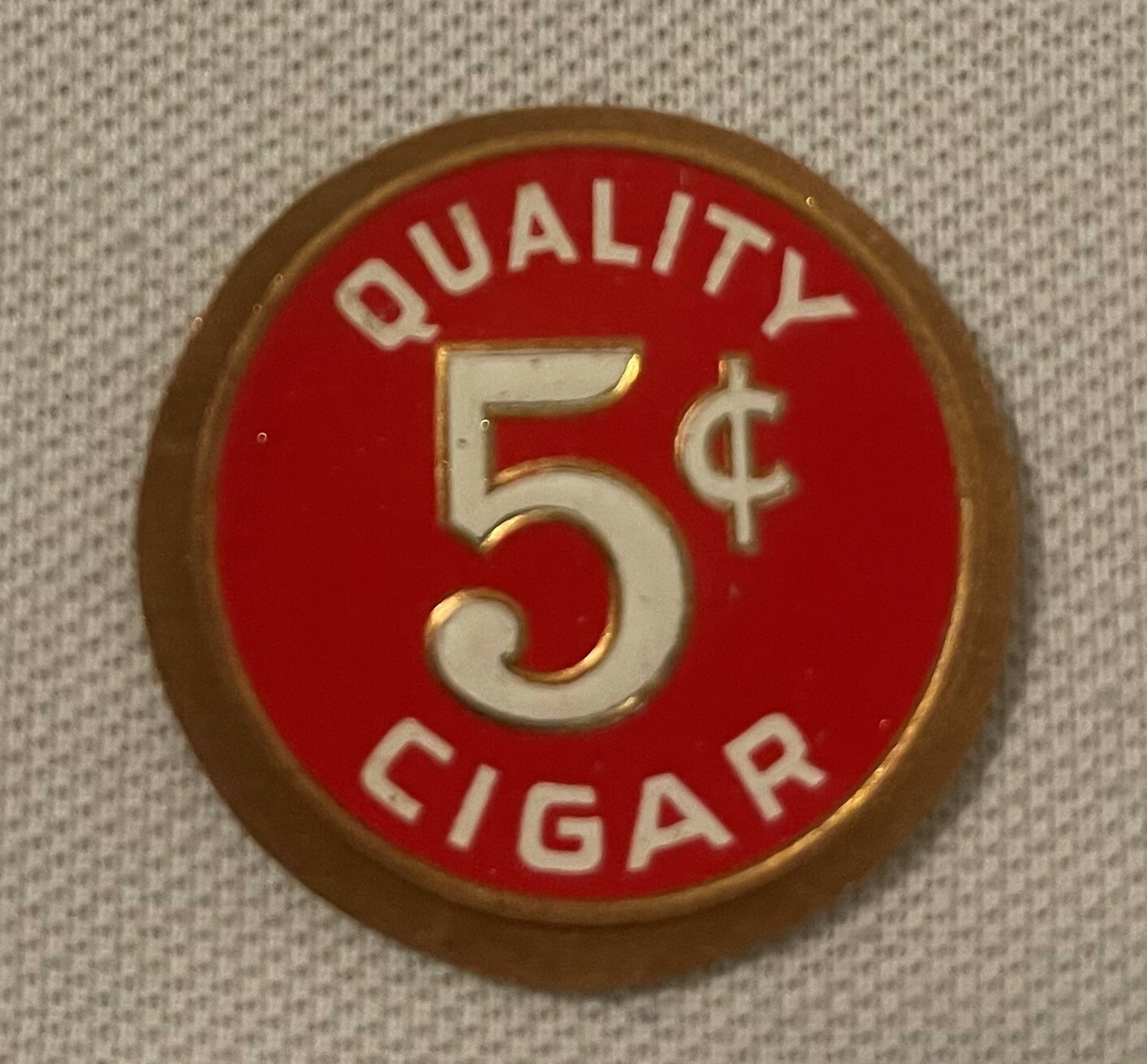
Tin? Brass? Celluloid? Fiber? I get asked all four, and the answer is paper - heavy paper, embossed so hard it passes for a little medallion. A red disc with a gold rim, QUALITY across the top, a bold 5¢ in the middle and CIGAR along the bottom, every letter raised, and the 5¢ outlined in gold. New old stock, never applied.
Flip it over and the plain cream back shows the 5¢ and the rim pressed through in reverse. That's how you know it's the real embossing and not just a printed picture of it. There's no printer's mark, no town, and no proprietor's name anywhere on it — unlike some cigar advertising that proudly names the shop behind it, this one keeps its origin to itself.
🚬 The Vice President and the Nickel Cigar
A seal like this belongs to the days when a nickel bought a good cigar and QUALITY printed right over the price was all the advertising a cigar maker needed.
Those were the days of the most famous cigar line in American politics. Thomas R. Marshall, the Indiana governor who became Woodrow Wilson's vice president (1913-1921), sat presiding over the Senate while Kansas senator Joseph Bristow worked through a long speech on everything "this country needs." Marshall, as the story goes, leaned over to Henry Rose, the Senate's assistant secretary, and said it: "Bristow hasn't hit it yet. What this country needs is a good five-cent cigar."
It's usually dated 1917 or later, but the story was in print by February 1914. The five-cent cigar makers loved it and piled sample boxes on the vice president's desk - and after smoking his way through a good many of them, Marshall reported that "the country's greatest need still exists." Indiana folks will also tell you the line started with Kin Hubbard's cartoon character Abe Martin, and Marshall, a fan, just borrowed it.
The cigar business hit its high-water mark a few years after Marshall's quip: 1920 was the biggest year American cigar makers ever had, something like eight billion cigars rolled off the lines that year. By the mid-1920s cigarettes had overtaken cigars as the country's tobacco of choice. The nickel cigar itself had all but disappeared for a few years after the First World War, but it came back strong in the 1920s and hung on right through the Depression.
✨ The Gold on It
Cigar labels like this one were printed by chromolithography, drawn out on stone and run through the press one color at a time - the same craft that produced the big, elaborate labels that lined the inside lids of cigar boxes. From about 1890 on, printers took it a step further, running their sheets back through the press to emboss them and add the gold - usually bronze powder, buffed on with a wheel a lot like a shoe-shine buffer. That's the raised lettering and warm rim you're looking at here, just shrunk down to a seal an inch and a quarter across.
🏆 One of My Best Sellers
This little label has sold dozens of times here on , and I'd bet the red and gold is why. It's a rare one too - I haven't seen another offered, and I'm down to my last few. Once they're gone, they're gone.
📋 Specifications
- Material: Embossed paper
- Diameter: 1.25 inches (about 3.2 cm)
- Color: Red, gold and white
- Printed text: QUALITY / 5¢ / CIGAR
- Condition: New old stock, never applied