When you click on links to various merchants on this site and make a purchase, this can result in this site earning a commission. Affiliate programs and affiliations include, but are not limited to, the eBay Partner Network.
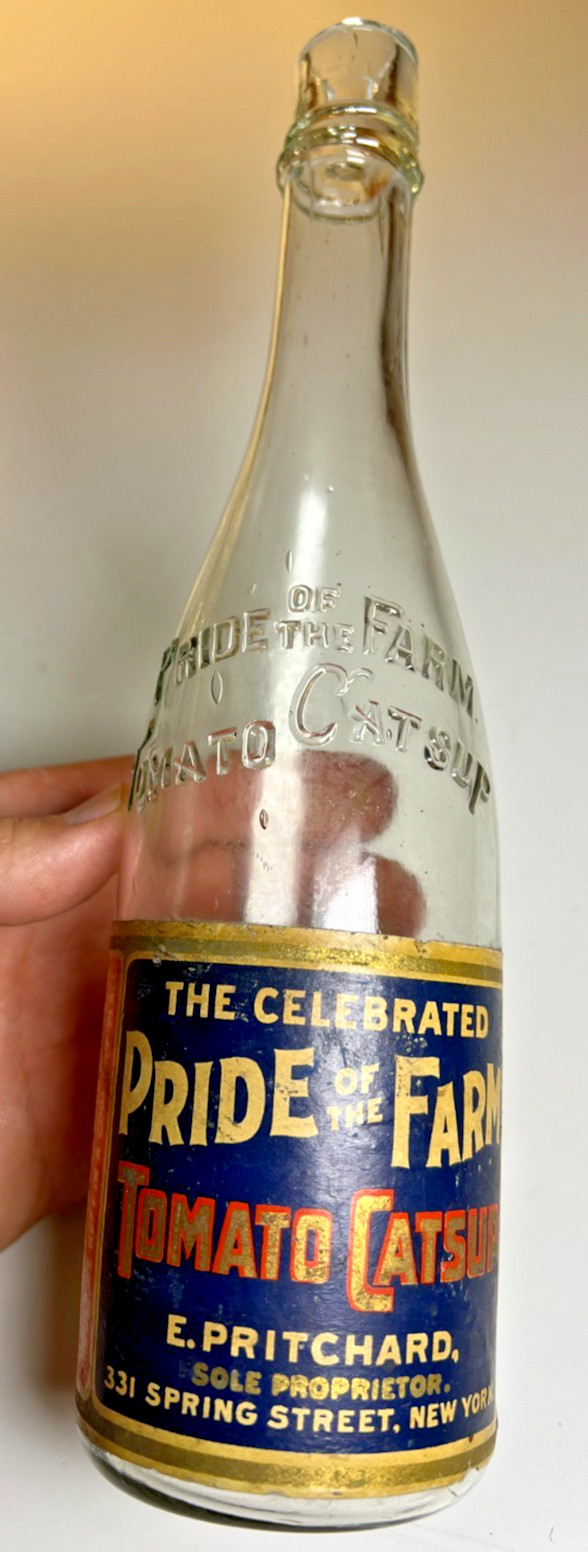
A beautifully preserved piece of early American grocery advertising, this 10-inch Pride Of The Farm Tomato Catsup bottle retains its striking original paper label - a richly colored combination of deep navy blue, red, and gold-colored lettering. Above the label, the product’s name appears again in bold raised glass lettering, including an oversized, decorative “C” in Catsup.
The label identifies “E. Pritchard, Sole Proprietor,” at 331 Spring Street, New York. Dating approximately to the turn of the twentieth century, circa 1900, this bottle captures a period when branded bottled foods were becoming familiar fixtures in American kitchens and grocery stores.
Edward Pritchard’s involvement in ketchup manufacturing began around 1878, when he experimented with producing the condiment from tomato purée. He subsequently established a New York business selling Pride Of The Farm and Eddy’s Brand catsups, later expanding into Bridgeton, New Jersey, in 1913.
The packaging is wonderfully expressive. “The Celebrated” and “Pride Of The Farm” present the contents with confidence, while the dramatic label typography is echoed in the embossed glass above. The long, tapering neck, scattered trapped bubbles, and irregularities in the glass add further character.
An especially charming detail survives in the side-panel instructions, which refer to drawing the cork and keeping the opened catsup in a cool, dry place. The neck has a coarse early threaded finish; its original closure is no longer present.
Condition:
• Original paper label remains substantially intact, with vivid colors and clearly readable principal lettering.
• Label shows scattered surface wear, small abrasions, and minor edge losses, as photographed.
• Strong, attractive embossed lettering matching the product named on the label.
• Tiniest flea-bite to the edge of the lip. (see finger point pic)
• Faint interior haze on the back of the bottle.
Measures approximately 10 inches tall.
An appealing survivor for collectors of antique food bottles, early grocery packaging, New York advertising, and historic kitchen displays. Its strongest feature is the combination of decorative embossed branding and the remarkably colorful surviving original label.