When you click on links to various merchants on this site and make a purchase, this can result in this site earning a commission. Affiliate programs and affiliations include, but are not limited to, the eBay Partner Network.
Ever wonder why a laxative tin would cheerfully tell you to let your kids eat the tablets like candy?💊
I\'ve handled a lot of old advertising tins over the years, but this one still makes me smile every time I pick it up. There\'s something wonderfully honest — almost reckless by today\'s standards — about a company printing \"keep out of reach of children, else they may eat them for candy\" right on the front, and then turning around and telling parents on the same tin to let the kids \"eat like candy\" because they \"love the pleasant taste.\" That\'s not a mixed message.That\'s early American patent medicine marketing working exactly the way it was built to work: sell the whole family on one little tin, and don\'t apologize for it.
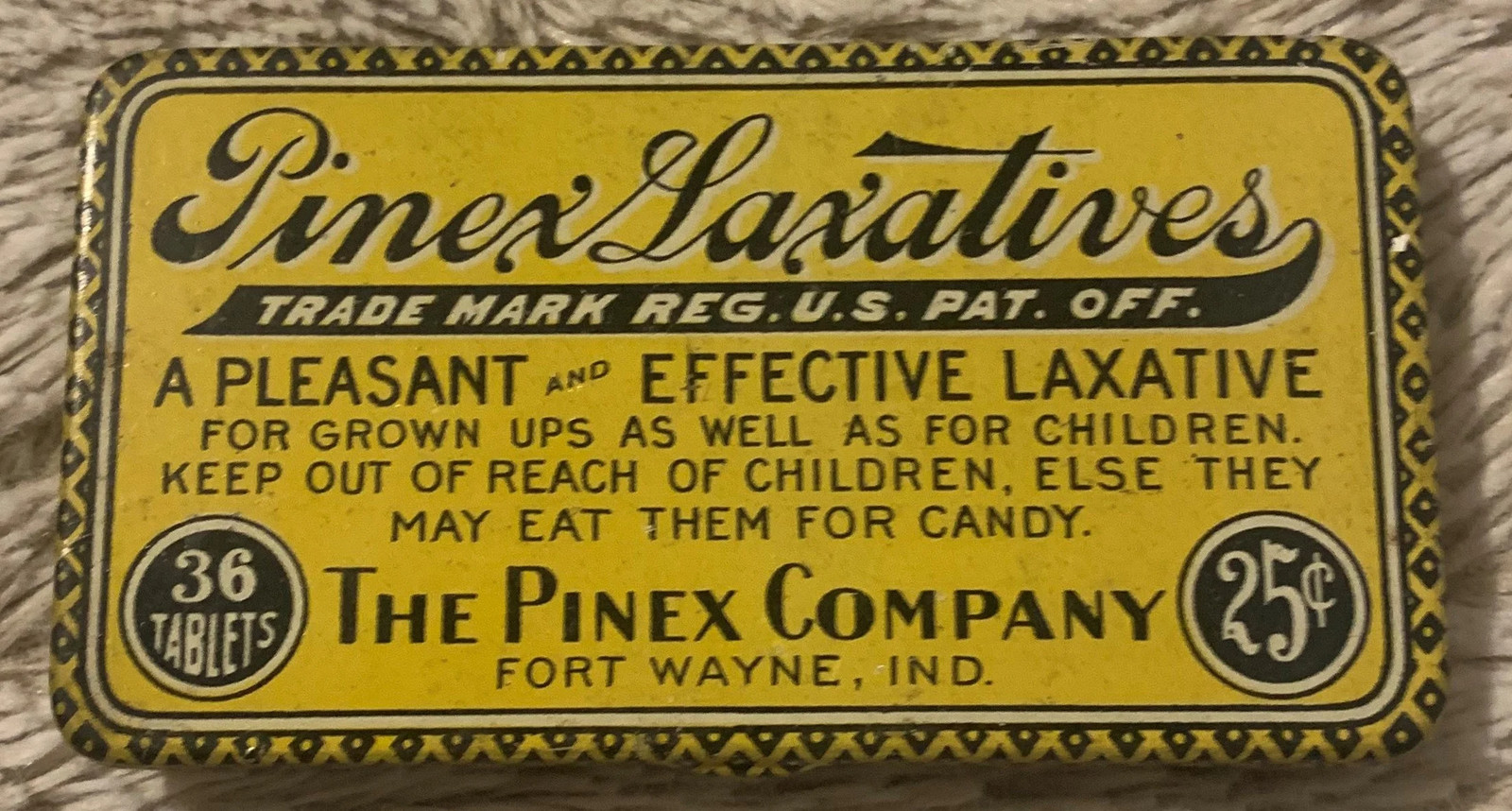
What you\'re looking at is an antique Pinex Laxatives tablet tin, produced by The Pinex Company of Fort Wayne, Indiana, and dating stylistically to the early-to-mid 20th century — the era when small hinged tins like this one lined drugstore counters and medicine cabinets from coast to coast, before federal regulation reshaped how medicine could be labeled, marketed, and sold.This example is New Old Stock (NOS) — meaning it never sold through a pharmacy counter and instead sat untouched in inventory for decades, which is exactly why a piece this small and this old is still around to tell its story. It measures 3.5 x 2 x 0.5 inches (roughly 8.9 x 5.1 x 1.3 cm) — a genuinely pocket-sized tin, meant to slip into a purse, a jacket pocket, or a bedside drawer without anyone the wiser.
The artwork is vivid, cheerful, and unmistakably of its era: a bright yellow lithographed ground bordered on every edge by a tight black-and-white diamond pattern, framing the whole tin like a little proscenium.Across the top, \"Pinex Laxatives\" sweeps out in bold flowing script, underscored by a black banner reading \"Trade Mark Reg. U.S. Pat. Off.\" Below that, in confident block lettering, the tin makes its pitch directly: \"A Pleasant and Effective Laxative for Grown Ups as well as for Children\" — followed immediately by that now-famous warning about children mistaking the tablets for candy.Two black roundels anchor the bottom corners — \"36 Tablets\" on the left, \"25¢\" on the right — with \"The Pinex Company, Fort Wayne, Ind.\" set in bold serif type dead center. Every element of the design does double duty: it\'s decoration, but it\'s also the entire sales pitch, dosage schedule, and price tag, all condensed onto a tin small enough to lose in a coat pocket.
💊 The Pinex Company and the Patent Medicine Boom
To understand this little tin, you have to understand the world it was born into.The Pinex name carried real weight in American households for much of the early 20th century — the company built its reputation primarily on Pinex Cough Syrup, a concentrated pine-tar-and-honey compound that families were instructed to mix themselves at home with sugar syrup to stretch a small bottle of concentrate into a full batch of cough remedy.It was a clever business model: sell the concentrate, let the customer supply the sugar and water, and suddenly one small bottle of Pinex furnished an entire household\'s cough season. That same instinct — sell a small, affordable, concentrated product and let it go a long way — clearly carried over into the laxative tablets in this tin.Thirty-six tablets for a quarter was a bargain any family could justify, and a tin this size meant it never had to sit unused on a shelf; it traveled with you.
This was the golden age of the American patent medicine trade — a period when the 1906 Pure Food and Drug Act had only just begun requiring companies to disclose certain ingredients, but decades before the Food, Drug, and Cosmetic Act of 1938 tightened labeling, dosing, and advertising claims into something closer to what we know today.Companies like Pinex operated in that in-between world: legitimate enough to register trademarks and print \"Reg. U.S. Pat. Off.\" proudly on their packaging, but still free to make the kind of sweeping, cheerful health claims that would never survive a modern regulatory review. The line \"Guaranteed to give complete satisfaction or money promptly refunded without red tape\" printed on this tin\'s directions panel is pure period confidence — no fine print, no disclaimers, just a plain promise stamped on a quarter\'s worth of medicine.Reading the actual dosing instructions today is a small time capsule in itself: adults were told to chew one tablet at bedtime, two if bowels were \"obstinate,\" children as young as one year old were dosed by fractions of a tablet, and parents were encouraged to crush the tablets to powder or simply let the child \"eat like candy\" if that made things easier.It\'s medicine, marketing, and parenting advice all folded into one small printed panel — exactly the kind of unfiltered voice that makes patent medicine ephemera so compelling to collectors today.
🏙️ Fort Wayne, Indiana — A Hometown Manufacturing Story
Fort Wayne in this era was no sleepy backwater — it was one of the Midwest\'s genuine industrial engines, a city thick with factories, foundries, and consumer goods manufacturers shipping product across the country by rail.It was home to major employers in knitting mills, wire and cable works, farm equipment, and electrical manufacturing, and it prided itself on being a city that made things — real, tangible, useful things that traveled far beyond Indiana\'s borders. A small, ambitious operation like The Pinex Company fit right into that civic identity: a hometown firm turning out a product cheap enough and clever enough in its packaging to compete on drugstore shelves against much larger national brands.
Local legend around Fort Wayne has long held that the Pinex Company\'s success was something of a hometown point of pride — a reminder that a city known for heavier industry could also send something as small and universal as a cough remedy or a laxative tablet into medicine cabinets nationwide.Whether that pride was ever formally documented or simply passed down among old-timers and collectors of Fort Wayne advertising ephemera, it\'s a story worth keeping alive alongside the tin itself — the kind of civic memory that rarely survives anywhere except on the objects that carried the company\'s name.
👨👩👧 The People Behind the Counter
Picture the world this tin actually lived in: no chain pharmacies, no consumer safety commissions, no childproof packaging requirements.A family\'s medicine cabinet — or more often, a kitchen drawer or a purse — held tins exactly like this one, dosed out by the household matriarch who knew, by memory and habit, how many tablets a child needed versus a grown adult. Druggists behind the counter sold these tins directly, often recommending them by name the way a modern pharmacist might suggest a store brand today.The whole culture of self-dosing, home remedy, and \"a little of this fixes just about anything\" ran directly through tins like this one — and the printed instructions on this piece capture that culture almost perfectly, walking a customer through adult dosing, child dosing by age bracket, and a money-back guarantee, all without a single warning label about active ingredients or side effects.
That \"eat them like candy\" line has become something of a legend in its own right among collectors of old pharmacy tins — a phrase so at odds with modern child-safety thinking that it stops people in their tracks every time they read it.Old-timers who collect this kind of ephemera will tell you it\'s exactly why pieces like this endure in memory long after the medicine itself has been forgotten: it\'s a single sentence that tells you everything about how differently an earlier generation of parents approached childhood, medicine, and trust in a brand name.
🕰️ Why It Still Matters Today
Tins like this one have become small, honest artifacts of a regulatory world that no longer exists.Every element of the design — the cheerful roundels, the flowing script, the plainly printed price and tablet count, the almost comic juxtaposition of \"keep away from children\" beside \"children love the pleasant taste\" — is a direct, unedited window into how medicine was sold to American families before advertising law, child-safety design, and pharmaceutical labeling caught up with the marketplace.Collectors of Americana, advertising history, and pharmacy memorabilia prize tins like this precisely because they weren\'t preserved on purpose; they survived by accident, tucked into warehouse stock that never made it to a shelf, which is exactly the story behind this particular example. It\'s a genuine, compact piece of early American advertising craft — small enough to hold in your palm, but dense with the history of an entire industry.
🖼️ Display Ideas
- 💊 Nestle it into a small apothecary or pharmacy-themed shelf display alongside other early advertising tins
- 🚐 Tuck it into a vintage camper, trailer, or travel medicine kit for an authentic period touch
- 🗄️ Place it in a curio cabinet or shadow box with other Fort Wayne or Indiana manufacturing memorabilia
- 🧴 Group it with other patent medicine bottles and tins for a themed \"medicine cabinet of the past\" vignette
- 📷 Photograph it flat as a striking piece of early advertising graphic design for a collection scrapbook or gallery wall
- 🎁 Gift it to a pharmacist, pharmacy student, or family with a multi-generation drugstore history as a conversation piece
🎁 Who Collects These
This tin sits at the crossroads of several serious collecting communities.Patent medicine and pharmacy memorabilia collectors chase pieces like this specifically for the printed dosage language and guarantee copy, which offer a documented look at pre-regulation medical marketing. Advertising tin collectors value it for the lithography — the diamond border, the script logo, the bold roundels — as a strong example of early commercial packaging design.Indiana history buffs and Fort Wayne locals collect it as a tangible piece of the city\'s manufacturing past. And general Americana collectors simply love the \"eat them for candy\" line as one of the great, unforgettable quotes of early 20th-century advertising honesty. Families with a multi-generation pharmacy or general store background often seek these out too, recognizing exactly the kind of stock that once sat behind their own family\'s counter.
❓ FAQ
Is this tin New Old Stock (NOS)?
Yes.This tin never sold through to a customer — it sat in warehouse stock rather than moving across a drugstore counter, which is why examples like this survive today rather than having been used up decades ago.
What era does this Pinex tin date to?
The lithography style, trademark registration language, and packaging format place it in the early-to-mid 20th century, the height of the American patent medicine era.No exact production year is confirmed, so it\'s best described within that broader period rather than a single date.
Where was The Pinex Company based?
Fort Wayne, Indiana — printed directly on the tin\'s face, anchoring it firmly to that city\'s early 20th-century manufacturing history.
Is this the same Pinex known for cough syrup?
Yes, the Pinex name most famously carries through its cough syrup concentrate, and this laxative tablet tin represents the same company extending its trusted brand name into a second household remedy category.
Why does the tin both warn against and encourage children eating the tablets?
That contradiction is genuine, original printed text from the era — a warning to keep the tin away from children paired with directions telling parents the tablets could be eaten like candy or crushed to a powder.It\'s one of the most talked-about details among collectors of this piece precisely because it reflects how differently medicine was marketed to families before modern safety standards.
How many tablets did the tin hold, and what did it originally sell for?
The tin was designed to hold 36 tablets and retailed for 25 cents, both printed directly on the front in bold roundels.
What size is the tin?
It measures 3.5 x 2 x 0.5 inches (about 8.9 x 5.1 x 1.3 cm) — a compact, pocket-sized piece built to travel easily with its original owner.