When you click on links to various merchants on this site and make a purchase, this can result in this site earning a commission. Affiliate programs and affiliations include, but are not limited to, the eBay Partner Network.
Two Velvet-Coated Cats, Face to Face on a Cigar Box Lid — Who Were They Meant to Charm?🐈⬛
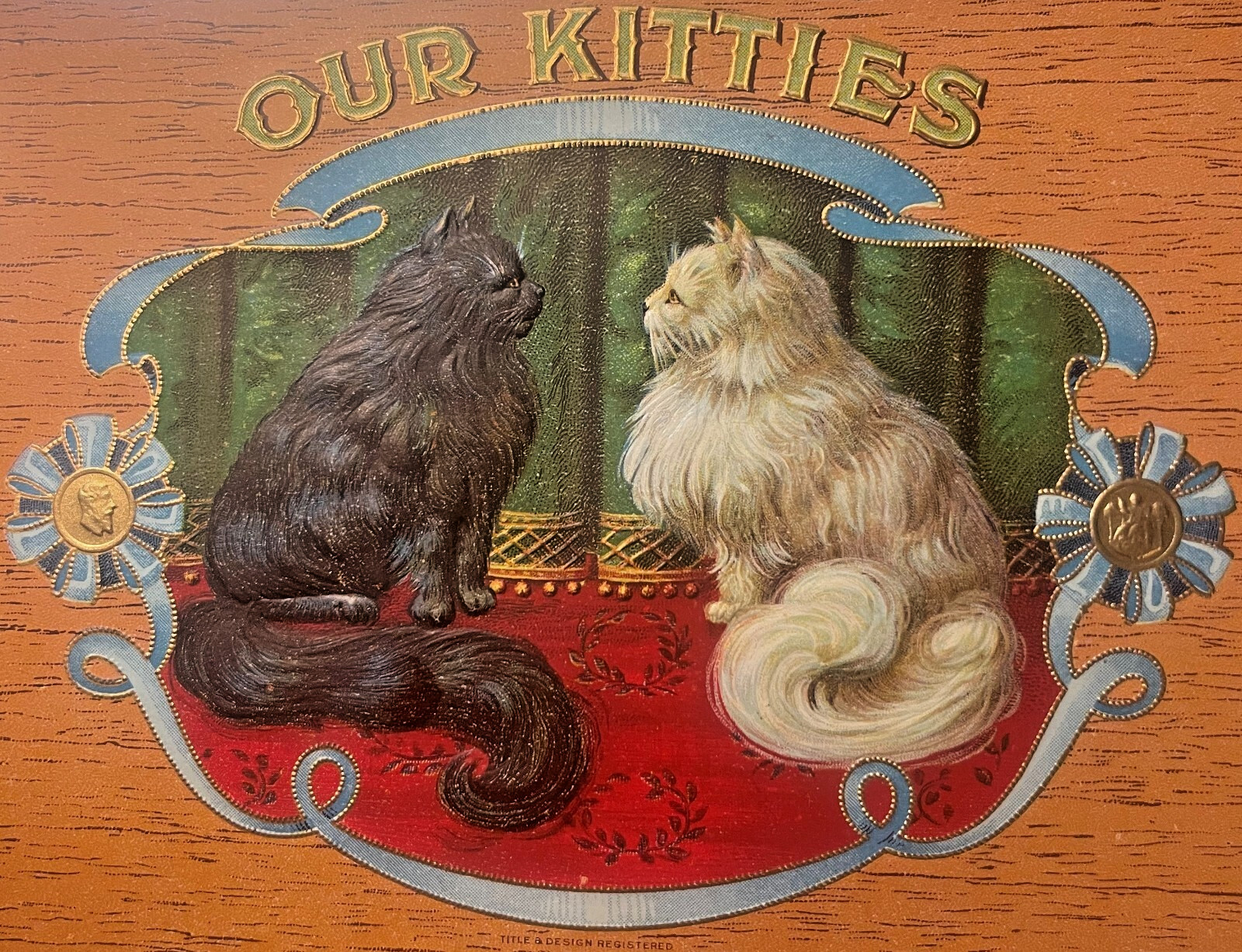
I've handled a lot of old cigar labels over the years, but I always slow down for the ones with cats on them. There's something almost funny about it — a rugged, cedar-scented product marketed to men, dressed up with the most parlor-room, sofa-cushion image imaginable: two long-haired cats sitting primly on a tasseled red cushion, sizing each other up like they're posing for a formal portrait.That contrast is exactly why labels like "Our Kitties" survive in collections today — they weren't made to be admired on their own, they were made to sell a box of cigars, and yet here we are, more than a century later, framing them as the small works of commercial art they always secretly were.
What This Piece Is
This is an original "Our Kitties" cigar box inner label, printed as a chromolithograph with raised gold embossing, dating stylistically to the 1900s–1910s.Across the top, the title "OUR KITTIES" is rendered in bold gold-embossed lettering with a green shadow outline, arching over a scalloped blue ribbon banner trimmed in gold beading. Below it, the central scene: a black long-haired cat and a cream-and-white long-haired cat — both drawn in the fluffy, Persian-type style so beloved by Victorian and Edwardian illustrators — sit face to face on a red cushioned platform patterned with delicate leaf sprigs, their full plume tails curled around their paws.Behind them, tall green drapery folds suggest a stage-like backdrop, with a gilded lattice trim running along the base. Flanking the scene are matching blue ribbon rosettes, each centered on a small gold medallion stamped with a profile portrait — a decorative flourish borrowed straight from the exposition-medal tradition of the era.The whole design sits on a warm faux wood-grain field, and beneath it runs the small printed line "TITLE & DESIGN REGISTERED." This example comes from New Old Stock — it was never applied to a box, so what you're getting is the label itself, in its original printed state, ready for a frame, a portfolio, or an ephemera collection.
🚬 The Cigar Label Trade — An Industry Built on Stock Art and Small Print Runs
By the turn of the 20th century, cigar manufacturing in America was a fragmented, wildly competitive business — thousands of small factories and regional brands, many turning out only a handful of box styles a year.Rather than commission original artwork for every brand, most of these companies turned to specialized lithography houses, concentrated heavily in New York and Philadelphia, that produced enormous stock libraries of pre-drawn label designs: patriotic eagles, exotic beauties, historical figures, children, dogs, and — as here — sentimental cats.A small cigar maker could flip through a lithographer's sample book, pick a design that suited their brand name, and have it overprinted or customized with minimal cost. That's very likely the story behind a title like "Our Kitties" — a charming, ready-made scene that could be paired with almost any brand name a tobacco jobber wanted to run.The line "Title & Design Registered" reflects a real and common trade practice of the period: label houses registered the specific title and artwork of a design to protect it from being copied outright by a competing lithographer, since the cigar label market was flooded with knockoffs and near-identical imitations chasing the same retail shelf space.
🐱 Why Cats, of All Things, Ended Up on a Cigar Box
The image of two fluffy, dignified long-haired cats wasn't a random choice — it rode in on a much larger cultural wave.The formal "cat fancy" as we know it took shape in England in 1871, when Harrison Weir organized the first proper cat show at London's Crystal Palace, and the fascination crossed the Atlantic quickly. By the final years of the 19th century, American cat clubs and cat shows were drawing genuine crowds, and the long-haired "Persian" or "Angora" type — plush, aristocratic, endlessly photogenic — became the breed every illustrator reached for when they wanted to signal refinement and domestic comfort.Advertisers of the era loved pairing a rugged, masculine product like tobacco with soft, sentimental imagery — flowers, children, and pampered pets — as a way to widen the appeal of the box on a shop counter, catching the eye of anyone browsing, not just the smoker himself. A pair of show-quality cats sitting like royalty on a velvet cushion was, in that sense, doing real commercial work: dressing up a cigar box in the language of parlor gentility.
🎖️ The Little Medallions and the Wood-Grain Trick
Collectors who spend time with cigar labels start to notice the same small conventions repeating across brands, and this label carries two of the classics.The profile-head medallions tucked into the blue ribbon rosettes are a stock decorative device lifted from the world's fair and exposition medal tradition of the late 1800s — a visual shorthand meant to suggest a brand of quality and distinction, whether or not any actual award was ever won. And that warm, faux wood-grain field the whole design sits on wasn't an accident either — lithographers used printed wood-grain backgrounds like this specifically so the paper label would visually blend with the actual cedar or mahogany cigar box it was destined to sit inside, making the printed label feel like part of the box's own material rather than a separate paper insert.Lore passed down among label collectors holds that this trick was one of the great cost-saving sleights of the whole cigar-box lithography trade — a way to suggest a finer wood box than many manufacturers could actually afford to build.
📦 Why These Survive at All
Most cigar labels never made it past the box they were pasted to — glued down, then thrown out with the box itself once the cigars were gone.The examples that exist today as clean, unused sheets, like this one, are almost always New Old Stock: printed sheets held back in a jobber's or printer's inventory, never applied to a box at all, then later dispersed as that old stock finally moved into the hands of paper and ephemera dealers decades later. That's exactly the path this "Our Kitties" label took — it survived not because someone saved it lovingly off a box, but because it simply never got used, which is precisely why the color and embossing read as vividly today as they would have on a tobacconist's shelf generations ago.
🖼️ Display Ideas
- 🐈 Frame it as a stand-alone piece of vintage cat art in a study, sunroom, or reading nook
- 🚬 Pair it with other antique cigar labels for a themed gallery wall of early tobacco advertising
- 🎀 Mat it with a warm red or gold border to echo the label's own ribbon and cushion tones
- 📚 Slip it into an archival sleeve for a paper ephemera or advertising art reference collection
- 🎁 Gift it to a cat lover or a cigar-label collector who'll recognize the artistry immediately
- 🖋️ Display it near vintage smoking accessories or an old humidor for an authentic period vignette
🎁 Who Collects These
"Our Kitties" sits right at the crossroads of two very different collecting worlds, which is part of what makes it fun to place.Cigar label and tobacciana collectors seek it out for the printing craft — the stone lithography, the gold embossing, the registered-title notation — as a well-preserved example of a trade that largely disappeared after the 1920s. At the same time, cat collectors and Persian-cat enthusiasts hunt down vintage advertising art featuring long-haired cats specifically, since Victorian and Edwardian illustrators rarely got the breed's fluff and personality this right.Ephemera dealers, ad-art collectors, and anyone furnishing a cottage-core or old-world display corner round out the appeal — this is a label that gets picked up by people who came looking for cigar history and people who came looking for cats, and both walk away satisfied.
❓ FAQIs this an original antique label, and not a modern print?
Yes — this is an original chromolithographed label, produced using stone lithography with true raised gold embossing, printing techniques characteristic of early 20th-century advertising art.
How old is this "Our Kitties" label?
The style — heavy gold-embossed lettering, Art Nouveau ribbon framing, faux wood-grain background, and fine dot-embossed detailing — places it in the 1900s–1910s window, before cheaper printing methods replaced this level of stone lithography industry-wide.
What does "New Old Stock" mean for a paper label like this?
It means this label was printed in period and held in inventory rather than ever being applied to an actual cigar box — so what you receive is the original unused sheet itself, not a label that was removed from a box later.
What breed are the two cats on the label?
They're drawn in the classic long-haired "Persian" or "Angora" style that dominated cat show and advertising art of the era — one black, one cream-and-white, both rendered with the full plume tails and ruffed coats that made the breed so popular on the Victorian and Edwardian show circuit.
What does "Title & Design Registered" mean?
It reflects the period practice of lithography houses registering a label's specific title and artwork to protect it from being copied by rival printers — a common notation on cigar labels of this era, not a government trademark filing.
Who made or issued this specific label?
No printer's imprint is confirmed on this example.Cigar label houses of the period commonly sold designs like this as stock artwork, licensed out to whichever small cigar manufacturer wanted to pair it with their own brand name — which is very likely how "Our Kitties" came to be.
What's the best way to display a label like this?
Because it was printed as a flat inner-box label rather than a bordered print, most collectors frame it behind glass or slip it into an archival sleeve to protect the embossing while still showing off its full color and raised detail.