When you click on links to various merchants on this site and make a purchase, this can result in this site earning a commission. Affiliate programs and affiliations include, but are not limited to, the eBay Partner Network.
Either the tang or the hilt is loose.
1. The BladeMaterial:
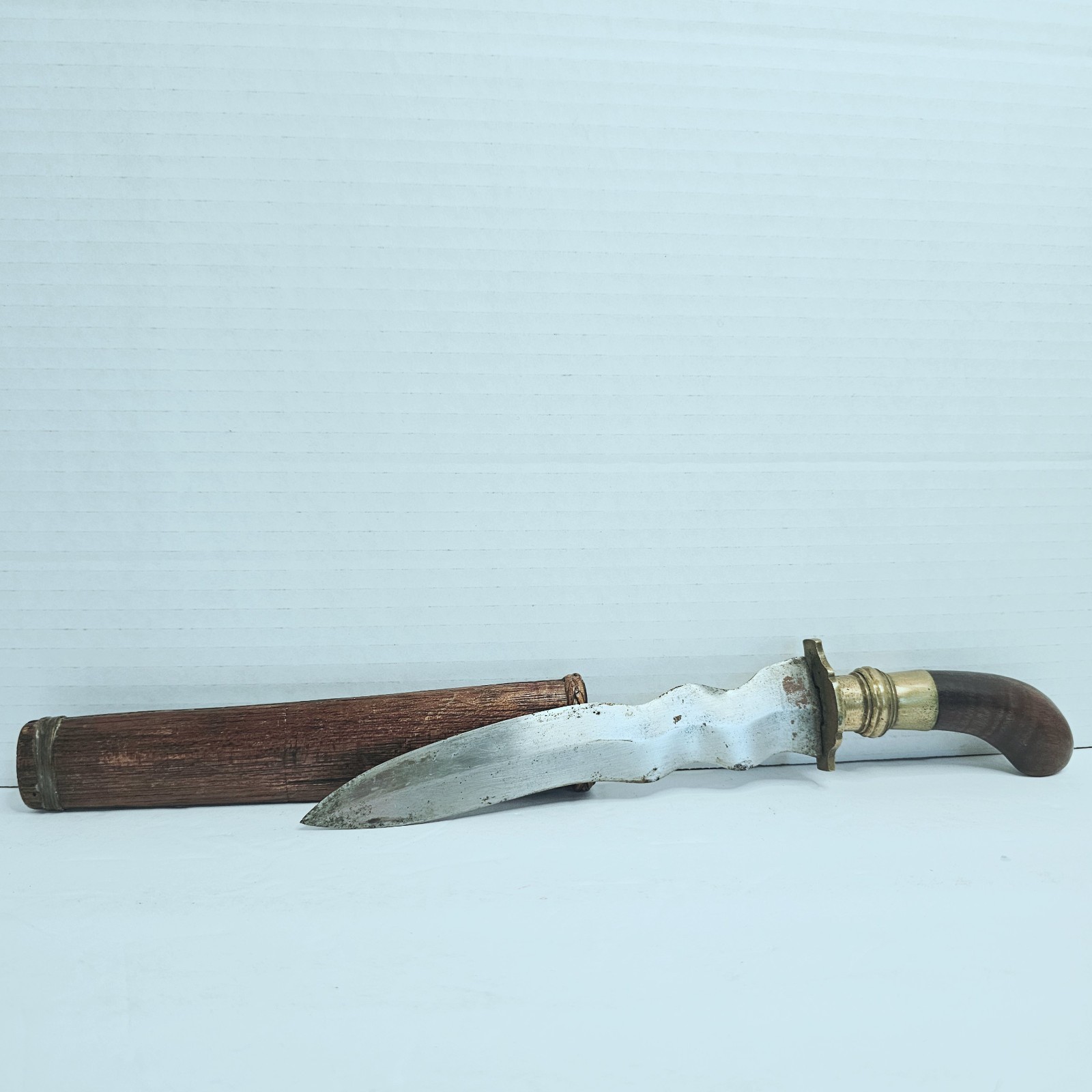
Traditionally made of hand-forged carbon steel or laminated steel. Historically, Moro blacksmiths (pandays) often repurposed high-quality iron and steel from scrap sources, such as vehicle leaf springs or old tools.
Details: The blade often displays a wavy pattern (luk) influenced by the larger Kris sword. The white residue visible on this specific blade is likely dried polishing compound, wax, or grease applied by a previous owner to prevent oxidation and rust.
2. The Handle (Hilt) Material:
Usually carved from high-density native Philippine hardwoods, such as Kamagong (Philippine Ebony) or Bayati/Banati wood, prized for their rich grain and durability.
Fittings: The base of the hilt features a distinct crossguard and a bulbous ferrule (collar). On this piece, these sections are made from brass.
3. The TangConstruction:
The knife uses a hidden stick tang (or rat-tail tang). The metal base of the blade thins out into a narrow rod that threads directly through the center of the guard, ferrule, and wooden handle.Assembly.
Historically, the tang was secured inside the hilt using a natural, ultra-strong tree resin matrix or a mechanical \"take-apart\" pin screw at the very butt end of the pommel, ensuring everything held together tightly during impact.
4. The Sheath (Scabbard)Material:
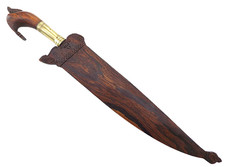
Made from two carved pieces of matching hardwood hollowed out and glued together to form a protective housing.
Accents: The sheath is held together and reinforced by metal bands at the throat and tip. In the provided image, you can see a matching metal band wrapped near the mouth of the scabbard