When you click on links to various merchants on this site and make a purchase, this can result in this site earning a commission. Affiliate programs and affiliations include, but are not limited to, the eBay Partner Network.
Antique Mayflower Broom Label NOS 🧹 1920s A.F. Weymer Co. Inc. Syracuse NY Nautical Sailing Ship Americana
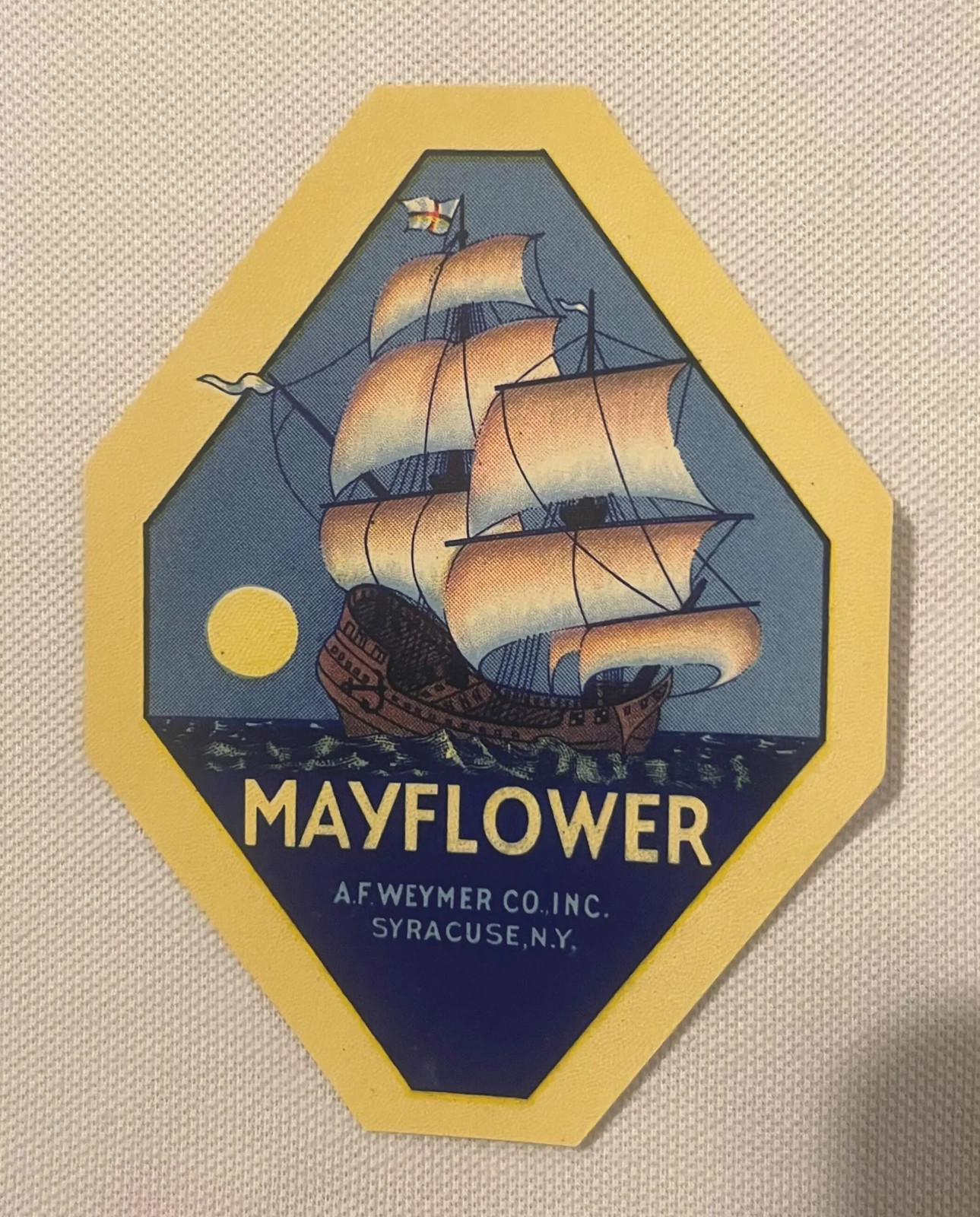
🌊 There is something quietly remarkable about holding a piece of paper this old and finding it in this condition. A broom label. That is what this is — a small octagonal label printed for the hardware counter or the general store shelf, designed to sell a broom to an American housewife sometime in the 1920s. The broom itself is long gone. The label survived. It measures 4 inches by 3 inches and fits comfortably in the palm of your hand. 🖐️
The label is diamond-oriented — a classic octagonal cut with the long axis running vertically — framed in a warm yellow-gold border that sets off the central illustration immediately. Against a deep slate-blue sky, a tall-masted sailing ship moves through dark water beneath a full yellow moon, her billowing cream-colored sails catching a wind that has been blowing for four hundred years in the American imagination. 🌕 A flag flies from the highest mast — a cross of St. George, white field with a red cross — marking her instantly as an English vessel of the colonial era. The hull is rendered in warm brown tones, intricately cross-hatched to show the carved and detailed woodwork of a period galleon. The ocean below her is dark navy, with small cresting whitecaps that read as both rough and majestic. The word MAYFLOWER runs large and confident across the lower portion of the label in cream lettering on that deep navy band, and below it, in smaller lettering, A.F. WEYMER CO. INC., SYRACUSE, N.Y.
That is the whole label. And it is enough. ⚓
🏙️ Syracuse, New York in the 1920s was a working industrial city — not a city people outside the Northeast thought about much, but a city that hummed. Salt had made it, the Erie Canal had grown it, and by the time A.F. Weymer Co. Inc. was printing broom labels there, it was a city of factories, trade houses, and the kind of commercial energy that produced small companies with big regional reach. The canal basin in the heart of the city was still a living thing in that era — boats, commerce, the smell of goods moving. The photograph that accompanies this listing shows that basin in its working prime: a wide commercial square, horse-drawn wagons unloading at the wharves, Victorian commercial blocks rising behind the water, everything busy and purposeful. That is the city where Weymer did business. 🛶
A.F. Weymer Co. Inc. was a broom manufacturer and distributor, and they understood what broom labels could do for them. In an era before television, before radio advertising had fully taken hold, the label on the broom was the brand. It was the only thing standing between your broom and the broom next to it on the hardware store shelf. So you put a sailing ship on it. You named it after the most famous vessel in American history. You printed it in rich blues and golds that stopped the eye. You made a small piece of paper do serious work. 🧹
The Weymer company produced multiple labeled broom brands across the 1920s and into the 1930s. The Witch Brand, their other known label, is documented from that same era — another strong graphic image, another instantly recognizable name. The Mother Goose Brand followed. These were not random choices. They were the choices of a company that understood its customers, understood the power of a recognizable image, and employed commercial artists who knew exactly how to execute. The Mayflower was the perfect choice for that moment — 1920 was the three hundredth anniversary of the Pilgrims\' crossing, and the whole country had just spent a year remembering that voyage. Tercentenary celebrations had run through New England and beyond. The Mayflower name carried weight, dignity, and deep American resonance that a housewife in 1920s Syracuse would have felt immediately. 🌟
🎨 The lore that circulates among broom label collectors — and there is a real community of them, people who have been chasing these for decades — holds that the commercial illustrators who painted these label designs were skilled artists working anonymously and for very little pay. They took on work wherever they could find it, lithography studios and print houses during the boom years of American consumer packaging, and their names almost never made it onto the work. The Mayflower on this label is beautifully rendered — the rigging is precise, the sails have genuine weight and volume, the moonlight hits the water correctly, the hull detail is the work of someone who knew ships. Whoever painted it worked for a printer\'s day rate and received no byline. The label itself is the only record. 🖌️
Old-timers in the label collecting world sometimes frame it this way: the vacuum cleaner eventually killed the broom label industry more thoroughly than anything else could have. Once electric vacuum cleaners became genuinely affordable for the American middle class in the years after World War II, broom companies faced a real contraction. The branded broom with its beautiful paper label, the staple of every hardware counter from the 1890s through the 1940s, faded fast. Most of the companies that had produced those labels — including, presumably, A.F. Weymer — did not survive into the television era. Their labels survived only because a small number of NOS stock found its way into storage, into attics, into old file drawers in buildings that took decades to be cleared out. The paper that was meant to be glued to a broom handle became, by accident, the most durable record of a lost industry. 💡
What we know for certain: Weymer operated out of Syracuse, the label is New Old Stock (NOS) from the 1920s era consistent with the company\'s documented production window, and the graphic quality on this example is everything you want from a label this age. The octagonal shape — wider in the middle, cut at all eight corners — was a common label format for brooms of the period, designed to fit the handle and face outward on the shelf simultaneously. The yellow-gold border is vivid. The navy of the lower band is deep and saturated. The cream of the ship\'s sails reads almost luminous against that slate-blue sky. 🌊
🖼️ Where does something like this end up?
Frame it — a simple black frame with a cream or navy mat, cut to approximately 5x7, lets this label become genuine wall art. The nautical palette — navy, gold, cream, dark brown — works beautifully against natural wood, white walls, exposed brick, or the kind of dark paneling you find in a well-appointed study or library. The Mayflower is one of the most recognizable vessels in American history, and a beautifully rendered period illustration of her belongs on a wall somewhere, not in a box.
Pair it — this label belongs naturally alongside other pieces of early American nautical ephemera: antique maps, period engravings of sailing ships, old postcards from New England ports, Plymouth Colony prints, or other vintage labels from the same era. A gallery wall built around colonial American maritime themes, with this label as one anchor, is a serious display. ⚓
Archive it — broom labels in NOS condition from documented makers of the 1920s are the kind of paper ephemera that label collectors, advertising historians, and Americana specialists all want. An acid-free archival sleeve keeps this one exactly as it is for another century.
Gift it — a framed Mayflower broom label from 1920s Syracuse is not a gift anyone will receive twice in their life. For the Americana collector, the nautical enthusiast, the New York State history lover, or anyone with a deep appreciation for the lost craft of American commercial lithography, this is the kind of piece that lands differently than anything else under a tree or in a box. 🎁
📚 There is a reason collectors have been chasing American broom labels for decades. These labels represent one of the last great eras of hand-illustrated commercial packaging in this country — before photography took over label design, before offset printing homogenized the grocery shelf, before the vacuum cleaner made the whole category obsolete. The artists who made them were working at the intersection of fine illustration and street-level commerce, producing images that had to stop a distracted shopper in under a second while also being beautiful enough to survive in someone\'s memory. Many of them succeeded completely. This Mayflower label, with its tall-masted ship sailing under a yellow moon, is one of those that succeeded.
A.F. Weymer Co. Inc. of Syracuse, New York made brooms. They labeled them beautifully. Somewhere around a century ago, a commercial artist whose name nobody recorded painted a ship that still looks like it is moving. New Old Stock (NOS). Four inches by three. 🌕⚓🧹