When you click on links to various merchants on this site and make a purchase, this can result in this site earning a commission. Affiliate programs and affiliations include, but are not limited to, the eBay Partner Network.
Antique Vegetable Pulmonary Balsam Bottle - Lowe & Reed, Boston, Massachusetts - Circa 1830–1850
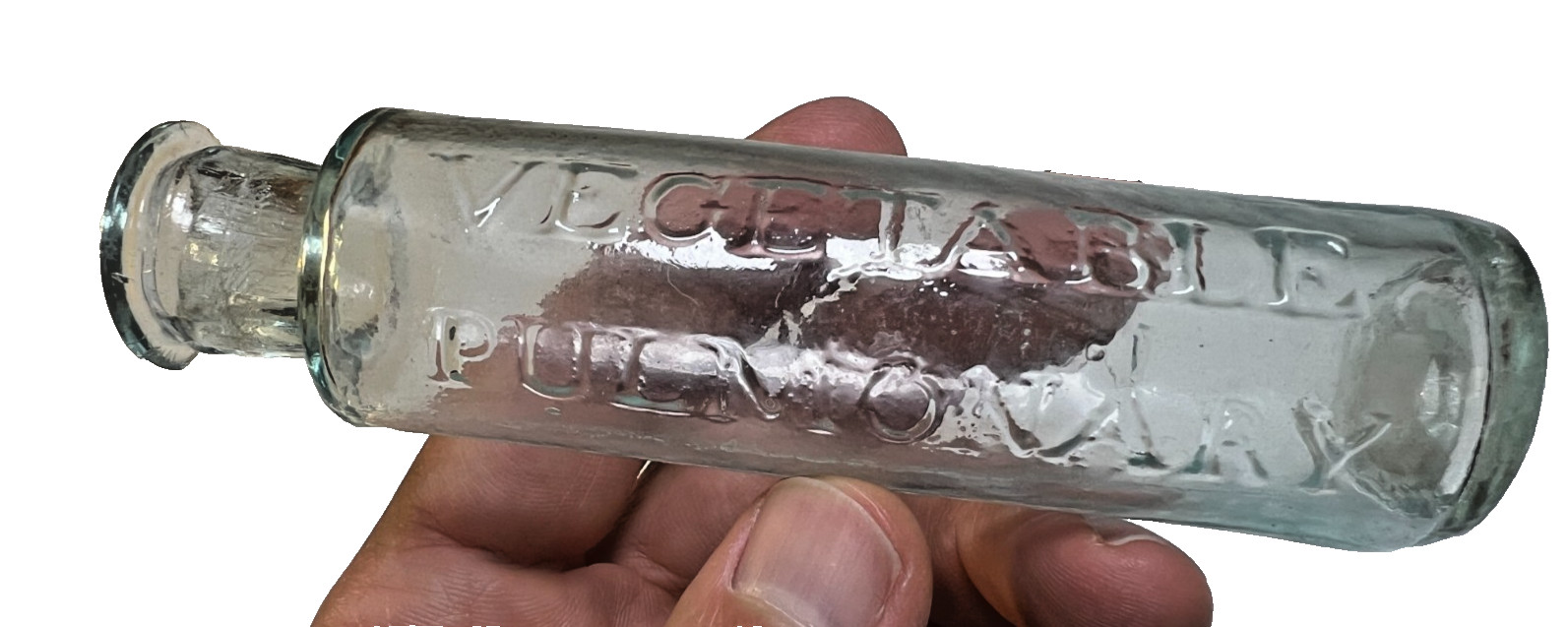
An outstanding little survivor from the early American medicine trade, this aqua Vegetable Pulmonary Balsam bottle combines bold embossing, a broad hand-finished flared lip, and a rugged open pontil with a sharp remnant of glass still projecting from its edge. Approximately 4⅞ inches tall, it has the appealing irregularity and luminous glass character that make early pontiled medicines so collectible.
This is the early small cylindrical bottle associated with Lowe & Reed’s Vegetable Pulmonary Balsam of Boston, Massachusetts, the remedy subsequently carried on by Reed, Cutler & Co. Dating circa 1830–1850, it represents the formative decades of a long-lived New England medicine brand. A closely comparable small flared-lip, open-pontil example is preserved in Québec’s archaeological reference collection.
The Men Behind The Medicine
The Lowe & Reed name brings together two particularly interesting figures in nineteenth-century Boston: Abraham Thompson Lowe and Sampson Reed.
Lowe was a physician who entered the wholesale drug business and later became prominent in Boston’s civic and financial life. His interests extended beyond medicines into banking, insurance, and railroads, and he served in city government and the Massachusetts legislature. In 1859, he helped establish the Safety Fund Bank, which subsequently became the First National Bank of Boston. He also wrote on the medicinal uses of plants—a fitting connection to a remedy marketed under the reassuring word “Vegetable.”
Sampson Reed (1800–1880) was a Harvard graduate, Boston druggist, religious thinker, and published author. Harvard’s historical catalogue records his bachelor’s degree in 1818 and master’s degree in 1821. His influential Observations on the Growth of the Mind, published in 1826, connected him with the intellectual world that helped shape Ralph Waldo Emerson and New England Transcendentalism. This medicine business belonged to a man whose interests reached from the apothecary counter into philosophy, literature, and spiritual life.
Vegetable Pulmonary Balsam’s advertising traced the remedy’s establishment to 1826. As the business evolved, the product continued under Reed and Cutler; by 1855, Reed, Cutler & Co. advertised at 33 India Street, Boston. The bottle’s product name connects it to that documented commercial history, although the individual proprietor’s name and city were not molded into this early example.
What Was Vegetable Pulmonary Balsam?
This was a proprietary medicine promoted for coughs, colds, asthma, whooping cough, consumption, and other complaints of the lungs and chest. “Pulmonary” identified its intended use, while “Balsam” suggested a soothing medicinal preparation.
Its marketing addressed some of the most frightening illnesses of the period. Advertisements offered testimonials, emphasized the genuine preparation, and warned customers against competing products with similar names.
An 1837 advertisement described the authentic medicine’s identifying packaging: a blue wrapper bearing a yellow label signed by Sampson Reed. Customers were instructed to request the complete product name. The prominent embossed wording on this bottle served the same practical purpose: keeping the medicine’s identity visible even after its paper wrapper had disappeared.
The brand’s later history reveals what could lie behind such reassuring medicinal language. Federal examination of a 1913 shipment of its successor’s preparation documented opium, alcohol, sugar syrup, tolu, and spearmint and sassafras flavoring. That is a documented later formula; the exact recipe originally placed in this much earlier bottle is unrecorded here.
Boston When This Bottle Was In Use
Picture Boston in the 1830s and 1840s: a compact maritime city of crowded wharves, warehouses, countinghouses, shops, and expanding commercial fortunes. The waterfront linked New England to Atlantic markets and distant trading ports, while wholesale businesses supplied goods to retailers throughout the region.
The National Park Service identifies the 1840s and 1850s as the height of Boston’s maritime commercial prosperity. Long Wharf handled trade connected with Europe, China, and the East Indies, and imposing granite commercial buildings rose along the docks. The Custom House Block, built in 1848, survives as a physical reminder of that prosperous waterfront world.
Boston was also witnessing extraordinary medical change. On October 16, 1846, Massachusetts General Hospital hosted the celebrated successful public demonstration of ether anesthesia. This little cough-remedy bottle belongs to that same broad historical moment, when familiar household medicines circulated alongside discoveries that would transform medical practice.
Early Glassmaking Character
The bottle was blown in a mold and finished by hand. Its aqua glass shows attractive waviness and irregularities around the raised lettering, while the broad flared lip gives the small form a distinctive silhouette.
Beneath the base is a conspicuous open pontil scar, left by the holding implement used during finishing. A sharp sliver of glass projects from its edge, preserving the rough character of the manufacturing process. This projecting glass should be handled carefully.
The combination of the small cylindrical body, flared mouth, and pontiled base gives this example its particularly early appearance.
Condition And Measurements
Height: Approximately 4⅞ inches.
Color: Aqua.
Embossing: VEGETABLE PULMONARY / BALSAM.
Lip: Hand-finished, outward-flared mouth.
Base: Open pontil with a sharp projecting glass remnant (extended pointil-chip; does not extend up the side of the bottle)
Condition: No chips, cracks, or staining.
Bright, clean glass with attractive handmade character.
A scarce and beautifully preserved early medicine bottle, distinguished by its Boston pharmaceutical history, small flared-lip form, bold embossing, and wonderfully rugged open pontil - a compelling survivor from the world of Lowe, Reed, and antebellum New England medicine.