When you click on links to various merchants on this site and make a purchase, this can result in this site earning a commission. Affiliate programs and affiliations include, but are not limited to, the eBay Partner Network.
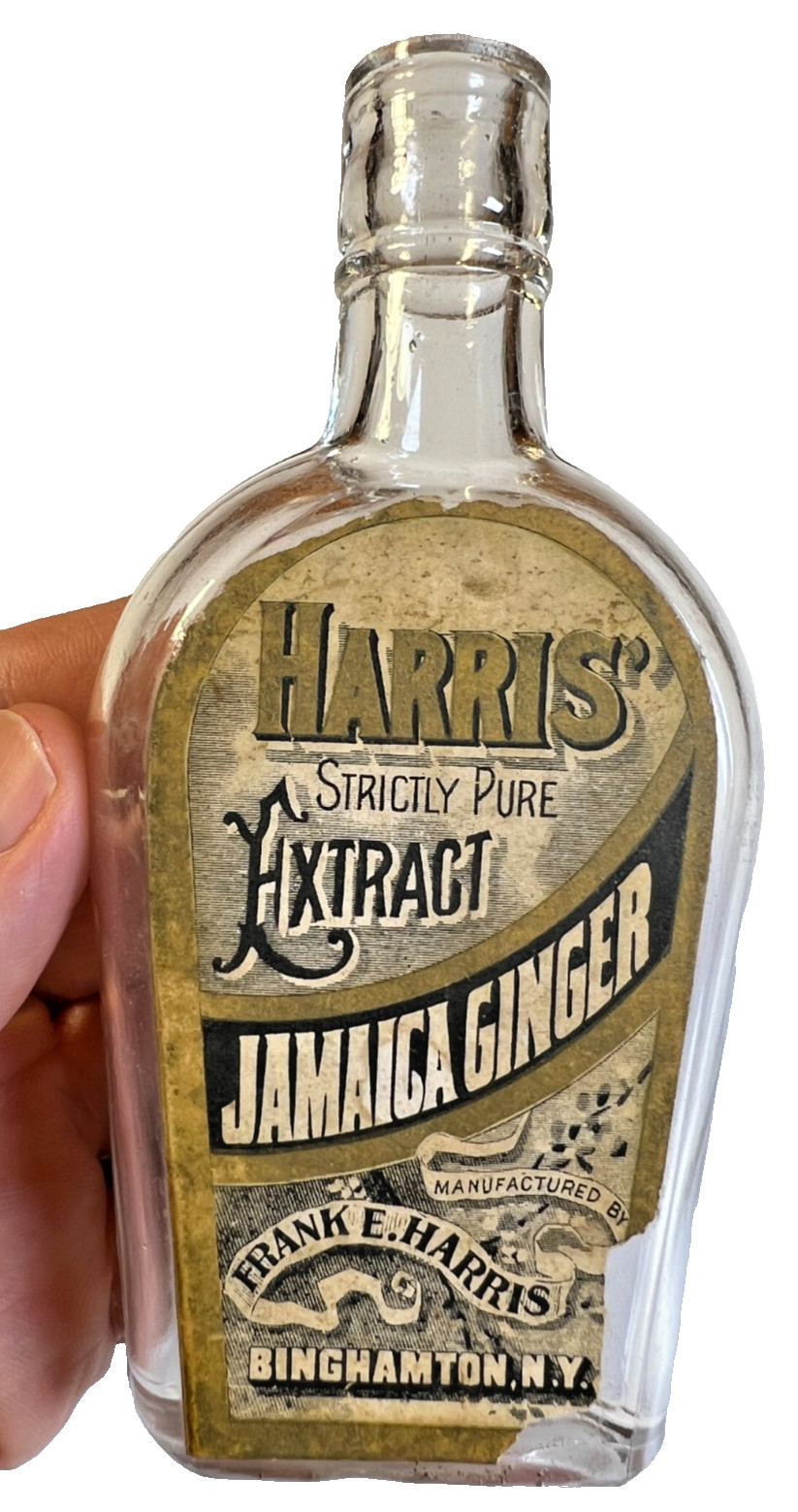
Before soda came in twelve flavors and a QR code, a little bottle like this was a household multi-tool: part kitchen flavoring, part “medicine,” and (during Prohibition) sometimes part loophole. Your HARRIS Strictly Pure Extract – Jamaica Ginger is exactly the kind of small, concentrated extract bottle that sat in pantries and drugstores—quietly powerful, and very of-the-era.
The company (Frank E. Harris, Binghamton, NY)
Your label names Frank E. Harris / Frank E. Harris Co., Binghamton, N.Y.—a regional maker/marketer of extracts and household preparations that show up on surviving bottles for flavors like vanilla and peppermint as well as Jamaica ginger.
Binghamton itself was an industrial, fast-growing upstate New York city in this era—factories, rail shipping, and mass-market consumer goods. (Your bottle fits right into that “made to be everywhere” moment.)
What it contained (and why people bought it)
Jamaica ginger extract (“Jake”) was a late-1800s/early-1900s patent medicine and flavoring—basically ginger in a very high-alcohol solution. In small doses it was marketed/used for digestive trouble, colds/catarrh, headaches, gas, menstrual complaints, etc., and it was commonly sold in small 2 oz-ish bottles.
A key “wow” detail for buyers: some Harris Jamaica Ginger packaging explicitly stated very high alcohol content (a Massachusetts court record quotes “Alcohol 88%” on a Harris Jamaica Ginger label, along with “For flavoring and medicinal purposes”).
That doesn’t mean your exact label had that wording—just that the brand/product category was genuinely high-proof.
How it was used (legit + not-so-legit)
Flavoring: a few drops into baking, sauces, candies, or homemade tonics (ginger was a go-to “warming” spice).
Home remedy: tiny measured doses in water/tea for stomach upset and “chills.”
Prohibition-era workaround: because it was sold as “medicine,” high-alcohol patent medicines became an obvious legal substitute once beverage alcohol was banned nationally in 1920.
Rarity (especially with the original label)
The bottle itself isn’t the rare part—the label is. Paper labels on utilitarian bottles usually got:
soaked off
torn by drawers and handling
destroyed by residue, heat, and time
Interesting facts
“Jake” was notorious: It was widely known enough to show up in songs and folklore (“Jake Walk/Jake Leg”).
A real public-health disaster happened later (1930s): some Jamaica ginger on the market was adulterated to evade tests, causing a paralysis outbreak (“Jake Leg”), traced to TOCP. Your bottle is a collectible tie-in to that era of medicine regulation and loopholes—but don’t imply your specific bottle was part of the tainted batches.
Regulation was tightening: the Pure Food & Drugs Act was signed in 1906, part of the Progressive Era push against misbranding/adulteration—exactly the kind of environment that made labels like “Strictly Pure” such a selling point.
“What was life like then?” (tech, medicine, politics)
This bottle lives in the overlap of:
Medicine: “patent medicines” everywhere, self-dosing at home, big claims, inconsistent oversight—until reforms like 1906 began changing expectations.
Technology: mass production, rail distribution, electrification in cities, and the rise of branded consumer packaging (labels doing the heavy lifting).
Politics: Progressive Era reform → then Prohibition (nationally effective 1920), which accidentally boosted “medicinal” alcohol products like Jamaica ginger.
“Jake leg” (also called ginger paralysis) is one of the strangest—and most tragic—chapters in American medical history. It turns an innocent-looking bottle like yours into a real conversation piece.
What was “Jake”?
“Jake” was the nickname for Jamaica ginger extract—a super-concentrated ginger tincture that was loaded with alcohol. Before Prohibition, it was sold as a remedy for stomach trouble, colds, and general misery. After Prohibition (1920), it became something else too: legal alcohol in disguise.
People drank it straight. A lot.
What went wrong
In the late 1920s–early 1930s, the government tried to crack down on people drinking Jake recreationally by testing its ginger solids. To pass those tests without reducing alcohol, some manufacturers adulterated the formula with a chemical plasticizer:
TOCP (tri-ortho-cresyl phosphate)
They didn’t know—or didn’t care—that it was neurotoxic.
The result: Jake leg
Thousands of people across the U.S. suddenly developed a strange paralysis:
Doctors were baffled at first. Victims looked healthy—but couldn’t walk properly. The condition became known as “Jake leg.”
It hit hardest in:
Poor and working-class communities
The rural South and Midwest
Black communities in particular (a grim reflection of who relied on patent medicines and who was ignored afterward)
Cultural fallout (this is the wild part)
Jake leg didn’t just make medical history—it made music history.
Blues musicians sang about it:
It became part of American folklore almost overnight—a medical disaster with a soundtrack.
Why your bottle matters (important distinction)
Not all Jamaica ginger caused Jake leg.
The paralysis came from specific adulterated batches
Many bottles—especially earlier, pre-Prohibition examples like yours—are from the legitimate medicinal era
But the association makes any labeled Jamaica ginger bottle historically electric
Collectors aren’t buying just glass.
They’re buying a tangible artifact from the moment when medicine, regulation, Prohibition, and desperation collided.
Why this story sells (and educates)
Jake leg directly led to:
In other words:
This bottle sits right at the fault line between 19th-century medicine and modern regulation.
Small bottle.
Big consequences.
And one of the strangest medical cautionary tales America ever produced.