When you click on links to various merchants on this site and make a purchase, this can result in this site earning a commission. Affiliate programs and affiliations include, but are not limited to, the eBay Partner Network.
A Little Bottle from an America That Bought Relief by the Corkful
Picture Providence in the 1850s: wagon wheels rumbling past shops, smoke rising over busy workshops, and newspapers promising extraordinary relief from an extraordinary assortment of ailments. A laborer’s aching hands, a household’s sudden illness, a traveler’s stomach trouble—each created a ready audience for a small bottle bearing three wonderfully direct words: Vegetable Pain Killer.
Before the Civil War, before antibiotics, and before modern consumer protections, Perry Davis built a remarkably successful business around that promise.
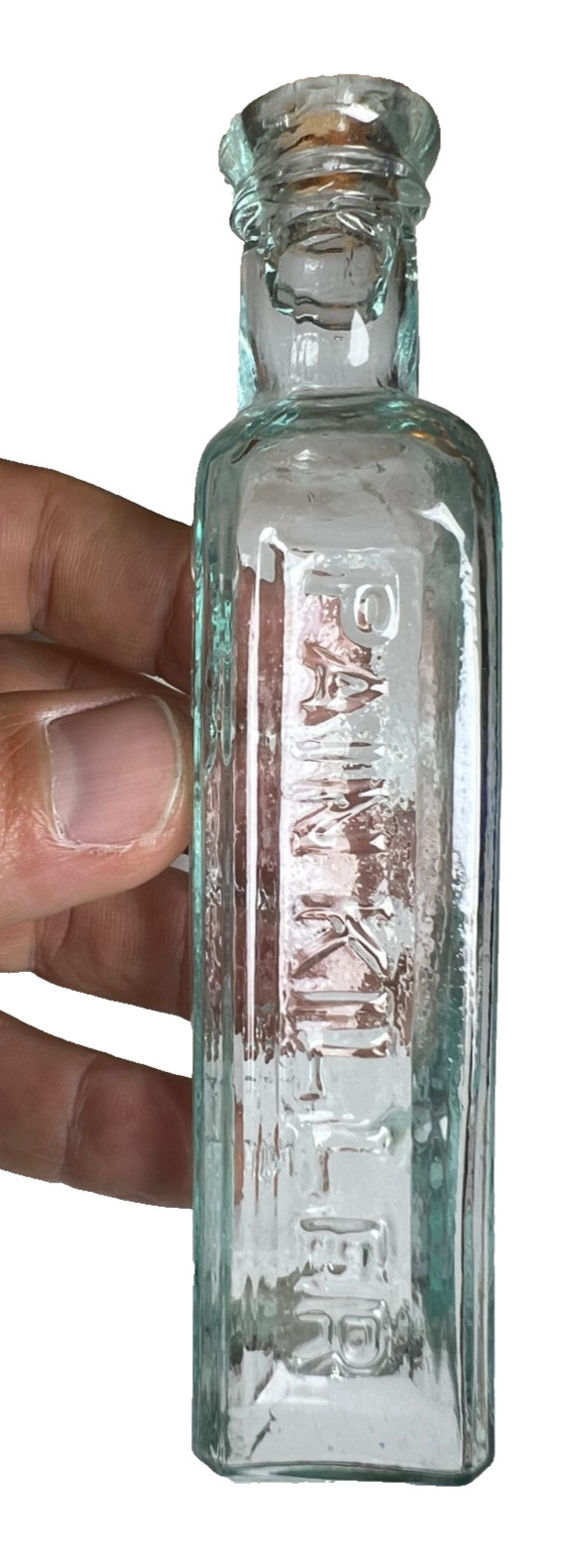
Standing approximately 5 inches tall, this early Davis’ Vegetable Pain Killer bottle brings that world into sharp focus. Its open pontil, diagonal hinge-mold seam, seed bubbles, flowing glass, and wonderfully crude applied top preserve the physical evidence of its handmade manufacture.
Most striking is the substantial drip of glass extending down inside the neck—an unusual and especially engaging detail in a bottle already overflowing with early glass character.
Date and Identification
Estimated date: circa 1855; approximately 1850–1860.
Product: Davis’ Vegetable Pain Killer
Proprietor: Perry Davis; the business subsequently operated as Perry Davis & Son
Company location: Providence, Rhode Island
Height: Approximately 5 inches
The embossed wording identifies one of nineteenth-century America’s best-known proprietary remedies. This example belongs to the early, pontil-held period of bottle manufacture, when the mouth was finished by hand while the bottle was supported from its base.
The date is an attribution based on its manufacturing characteristics rather than a year stamped into the glass.
Remarkable Glass Character—Including an Interior Neck Drip
This bottle rewards close inspection.
The applied top is notably crude, with abundant evidence of hot glass being added and worked by hand. Its standout feature is a substantial, irregular accumulation of glass descending into the interior of the neck.
This interior glass drip is an original manufacturing feature, as described, rather than a chip or crack. It gives the neck a particularly sculptural appearance—a moment of hot-glass working preserved within the finished bottle.
Numerous tiny seed bubbles and pronounced wavy manufacturing lines further animate the glass. These details give the surface movement and depth, particularly when viewed against the light.
On the underside, an open pontil scar crosses the diagonal hinge-mold seam. The seam records the meeting of the mold halves; the pontil scar records the attachment used to hold the bottle during finishing. Together, they provide a compelling record of the bottle’s manufacture.
The bottle offers several distinct points of interest:
An exceptionally crude applied finish.
A substantial original glass drip inside the neck.
Numerous small seed bubbles.
Flowing, wavy glass and abundant handmade character.
An open pontil scar intersecting the diagonal base seam.
Bright, clean glass that allows these features to be appreciated clearly.
Perry Davis—The Man Behind the Medicine
Perry Davis was born in Dartmouth, Massachusetts, in 1791 and died in 1862. An inventor and entrepreneur rather than a physician, he developed the remedy around 1839–1840.
His early life included physical injury, recurrent illness, financial difficulty, and unsuccessful business ventures. Nineteenth-century accounts describe his experimentation with medicines as arising partly from his own search for relief.
Davis established his manufacturing business in Providence in 1843. What began as a modest family undertaking eventually became an international enterprise. His son Edmund joined the business, and the firm became known as Perry Davis & Son.
This bottle represents the formative decades of that success, when the medicine’s name was becoming familiar far beyond Rhode Island.
What Was Inside?
The reassuring word “Vegetable” deserves a closer look.
Historical research identifies Perry Davis’ Pain Killer as a preparation containing opium, alcohol, and other ingredients. It was promoted for both internal and external use.
Its botanical branding would have appealed to customers seeking a familiar, seemingly natural remedy. Yet this was a potent nineteenth-century medicinal preparation, and its ability to produce relief did not establish the sweeping cures claimed in its advertising.
The exact formulation of the contents once held in this particular bottle cannot be determined from the empty container.
As an artifact, it captures a fascinating stage in medical history: recognizable branding and widespread distribution had developed faster than reliable testing, ingredient disclosure, and regulation.
Marketing a Promise of Relief
Perry Davis helped turn a local remedy into an internationally recognized product through persistent promotion and distribution.
Newspaper advertisements, testimonials, printed promotional material, and networks of sellers carried the medicine’s reputation outward. Contemporary accounts also describe free supplies being provided to missionaries, helping introduce the product overseas.
Its promotional appeal was broad: one recognizable bottle, one memorable name, and the promise that relief could be kept close at hand.
By the 1850s, the company was also confronting imitation products. Advertisements stressed distinctive packaging and embossed wording as ways for customers to recognize the genuine article.
The lettering on this bottle therefore served a commercial purpose as well as an identifying one. The product’s name remained in the glass even if its paper label disappeared.
Life When This Bottle Was Made
The 1850s were a decade of extraordinary change and deep uncertainty.
Technology: Railroads and steam power were transforming travel, manufacturing, and commerce. Telegraph messages could move information far faster than a horse or ship. Nevertheless, a small medicine bottle like this still depended on individual glassworkers to form and finish it.
Medicine: Ether anesthesia had recently changed the possibilities of surgery, but antibiotics were many decades away. Germ theory had not yet become the foundation of everyday medical practice, and antiseptic surgery was still developing. Families faced illness with far fewer dependable treatments than exist today.
Politics: The United States was becoming increasingly divided over slavery. The Fugitive Slave Act of 1850 and Kansas–Nebraska Act of 1854 intensified the conflicts that would lead to the Civil War.
This little bottle belongs to that unsettled world: industrial progress, expanding markets, frightening disease, and powerful faith in the next advertised remedy.
Providence During the 1850s
Several developments help place this bottle in its home city’s history:
1853—Brown & Sharpe takes its familiar name. Joseph R. Brown’s partnership with Lucian Sharpe helped establish a business that would become central to Providence’s reputation for precision manufacturing.
1854—A devastating cholera outbreak. The epidemic became a defining event in the city’s history. Such outbreaks explain the urgent demand for advertised remedies, although historical claims that Pain Killer cured cholera should not be accepted as medical fact.
1855–1857—A growing financial and commercial district. New banking buildings and the Custom House reshaped the area around Weybosset Street, reflecting Providence’s expanding industrial and trading economy.
Davis’ medicine business developed within this same city of workshops, commerce, invention, and public-health anxiety.
Condition—An Exceptional “Attic Mint” Example
Exceptionally preserved, with the following condition reported:
No chips.
No cracks.
No scratches.
No haze.
Bright, clean, shiny glass.
Numerous original seed bubbles and wavy manufacturing lines.
Crude applied top with a substantial original interior glass drip.
Open pontil scar across the diagonal hinge-mold base seam.
Approximately 5 inches tall.
“Attic mint” describes its outstanding state of preservation; it does not establish a documented attic discovery.
The bubbles, flowing lines, pontil scar, mold seam, and irregular applied finish are original manufacturing characteristics and integral to its appeal.
A Particularly Expressive Early Example
Davis’ Vegetable Pain Killer is a recognized name in early American medicine bottles. The appeal of this example lies in its combination of exceptional preservation and unusually expressive glasswork.
Its clear, brilliant surfaces allow the small bubbles, flowing lines, and remarkable interior neck drip to take center stage.
An engaging survivor of antebellum American medicine, Providence enterprise, and the individual skill—and occasional exuberance—of the nineteenth-century glassworker.