When you click on links to various merchants on this site and make a purchase, this can result in this site earning a commission. Affiliate programs and affiliations include, but are not limited to, the eBay Partner Network.
A Small Survivor from a Wild Era
Imagine this bottle sitting on a general store shelf in 1855.
Outside, horses and wagons line the dirt road.
Telegraph wires hum overhead.
Newspapers are filled with stories of gold in California and political arguments over slavery.
A farmer walks in complaining of tooth pain.
The storekeeper reaches behind the counter, grabs this very bottle, and says:
"Take a spoonful of Davis’ Pain Killer. Works every time."
And just like that, the medicine — and the bottle — entered everyday American life.
Perry Davis’ Vegetable Pain KillerA Bottle from the Age of Traveling Medicine
In the middle decades of the 19th century, when America was still expanding westward and doctors were scarce in rural towns, most families relied on patent medicines — bottled remedies sold through traveling agents, general stores, and newspaper advertisements.
Among the most famous of them all was Davis’ Vegetable Pain Killer, created by a Rhode Island inventor named Perry Davis.
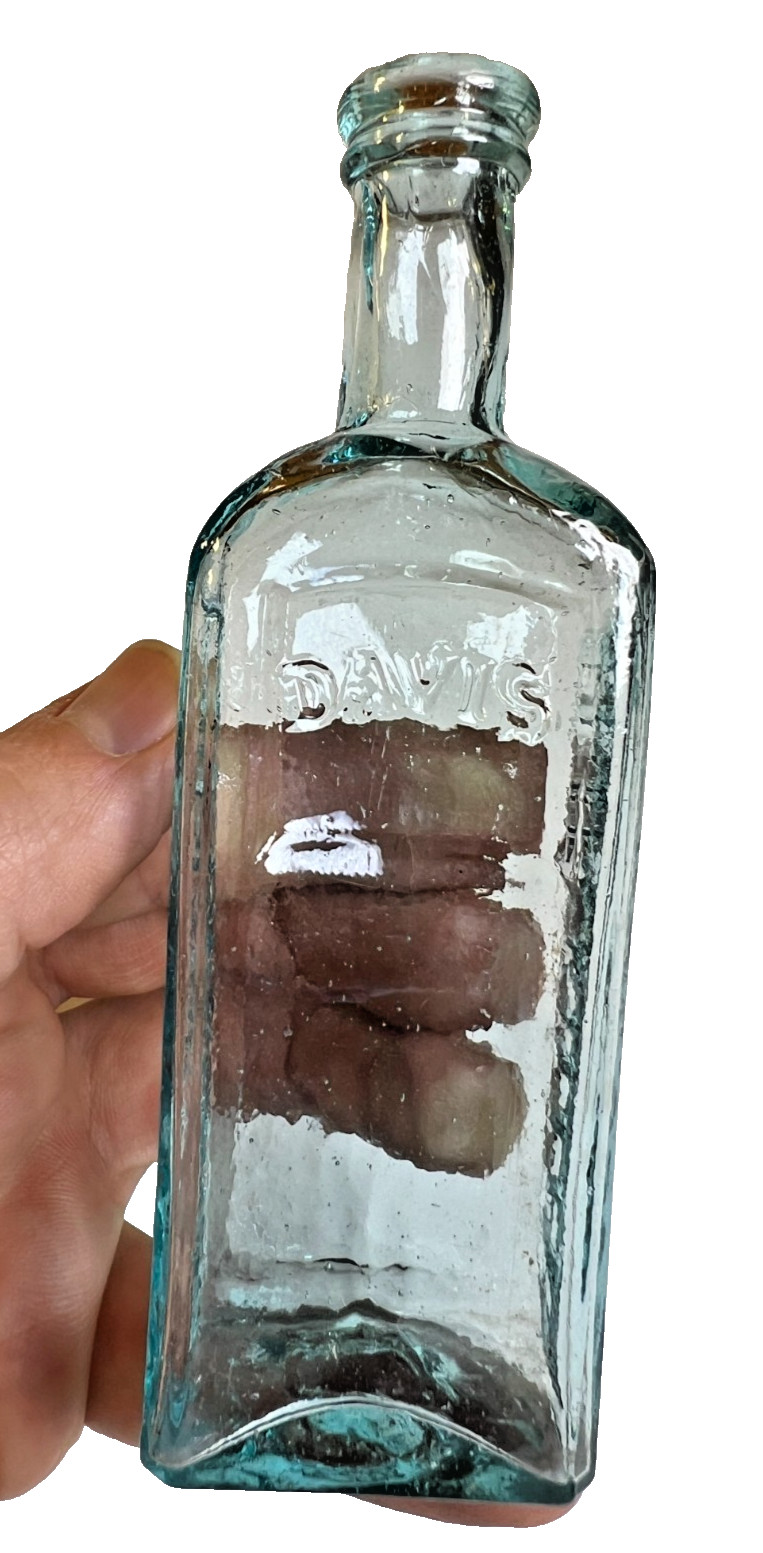
Your bottle — standing 5⅛ inches tall, with an open pontil base, applied collar lip, and embossed panels — is a physical survivor from that era. It dates to roughly 1850–1860, when the product was exploding in popularity across the United States and the world.
The Man Behind the Medicine
Perry Davis (1791–1876) was a shoemaker turned entrepreneur living in Providence, Rhode Island.
Around 1840, Davis began selling a homemade medicinal formula he claimed could relieve:
• pain
• coughs
• dysentery
• toothaches
• burns
• cholera
• rheumatism
• snake bites
• stomach illness
• fevers
It was marketed as a universal household remedy.
The name “Vegetable Pain Killer” was meant to reassure people that the ingredients came from plant extracts rather than dangerous chemicals — though the formula actually contained a significant amount of alcohol and opium, which certainly helped it “kill pain.”
What Was Actually In It
The exact formula varied slightly over time, but the known ingredients included:
• Alcohol
• Opium
• Camphor
• Capsicum (red pepper)
• Myrrh
• Turpentine
• Various plant extracts
Taken internally, it worked as a powerful sedative and pain reliever.
Applied externally, it produced a warming sensation.
In other words, it was 19th-century ibuprofen, cough syrup, and whiskey — all in one bottle.
A Global Sensation
By the 1850s, the product had become one of the most widely distributed patent medicines in the world.
Advertisements claimed it was sold in:
• the United States
• Canada
• England
• India
• China
• South America
• Australia
Missionaries, sailors, and traders carried it abroad, and it was often promoted as a cure for cholera outbreaks, which terrified populations during that century.
The label proudly declared:
"Used throughout the civilized world."
Which was not entirely an exaggeration.
The Bottle Itself
Your bottle represents the early production period, and several features confirm this.
Open Pontil Base
The rough circular scar on the bottom comes from the pontil rod, the metal tool used by glassblowers to hold the bottle during finishing.
Pontil scars generally indicate manufacture before about 1860.
The two stars embossed on the base are mold identifiers used by the glasshouse.
Applied Dripping Lip
The lip was formed by:
Finishing the bottle body
Applying extra molten glass around the neck
Tooling it into a collar
The slight “drippy” look is common on mid-19th century medicine bottles.
Early Mold Characteristics
Your bottle shows:
• uneven glass thickness
• small bubbles
• slightly warped panels
• heavy aqua coloration
These are classic hallmarks of hand-blown mold production from the 1840s–1850s.
The Shape
The bottle is the typical square panel medicine style used for many early patent medicines.
Advantages of this design:
• easy to label
• stable for shipping
• efficient to pack in wooden crates
The side embossing “DAVIS’ VEGETABLE PAIN KILLER” helped prevent counterfeiting, which was already a major issue.
Life in America When This Bottle Was Made
When your bottle was produced (roughly 1850–1860):
The United States had only 31 states.
Major events happening around the same time included:
• the California Gold Rush
• the building of the first railroads across the continent
• the telegraph revolution
• rising tensions that would soon lead to the Civil War
Medical science was still primitive.
Doctors did not yet understand:
• bacteria
• antiseptics
• germ theory
In fact, surgery without anesthesia had only recently become possible in the 1840s.
For many people, a bottle like this was the medicine cabinet.
Advertising Genius
Perry Davis was also a marketing pioneer.
His advertisements included:
• traveling demonstration wagons
• newspaper ads
• pamphlets in multiple languages
• testimonials from ministers and doctors
The company later became Perry Davis & Son, and production moved to Providence and later New York.
Millions of bottles were produced.
Condition
Exceptionally nice.
From the photos:
• strong embossing
• bright aqua glass
• attic shine and sparkle
• excellent early lip
• sharp pontil scar