When you click on links to various merchants on this site and make a purchase, this can result in this site earning a commission. Affiliate programs and affiliations include, but are not limited to, the eBay Partner Network.
Consumers Brewing Co. Newark, Ohio Quart Beer BottleDate: Circa 1900–1905
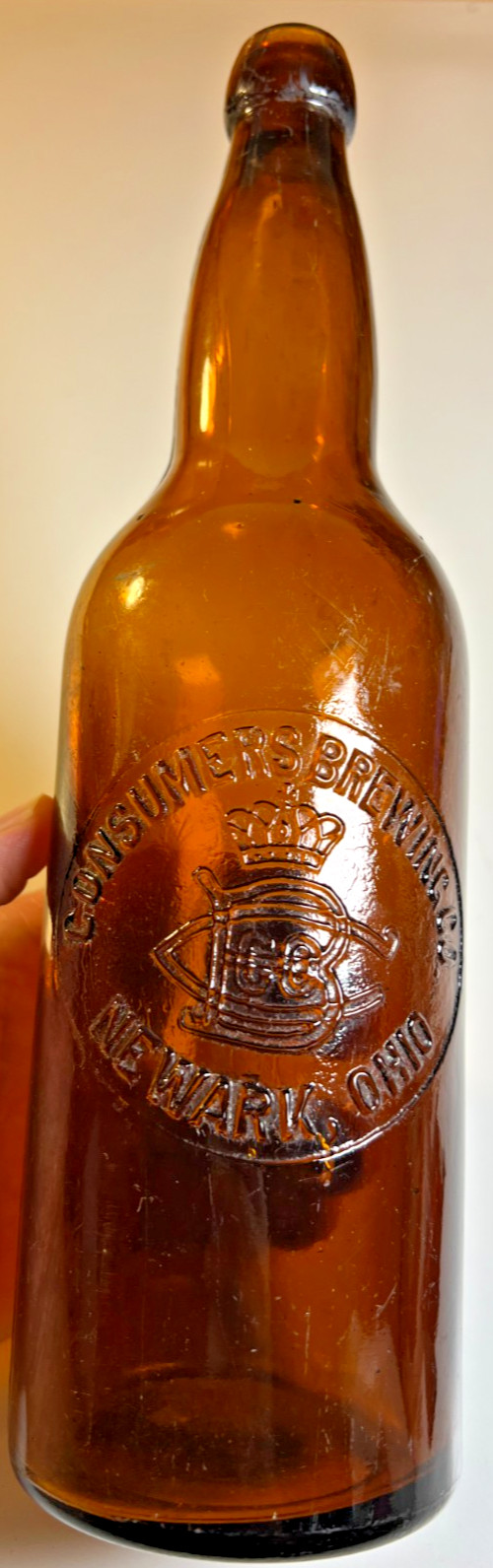
This is a handsome pre-Prohibition amber quart beer bottle made for the original Consumers Brewing Company of Newark, Ohio.
The company began brewing in 1897–1898 and operated until national Prohibition forced it to close in 1919. Its brewery stood at 75 East Locust Street, at First Street, Newark, Licking County, Ohio. Brewery records associate the company with Consumers Special Beer, Eagles Special Beer, Old Dutch Lager Beer, and Van Vogt Brand. Tavern Trove brewery history
Although a second Consumers Brewing Company operated in Newark from 1933 to 1954, this bottle unquestionably belongs to the earlier concern. The large applied blob top, cork-and-wire closure, oversized returnable-quart form, amber glass, and hand-finished appearance are all characteristic of the pre-Prohibition period.
My strongest working date is:
Circa 1900–1905, with approximately 1902 being a reasonable single-year estimate.
A completely honest catalog range would be circa 1898–1910. It cannot be assigned to one proven calendar year without a dated advertisement or brewery document illustrating this exact mold.
That Extraordinary Slug Plate
The main attraction is the enormous circular slug plate:
CONSUMERS BREWING CO.
NEWARK, OHIO
At its center is an elaborate brewery trademark consisting of a crowned brewing emblem with intertwined “CBC” initials, surrounded by stylized brewing imagery. The crown gave the product an upscale, Old World identity, while the ornamental monogram made the bottle immediately recognizable when sitting behind a saloon bar.
And this one is an absolute hammer strike. The lettering is exceptionally deep, raised, and sharply defined. Even the delicate interior lines of the crown and central monogram came out beautifully. Many examples show weak or uneven embossing where the glass failed to fill the deepest portions of the mold. This bottle did precisely the opposite—it filled the mold like it had something to prove.
What It Originally Contained
This was a large returnable beer bottle, probably holding approximately one quart. It would have contained one of Consumers Brewing Company’s lager or specialty beers rather than medicine, whiskey, or soda.
The blob top was designed for a cork secured by wire or a mechanical fastener. Before disposable crown-cap bottles completely displaced them, these substantial amber bottles circulated repeatedly between the brewery, saloons, hotels, restaurants, and private customers.
Amber glass was purposeful: it reduced the damaging effects of light on beer while the thick construction allowed the bottle to survive washing, refilling, wagon delivery, and repeated handling.
Consumers Brewing marketed beer under names including:
- Consumers Special Beer
- Eagles Special Beer
- Old Dutch Lager Beer
- Van Vogt Brand
“Old Dutch” and the crowned, Old World-style emblem drew on the Germanic brewing tradition that still defined American lager advertising around 1900. The goal was to suggest skilled European brewing, purity, quality ingredients, and a respectable local product.
How It Was Marketed and Used
This was packaging, advertising, and brewery property rolled into one.
The giant embossed slug plate permanently advertised the brewery even after the paper label had washed away. The unusually ornate central logo also helped discourage competing bottlers from quietly appropriating the container.
At the time, bottled beer was commonly delivered in wooden cases by horse-drawn brewery wagons. Customers paid a deposit or were expected to return the empties. The bottles were then washed, inspected, refilled, corked, labeled, and sent back into circulation. That reuse helps explain both the robust glass and the light scratching frequently found on authentic examples.
This example’s scattered faint hairline surface scratches are therefore entirely believable as period handling, reuse, and eventual burial wear.
Construction and Condition
- Height: 11 1/2 inches
- Color: Rich golden-to-medium amber
- Finish: Large applied blob top
- Body: Oversized quart-style beer form
- Embossing: Exceptionally deep and powerful
- Base: Smooth, pre-machine construction
- Condition: No chips and no cracks
- Surface: Faint hairline scratches scattered throughout; scuff to the letter "M" in consumers.
- Interior: Localized patch of remaining internal dirt immediately to the right of the slug plate
- Provenance clues: Overall appearance is consistent with a bottle that was excavated and carefully cleaned
Historical Setting
Around 1902, Newark was a growing railroad and industrial center with a substantial working population and a healthy saloon trade. Local breweries competed against increasingly powerful regional and national brands, so a bold proprietary bottle was valuable advertising.
Beer was sold not merely as recreation but as a nourishing, comparatively wholesome everyday beverage. Advertisements routinely emphasized purity, malt, hops, cleanliness, and Old World brewing expertise. Within two decades, however, the entire legal market disappeared. Ohio adopted statewide prohibition in 1919, followed almost immediately by national Prohibition, ending the original Consumers Brewing Company’s first era.
This bottle therefore represents the brewery’s original pre-Prohibition operation—not the later company that resumed production after repeal in 1933. Post-Prohibition company dates