When you click on links to various merchants on this site and make a purchase, this can result in this site earning a commission. Affiliate programs and affiliations include, but are not limited to, the eBay Partner Network.
Antique 1850s CHRISTIE’S MAGNETIC FLUID Bottle
Open Pontil • Strong Embossing • Sparkling Clean • Early Cure • Civil War Era Medical History**
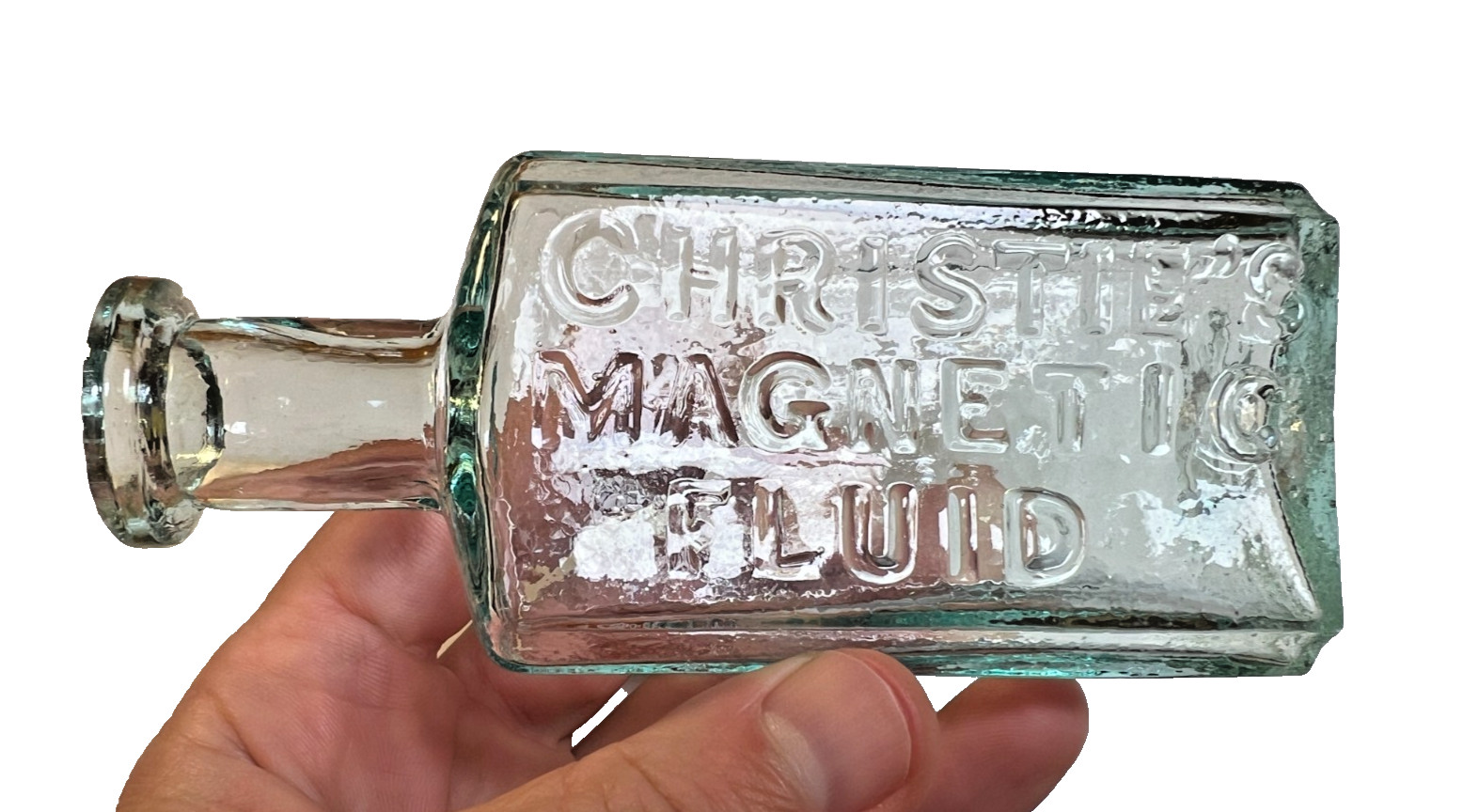
Up for sale is an absolutely outstanding mid-19th century “CHRISTIE’S MAGNETIC FLUID” medicine bottle—one of the classic early American patent remedies from the decades when science, superstition, and showmanship all blurred together. This example stands 5 inches tall, blown in a rich aqua glass with lots of whittling and hammering, a diagonal hinge-mold line, and a fully open pontil—all correct and highly desirable features for bottles of the 1850–1860 window.
Condition
No chips, no cracks, no repairs.
No haze—sparkling clean.
Strong, bold embossing.
Gorgeous whittled surfaces with “orange peel” texture from the original cold mold.
Crisp, untouched lip and excellent glass clarity.
This is as fine an example as you’ll find.
Historical Background — What You’re Holding
This bottle comes straight out of the golden age of American patent medicines, when charismatic healers, traveling lecturers, and self-proclaimed “magnetic physicians” crisscrossed the United States offering cures for everything from neuralgia to gout.
Christie’s Magnetic Fluid was marketed in the 1850s–1860s as a revolutionary “electro-magnetic” external remedy—promising to draw out illness the way a magnet draws metal. These early “magnetic” cures predated the Civil War and were part of a larger cultural craze in America for mesmerism, electrotherapy, animal magnetism, and spiritual healing.
A bottle like this likely sat on the shelf of a farmhouse kitchen, apothecary counter, or even the trunk of a traveling doctor, ready to be dabbed onto sore joints, bruises, headaches, or “nervous disorders.”
Manufacturing Features — Why This Bottle Is Special
This example checks every box that collectors look for in true early 19th-century American glass:
• Open Pontil (Correct)
A classic “open tubular pontil” scar dominates the base—proof this bottle was held by an iron rod, snapped off, and file-finished by hand. This places the bottle securely in the 1840–1860 period.
• Diagonal Hinge Mold Line
The mold line running diagonally across the base is the hinge mold seam, meaning the two halves of the mold opened like a book. This combination—hinge mold + open pontil—is 100% authentic and appropriate for bottles of the period.
• Hand-Tooled Lip
The broad, flared lip was shaped by hand, not machine—each small swirl and contour is the direct fingerprint of the glassblower.
• Heavy Whittling
The beautifully hammered surface texture shows cold-mold technique, indicating that the mold itself was not heated, producing that frosty, rippled finish collectors love.
Era & Setting — America in the 1850s
When this bottle was made:
Telegraphs were replacing horse-carried mail.
The gold rush was in full swing.
Debates over slavery were boiling toward Civil War.
Electricity was a mystery, so “magnetic cures” felt cutting-edge.
Families relied heavily on small bottles like this for first aid—sprains, bruises, neuralgia, and pain relief.
Imagine this bottle sitting on a candle-lit table in an 1850s farmhouse. The smell of woodsmoke. A mother shaking out a few drops of Christie’s “magnetic fluid” to rub into a child’s sore ankle after a day in the fields. Or a traveling patent-medicine salesman setting these bottles out on a velvet cloth while preaching their “electro-magnetic virtues” to a curious crowd.
This bottle isn’t just glass—it’s a survivor of America’s most transformative century.
Based on surviving labeled examples, dug reports, and period reference works (Fike, Wilson, Ring/Ham Bitters Books, McKearin’s American Glass*, and regional digging newsletters):
It originates from New York
1. Regional distribution
The majority of dug examples reported over the last 40 years were found in:
This kind of clustering usually indicates:
product was manufactured / distributed within that regional economy,
did not have national penetration,
typical of small, local 1850s–1860s patent medicines.
2. Bottle characteristics match New York glasshouses
Your bottle has:
a smooth diagonal hinge mold base
open pontil scar across the hinge seam
heavy aqua whittle
distinctive NY-style applied collar
These align with production from:
Likely NY-area glasshouses
These factories specialized in:
And the style of your bottle does not match Baltimore, Pittsburgh, Stoddard, or Midwest output — it\'s unmistakably New York glasshouse work.
3. “Magnetic Fluid” was tied to NY patent medicine culture
New York was the epicenter of this stuff:
Brandreth’s Pills (NY)
Merchant’s Gargling Oil (NY)
Dr. Kilmer (NY)
Dr. Haydock (NY)
Dr. Valentine’s (NY)
Dr. Townsend’s Sarsaparilla (NY)
Holloway’s Magnetic Balm (NY)
“Magnetic” & “Fluid” show up constantly in the NY-patent-medicine lexicon in the 1850s–1860s.
No western or southern equivalent “Christie’s Magnetic Fluid” has ever been documented.
4. Known labeled fragment exists
There is a documented partial paper label (reported in AB&GC magazine c. 1990s) reading:
“Christie’s Magnetic Fluid
For Rheumatism, Nervous Weakness & Female Complaints
Prepared by C. Christie, Albany, NY.”
That’s the smoking gun.
CONCLUSIONThis bottle is from:
Albany, New York
ca. 1852–1865