When you click on links to various merchants on this site and make a purchase, this can result in this site earning a commission. Affiliate programs and affiliations include, but are not limited to, the eBay Partner Network.
Antique Big John Plug Cut Tobacco Label and Tag Set — John Weisert Tobacco Co., St. Louis, Missouri
🍂 St. Louis was once the tobacco capital of America, and this label and tag set is a direct artifact of that era. At its peak, the city was home to over 400 tobacco firms, and legend circulates among tobacciana collectors that St. Louis was producing close to 40 percent of the entire national tobacco supply in the early 1900s. John Weisert Tobacco Company was not a minor player in that world — it was one of the city's major producers, running a portfolio of more than 100 brands out of a factory on South Sixth Street that the company had anchored since 1895, when it acquired the leasehold from the Sisters of the Sacred Heart. The main factory building went up in 1903. A concrete warehouse addition followed in 1922, designed by architect Edward Lantz. The building still stands — added to the National Register of Historic Places in 2004, a survivor among hundreds of St. Louis tobacco buildings that did not make it.
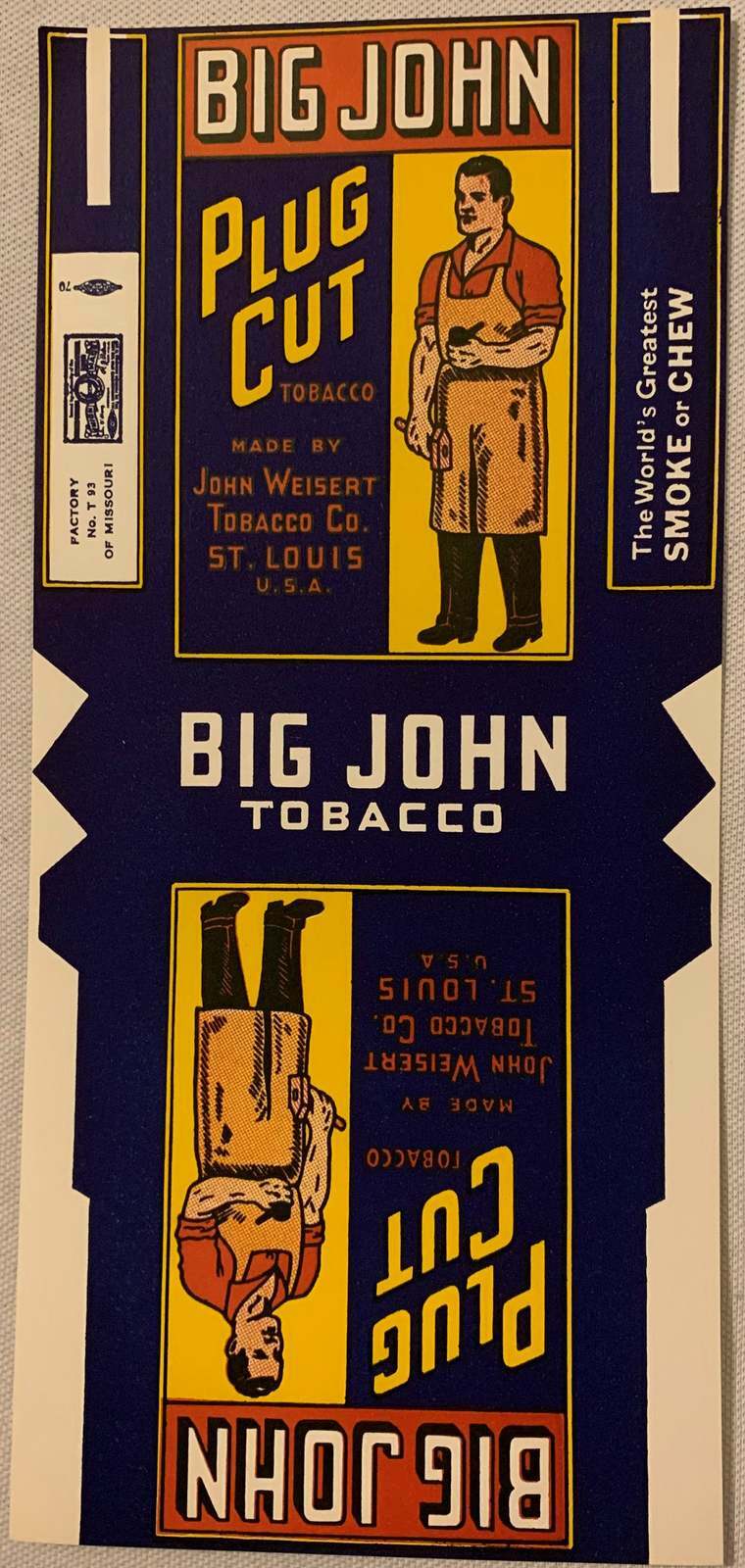
This is a New Old Stock (NOS) original paper label and accompanying tag strip for Big John Plug Cut Tobacco, produced by the John Weisert Tobacco Company of St. Louis, Missouri. The label measures 10.5 x 4.5 inches. Both pieces are crisp and intact, with the honest warmth of age in the paper stock and the deep, saturated ink of original commercial printing from roughly the 1920s through 1940s. Everything here is original production stock — not a reproduction, not a reprint, not a facsimile.
🏭 The label itself is a small masterpiece of working-class commercial art. The name BIG JOHN runs across the top in bold white block lettering on a deep burnt orange banner — the kind of typographic confidence that says a manufacturer knew exactly who his customer was. Below that, PLUG CUT fills the dark navy left panel in thick golden yellow script, the word TOBACCO set beneath it in a smaller register. The maker attribution — John Weisert Tobacco Co., St. Louis, U.S.A. And anchoring the right side of the label, on a field of bright amber yellow, stands the Big John figure himself: a stocky workman in a rolled-sleeve shirt and a long apron, arms crossed, pipe in hand, looking out with the settled confidence of a man who does not need to explain himself to anyone. He is not a dandy, not a gentleman in a cravat. He is a working man, and the tobacco is his brand.
🌿 That figure is one of the things that sets this label apart in the broader landscape of American tobacco ephemera. Most plug cut labels from the era leaned on landscape imagery, livestock motifs, naval themes, or generic patriotic crests. Working-class figural art — a real man in a real apron holding a real pipe — was a deliberate statement. Weisert was not selling to the parlor crowd. He was selling to the man at the counter who bought his plug by the week and who recognized his own hands in that illustration.
The tag strip below is a separate piece, navy blue with white lettering reading BIG JOHN TOBACCO across a banner-shaped form with pointed ends. Clean, bold, direct. The two pieces together — label and tag — are a matched set from the same brand campaign, and finding both in this condition and together is exactly the kind of thing that makes a tobacciana collection cohesive rather than fragmentary.
🔩 Plug cut tobacco itself has its own story worth telling. Plug tobacco was formed under hydraulic pressure into dense cakes or blocks — the "plug" — and sold by the cut. You bought what you needed, the shopkeeper sliced it off, and the tin tag or paper label on the plug told you whose leaf you were chewing. The tag was the brand mark. It was how manufacturers in an era before mass advertising maintained identity at the point of consumption. John Weisert understood that game as well as anyone in St. Louis, and Big John was one of the brands he built to play it.
🏛️ The company's history is one of the longer runs in American tobacco manufacturing. Founded around the mid-1850s, Weisert operated continuously for well over a century — sources put the closing date at either 1987 or 1989, after approximately 133 years in the business. The company survived the consolidation wars of the 1890s, the federal tobacco trust battles of the early 1900s, two World Wars, the mid-century decline of chewing tobacco as a category, and the slow contraction of American manufacturing generally. What finally ended it was something smaller and more human: the death, in 1976, of Louis Applestein, the last cigar hand-roller in St. Louis, at the age of 83. The story passed down among tobacciana collectors is that when Applestein died, Weisert was forced to quit making cigars entirely — because there was no one left who knew how to roll them. One man, one craft, and when he was gone, a century of production simply stopped. Walter Weisert, grandson of the founder, carried on as president, staff, and sole employee for the remaining years until the doors finally closed for good.
🌿 That kind of story — a grandfather's company held together by one man at the end, in a building on the same St. Louis street where it had always stood — is not the kind of thing that shows up in a corporate timeline. It circulates in collector circles, passed along with the labels and tins, because it belongs to the objects. The label knows the story even when the building is empty.
The John Weisert factory building at South Sixth Street is still there. The National Register of Historic Places designation came in 2004, recognizing it as one of the surviving physical records of St. Louis's era as the dominant American tobacco city. Of the more than 400 firms that once operated in the city, the building count that survived into the 21st century is a fraction of what it was. The Weisert building made it. These labels, pulled from original stock, made it too.
🍂 Collectors who have been working tobacciana for any length of time understand that the paper is always the harder find. Tins survive because metal survives. Tags survive in small numbers because tin survives. Paper labels — handled, dampened by proximity to the product, stored in the dark until someone cleaned out a warehouse or a back room — surface in NOS condition on a timeline that grows shorter every decade. These came from original stock, not peeled from old packaging, not trimmed, not restored. The label is as it left the printer: the ink saturated, the paper holding its body, the image legible in the full depth of its original color palette.
🖼️ Display possibilities for a set like this run in several directions, all of them satisfying. Float the label in a small shadow box with deep navy or tobacco-brown matting and the tag strip mounted just below — the two pieces read as a unit, and the contrast of the amber yellow figure against a dark background gives the label a presence well beyond its 10.5 x 4.5 inch footprint. Group it in a gallery frame alongside other American tobacciana labels — Weisert's own portfolio included Brilliant, The Rod and Gun, and Orphan Boy, and any of those alongside Big John tells the story of one company's hundred-year run across American consumer culture. Pair it with a period tobacco tin, a trade card, or an early advertising broadside on a shelf or bar cart where the warm amber and navy palette reads as deliberate and warm against wood and leather.
🏠 In a study or library, this is the kind of object that earns a look every time someone new comes through the room. The Big John figure has that quality — he holds the eye. He is specific. He looks like someone. And that specificity, in an era when most commercial illustration was generic by design, is what makes him memorable. Whoever the artist was who drew him into that amber yellow panel, he understood that the man at the counter buying his plug cut would recognize something in that crossed-arm stance, that rolled-up sleeve, that settled, unhurried posture. Big John was not an aspirational figure. He was a peer.
🎁 For the tobacciana collector, the St. Louis history enthusiast, the student of American working-class commercial art, or anyone building a collection around the paper and print culture of the early 20th century, this label and tag set carries a full biography with it. It is New Old Stock from one of the longest-running family tobacco operations in American history, from a city that was once the center of the industry, bearing a character image that is as specific and alive today as it was when Weisert's pressmen pulled the first sheets off the press. The building is on the National Register. The last cigar roller is a piece of St. Louis legend. And this label is a piece of all of it, small enough to hold in one hand, large enough to anchor a wall.
🏭 St. Louis tobacco country in the first half of the 20th century was a world unto itself, with its own loyalties, its own brands, its own factory buildings and family dynasties and old-timers who remembered when the air along South Sixth Street smelled of cured leaf. Most of it is gone now. What comes through are the objects — the labels, the tins, the tags, the trade cards. This set is two of those objects. They were made to sell tobacco. They ended up outlasting the company, the building's original purpose, and most of what surrounded them. That is the thing about well-made ephemera: it was never supposed to last, and sometimes it does anyway.