When you click on links to various merchants on this site and make a purchase, this can result in this site earning a commission. Affiliate programs and affiliations include, but are not limited to, the eBay Partner Network.
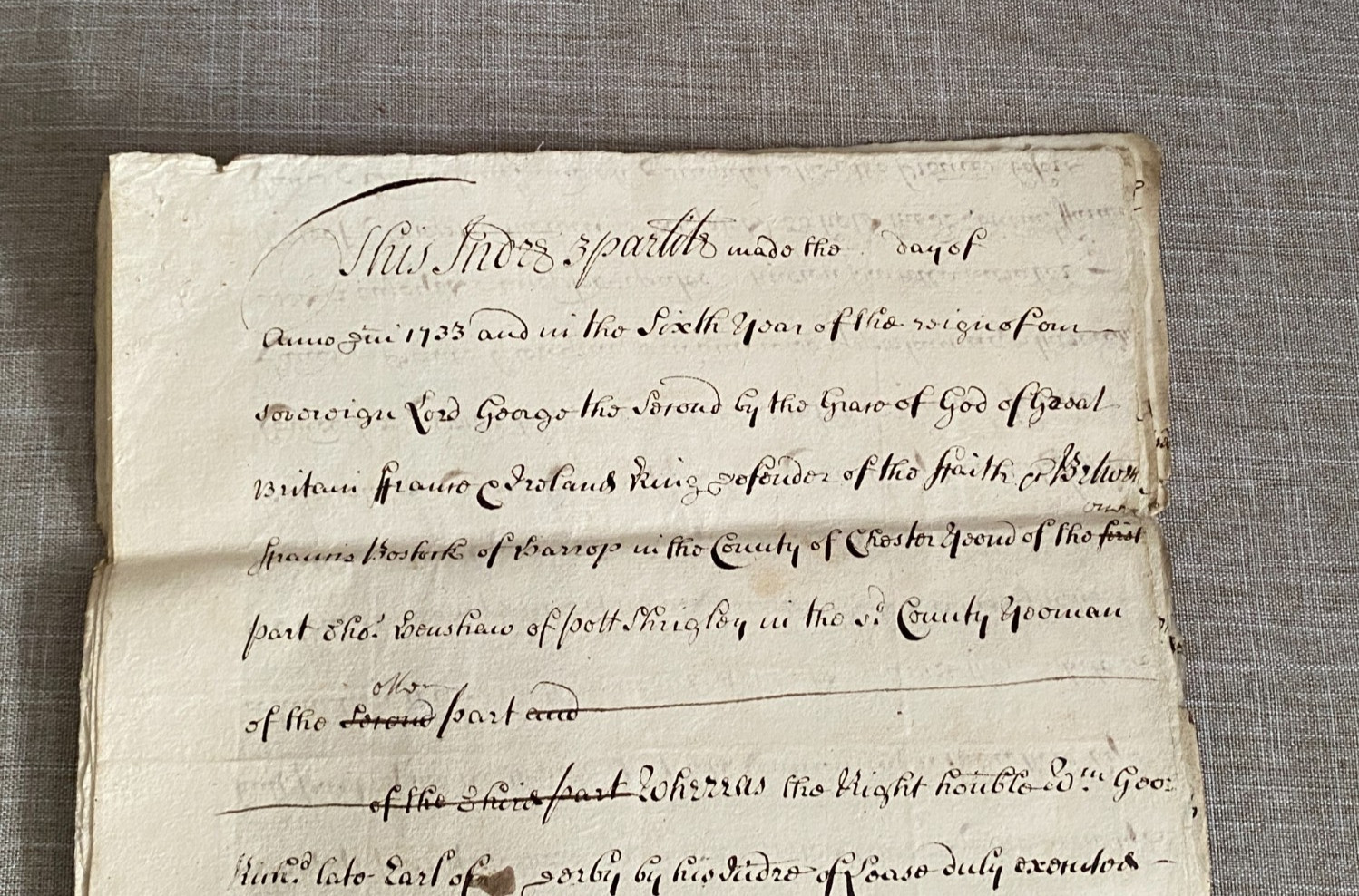
A substantial original Georgian manuscript mortgage deed dated 1733, relating to Francis Bostock, Thomas Henshaw of Pott Shrigley and a farmholding within the Forest of Macclesfield, Cheshire. Running to approximately ten handwritten pages, it is much more than a financial document: it gives a remarkably detailed glimpse of land, farming, family ownership and everyday rural society in early 18th-century Cheshire.
The deed centres on Francis Bostock, whose family had held the property through earlier generations, and Thomas Henshaw of Pott Shrigley, described as a yeoman. Bostock was raising £100 against his remaining interest in the property – a significant sum at the time – showing how land and long leases were used to obtain credit within the local community.
Particularly interesting is the earlier history recited within the document. The property had descended through members of the Bostock family, including Edward and Laurence Bostock, under long leases connected with James Stanley, 10th Earl of Derby. This gives the document a direct link between an ordinary Cheshire farming family and the great landowning and manorial structure above them: the Earl and lordship at one end, the tenant farmer and local yeoman at the other.
The property itself was much more than simply a house. The deed describes a farmhouse, a three-bay outbuilding, garden and areas of arable land, meadow, pasture and woodland. Individual pieces of land are actually named, including Hubble Fields, Little Close, Middle Field, Great or Old Hay and Brownings.
These names are perhaps the most atmospheric part of the document. They preserve the working landscape as the people of Pott Shrigley and the Macclesfield Forest knew it almost 300 years ago – separate closes, hay ground, pasture and woodland forming the economic life of a Georgian farm.
The deed also shows how closely family, property and money were connected. Bostock could continue occupying the farm and receiving its rents and profits provided the £100 and interest were repaid. The land therefore represented not only a home and livelihood but also the family\'s principal financial asset.
Thomas Henshaw\'s description as a yeoman is equally revealing. He was not an aristocratic landowner but a substantial member of the local rural community, financially able to advance £100 against another man\'s property. The document consequently captures several layers of Georgian Cheshire society within a single transaction – the Earl of Derby and manorial estate, established leaseholding families such as the Bostocks, and prosperous local yeomen such as Henshaw.
The manuscript itself is also fascinating. Written throughout in an accomplished early Georgian legal hand, it contains crossings-out, additions and interlineations rather than simply being a pristine ceremonial document. It appears to be a solicitor\'s working or engrossing draft, allowing the preparation of the transaction to be seen almost as it happened.
For local historians and genealogists, the combination of Bostock and Henshaw family names, Pott Shrigley, the Forest of Macclesfield, the Earl of Derby connection and individually named fields gives the deed considerable research interest.
An evocative piece of Cheshire social history: not simply a 1733 mortgage, but a surviving record of who occupied the land, who controlled it, how it was farmed, how money was raised against it and how a rural community operated during the reign of George II.
*Please go to our shop on for other similar items, we can also look to combine postage where possible