When you click on links to various merchants on this site and make a purchase, this can result in this site earning a commission. Affiliate programs and affiliations include, but are not limited to, the eBay Partner Network.
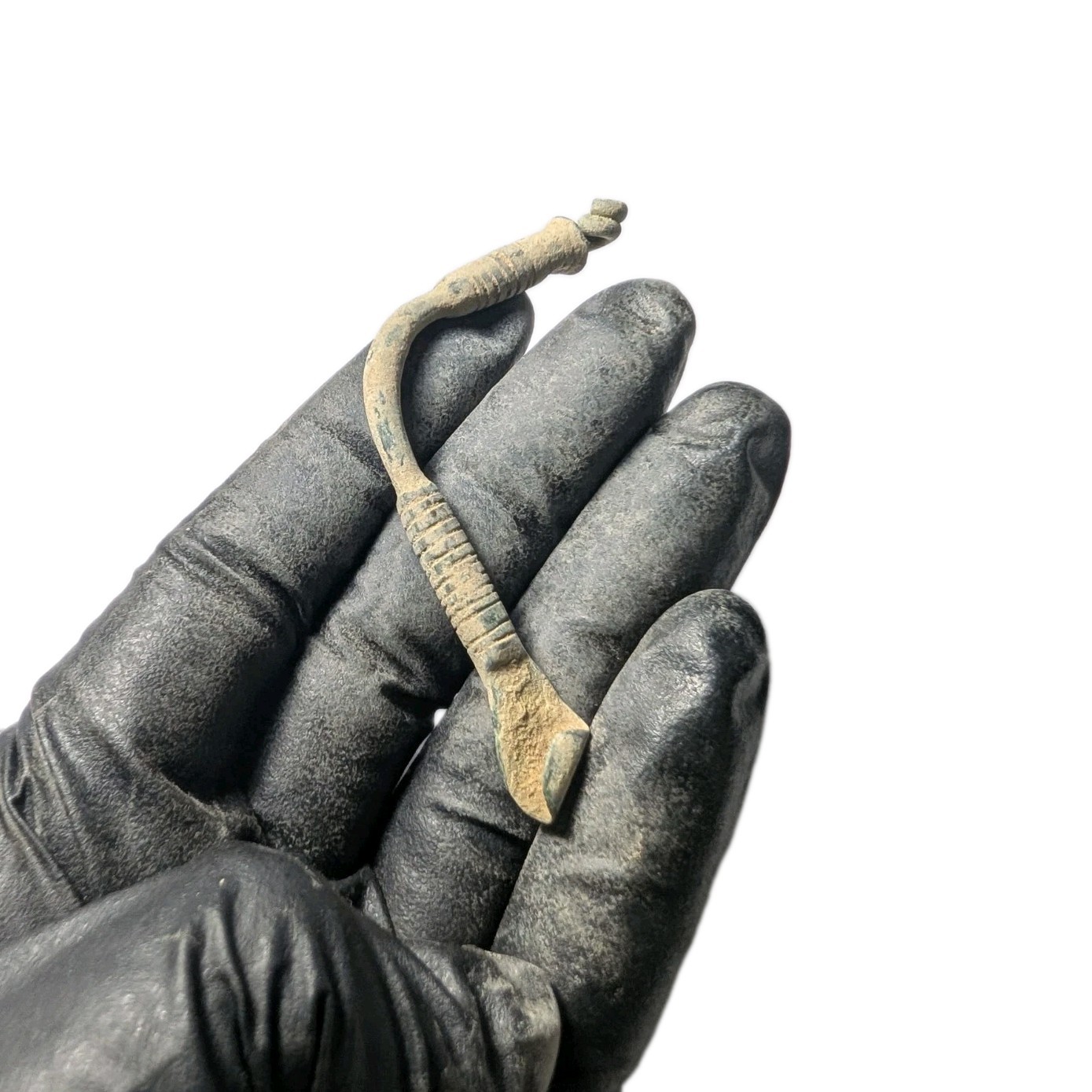
Ancient Hellenistic Cast Bronze Ringed Knee-Bow Fibula Brooch (Approx. 6.5cm — c. 3rd–1st Century BC)
Authenticity & Guarantee
Certification: Certified Authentic — includes signed Certificate of Authenticity (COA) with full provenance documentation.
Provenance: Ex-private European collection, legally acquired from international sales; Hellenistic / Levantine-Greek Sphere.
Item Specifications & Estimated Dimensions
Object: Cast Bronze Knee-Bow Fibula / Garment Fastening Brooch (Fibula)
Culture / Period: Hellenistic Period to Early Graeco-Roman Levant
Date Range: Circa 3rd Century BC – 1st Century BC (c. 300 BC – 50 BC)
Estimated Dimensions: Approx. 6.5 cm length (65 mm) × 2.0 cm bow height (Extrapolated from hand scale)
Material: Cast Bronze (Copper Alloy)
Form & Architecture: High-arched knee-bow (Kniefibel) profile featuring a molded/knopped head terminal; angled elbow transition leading to a slender lower shaft embellished with delicate transverse incised ring moldings; terminates in a flattened spatulate catchplate foot
Condition: Exceptional, complete ancient condition as an intact structural bow frame. Crisp ringed moldings, intact head and foot geometry, preserved under an authentic pale sandy-tan to olive-green earthen burial patina. Free of modern restoration or tooling.
HISTORICAL CONTEXT & TYPOLOGICAL LORE
Hellenistic Levantine Dress & Brooch Aesthetics
Following the conquests of Alexander the Great and the establishment of the Seleucid Empire across the Levant, Hellenistic fashion transformed Eastern Mediterranean dress. High-arched bow fibulae were worn by soldiers, merchants, and citizens to fasten heavy woolen cloaks (chlamys) and draped tunics (chiton) at the shoulder, combining functional utility with Greek artistic elegance.
Knee-Bow Mechanics & Transverse Ring Molding
The pronounced \"knee\" bend provided extra clearance within the arch, allowing the brooch to bundle heavy layers of folded textile without placing excessive strain on the pin. The transverse ringed moldings cast along the bow reflected popular Hellenistic metalworking trends, offering visual texture while giving the user a textured grip when securing the fastener.
Typological Analysis & Exact Classification
Primary Class: Ancient Personal Equipment / Hellenistic Bow Fibula
Sub-Class: Molded-Ring Knee-Bow Fibula Class (Kniefibel)
Manufacturing Technique: Cast copper alloy bow with cold-carved/chiseled transverse decorative grooves.
Comparable Archaeological Examples & Museum Accession Numbers
British Museum (Accession No. 1856,0701.2185): Hellenistic bronze knee-bow fibula with ringed decoration.
Israel Museum, Jerusalem: Hellenistic period Levantine bow brooches recovered from Holy Land urban sites.
Metropolitan Museum of Art (Accession No. 74.51.5210): Graeco-Roman bronze bow brooch with transverse molded rings.
A4