When you click on links to various merchants on this site and make a purchase, this can result in this site earning a commission. Affiliate programs and affiliations include, but are not limited to, the eBay Partner Network.
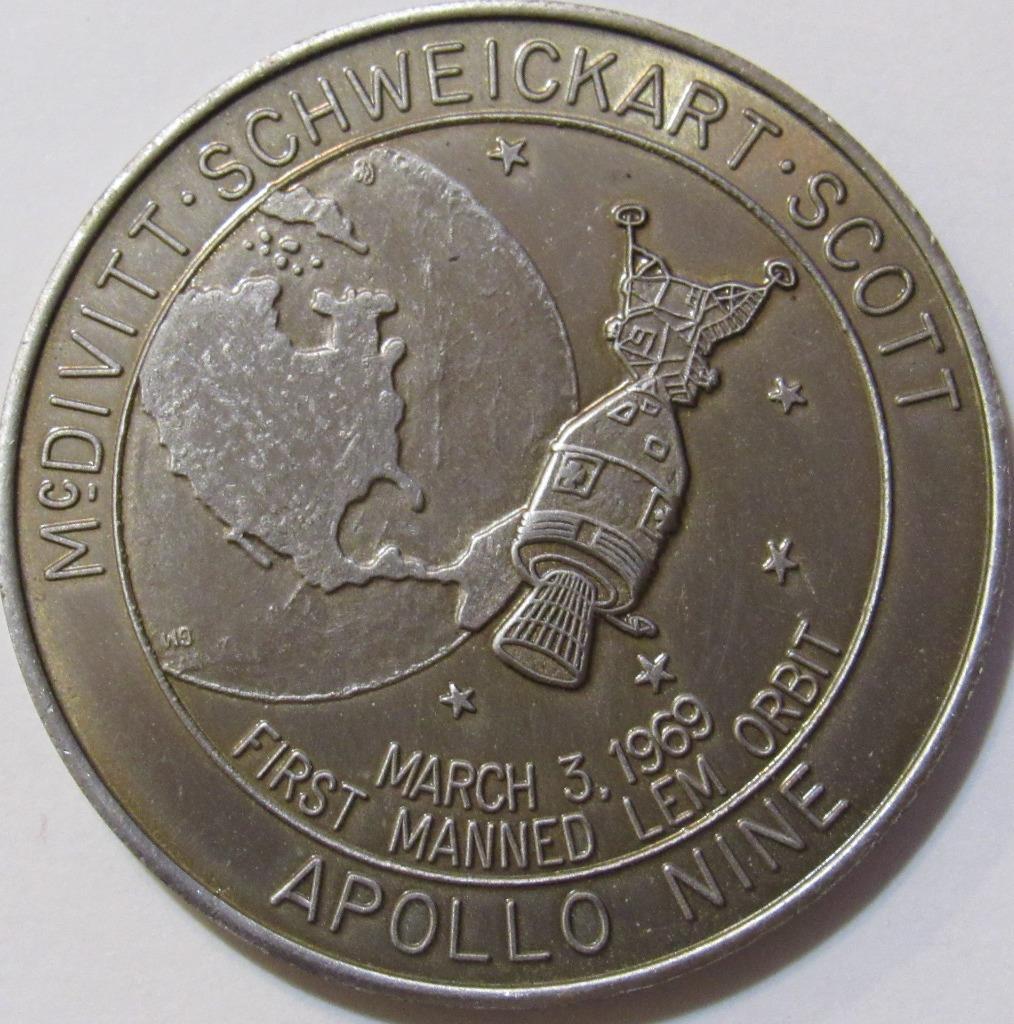
APOLLO 9 CREW COIN McDIVITT, SCHWEICKART & SCOTT MINTED BACK IN 1960'S The primary objective of Apollo 9 was an Earth-orbital engineering test of the first crewed lunar module, or LM. Other prime objectives included an overall checkout of launch vehicle and spacecraft systems, the crew, and procedures. This was done by performing an integrated series of flight tasks with the command module, or CM, the service module, or SM, the joined command and service module, or CSM, the LM and S-IVB stage while they were linked in launch or various docked configurations, and while they were flying independently. The LM was to be tested as a self-sufficient spacecraft, and was also to perform active rendezvous and docking maneuvers paralleling those scheduled for the Apollo 10 lunar-orbit mission.
APOLLO 9 CREW COIN McDIVITT, SCHWEICKART & SCOTT MINTED BACK IN 1960'S a.imagelink {color:#FFFFFF;} a:hover.imagelink {color:#FFFFFF;} a:visited.imagelink {color:#223635;} a.imagelink img.saleimage { border: 2px solid #FFFFFF; } a:visited.imagelink img.saleimage { border: 2px solid #223635; }
APOLLO 9 CREW COIN McDIVITT, SCHWEICKART & SCOTT MINTED BACK IN 1960'S
GREAT condition 1.5" BRONZE COIN ORIGINAL MINTED IN 1960'S
Mission Objective
The primary objective of Apollo 9 was an Earth-orbital engineering test of the first crewed lunar module, or LM. Other prime objectives included an overall checkout of launch vehicle and spacecraft systems, the crew, and procedures. This was done by performing an integrated series of flight tasks with the command module, or CM, the service module, or SM, the joined command and service module, or CSM, the LM and S-IVB stage while they were linked in launch or various docked configurations, and while they were flying independently. The LM was to be tested as a self-sufficient spacecraft, and was also to perform active rendezvous and docking maneuvers paralleling those scheduled for the following Apollo 10 lunar-orbit mission.
The flight plan’s top priority was the CSM and LM rendezvous and docking. This was performed twice – once while the LM was still attached to the S-IVB, and again when the LM was active. Further goals included internal crew transfer from the docked CSM to the LM; special tests of the LM’s support systems; crew procedures; and tests of flight equipment and the extravehicular activity, or EVA, mobility unit. The crew also configured the LM to support a two-hour EVA, and simulated an LM crew rescue, which was the only planned EVA from the LM before an actual lunar landing.
The LM descent and ascent engines fired on orbital change patterns to simulate a lunar-orbit rendezvous and backup abort procedures. The CSM service propulsion system, or SPS, fired five times, including a simulation of an active rendezvous to rescue an LM that had become inactivate.
After separation of the CSM from the SLA in Earth orbit and jettison of the SLA’s LM protective panels, the CSM was to perform a transposition maneuver to dock with the exposed LM. The docked modules were to separate and the spacecraft was to adjust its orbit 2,000 feet away from the S-IVB stage. The S-IVB engine was then to restart twice, placing the stage in an Earth-escape trajectory and into solar orbit. This would simulate a translunar injection of the stage for Apollo 10 and subsequent lunar missions. Other objectives included the multi-spectral photographic experiment for subsequent crewed spacecraft.
All prime mission objectives were met. All major spacecraft systems were successfully demonstrated. The few off-nominal conditions that developed did not affect achievement of the major goals.
Images sell!
Get Supersized Images & Free Image HostingCreate your brand with Auctiva's
Customizable Templates.
Attention Sellers - Get Templates
Image Hosting, Scheduling at Auctiva.com.
Track Page Views With
Auctiva's Counter