When you click on links to various merchants on this site and make a purchase, this can result in this site earning a commission. Affiliate programs and affiliations include, but are not limited to, the eBay Partner Network.
Finely cleanedReady towearableandcollectible.
>>> GUARANTEES : We give for buyer a 100% lifetime warranty for the uniqueness of this pieceONE OF A KIND EXTREMELY UNIQUE.
>>> Expertise of the materials : GUARANTEED SOLID SILVER (900 / 920) andSilver have authentic GENUINE OLD PATINA.
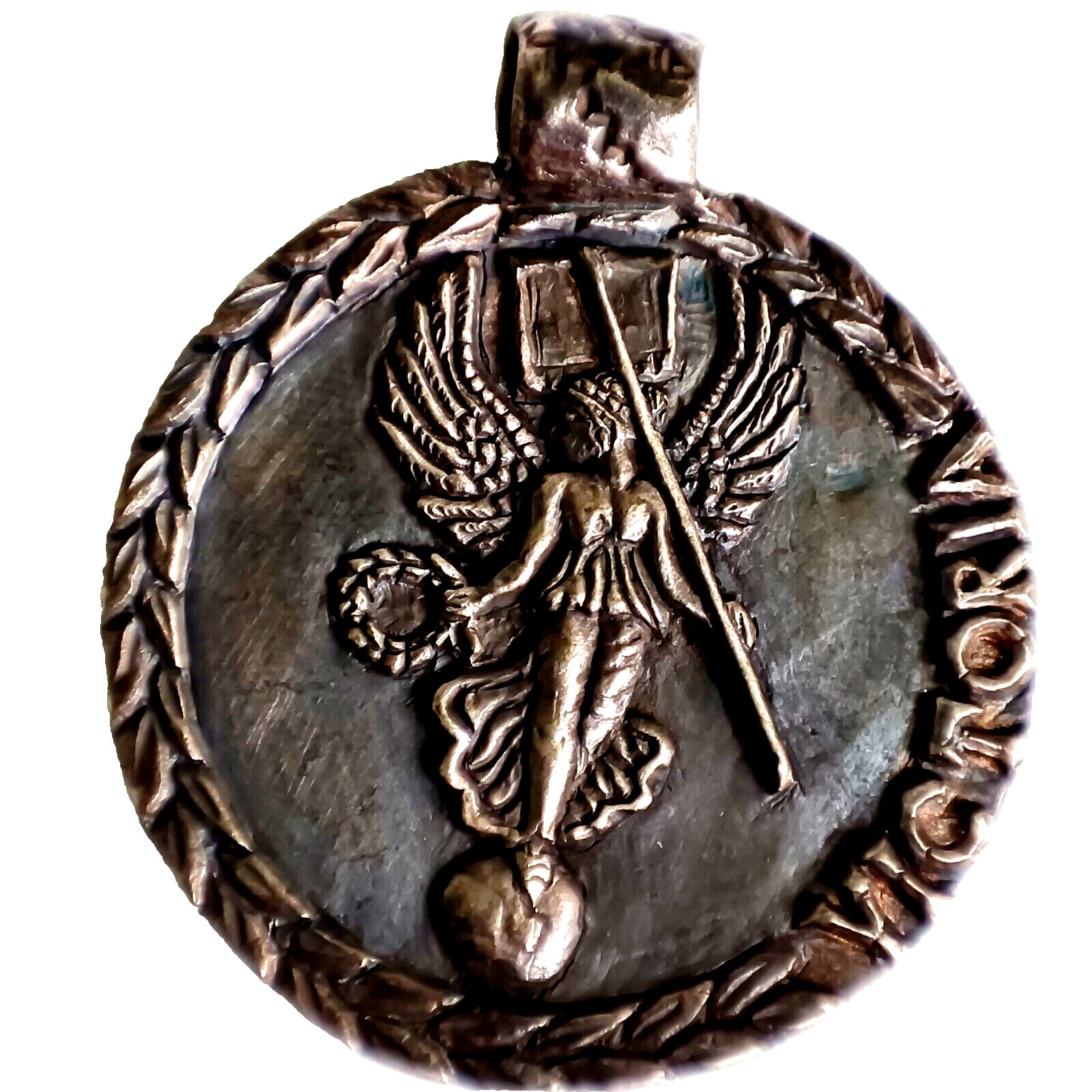
Delve into history with the 29-27 BC Ancient Roman Legionary Silver Pendant, a piece as timeless as it is intricately detailed. This pendant showcases a depiction of Victoria, the Roman goddess of victory, rendered in high relief for an extraordinary level of craftsmanship. Its silver composition, solid with a purity of 900/920, ensures both quality and durability. Unbranded yet boasting a prestigious heritage, this piece hails from Europe, bearing the authentic hallmark of its era. With its intaglio feature, the pendant\'s design is recessed, creating a sophisticated and enduring statement. It is an original piece from a private collection, backed by a 100% lifetime warranty for its uniqueness and authenticity as a one-of-a-kind item.
MEASUREMENTS & WEIGHT
<>14.10grams<>
<>45 / 40millimeters<>
<>Condition :Extremely Fine
Victoria first appears during the first Punic War, as a translation or renaming of Nike, the Greek goddess of victory in peace or war. Nike would have become familiar to the Roman military as a goddess of Rome\'s Greek allies in the Punic Wars. She was worshipped in Magna Graecia and mainland Greece, and was a subject of Greek myth. Around this time, various Roman war-deities begin to receive the epithet victor (conqueror) or invictus (unconquered). By the late republican and early imperial eras, Victoria had become a popular civilian and military goddess, both in association with other deities and in her own right. In 294 BC she was given a temple on the Palatine Hill. It was used to store war-booty, and it hosted the Magna Mater\'s statue while her own temple was under construction. Victoria had several other shrines throughout Rome. In Imperial-era Timgad, victoria victrix (conquering victory) was given credit for Imperial successes. Victoria\'s coin images and cult images are probably based on an original cult image used in her temple. Her cult images show her in the attitude of a winged woman who steps forwards, supported on a globe, and holds aloft (or offers) a wreath or a palm-branch, not symbols of war but of triumph, and a peace that was consequent to victory. Other images show her as human-sized, driving a triumphal war-chariot, or in free-standing statuary, standing on the right-hand palm of a much larger figure, typically Rome\'s supreme god, Jupiter, or war-god Mars, or Roma, divine personification of the Roman state. The goddess Vica Pota is sometimes identified with Victoria, but is almost certainly too ancient for her iconography to have been influenced by Greek Nike, so is treated as a separate deity. Victoria is one of many Roman deities associated with the Sabine goddess Vacuna. With the ascendancy of Christianity, Rome\'s religious affairs and institutions remained under the authority of the ruling emperor as pontifex maximus, whether he was Christian or pagan. On the whole, Senates still respected, or at least allowed the performance of pagan sacrificial rites deemed essential to Rome\'s well-being, including the sacrifice to Victoria at her Senate-house altar before every meeting. This had been an essential procedure ever since the altar had been given by Octavian, in 29 BC. In 379 the Christian emperor Gratian refused the post of pontifex maximus, and abolished state support of Rome\'s traditional deities and rites. In 382 he had Victoria\'s altar removed from her temple at the Curia Julia. They had been removed before, by Constantius II, and had been returned after protest. This time, despite widespread anger and anxietie, shared by officials at the highest level, they were not restored.
PROVENANCE :Formerlypurchased at the Austrian ancient art market in Vienna in 1996.
>>>Dear buyers, please keep in mind that we are dealing with ancient and antique items. You should not expect ancient and antique items to be as brand new ones. They always have some degree of wearing. Please, take care to examine the photos and read descriptions. Thank you.
>>>The photos arepart of the description in this Listing!!!Dear Customers,youwill receiveexactly the same item which you see on the pictures, not similar or other. Please read the description carefully and review the photos. All items, which I sell, are captured with high - photographic equipment and the photos, which I insert in my sales, are with high resolution. The photos are absolutely clear and the potential buyer can truly identify the item, which purchased. Photos are not further processed by specialized software! Upon purchase my item, you will receive exactly the same item which you saw on the photo !!!The pictures in listing areCLEARwithopportunitiesZOOMfor expansion sothat you can perfectly identify all the details of item!
>>>RETURNS : IF YOU HAVE ANY REASON TO DOUBT A ITEM THAT YOU HAVE PURCHASED, YOU MAY RETURN IT WITHIN14DAYS !!!
Thanks, Good luck and have a nice day.