When you click on links to various merchants on this site and make a purchase, this can result in this site earning a commission. Affiliate programs and affiliations include, but are not limited to, the eBay Partner Network.
Thank you!
If you do not wish to have your item(s) delivered on data disc(s), I can provide them on a flash drive and other means as well. Just let me know if a disc does not work for you and we can discuss delivery by other methods.
COMBINING SHIPPING COSTS
Are you purchasing multiple items? I will: a) combine all invoices before payment and charge shipping equivalent to one item, or b) refund all shipping costs in excess of one item after payment.
All derivative (i.e. change in media; by compilation) work from this underlying U.S. Government public domain/public release data is COPYRIGHT © GOVPUBS
$5.00 first class shipping in U.S.; $20.00 for air post outside of United States. I will combined sales for reduced postage prior to payment - simply ask for a combined invoice!
See numerous images of actual pages within manual.
Be sure to see my many other flight manual and aviation maintenance and parts manuals on CD sales.
Public domain U.S. government manual in PDF format copied to blank CD.
Includes the easy to use Adobe Acrobat Reader software for viewing and printing publications.
CONTENTS (as both individual volumes and one combined PDF):
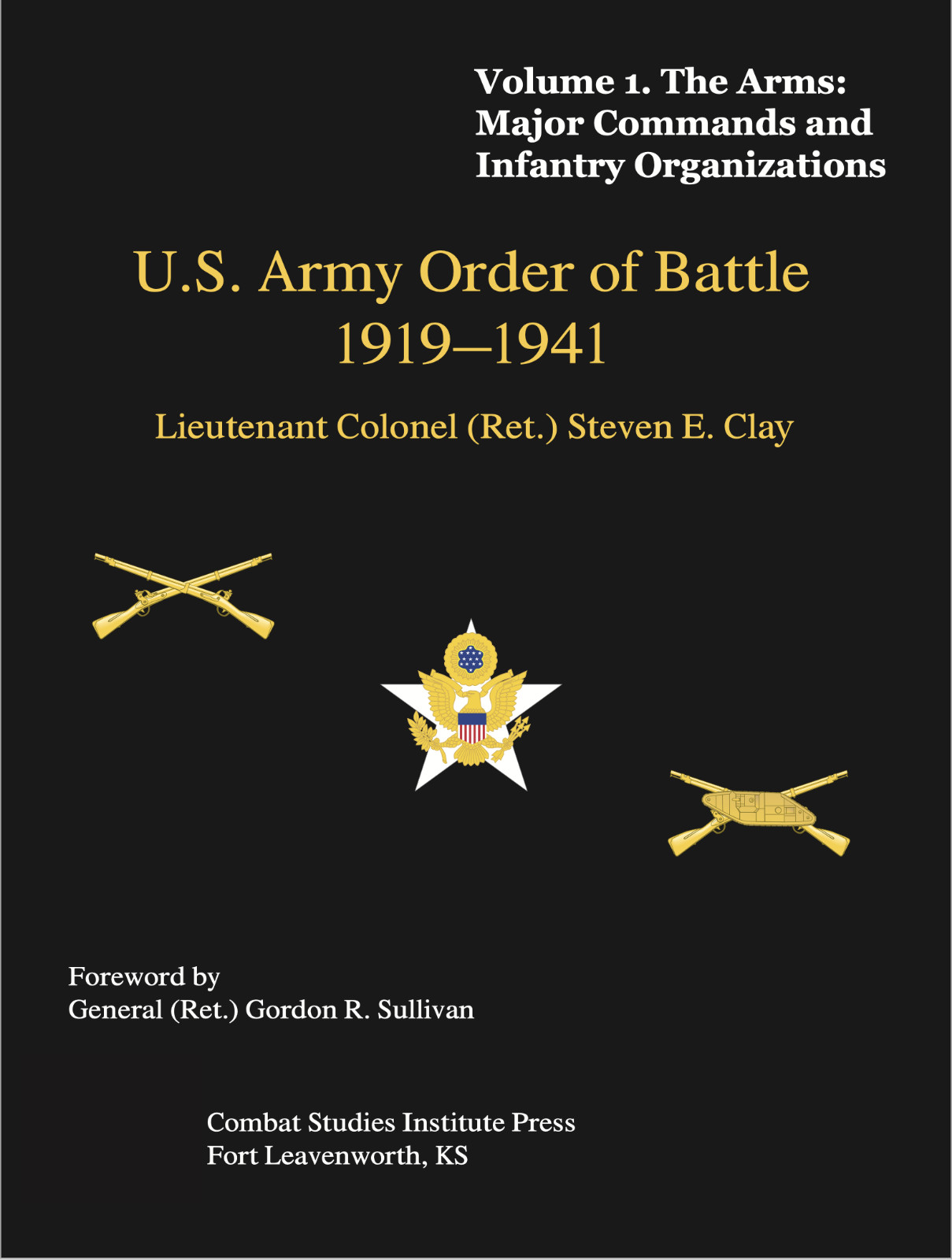
1. U.S. Army Order of Battle 1919–1941: Volume 1 The Arms: Major Commands and Infantry Organizations, 1919–41
2. U.S. Army Order of Battle 1919–1941: Volume 2 The Arms: Cavalry, Field Artillery, and Coast Artillery, 1919–41
3. U.S. Army Order of Battle 1919–1941: Volume 3 The Services: Air Service, Engineer, and Special Troops, 1919-41
4. U.S. Army Order of Battle 1919–1941: Volume 4 The Services: Quartermaster, Medical, Military Police, Signal Corps, Chemical Warfare, and Miscellaneous Organizations, Clay’s massive work, US Army Order of Battle, 1919–1941, is, in many respects, the story of the American Army, its units, and its soldiers, during a period of neglect by a parsimonious Congress and others who perhaps believed in the notion that a “War to End All Wars” had actually been fought. Indirectly, it tells the story of a diminutive Regular Army that continued to watch faithfully over the ramparts of freedom in far-flung outposts like Panama, Alaska, the Philippines, and China, as well as the many small and isolated garrisons throughout the United States; a National Guard that was called on frequently by various governors to prevent labor troubles, fight forest fires, and provide disaster relief to their state’s citizens; and an Organized Reserve whose members attended monthly drills without pay and for 20 years creatively and conscientiously prepared themselves for another major war.
The US Army Order of Battle, 1919–1941 is an important addition to the library of all Army historians, professional and amateur. More than a simple listing of units and the headquarters to which they were assigned, this book is an encyclopedia of information on Army tactical organizations in existence during the interwar period. This four-volume work, based on almost 20 years of research, fills a distinct void in the history of Army units, especially those of the Organized Reserve (now known as the US Army Reserve). Clay’s comprehensive work details the history of every tactical organization from separate battalion to field army, as well as certain other major commands important to the Army in the 1920s and 1930s. It also includes the various units’ changes of station, commanding officers, accomplishments, and key events such as major maneuvers and, for National Guard units, active duty periods for state emergencies. Also included are the organizations’ distinctive unit insignia, as well as maps showing command boundaries and charts illustrating the assortment of tables of organization germane to the organizations of the time. In short, this Order of Battle is the “go to” reference for the historian who wishes to understand the history, organization, and evolution of Army units between the World Wars.
Acknowledgments
These volumes were compiled from numerous archives and libraries from virtually around the world. At every available opportunity, I visited a library or archive that might contain useful information for this project and hunted through any file or book that might contribute to its completion. Some of those places were as far away as the 2d Infantry Division Museum at Camp Red Cloud, Korea; the Eighth Army Museum at Yongsan in Seoul, Korea; and the V Corps historian’s office in Frankfurt, Germany. The primary sources of information in these volumes, however, are from Record Groups 394 and 407 in the National Archives II at College Park, MD. The people at National Archives II to whom I am particularly grateful are Mr. Mitchel Yockelson, Dr. Tim Nininger, and Mr. Shawn Smith. Mitch was particularly helpful with dropping pull slips for me before I arrived and for advising me on where to look for various interwar period documents. He was truly invaluable to my efforts for this work.
A close second for primary source documents and information was the Center of Military History in Washington, DC. My point of contact there, and someone to whom I am also greatly indebted, is Ms. Romana Danysh. Roma was a great help in showing me what the Center’s archives held and allowing me access to unit data cards and other unit historical documents. The late Mr. John Slonaker of the Military History Institute at Carlisle Barracks, PA, was of great help in locating information and documents there. I am also indebted to the staff of the Combined Arms Research Library (CARL) at Fort Leavenworth, KS, particularly Mr. Ed Burgess, the director. Ed made possible the compilation of an extremely accurate and virtually complete listing of Regular Army unit commanders. Other CARL staff members who were of great assistance include Mr. Steven Brown, Mr. Ed Metz, Ms. Dorothy Rogers, Mr. Carl Fischer, Ms. Kathy Buker, Ms. Elizabeth Merrifield, and Ms. Pamela Kontowicz. The staff of the Air Force Historical Research Agency (AFHRA) at Maxwell Air Force Base, AL, was very helpful with the Air Service/Air Corps section. Mr. John T. O’Gorman of the US Army Quartermaster Museum provided useful help with the Army Transport Service portion of this project.
In terms of financial support, I would like to thank Dr. Jeff Clark and the Center of Military History. Without the Center’s help, this information would probably never be available to Army historians and others. I also wish to thank General Gordon Sullivan, Mr. Roger Cirillo, and the Association of the United States Army. Early on General Sullivan and Mr. Cirillo recognized the value of this work and persuaded the Association to provide some of the early financial support to my research. The Fort Leavenworth Historical Society was also a backer, and I am grateful to that organization as well.
I would be remiss if I did not mention the outstanding support and encouragement I received from my bosses at the Combat Studies Institute, Fort Leavenworth, KS, my place of employment during much of the time I was writing these volumes. These included Colonel Jerry Morelock, Colonel Lawyn Edwards, and Dr. William G. Robertson, all of whom gave me encouragement and the time I needed to travel to the National Archives and other locations to compile much of this work. I would especially like to thank Colonel Timothy Reese who made the later stages of research and the actual publication of this work possible. For the assistance with the selection of military insignia and other illustrations used in this work, I am grateful for the help of Mr. Ival Lawhon of St. Joseph, MO. He ensured that the illustrations represent the actual insignia in use from 1919 to 1941. A big “thank you” goes to Lieutenant Colonel Drew Sullins, his wife Stacey, and Drew’s parents for their willingness to put me up at their home when I did research at the National Archives in Maryland. I enjoyed the chance to visit with them when I was there and it made my own sparse dollars stretch a lot farther.
Most importantly, I want to thank my wife and best friend, Elizabeth. I spent 19 years researching and writing this work, but she never complained about the many times I was absent conducting research nor about the money I spent in doing so. She did not necessarily understand my passion for this project, but she always supported me in my efforts. I thank God for her and her friendship.