

|
Site Categories |
|
Featured Items |

Poodle, Spaghetti Trim, Ucagco


|
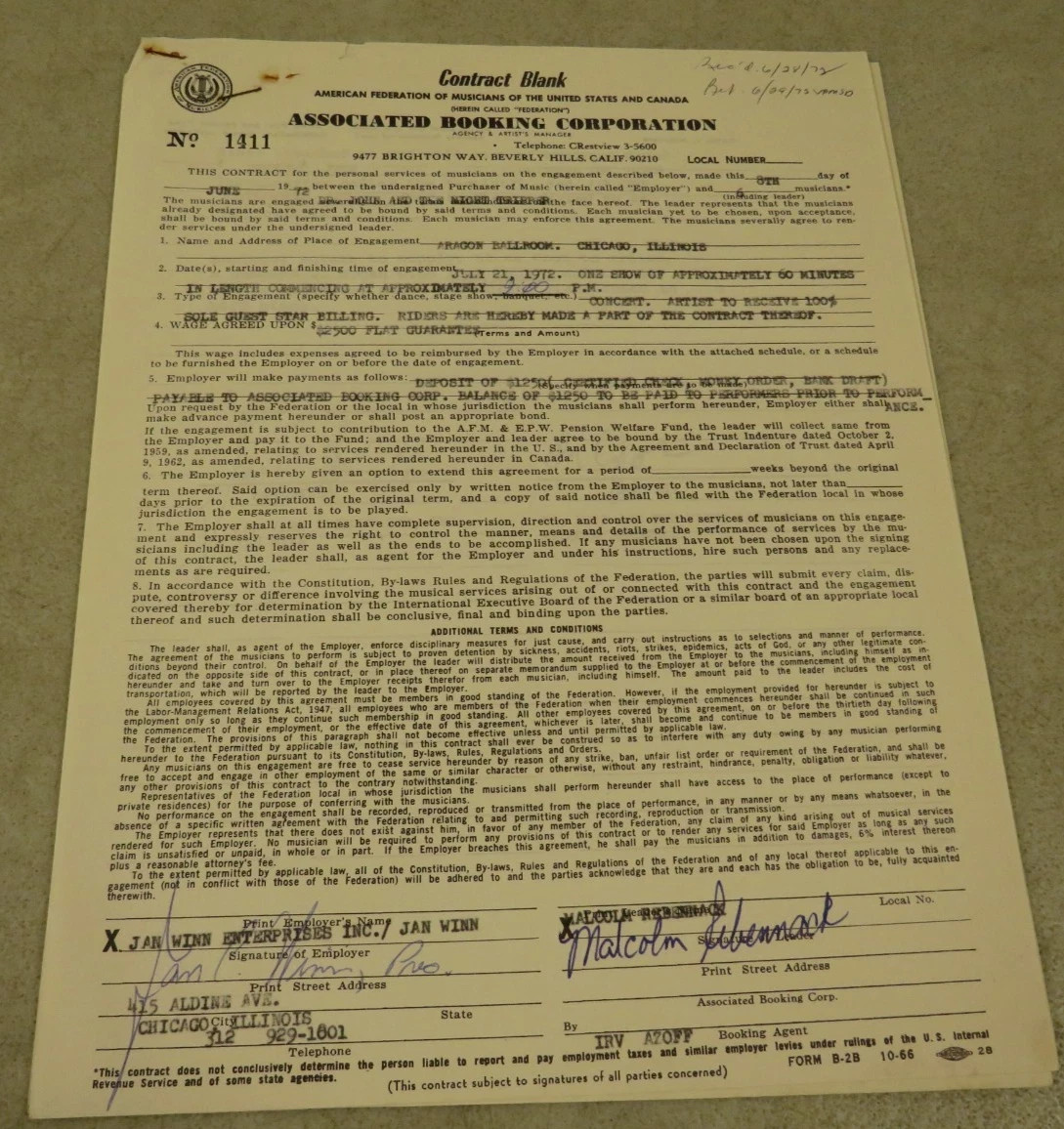
1972 Dr John Signed Contract Mac Rebennack Autograph Aragon Ballroom Chicago wow For Sale

When you click on links to various merchants on this site and make a purchase, this can result in this site earning a commission. Affiliate programs and affiliations include, but are not limited to, the eBay Partner Network.

1972 Dr John Signed Contract Mac Rebennack Autograph Aragon Ballroom Chicago wow:
$600.00
This is a fantastic find—a 1972 concert contract for Dr. John (Mac Rebennack) for a performance at the legendary Aragon Ballroom in Chicago. Collectors of New Orleans jazz and 70s rock history value these highly, especially because he signed with his legal name.
Up for sale is an incredible piece of music history: an original 1972 performance contract for the legendary Dr. John (The Night Tripper). This document is for a concert held at the Aragon Ballroom in Chicago, Illinois. Most notably, the contract is hand-signed by the artist using his real name, Mac Rebennack, making it a premier addition to any serious autograph or music memorabilia collection. Transcription of Document Front Side: Type of Engagement: Concert Artist: Dr. John Date of Engagement: [Specific Date from your document, e.g., October 14, 1972] Place of Engagement: Aragon Ballroom, Chicago, Illinois Signed: Mac Rebennack (Legal name of Dr. John)
Back Side: [Note: Most 1970s concert contracts contain standard \"Union Rules\" and \"Riders\" on the back. Transcribe any specific handwritten notes or stamps found there, such as \"Paid in Full\" or agency stamps like \"ATI - American Talent Significance & Biography Dr. John (Mac Rebennack, 1941–2019): Malcolm John Rebennack, better known by his stage name Dr. John, was a six-time Grammy winner and a pioneer of the \"voodoo-infused\" New Orleans R&B sound. In 1972, he was at the height of his \"Night Tripper\" persona, having recently released the landmark album Gumbo. Because he performed under a stage name, documents signed with his birth name, Mac Rebennack, are significantly more desirable for authentication and rarity. The Aragon Ballroom, Chicago: The Aragon is one of the most famous ballrooms in American history. By 1972, it had transitioned from a big-band era hall into a premier venue for the \"Golden Age\" of rock and roll. Seeing a contract for this specific venue adds a layer of \"venue-specific\" value that Chicago music historians prize. Why This is a Must-Have for CollectorsLegal Signature: Features the rare \"Mac Rebennack\" signature. Vantage Point: 1972 was a pivotal year in his career. Venue History: The Aragon Ballroom is a \"Holy Grail\" venue for poster and contract collectors. Investment Grade: Signed contracts are considered \"hard\" provenance, often used by authenticators (like PSA/DNA or JSA) as \"exemplars\" of a celebrity\'s real handwriting.
New Orleans Jazz, Gris-Gris, Night Tripper, 1970s Rock, Concert Ephemera, Music Autograph, 70s Chicago History, Mac Rebennack Signature, American Talent International.
_______
Malcolm John Rebennack Jr. (November 20, 1941 – June 6, 2019), better known by his stage name Dr. John, was an American singer, songwriter and pianist. His music combined New Orleans blues, jazz, R&B, soul and funk.[1]Active as a session musician from the late 1950s until his death, he gained a following in the late 1960s after the release of his album Gris-Gris (1968) and his appearance at the Bath Festival of Blues and Progressive Music (1970). He typically performed a lively, theatrical stage show inspired by medicine shows, Mardi Gras costumes, and voodoo ceremonies. Rebennack recorded thirty studio albums and nine live albums, as well as contributing to thousands of other musicians\' recordings. In 1973, he achieved a top-10 hit single with \"Right Place, Wrong Time\".
Early life and careerRebennack was born in New Orleans, Louisiana, on November 20, 1941.[2][3] He was the son of Dorothy (née Cronin) and Malcolm John Rebennack, and had German, Irish, Spanish, English, and French heritage.[4][5] His father ran an appliance shop in the East End of New Orleans, fixing radios and televisions and selling records.[6] Growing up in the 3rd Ward of New Orleans, he found early musical inspiration in the minstrel show tunes sung by his grandfather and a number of aunts, uncles, sister, and cousins who played piano. He did not take music lessons before his teens and endured only a short stint in choir before getting kicked out.[7] When Rebennack was a young boy, his father exposed him to jazz musicians King Oliver and Louis Armstrong, who later inspired his 2014 release, Ske-Dat-De-Dat: The Spirit of Satch. Throughout his adolescence, his father\'s connections enabled him access to the recording rooms of rock artists, including Little Richard and Guitar Slim. Later he began to perform in New Orleans clubs, mainly on guitar, and played on stage with various local artists.[8]When he was about 13 years old, Rebennack met Professor Longhair. Impressed by the professor\'s flamboyant attire and striking musical style,[7] Rebennack soon began performing with him, and began his life as a professional musician.[8] He later recalled that his debut in the studio, in about 1955 or 1956, came when he was signed as a songwriter and artist by Eddie Mesner at Aladdin Records. He joined the musicians\' union at the end of 1957, with the help of Danny Kessler, and then considered himself to be a professional musician.[9]At age 16, Rebennack was hired by Johnny Vincent as a producer at Ace Records.[9] There, he gained experience working with many artists, including James Booker, Earl King, and Jimmy Clanton. While a struggling student at Jesuit High School, he was already playing in night clubs, something the Jesuit fathers disapproved of. He formed his first band, The Dominoes, while at the school.[10] The priests told him to either stop playing in clubs or leave the school. Rebennack was expelled from the high school in 1954[11] and from then on focused entirely on music.In late 1950s New Orleans, Rebennack led his own band, Mac Rebennack and the Skyliners, (Paul Staehle/Dennis \"Bootsie\" Cuquet, drums; Earl Stanley, bass; Charlie Miller, trumpet; Charlie Maduell, sax; Roland \"Stone\" LeBlanc, vocals), while playing gigs with others, including Frankie Ford and the Thunderbirds, and Jerry Byrne and the Loafers. His first (co-written) rock and roll song \"Lights Out\" (1957), sung by Jerry Byrne, was a regional hit.[10] He had a regional hit with a Bo Diddley-influenced instrumental called \"Storm Warning\" on Rex Records in 1959. At A&R, he and Charlie Miller recorded monophonic singles on 45s for Johnny Vincent and Joe Ruffino for local labels Ace, Ric, and Ron. He oversaw the rhythm section while Miller wrote the horn arrangements and headed up the horns. This continued until Miller moved to New York to study music formally.[12]Rebennack\'s career as a guitarist was stunted around 1960,[13] when the ring finger on his left (guitar fretting) hand was injured by a gunshot during an incident at a Jacksonville, Florida gig.[14][15] After the injury, Rebennack concentrated on bass guitar before making piano his main instrument, developing a style influenced by Professor Longhair.[16]Rebennack became involved in illegal activities in New Orleans, using and selling narcotics and running a brothel. He was arrested on drug charges and sentenced to two years in the Federal Correctional Institution, Fort Worth. His sentence ended in 1965 and he left for Los Angeles.[17]Once settled in Los Angeles[8] he became a \"first call\" session musician in the Los Angeles studio scene in the 1960s and 1970s and was part of \"The Wrecking Crew\" stable of studio musicians.[16] He provided backing for Sonny & Cher (and some of the incidental music for Cher\'s first film, Chastity), for Canned Heat on their albums Living the Blues (1968) and Future Blues (1970), and for Frank Zappa and the Mothers of Invention on Freak Out! (1966).[16]
Voodoo influenceAs a young man, Rebennack was interested in New Orleans voodoo, and in Los Angeles he developed the idea of the Dr. John persona for his old friend Ronnie Barron, based on the life of Dr. John, a Senegalese prince, conjure man, herb doctor, and spiritual healer who came to New Orleans from Haiti. This free man of color lived on Bayou Road and claimed to have 15 wives and over 50 children. He kept an assortment of snakes and lizards, along with embalmed scorpions and animal and human skulls, and sold gris-gris, voodoo amulets which supposedly protect the wearer from harm.[18][19]Rebennack decided to produce a record and a stage show based on this concept, with Dr. John serving as an emblem of New Orleans heritage. Although initially, the plan was for Barron to front the act assuming the identity of \"Dr. John\", while Rebennack worked behind the scenes as Dr. John\'s writer, musician, and producer, this did not come to pass. Barron dropped out of the project, and Rebennack took over the role (and identity) of Dr. John.[20] Gris-Gris became the name of Dr. John\'s debut album, released in January 1968, representing his own form of \"voodoo medicine\".[21]
1968–1971: Dr. John, the Night Tripper
Dr. John, the Night Tripper at Kralingen 1970Beginning in the late 1960s, Rebennack gained fame as a solo artist after adopting the persona of \"Dr. John, The Night Tripper\". Dr. John\'s act combined New Orleans-style rhythm and blues with psychedelic rock and elaborate stage shows that bordered on voodoo religious ceremonies, including elaborate costumes and headdress. In 1970, when Howard Smith asked him where the name \"Dr. John the Night Tripper\" came from, he responded, \"Before that I was Professor Bizarre. Cats used to call me things like \"Bishop\" or \"Governor\" or somethin\' but they started callin\' me \"Doctor\" for a while, so I just hung it on myself for keeps.\"[22] On the earliest Dr. John records, the artist billing was \"Dr. John, The Night Tripper\", while the songwriting credits billed him as \"Dr. John Creaux\". Within a few years, the \"Night Tripper\" subtitle was dropped, and Rebennack resumed using his real name for writing and producing/arranging credits.Gris-Gris, his 1968 debut album combining voodoo rhythms and chants with the New Orleans music tradition, was ranked 143rd on Rolling Stone\'s \"The 500 Greatest Albums of All Time\" list.[23] Three more albums, Babylon (1969), Remedies (1970) and The Sun, Moon & Herbs (1971), were released in the same vein as Gris-Gris.During early to mid-1969, Dr. John toured extensively, backed by supporting musicians Richard \"Didymus\" Washington (congas), Richard Crooks (drums), David L. Johnson (bass), Gary Carino (guitar), and singers Eleanor Barooshian, Jeanette Jacobs from The Cake, and Sherry Graddie. A second lineup formed later in the year for an extensive tour of the East Coast with Crooks and Johnson joined by Doug Hastings (guitar) and Don MacAllister (mandolin). The same year, Dr. John contributed to the Music from Free Creek \"supersession\" project, playing on three tracks with Eric Clapton. Washington and Crooks also contributed to the project.By the time The Sun, Moon & Herbs was released, he had gained a notable cult following, which included artists such as Eric Clapton and Mick Jagger, who both took part in the sessions for that album. This album served as a transition from his Night Tripper voodoo, psychedelic persona to one more closely associated with traditional New Orleans R&B and funk. His next album, Dr. John\'s Gumbo, with drummer Fred Staehle serving as the band\'s backbone, proved to be a landmark recording and is one of his most popular to this day.
1972–1974: Gumbo, In the Right Place, and Desitively BonnarooAlong with Gris-Gris, Dr. John is perhaps best known for his recordings in the period 1972–74. 1972\'s Dr. John\'s Gumbo, an album covering several New Orleans R&B standards with only one original, is considered a cornerstone of New Orleans music. In his 1994 autobiography, Under a Hoodoo Moon, Dr. John writes, \"In 1972, I recorded Gumbo, an album that was both a tribute to and my interpretation of the music I had grown up with in New Orleans in the late 1940s and 1950s. I tried to keep a lot of little changes that were characteristic of New Orleans, while working my own funknology on piano and guitar.\" The lead single from the album, \"Iko Iko\", broke into the Billboard Hot 100 singles chart, eventually reaching No. 71. In 2003 the album was ranked number 404 on Rolling Stone magazine\'s list of the 500 greatest albums of all time.[24]With Gumbo, Dr. John expanded his career beyond the psychedelic voodoo music and theatrics which had driven his career since he took on the Dr. John persona, although it always remained an integral part of his music and identity. It was not until 1998\'s Anutha Zone that he again concentrated on this aspect of his music wholly for a full album. \"After we cut the new record\", he wrote, \"I decided I\'d had enough of the mighty-coo-de-fiyo hoodoo show, so I dumped the Gris-Gris routine we had been touring with since 1967 and worked up a new act—a Mardi Gras revue featuring the New Orleans standards we had covered in Gumbo.\"In early 1973 Thomas Jefferson Kaye produced an album featuring a collaboration with Dr. John, Mike Bloomfield and John Paul Hammond. This album, Triumvirate, was recorded in Columbia Studios, San Francisco, and Village Recorders, Los Angeles.In 1973, with Allen Toussaint producing and The Meters backing, Dr. John released the seminal New Orleans funk album In the Right Place. In the same way that Gris-Gris introduced the world to the voodoo-influenced side of his music, and in the manner that Dr. John\'s Gumbo began his career-long reputation as an esteemed interpreter of New Orleans standards, In the Right Place established Dr. John as one of the main ambassadors of New Orleans funk. In describing the album, Dr. John stated, \"The album had more of a straight-ahead dance feel than ones I had done in the past, although it was still anchored solid in R&B.\"[citation needed] It rose to No. 24 on the Billboard album chart. In July 1973, the single \"Right Place, Wrong Time\" peaked at No. 9 on the Billboard Hot 100 singles chart, as well as peaking at No. 19 on the Hot Soul Singles chart.[25] A second single, \"Such a Night\", peaked at No. 42. Still in heavy rotation on most classic rock stations, \"Right Place Wrong Time\" remains his most recognized song. Artists such as Bob Dylan, Bette Midler, and Doug Sahm contributed single lines to the lyrics, which lists several instances of ironic bad luck and failure.Dr. John attempted to capitalize on In the Right Place\'s successful formula, again collaborating with Allen Toussaint and The Meters, for his next album, Desitively Bonnaroo – from part of which a Tennessee festival took as its name – released in 1974. Although similar in feel to In the Right Place, it failed to catch hold in the mainstream as its predecessor had done. It did produce the single \"(Everybody Wanna Get Rich) Rite Away\", which peaked at No. 92 on the Billboard Hot 100 chart, and to date is the last time he hit the Hot 100. It was his last pure funk album until 1994\'s Television,[26] although like his voodoo and traditional New Orleans R&B influences, funk continued to heavily influence most of his work to the end, especially his live concerts.In the mid-1970s Dr. John began an almost 20-year collaboration with the R&R Hall of Fame/Songwriters Hall of Fame writer Doc Pomus, to create songs for Dr. John\'s releases City Lights and Tango Palace, and for B.B. King\'s Stuart Levine-produced There Must Be a Better World Somewhere, which won a Grammy for Best Ethnic or Traditional Recording in 1982. Dr. John also recorded \"I\'m On a Roll\" – the last song written with Pomus prior to his death in 1991 – for the now out-of-print Rhino/Forward Records 1995 tribute to Pomus titled Til the Night Is Gone: A Tribute to Doc Pomus. The tribute included covers of Pomus-penned songs by Bob Dylan, John Hiatt, Shawn Colvin, Brian Wilson, The Band, Los Lobos, Dion, Rosanne Cash, Solomon Burke, and Lou Reed. According to Pomus\' daughter, Dr. John and her father were very close friends as well as writing partners. Dr. John delivered one of a number of eulogies and performed with singer Jimmy Scott at Pomus\' funeral on March 17, 1991, in New York City.On Thanksgiving Day 1976 he performed \"Such a Night\" at the farewell concert for The Band, which was filmed by Martin Scorsese and released as The Last Waltz. In 1979, he collaborated with the legendary Professor Longhair on Fess\' (another nickname for Henry Byrd) last recording, Crawfish Fiesta, as a guitarist and co-producer. The album received the first W.C. Handy Blues Album of the Year award in 1980, and was released shortly after Longhair\'s death in January 1980.
Later work
Dr. John at the 2006 Jazz à Vienne festival, in Vienne, FranceBy the mid-1970s, Rebennack was focusing on a blend of music that touched on blues, New Orleans R&B, Tin Pan Alley standards, and more. In 1975, his manager, Richard Flanzer, hired producer Bob Ezrin, and Hollywood Be Thy Name was recorded live at Cherokee Studios in Los Angeles, California.[27] The studio was transformed into a New Orleans nightclub for the sessions. In 1981 and 1983, Dr. John recorded two solo piano albums, Dr. John Plays Mac Rebennack and The Brightest Smile in Town, for the Baltimore-based Clean Cuts label. In these two recordings he played many of his own boogie-woogie compositions.Dr. John was also a prominent session musician throughout his career. He provided back-up vocals on the Rolling Stones\' 1972 song \"Let It Loose\", and backed Carly Simon and James Taylor in their duet of \"Mockingbird\" (from Hotcakes) in 1974, and Neil Diamond on Beautiful Noise in 1976. He also contributed the song \"More and More\" to Simon\'s Playing Possum album. He played on 3 songs on the 1973 debut solo album by Maria Muldaur, including his composition \"Three Dollar Bill\". He sang on four songs and played piano on two songs on Muldaur\'s 1992 Louisiana Love Call. He was co-producer on Van Morrison\'s 1977 album A Period of Transition and also played keyboards and guitar. He contributed three songs as writer or co-writer (\"Washer Woman\", \"The Ties That Bind\", and \"That\'s My Home\") and also played guitar and keyboards on Levon Helm\'s 1977 release, Levon Helm & the RCO All-Stars. He performed on the March 19, 1977, episode of NBC\'s Saturday Night Live.He played keyboards on the highly successful 1979 solo debut album by Rickie Lee Jones. He toured with Willy DeVille and contributed to his albums Return to Magenta (1978), Victory Mixture (1990), Backstreets of Desire (1992), and Big Easy Fantasy (1995). In 1997 he contributed piano and vocals to the Spiritualized song \"Cop Shoot Cop\" which appears on their album, Ladies and Gentlemen We Are Floating in Space. His music was featured in many films, including \"New Looks\" in National Lampoon\'s European Vacation in 1985 and \"Such a Night\" in Colors in 1988. In 1992, Dr. John released the album Goin\' Back to New Orleans, which included many classic songs from New Orleans. Many great New Orleans–based musicians, such as Aaron Neville, the Neville Brothers, Al Hirt and Pete Fountain, backed up Dr. John on this album. He also performed as the first American artist at the Franco Follies festival in 1992.Dr. John\'s longtime confidant and former personal manager, Paul Howrilla, was responsible for moving Dr. John from Los Angeles to New York and securing \"crossover\" work, as well as modifying Dr. John\'s image from the 1970s to the 1990s. Paul Howrilla was the brains behind the scenes, as Dr. John would attest. They remained close friends. Dr. John also provided vocals for Popeyes Chicken & Biscuits\' \"Luv dat chicken ...\" jingle, as well as the theme song (\"My Opinionation\") for the early-1990s television sitcom Blossom. A version of \"Do You Know What It Means to Miss New Orleans?\" with Harry Connick Jr. was released on Connick\'s album 20 and VHS Singin\' & Swingin\' in 1990. Dr. John moved back to Louisiana in 2009.From the late 1970s to 1991, Dr. John co-wrote over 115 songs with legendary Brill Building songwriter Doc Pomus. Some of the songs created with Pomus were recorded by Marianne Faithfull, B.B. King, Irma Thomas, Johnny Adams, and others. On March 17, 1991, Dr. John performed \"My Buddy\" at the funeral for Pomus.His movie credits included Martin Scorsese\'s documentary The Last Waltz, in which he joined the Band for a performance of his song \"Such a Night\", the 1978 Beatles-inspired musical Sgt. Pepper\'s Lonely Hearts Club Band, and Blues Brothers 2000, in which he joined the fictional band the Louisiana Gator Boys to perform the songs \"How Blue Can You Get\" and \"New Orleans\". His version of the Donovan song \"Season of the Witch\" was also featured in this movie and on the soundtrack. In 1996, he performed the song \"Cruella de Ville\" during the end credits of the film 101 Dalmatians.
Dr. John at the Liri Blues Festival, Italy, July 2010He wrote and performed the score for the film version of John Steinbeck\'s Cannery Row released in 1982. His hit song \"Right Place Wrong Time\" was used extensively in the movies Dazed and Confused and Sahara and the series American Horror Story: Coven. Dr. John was also featured in several video and audio blues and New Orleans piano lessons published by Homespun Tapes. Other documentary film scores include the New Orleans dialect film Yeah You Rite! (1985)[28] and American Tongues in 1987.Between July and September 1989, Dr. John toured in the first Ringo Starr & His All-Starr Band, alongside Levon Helm, Rick Danko, Nils Lofgren, Jim Keltner, Joe Walsh, Billy Preston, Clarence Clemons and himself of piano, bass and vocals.[29] The tour produced the 1990 live album Ringo Starr and His All-Starr Band.In 1997, he appeared on the charity single version of Lou Reed\'s \"Perfect Day\". In the same year, he played piano on the Spiritualized song \"Cop Shoot Cop ...\", from their critically acclaimed album Ladies and Gentlemen We Are Floating in Space. Frontman Jason Pierce, a fan of Dr. John\'s music, reciprocated by guesting on Dr. John\'s 1998 album Anutha Zone along with drummer Damon Reece and guitarist Thighpaulsandra. He recorded the live album Trippin\' Live with drummer Herman V. Ernest III, David Barard, bass, Tommy Moran, guitar, trumpeter Charlie Miller, tenor Red Tyler, and baritone sax Ronnie Cuber.In September 2005, he performed Bobby Charles\' \"Walkin\' to New Orleans\", to close the Shelter from the Storm: A Concert for the Gulf Coast telethon. This was for the relief of Hurricane Katrina victims, following the devastation of his hometown of New Orleans. In November 2005, he released a four-song EP, Sippiana Hericane, to benefit New Orleans Musicians Clinic, Salvation Army, and the Jazz Foundation of America. On February 5, 2006, he joined fellow New Orleans native Aaron Neville, Detroit resident Aretha Franklin and a 150-member choir for the national anthem at Super Bowl XL as part of a pre-game tribute to New Orleans. On February 8, 2006, he joined Allen Toussaint, Bonnie Raitt, The Edge, and Irma Thomas to perform \"We Can Can\" as the closing performance at the Grammy Awards of 2006. In 2014 he performed at the NBA All Star Game as did Pharrell Williams and Janelle Monáe.On May 12, 2006, Dr. John recorded a live session at Abbey Road Studios for Live from Abbey Road. His performance was aired alongside those of LeAnn Rimes and Massive Attack on the Sundance Channel in the US and Channel 4 in the UK. He performed the opening theme music to the PBS children\'s program Curious George, broadcast since 2006.
Dr. John performing at Le Poisson Rouge, New York City, 2011On July 30, 2006, Dr. John performed a solo piano benefit for New Orleans composer and arranger Wardell Quezergue (King Floyd\'s \"Groove Me\") at a New Orleans Musicians Relief Fund benefit at the Black Orchid Theatre in Chicago.[30] Special guest Mike Mills of R.E.M. was in attendance, along with an all-star funk band.Dr. John performed the theme music to the Fox drama K-Ville. In 2007, he contributed to Goin\' Home: A Tribute to Fats Domino, performing \"Don\'t Leave Me This Way\". In January 2008, Dr. John was inducted into The Louisiana Music Hall of Fame. Later, in February, he performed at All-Star Saturday Night, part of the NBA All-Star Weekend hosted by New Orleans. The same year, Dr. John released his Grammy Award-winning City that Care Forgot, about Hurricane Katrina\'s devastation in New Orleans.In the 2009 Disney film The Princess and the Frog, Dr. John sang the opening tune, \"Down in New Orleans\". He reigned as King of the Krewe du Vieux for the 2010 New Orleans Mardi Gras season. On May 13, 2010, Dr. John played alongside The Roots on Late Night with Jimmy Fallon (episode 246) and was warmly greeted by Jimmy\'s first guest, Keith Richards. In June 2010, Dr John played at the Glastonbury festival, Shepton Mallet, UK.Dr. John played keyboards and had a major role in shaping Gregg Allman\'s 2011 album Low Country Blues, which was produced by T-Bone Burnett.[31] In 2011, he collaborated with Hugh Laurie on the song \"After You\'ve Gone\" on Laurie\'s album Let Them Talk. The same year, Dr. John, Allen Toussaint and The Meters performed Desitively Bonnaroo at the Bonnaroo Music and Arts Festival in Manchester, Tennessee, as part of the festival\'s tenth year celebration. The name of the festival was taken from the 1974 Dr. John album, Desitively Bonnaroo. The same year he was inducted into the Rock & Roll Hall of Fame along with Neil Diamond, Alice Cooper, Darlene Love and Tom Waits.In 2012, Dr. John released Locked Down, a collaboration with Dan Auerbach of The Black Keys, who produced the record and played guitar on it.[32] The album received very positive reviews for its raw, Afrobeat-influenced sound. The Los Angeles Times said that it showed Dr. John \"exiting a period of relative creative stagnation by creating something magical, the embodiment of everything he\'s done but pushed in a clear new direction\". It won a Grammy Award, as did Auerbach for producing it.[33]In 2014, Dr. John released a Louis Armstrong tribute album, Ske-Dat-De-Dat: The Spirit of Satch,[34] on Concord Records USA and Proper Records in Europe. Dr. John described the inspiration of the album as Louis Armstrong coming to him in a dream and telling him \"do my music your way\". The Los Angeles Times said, \"Tribute albums come and go, but it\'s a real rarity that can snap a listener to attention like Dr. John\'s new salute to jazz founding father Louis Armstrong.\"[35] That spring, \"The Musical Mojo of Mac\", a New Orleans concert to honor Dr. John, was introduced by Brian Williams and kicked off by Bruce Springsteen singing \"Right Place, Wrong Time\", with Dr. John and an all-star band which included event producer Don Was on bass.Dr. John recorded \"Let \'Em In\" in the Paul McCartney tribute album The Art of McCartney. \"It\'s a wonder to behold, as the ageless Dr. John re-envisions \"Let \'Em In\" as a laconic come on, an invitation to party or maybe something more, once a few more glasses have been raised\", wrote Something Else. \"At the same time, he ends up lacing the song with darker feelings, as well.\"[36]Foo Fighters\' Dave Grohl interviewed Dr. John about music in the New Orleans-themed episode of their HBO series Sonic Highways \"(including the hypnotic reveal of Dr. John\'s given name)\", wrote a Decider reviewer.[37]From 2014 to 2016, Dr. John performed with an alternate band, including at a Hollywood Bowl tribute \"Yes We Can Can\" for his late friend Allen Toussaint on July 20, 2016. Also performing Allen Toussaint compositions were New Orleans artists Irma Thomas, Cyril Neville, the band Galactic, and the Allen Toussaint Band. In 2016, a double album and DVD of the concert, The Musical Mojo of Dr. John: Celebrating Mac and his Music, was released.[38][39][40]In 2017, Members of Dr. John\'s band The Gris Gris Krewe with music director Roland Guerin performed \"Right Place Wrong Time\" in the video kicking off the 2017 NBA All-Star Game. The same year, Dr. John was a headliner on The Last Waltz 40th Anniversary Tour with Music Directors Warren Haynes and Don Was, reprising his \"Such a Night\" performance from the original concert and film with The Band.The year 2017 also saw his first single \"Storm Warning\", recorded as a tribute to Bo Diddley, featured on the Logan Lucky soundtrack. In April, he joined John Legend (who inducted him into the Rock Hall) and Jon Batiste on The Late Show with Stephen Colbert, and he appeared in Tig Notaro\'s critically acclaimed Amazon TV series One Mississippi.On November 1, 2017, Dr. John celebrated Mac Month as proclaimed by the New Orleans City Council in a reception at Napoleon House, and his birthday was proclaimed Dr. John Day in the City of New Orleans for the fact that he \"rose to international recognition for his musical funkitude in performing, writing and producing.\" Louisiana Governor John Bel Edwards also issued a Statement of Recognition to Dr. John for \"embodying the culture of the state from New Orleans to the Bayou.\"Dr. John\'s birth date was corrected in 2018 when his hometown newspaper, The Times-Picayune, discovered in their records that he was actually born on November 20, 1941, as opposed to the commonly listed November 21, 1940. He added a year to his age as an underage prodigy with a local hit, so he could get into gigs.[41]On September 23, 2022, Rounder Records and the Dr. John estate released Dr. John\'s posthumous country & western album Things Happen That Way with guests Aaron Neville, Willie Nelson, and Lukas Nelson & Promise of the Real. \"The New Orleans piano man who embodied the musical mélange of his hometown had the kind of drawly, lived-in voice that only improved with age,\" The New York Times wrote. \"So Things Happen That Way, Dr. John\'s final album, recorded the year he died, 2019 - captures him in peak form.\"[42] The album was nominated for a Grammy for Best Americana Album in November 2022.[43]On June 2, 2023, Montreux Jazz Fest and the Dr. John estate released Dr. John: The Montreux Years, with live performances from 1986 to 2012. \"It\'s a great way to say adieu\", stated Offbeat Magazine.[44]In November 2023, Dr. John: Solo Piano Live in New Orleans 1984 was released by the Dr. John estate and 501 Record Club.[45]On April 20, 2024, Dr. John: Gris-Gris Gumbo Ya Ya: Singles 1968-1974 was released by Omnivore and the Dr. John estate, on double purple vinyl as a special Record Store Day release, and as a CD on April 26, 2024.[46]In November, 2024, \"When The Saints Go Marching In Medley\"[47] was released by Montreux Jazz Festival and the Dr. John estate, as a preview to the digital album Dr. John: Live in Montreux 1986,[48] released to commemorate Dr. John\'s birthday on November 20.In October, 2025, the single \"Mama Roux (Live at The Village Gate)\"[49] was released by Omnivore and the Dr. John Estate. In November, 2025, The Estate and Omnivore released the full live album from a 1988 show both on a double CD set and digitally.[50]
Musical style
[icon]
This section needs expansion. You can help by expanding it. (August 2023)Dr. John\'s style pans from blues and pop to jazz, boogie woogie, rock-and-roll, R&B & psychedelic rock.[51]According to AllMusic, Dr. John \"first became a star by taking the sounds and traditions of New Orleans blues, jazz, and R&B and twisting them into new forms\".[1] Billboard described him as a soul, funk and boogie-woogie musician who \"became a New Orleans musical icon not as a pop star of the present, but as a channeler of those who came before.\"[52] NPR placed his style within New Orleans rhythm and blues.[53] Ultimate Classic Rock said that he was known \"for his influential brand of blues rock\".[54] He was also a \"major swamp rock artist\", according to Americana UK.[55] Dr. John had a strong relationship with Gospel music, and often integrated/based his own music with Gospel music.
Personal life and deathDr. John was married three times and told The New York Times that he had \"a lot\" of children.[56]His first wife was Lydia Crow, with whom he had two children, Craig and Karla. His second wife was Lorraine Sherman, with whom he had three children: Tara, Jessica, and Jennifer. His third wife was Cat Yellen. His children Craig and Jessica predeceased him. He also had a granddaughter, Stephanie, and a grandson named Allen O\'Quin who predeceased him.[57]He had a heroin addiction; however, in December 1989, he completed his final rehabilitation stint with the help of Narcotics Anonymous, and remained clean for the rest of his life.[58]On June 6, 2019, Dr. John died of a heart attack.[14] His family announced through his longtime publicist Karen Dalton Beninato that he died at the break of day, and \"he created a unique blend of music which carried his hometown, New Orleans, at its heart, as it was always in his heart.\"[16][59][60]
Awards and honorsThe winner of six Grammy Awards, Rebennack was inducted into the Rock and Roll Hall of Fame by singer John Legend in March 2011.[61]In May 2013, Rebennack received an honorary doctorate of fine arts from Tulane University.[62] His posthumous album Things Happen That Way was nominated for a Grammy for Best Americana Album in November 2022.[43]
Filmography Soundstage - New Orleans Swamp (1974), as himself (TV Special featuring Professor Longhair, Earl King, The Meters & Dr. John)[63]
The Last Waltz (1978), as himself (performs \"Such A Night\")
SCTV, episode 80, (1981), as himself (appears in sketch \"Polynesian Town\"; performs \"Iko Iko\" and \"Such a Night\")
Late Night with David Letterman (April 27, 1982), as himself (accompanying Sippie Wallace and Bonnie Raitt on \"Women Be Wise\")[64]
Late Night with David Letterman (March 17, 1983), as himself (performs \"Such A Night\")[64]
Late Night with David Letterman (September 7, 1987), as himself (performs \"Accentuate The Positive\")[64]
Late Night with David Letterman (December 15, 1989), as himself (performs \"Silent Night\")[64]
Late Night with David Letterman (December 28, 1990), as himself (performs duet of \"Merry Christmas, Baby\" with Charles Brown)[64]
Yakety Yak, Take it Back (1991), as himself and \'Yakety Yak\' (voice) (live action/animated music video)
Late Night with David Letterman (September 19, 1992), as himself (performs \"Goodnight, Irene\")[64]
Touched by an Angel (1996), as himself (2 episodes)
VH1 Duets - Eric Clapton and Dr. John (1996), as himself (performance recorded at Roseland Ballroom, New York City; \"Right Place, Wrong Time\"; \"St. James Infirmary\"; \"How Long Blues\"; \"Roberta\"; and \"Layla\")[65]
Late Show with David Letterman (December 22, 1997), as himself (performs \"Stepping Stone\" with G. Love and Special Sauce)[64]
Blues Brothers 2000 (1998), as himself
Late Show with David Letterman (December 1, 1999), as himself (performs \"Is You Is or Is You Ain\'t My Baby\" with B. B. King)[64]
Late Show with David Letterman (November 28, 2000), as himself (performs duet of \"Merry Christmas, Baby\" with Christina Aguilera)[64]
Late Show with David Letterman (June 17, 2008), as himself (performs \"Time for Change\" with The Lower 911)[64]
Treme (HBO Series - 2010–2013), as himself[66]
Top Chef (2013), as himself (guest judge)
NCIS: New Orleans (2015), as himself (1 episode)
One Note at a Time (2018), as himselfDiscography
As leaderSources:[67][68][69] Gris-Gris (1968) (Atco 33-234 [monaural]; SD 33-234 [stereo])
Babylon (1969) (Atco, SD 33-270)
Remedies (1970) (Atco, SD 33-316)
The Sun, Moon & Herbs (1971) (Atco, SD 33-362)
Dr. John\'s Gumbo (1972) (Atco, SD 7006)
In the Right Place (1973) (Atco, SD 7018)
Zu Zu Man (1973) (Trip Records, TLP 9518)
Desitively Bonnaroo (1974) (Atco, SD 7043)
Anytime, Anyplace (1974) (Barometer, BRM 67001)
Cut Me While I\'m Hot (The Sixties Sessions) (1975) (DJM, 2019)
The Night Tripper (1977) (Crazy Cajun, CCLP-1037)
MalcolM RebennacK (1977) (Crazy Cajun, CCLP-1040)
One Night Late (1977) (Karate, KSD-5404) same tracks as Anytime, Anyplace
City Lights (1978) (Horizon/A&M, SP-732)
Tango Palace (1979) (Horizon/A&M, SP-740)
Love Potion [AKA Loser for You Baby] (1981) (Accord, 7118)
Take Me back to New Orleans (1981) (Black Lion, BLM 61001) with Chris Barber)
Dr. John Plays Mac Rebennack, Vol. 1 (1982) (Clean Cuts, 705; CD: Clean Cuts 720)
The Brightest Smile in Town (Dr. John Plays Mac Rebennack, Vol. 2) (1983) (Clean Cuts, 707; CD: Clean Cuts 722)
In a Sentimental Mood (1989) (Warner Bros., 25889)
Goin\' Back to New Orleans (1992) (Warner Bros., 26940)
Brer Rabbit and Boss Lion (1992) (Kid Rhino, 70496) children\'s album
Television (1994) (GRP/MCA, 4024)
Afterglow (1995) (Blue Thumb/GRP/MCA, 7000)
Anutha Zone (1998) (Pointblank/Virgin/EMI, 46218)
Duke Elegant (2000) (Blue Note/Parlophone/EMI, 23220) (a tribute to Duke Ellington)
Creole Moon (2001) (Blue Note/Parlophone/EMI, 34591)
N\'Awlinz: Dis Dat or d\'Udda (2004) (Blue Note/Parlophone/EMI, 78602)
Sippiana Hericane (2005) (Blue Note/Parlophone/EMI, 45687)
Mercernary (2006) (Blue Note/Parlophone/EMI, 54541) (a tribute to Johnny Mercer)
City That Care Forgot (2008) (429/Savoy, 17703) (with The Lower 911)
Curious George: A Very Monkey Christmas - Music from the Motion Picture (2009) (429/Savoy, 17748)[70]
Tribal (2010) (429/Savoy, 17803) (with The Lower 911)
Locked Down (2012) (Nonesuch/WEA, 530395)
Ske-Dat-De-Dat: The Spirit of Satch (2014) (Concord/UMe, 35187) (a tribute to Louis Armstrong)
Things Happen That Way (2022) (Rounder, 1166101698)
Big Band Voodoo (2019) (Orange Music, [UPC: 762183509823]) (with WDR Big Band Köln)
Gumbo Blues (2020) (Purple Pyramid, 2023)
Frankie & Johnny (2024) (Sundazed, 5660) - recorded 1981/1982Live albumsSources:[67][68] Hollywood Be Thy Name (1975) (United Artists, UA-LA552G)
Such a Night! Live in London (1984) (Spindrift, SPIN 107)
On a Mardi Gras Day (1983 [1990]) (Great Southern, GS-11024) (with Chris Barber)
Trippin\' Live (1997) (Wind-Up/Surefire, 13047)
Live at Wrightegaarden 2000-07-18 (2001) (Wrightegaarden Concerts/Langesund Muse, Wr/LMPCD-2)
All By Hisself: Live at The Lonestar (2003) (Skinji Brim/Hyena, 9317) - recorded December 22–23, 1986[71]
Live at Montreux 1995 (2005) (Eagle, 20078)
Right Place, Right Time (Live at Tipitina\'s – Mardi Gras \'89) (2006) (Hyena, 9344)
Live in Sweden 1987 (2016) (MVD, 8128) (with Johnny Winter)
The Musical Mojo of Dr. John: Celebrating Mac and His Music (2016) (Concord/UMe, 00216 [UPC: 888072009820]) - recorded May 3, 2014 [2-CD set]
Recorded Live In Tokyo, Japan (2019) (Cargo, 5001) - recorded 1992
Dr. John: Solo Piano Live in New Orleans 1984 (2023) (501/Tipitina\'s Record Club, TRC-0302)[72]
Dr. John: The Montreux Years 1986–2012 (2023) (BMG, [UPC: 4050538799712])[73]
Dr. John: Live at Montreux 1986[48] (2024) (Montreux Sounds, under exclusive license to Montreux Media Ventures and BMG Rights Management)
Dr. John: Live at the Village Gate 1988[50] (2025) (Omnivore Recordings and The Estate of Dr. John, UPC: 810075115208) [2-CD set]With Bluesiana TriangleSources:[67] Bluesiana Triangle (1990) (Windham Hill Jazz, 10125) (with Art Blakey and David Newman)[74]
Bluesiana II (1991) (Windham Hill Jazz, 10133) (with David Newman and Ray Anderson)[75]With Crescent City Gold The Ultimate Session (1994) (High Street/Windham Hill, 10324) (with Allen Toussaint, Red Tyler, Lee Allen and Earl Palmer)Compilations The Ultimate Dr. John (1987) (Warner Special Products, 27612)
Mos\' Scocious: The Dr. John Anthology (1993) (Rhino, 71450) 2-CD set
The Very Best of Dr. John (1995) (Rhino, 71924)
\'Right Place Wrong Time\' and Other Hits (1997) (Flashback/Rhino, 72885)
The Essentials (2002) (Elektra/Rhino, 76068)
Storm Warning (The Early Sessions of Mac \'Dr. John\' Rebennack) (2004) (Westside, WESM-641)
The Best of the Parlophone Years (2005) (Blue Note/Parlophone/EMI, 60920)
The Definitive Pop Collection (2006) (Atlantic/Rhino, 70814) 2-CD set
Dr. John: Original Album Series (2009) (Atco/Rhino, UPC: 081227983673) 5-CD set (reissues Gris-Gris; Babylon; The Sun, Moon & Herbs; Dr. John\'s Gumbo; In The Right Place in a slipcase box set)
The Atco/Atlantic Singles 1968–1974 (2015) (Omnivore Recordings, OVCD-149)
The Atco Albums Collection (2017) (Atco/Rhino, UPC: 081227933876) 7-CD set (reissues all 7 original Atco albums in a clamshell box set; all recordings remastered)
An Introduction to Dr. John (2019) (Flashback/Atlantic, UPC: 603497852642)
Gris-Gris Gumbo Ya Ya: Singles 1968–1974 (2024) (Omnivore Recordings, UPC: 810075113853) (Double purple vinyl album-set for Record Store Day; the CD release followed).Other contributionsSource: from the 2,012 credits listed by AllMusic[76] Freak Out!, The Mothers of Invention (Verve, 1966)
Living the Blues, Canned Heat (Liberty, 1968)
Future Blues, Canned Heat (Liberty, 1970)
Play the Blues, Buddy Guy & Junior Wells (Atlantic, 1972) – piano on \"A Man of Many Words\", \"T-Bone Shuffle\" and \"Messin\' With the Kid\".
Young, Gifted and Black, Aretha Franklin (Atlantic, 1972) – percussion on \"Rock Steady\".
Exile on Main St., The Rolling Stones (Rolling Stones Records, 1972) – piano, backing vocals on \"Let It Loose\"; backing vocals on \"All Down the Line\".
The Weapon, David Newman (Atlantic, 1973)
Triumvirate, with Mike Bloomfield and John Hammond, Jr. (Columbia, 1973)
Hotcakes, Carly Simon (Elektra, 1974) – piano and organ on \"Mockingbird\".
Beautiful Noise, Neil Diamond (Columbia, 1976) – organ
Levon Helm & the RCO All-Stars, Levon Helm (ABC, 1977)
Playin\' Up a Storm, Gregg Allman Band (Capricorn, 1977) – piano and clavinet, songwriting credits on \"Let This Be a Lesson to Ya\'\".
A Period of Transition, Van Morrison (Warner Bros., 1977)
Inphasion, Papa John Creach (DJM, 1978) – piano and organ on \"All the World Loves a Winner\" and \"Southern Strut\".
Casey\'s Shadow - Original Motion Picture Soundtrack (Columbia, 1978) – performing \"Jolie Blonde\" and \"Coon-Ass Song\".
Return to Magenta, Mink DeVille (Capitol, 1978) – piano
Rickie Lee Jones, Rickie Lee Jones (Warner Bros., 1979) – keyboards
In Harmony: A Sesame Street Record (various artists) (Warner Bros., 1980) – duet with Libby Titus on \"The Sailor and the Mermaid\".
Against the Wind, Bob Seger (Capitol, 1980) – keyboards on \"The Horizontal Bop\".
In Harmony 2 (various artists) (Columbia, 1981) – performing \"Splish Splash\".
Twilight Time, Bennie Wallace (Blue Note, 1985) – piano and organ; also features Stevie Ray Vaughan as a guest on guitar.
Midnight Lady Called the Blues, Jimmy Witherspoon (Muse, 1986) – piano
Christmas Island, Leon Redbone (Rounder, 1987) – duet with Redbone on \"Frosty the Snowman\".
Accidentally on Purpose, Gillan & Glover (Virgin, 1988) – piano on \"Can\'t Believe You Wanna Leave\".
20, Harry Connick Jr. (Columbia, 1988) – organ and duet with Connick on \"Do You Know What It Means to Miss New Orleans\".
Big Fun, Elvin Bishop (Alligator, 1988)
Voodoo, Dirty Dozen Brass Band (Columbia, 1989) – piano and vocal on \"It\'s All Over Now\".
Night Beat, Hank Crawford (Milestone, 1989)
Groove Master, Hank Crawford (Milestone, 1990)
Ringo Starr and His All-Starr Band, Ringo Starr (EMI, 1990; CD: Rykodisc RCD-10190)
Indian Blues, Donald Harrison (Candid, 1991)
New Orleans Gumbo, Donald Harrison (Candid, 1991 [rel. 2013])
Let Me In, Johnny Winter (Pointblank/Virgin 1991)[77]
Who\'s Snakin\' Who?, Syndicate of Soul (Shanachie, 1993) – vocal on \"Ain\'t No Sunshine\".
Strange Pleasure, Jimmie Vaughan (Epic, 1994)
Till the Night is Gone: A Tribute to Doc Pomus (various artists) (Forward/Rhino, 1995) – performing \"I\'m on a Roll\".
Boogie to Heaven, Gail Wynters (VWC Records, 1995)[78] – featuring Dr. John and Roger Kellaway
101 Dalmatians - Original Soundtrack (Disney/Hollywood, 1996) – performing \"Cruella De Vil\".
\"Perfect Day\" (BBC corporate film and charity release, 1997) – featuring amongst others, Dr. John (performing Lou Reed\'s \"Perfect Day\"). Reached number one on the UK singles chart.
Ladies and Gentlemen We Are Floating in Space, Spiritualized (Dedicated Records, 1997) – piano and vocal on \"Cop Shoot Cop\".
Blues Brothers 2000 - Original Motion Picture Soundtrack (Uptown/Universal, 1998) – performing \"Season of the Witch\" with the Blues Brothers Band.
Let the Good Times Roll: The Music of Louis Jordan, B.B. King (MCA, 1999) – piano and duet with King on \"\"Is You Is, or Is You Ain\'t (My Baby)\".
The Skiffle Sessions – Live in Belfast 1998, Van Morrison/Lonnie Donegan/Chris Barber (Pointblank/Virgin/EMI, 2000). Dr. John was playing Belfast the same night, and after his own concert had finished, turned up to play on the last few tracks.
The Max Weinberg 7 (Hip-O, 2000) – piano and vocal on \"Catch \'Em in the Act\".
My Kind of Christmas, Christina Aguilera (RCA, 2000) – duet with Aguilera on \"Merry Christmas, Baby\".
Dear Louis, Nicholas Payton (Verve, 2001) – vocal on \"Blues in the Night\" (a duet with Dianne Reeves) and \"Mack the Knife\".
Dot Com Blues, Jimmy Smith (Blue Thumb/Verve, 2001) – piano and vocal on \"Only in It for the Money\", piano on \"I Just Wanna Make Love to You\".
Jools Holland\'s Big Band Rhythm & Blues, Jools Holland (Rhino, 2002) – performing \"The Hand That Changed Its Mind\".
Sousafunk Ave., Kirk Joseph\'s Backyard Groove (Audible Vision, 2005) – vocal on \"I Can\'t Get Started\".
Our New Orleans 2005 (various artists) (Nonesuch/WEA, 2005) – performing \"World I Never Made\".
The Disney Standards, Steve Tyrell (Disney/Hollywood, 2006) – duet with Tyrell on \"You\'ve Got a Friend in Me\".
The New Orleans Social Club: Sing Me Back Home (various artists) (Burgundy/Sony BMG/Honey Darling Records, 2006) – performing \"Walking to New Orleans\".
Goin\' Home: A Tribute to Fats Domino (various artists) (Vanguard, 2007) 2-CD set – performing \"Don\'t Leave Me This Way\".
One Kind Favor, B. B. King (Geffen, 2008) – on piano.
Let Them Talk, Hugh Laurie (Warner Bros., 2011) – duet with Laurie on \"After You\'ve Gone\".
Use Me, David Bromberg (Appleseed, 2011)[79]
Low Country Blues, Gregg Allman (Rounder, 2011)
Renaissance, Marcus Miller (Concord/UMe, 2012) – vocal on \"Tightrope\".
The Rough Guide to Voodoo (various artists) (World Music Network, 2013)
Son of Rogues Gallery: Pirate Ballads, Sea Songs & Chanteys (ANTI-/Epitaph, 2013) 2-CD set – performing \"In Lure of the Tropics\".[80]
Cracking the Code, Stephen Dale Petit (333 Records, 2013) – piano and organ on \"Get You Off\" and \"Hubert\'s Blues\".
Decisions, Bobby Rush with Blinddog Smokin\' (Silver Talon, 2014) – duet with Rush on \"Another Murder in New Orleans\".
The Arcs vs. The Inventors, Vol. 1, The Arcs (feat. Dan Auerbach) (Nonesuch, 2015) Limited Edition 10\" EP – with Dr. John, David Hidalgo
One Note at a Time (original soundtrack) (Louisiana Red Hot Records, 2018) – performing \"Roscoe\'s Song/Down the Road\", and \"This Little Light of Mine\" (feat. Gaynelle Neville, Cyril Neville, Amasi Miller, Shannon Powell, Jesse Boyd, Detroit Brooks, Paul Pattan, Donald Harrison).In popular culture
icon
This section needs additional citations for verification. Please help improve this article by adding citations to reliable sources in this section. Unsourced material may be challenged and removed. (June 2019) (Learn how and when to remove this message) Dr. John was featured in the third episode of the HBO series Treme, as well as three episodes of the second season and the final episode of the fourth season, playing himself in all of them.
Dr. John was the inspiration for Jim Henson\'s Muppet character Dr. Teeth.[81]
Dr. John sings \"Huggy Can\'t Go Back\" in the TV series Starsky & Hutch.
Dr. John appeared as himself in the SCTV skit \"Polynesian Town\", opposite John Candy, Catherine O\'Hara and Joe Flaherty, also performing \"Iko Iko\" and \"Such a Night\" as the musical guest.
Dr. John is referenced in Reunion\'s 1974 pop song \"Life Is a Rock (But the Radio Rolled Me)\".
Dr. John was featured in the sixth episode of the 2014 mini-series Sonic Highways
Dr. John appears as himself in the first episode of the second season of NCIS: New Orleans, \"Sic Semper Tyrannis\", playing \"Right Place, Wrong Time\".
Dr. John performs \"The Bare Necessities\" in the credits of the 2016 film The Jungle Book.
Dr. John\'s unexpected performance on June 20, 1986, in Blairgowrie, Scotland is the subject of Michael Marra\'s song \"Mac Rebennack\'s Visit to Blairgowrie\" on his 2007 EP, Quintet.[82] Upon being told of the song, Dr. John wrote Marra a cheque for \"love and life\".[82]
Dr. John appears in Martin Scorsese\'s The Blues, Episode 7: \"Piano Blues\" directed by Clint Eastwood for PBS.Recognition
Grammy AwardsSource:[83] 1989 Best Jazz Vocal Performance, Duo Or Group – \"Makin\' Whoopee\" with Rickie Lee Jones
1992 Best Traditional Blues Album – Goin\' Back To New Orleans
1997 Best Rock Instrumental Performance – \"SRV Shuffle\" with Jimmie Vaughan, Eric Clapton, Bonnie Raitt, Robert Cray, B.B. King, Buddy Guy, and Art Neville
2000 Best Pop Collaboration With Vocals – \"Is You Is, Or Is You Ain\'t (My Baby)\" with B.B. King
2008 Best Contemporary Blues Album – City That Care Forgot
2013 Best Blues Album – Locked DownRock and Roll Hall of Fame 2011 Rock and Roll Hall of Fame Inductee[61]New Orleans blues is a subgenre of blues that developed in and around the city of New Orleans, in Louisiana, United States, influenced by Jazz and Caribbean music. It is dominated by piano and saxophone, but also produced guitar bluesmen.
CharacteristicsAs a style, New Orleans blues is primarily driven by piano and enlivened by Caribbean rhythms and Dixieland music. It is generally cheerful in delivery regardless of the subject, with a laidback tempo and complex rhythms falling just behind the beat. Vocals range from laidback crooning to full-throated gospel shouting.[1]
HistoryNew Orleans is generally credited as the birthplace of jazz music, but has attracted less attention as a center of the blues. The 12-bar blues were well known in the city before most of the rest of the country. Buddy Bolden\'s band was remembered at excelling on playing blues before 1906. Anthony Maggio\'s \"I Got the Blues\" was an early example of published blues sheet music from 1908. The Original Dixieland Jass Band\'s \"Livery Stable Blues\", generally considered the first jazz record, is in a fast blues form.[citation needed][opinion]Although New Orleans has drawn to it and produced fewer blues musicians than other major US urban centers with large African-American populations, it has been the center of a distinctive form of blues music, which has been pursued by some notable musicians and produced important recordings,[2] such as Professor Longhair and Guitar Slim, who both had regional, R&B and even mainstream chart hits.[citation needed]In the period after World War II, a very large number of recordings were produced in the city that were informed by the blues, but had strong R&B and pop influences that anticipated rock and roll and are difficult to classify.[2] Among these artists, the most highly regarded and most influenced by the blues was piano-player Professor Longhair, whose signature song \"Mardi Gras in New Orleans\" (1949) and other recordings such as \"Tipitina\" (1959) were major R&B hits, and who remained a central figure in New Orleans music through to his death in 1980.[3]
Mural of Buddy Bolden\'s bandOther significant figures playing keyboard-based blues include James Booker, whose organ instrumental \"Gonzo\" reached the top 50 in the Billboard chart in 1960 and was followed by a series of minor single hits.[4]The most significant blues guitarist to emerge from the city in the post-World War II period was Guitar Slim, originally from the Delta. His \"The Things That I Used to Do\", which combined gospel, blues and R&B, was a major R&B hit in 1954 and may have influenced the development of later soul music.[2] It also influenced the development of rock music, having been included in The Rock and Roll Hall of Fame\'s 500 Songs that Shaped Rock and Roll,[5] featuring an electric guitar solo with distorted overtones.[6]Other important blues guitarists from the city include Snooks Eaglin, who recorded both acoustic folk and electric-based R&B,[2] and Earl King, who composed blues standards including \"Come On\" (covered by Jimi Hendrix and Stevie Ray Vaughan) and Professor Longhair\'s \"Big Chief\".[7] Also among the major figures of the genre was Dr. John, who began as a guitarist and enjoyed regional success with the Bo Diddley–influenced \"Storm Warning\" in 1959, and had a highly successful career from the 1960s after moving to Los Angeles, mixing R&B with psychedelic rock and using New Orleans-themed aesthetics.[8]
Snooks Eaglin performing in 2006The careers of many New Orleans bluesmen declined in the 1960s, as rock and roll and soul began to dominate popular music, but revived in the 1970s, when there was renewed interest in their recordings.[2]Jazz is a music genre that originated in the African-American communities of New Orleans, Louisiana, in the late 19th and early 20th centuries. Its roots are in blues, ragtime, European harmony, African rhythmic rituals, spirituals, hymns, marches, vaudeville song, and dance music. Since the 1920s Jazz Age, it has been recognized as a major form of musical expression in traditional and popular music. Jazz is characterized by swing and blue notes, complex chords, call and response vocals, polyrhythms and improvisation.As jazz spread around the world, it drew on national, regional, and local musical cultures, which gave rise to different styles. New Orleans jazz began in the early 1910s, combining earlier brass band marches, French quadrilles, biguine, ragtime and blues with collective polyphonic improvisation. However, jazz did not begin as a single musical tradition in New Orleans or elsewhere.[1] In the 1930s, arranged dance-oriented swing big bands, Kansas City jazz (a hard-swinging, bluesy, improvisational style), and gypsy jazz (a style that emphasized musette waltzes) were the prominent styles. Bebop emerged in the 1940s, shifting jazz from danceable popular music toward a more challenging \"musician\'s music\" which was played at faster tempos and used more chord-based improvisation. Cool jazz developed near the end of the 1940s, introducing calmer, smoother sounds and long, linear melodic lines.[2]The mid-1950s saw the emergence of hard bop, which introduced influences from rhythm and blues, gospel, and blues to small groups and particularly to saxophone and piano. Modal jazz developed in the late 1950s, using the mode, or musical scale, as the basis of musical structure and improvisation, as did free jazz, which explored playing without regular meter, beat and formal structures. Jazz fusion appeared in the late 1960s and early 1970s, combining jazz improvisation with rock music\'s rhythms, electric instruments, and highly amplified stage sound. In the early 1980s, a commercial form of jazz fusion called smooth jazz became successful, garnering significant radio airplay. Other styles and genres abound in the 21st century, such as Latin and Afro-Cuban jazz.
Etymology and definition
Main article: Jazz (word)
American jazz composer, lyricist, and pianist Eubie Blake made an early contribution to the genre\'s etymology.The origin of the word jazz has resulted in considerable research, and its history is well documented. It is believed to be related to jasm, a slang term dating back to 1860 meaning \'pep, energy\'.[3][4] The earliest written record of the word is in a 1912 article in the Los Angeles Times in which a minor league baseball pitcher described a pitch which he called a \'jazz ball\' \"because it wobbles and you simply can\'t do anything with it\".[3][4]The use of the word in a musical context was documented as early as 1915 in the Chicago Daily Tribune.[4][5] Its first documented use in a musical context in New Orleans was in a November 14, 1916, Times-Picayune article about \"jas bands\".[6] In an interview with National Public Radio, musician Eubie Blake offered his recollections of the slang connotations of the term, saying: \"When Broadway picked it up, they called it \'J-A-Z-Z\'. It wasn\'t called that. It was spelled \'J-A-S-S\'. That was dirty, and if you knew what it was, you wouldn\'t say it in front of ladies.\"[7] The American Dialect Society named it the Word of the 20th Century.[8]
Albert Gleizes, 1915, Composition for \"Jazz\" from the Solomon R. Guggenheim Museum, New YorkJazz is difficult to define because it encompasses a wide range of music spanning a period of over 100 years, from ragtime to rock-infused fusion. Attempts have been made to define jazz from the perspective of other musical traditions, such as European music history or African music. But critic Joachim-Ernst Berendt argues that its terms of reference and its definition should be broader,[9] defining jazz as a \"form of art music which originated in the United States through the confrontation of the Negro with European music\"[10] and arguing that it differs from European music in that jazz has a \"special relationship to time defined as \'swing\'\". Jazz involves \"a spontaneity and vitality of musical production in which improvisation plays a role\" and contains a \"sonority and manner of phrasing which mirror the individuality of the performing jazz musician\".[9]A broader definition that encompasses different eras of jazz has been proposed by Travis Jackson: \"it is music that includes qualities such as swing, improvising, group interaction, developing an \'individual voice\', and being open to different musical possibilities\".[11] Krin Gabbard argued that \"jazz is a construct\" which designates \"a number of musics with enough in common to be understood as part of a coherent tradition\".[12] Duke Ellington, one of jazz\'s most famous figures, said, \"It\'s all article: Jazz improvisationAlthough jazz is considered difficult to define, in part because it contains many subgenres, improvisation is one of its defining elements. The centrality of improvisation is attributed to the influence of earlier forms of music such as blues, a form of folk music which arose in part from the work songs and field hollers of African-American slaves on plantations. These work songs were commonly structured around a repetitive call-and-response pattern, but early blues was also improvisational. Classical music performance is evaluated more by its fidelity to the musical score, with less attention given to interpretation, ornamentation, and accompaniment. The classical performer\'s goal is to play the composition as it was written. In contrast, jazz is often characterized by the product of interaction and collaboration, placing less value on the contribution of the composer, if there is one, and more on the performer.[14] The jazz performer interprets a tune in individual ways, never playing the same composition twice. Depending on the performer\'s mood, experience, and interaction with band members or audience members, the performer may change melodies, harmonies, and time signatures.[15]In early Dixieland, a.k.a. New Orleans jazz, performers took turns playing melodies and improvising countermelodies. In the swing era of the 1920s–1940s, big bands relied more on arrangements which were written or learned by ear and memorized. Soloists improvised within these arrangements. In the bebop era of the 1940s, big bands gave way to small groups and minimal arrangements in which the melody was stated briefly at the beginning and most of the piece was improvised. Modal jazz abandoned chord progressions to allow musicians to improvise even more. In many forms of jazz, a soloist is supported by a rhythm section of one or more chordal instruments (piano, guitar), double bass, and drums. The rhythm section plays chords and rhythms that outline the composition structure and complement the soloist.[16] In avant-garde and free jazz, the separation of soloist and band is reduced, and there is license, or even a requirement, for the abandoning of chords, scales, and meters.
TraditionalismSince the emergence of bebop, forms of jazz that are commercially oriented or influenced by popular music have been criticized. According to Bruce Johnson, there has always been a \"tension between jazz as a commercial music and an art form\".[11] Regarding the Dixieland jazz revival of the 1940s, Black musicians rejected it as being shallow nostalgia entertainment for white audiences.[17][18] On the other hand, traditional jazz enthusiasts have dismissed bebop, free jazz, and jazz fusion as forms of debasement and betrayal. An alternative view is that jazz can absorb and transform diverse musical styles.[19] By avoiding the creation of norms, jazz allows avant-garde styles to emerge.[11]
Diversity in jazz
Jazz and raceFor some African Americans, jazz has drawn attention to African-American contributions to culture and history. For others, jazz is a reminder of \"an oppressive and racist society and restrictions on their artistic visions\".[20] Amiri Baraka argues that there is a \"white jazz\" genre that expresses whiteness.[21] White jazz musicians appeared in the Midwest and in other areas throughout the U.S. Papa Jack Laine, who ran the Reliance band in New Orleans in the 1910s, was called \"the father of white jazz\".[22] The Original Dixieland Jazz Band, whose members were white, were the first jazz group to record, and Bix Beiderbecke was one of the most prominent jazz soloists of the 1920s.[23] The Chicago Style was developed by white musicians such as Eddie Condon, Bud Freeman, Jimmy McPartland, and Dave Tough. Others from Chicago such as Benny Goodman and Gene Krupa became leading members of swing during the 1930s.[24] Many bands included both Black and white musicians. These musicians helped change attitudes toward race in the U.S.[25]
Roles of women
Main article: Women in jazz
Ethel Waters sang \"Stormy Weather\" at the Cotton Club.Female jazz performers and composers have contributed to jazz throughout its history. Although Betty Carter, Ella Fitzgerald, Adelaide Hall, Billie Holiday, Peggy Lee, Abbey Lincoln, Anita O\'Day, Dinah Washington, and Ethel Waters were recognized for their vocal talent, less familiar were bandleaders, composers, and instrumentalists such as pianist Lil Hardin Armstrong, trumpeter Valaida Snow, and songwriters Irene Higginbotham and Dorothy Fields. Women began playing instruments in jazz in the early 1920s, drawing particular recognition on piano.[26]When male jazz musicians were drafted during World War II, many all-female bands replaced them.[26] The International Sweethearts of Rhythm, which was founded in 1937, was a popular band that became the first all-female integrated band in the U.S. and the first to travel with the USO, touring Europe in 1945. Women were members of the big bands of Woody Herman and Gerald Wilson. Beginning in the 1950s, many women jazz instrumentalists were prominent, some sustaining long careers. Some of the most distinctive improvisers, composers, and bandleaders in jazz have been women.[27] Trombonist Melba Liston is acknowledged as the first female horn player to work in major bands and to make a real impact on jazz, not only as a musician but also as a respected composer and arranger, particularly through her collaborations with Randy Weston from the late 1950s into the 1990s.[28][29]
Jews in jazz
Main articles: Jews in jazz and Jewish women in jazz
Al Jolson in 1925Jewish Americans played a significant role in jazz. As jazz spread, it developed to encompass many different cultures, and the work of Jewish composers in Tin Pan Alley helped shape the many different sounds that jazz came to incorporate.[30]Jewish Americans were able to thrive in Jazz because of the probationary whiteness that they were allotted at the time.[31] George Bornstein wrote that African Americans were sympathetic to the plight of the Jewish American and vice versa. As disenfranchised minorities themselves, Jewish composers of popular music saw themselves as natural allies with African Americans.[32]The Jazz Singer with Al Jolson is one example of how Jewish Americans were able to bring jazz, music that African Americans developed, into popular culture.[33] Benny Goodman was a vital Jewish American to the progression of Jazz. Goodman was the leader of a racially integrated band named King of Swing. His jazz concert in the Carnegie Hall in 1938 was the first ever to be played there. The concert was described by Bruce Eder as \"the single most important jazz or popular music concert in history\".[34]Shep Fields also helped to popularize sweet jazz through his appearances and big band remote broadcasts from such landmark venues as Chicago\'s Palmer House, Broadway\'s Paramount Theater and the Starlight Roof at the famed Waldorf-Astoria Hotel. He entertained audiences with a light elegant musical style which remained popular with audiences for nearly three decades from the 1930s until the late 1950s.[35][36][37]
Early developmentJazz originated in the late-19th to early-20th century. It developed out of many forms of music, including blues, ragtime, European harmony, African rhythmic rituals, spirituals, hymns, marches, vaudeville song, and dance music.[38][39][40][41][42][43][44] It also incorporated interpretations of American and European classical music, entwined with African and slave folk songs and the influences of West African culture.[45] Its composition and style have changed many times throughout the years with each performer\'s personal interpretation and improvisation, which is also one of the greatest appeals of the genre.[46]
Blended African and European music sensibilities
Dance in Congo Square in the late 1700s, artist\'s conception by E. W. Kemble from a century later
The late 18th-century painting The Old Plantation, depicting African-Americans on a Virginia plantation dancing to percussion and a banjoBy the 18th century, slaves in the New Orleans area gathered socially at a special market, in an area which later became known as Congo Square, famous for its African dances.[47]By 1866, the Atlantic slave trade had brought nearly 400,000 Africans to North America.[48] The slaves came largely from West Africa and the greater Congo River basin and brought strong musical traditions with them.[49] The African traditions primarily use a single-line melody and call-and-response pattern, and the rhythms have a counter-metric structure and reflect African speech patterns.[50]An 1885 account says that they were making strange music (Creole) on an equally strange variety of \'instruments\'—washboards, washtubs, jugs, boxes beaten with sticks or bones and a drum made by stretching skin over a flour-barrel.[41][51]Lavish festivals with African-based dances to drums were organized on Sundays at Place Congo, or Congo Square, in New Orleans until 1843.[52] There are historical accounts of other music and dance gatherings elsewhere in the southern United States. Robert Palmer said of percussive slave music: Usually such music was associated with annual festivals, when the year\'s crop was harvested and several days were set aside for celebration. As late as 1861, a traveler in North Carolina saw dancers dressed in costumes that included horned headdresses and cow tails and heard music provided by a sheepskin-covered \"gumbo box\", apparently a frame drum; triangles and jawbones furnished the auxiliary percussion. There are quite a few [accounts] from the southeastern states and Louisiana dating from the period 1820–1850. Some of the earliest [Mississippi] Delta settlers came from the vicinity of New Orleans, where drumming was never actively discouraged for very long and homemade drums were used to accompany public dancing until the outbreak of the Civil War.[53]Another influence came from the harmonic style of hymns of the church, which black slaves had learned and incorporated into their own music as spirituals.[54] The origins of the blues are undocumented, though they can be seen as the secular counterpart of the spirituals. However, as Gerhard Kubik points out, whereas the spirituals are homophonic, rural blues and early jazz \"was largely based on concepts of heterophony\".[55]
The blackface Virginia Minstrels in 1843, featuring tambourine, fiddle, banjo, and bonesDuring the early 19th century an increasing number of black musicians learned to play European instruments, particularly the violin, which they used to parody European dance music in their own cakewalk dances. In turn, European American minstrel show performers in blackface popularized the music internationally, combining syncopation with European harmonic accompaniment. In the mid-1800s the white New Orleans composer Louis Moreau Gottschalk adapted slave rhythms and melodies from Cuba and other Caribbean islands into piano salon music. New Orleans was the main nexus between the Afro-Caribbean and African American cultures.
African rhythmic retention
See also: Traditional sub-Saharan African harmonyThe Black Codes outlawed drumming by slaves, which meant that African drumming traditions were not preserved in North America, unlike in Cuba, Haiti, and elsewhere in the Caribbean. African-based rhythmic patterns were retained in the United States in large part through \"body rhythms\" such as stomping, clapping, and patting juba dancing.[56]In the opinion of jazz historian Ernest Borneman, what preceded New Orleans jazz before 1890 was \"Afro-Latin music\", similar to what was played in the Caribbean at the time.[57] A three-stroke pattern known in Cuban music as tresillo is a fundamental rhythmic figure heard in many different slave musics of the Caribbean, as well as the Afro-Caribbean folk dances performed in New Orleans Congo Square and Gottschalk\'s compositions (for example \"Souvenirs From Havana\" (1859)). Tresillo (shown below) is the most basic and most prevalent duple-pulse rhythmic cell in sub-Saharan African music traditions and the music of the African Diaspora.[58][59] \ew RhythmicStaff { \\clef percussion \\time 2/4 \epeat volta 2 { c8. c16 r8[ c] } }
Duration: 3 seconds.0:03Tresillo is heard prominently in New Orleans second line music and in other forms of popular music from that city from the turn of the 20th century to present.[60] \"By and large the simpler African rhythmic patterns survived in jazz ... because they could be adapted more readily to European rhythmic conceptions,\" jazz historian Gunther Schuller observed. \"Some survived, others were discarded as the Europeanization progressed.\"[61]In the post-Civil War period (after 1865), African Americans were able to obtain surplus military bass drums, snare drums and fifes, and an original African-American drum and fife music emerged, featuring tresillo and related syncopated rhythmic figures.[62] This was a drumming tradition that was distinct from its Caribbean counterparts, expressing a uniquely African-American sensibility. \"The snare and bass drummers played syncopated cross-rhythms,\" observed the writer Robert Palmer, speculating that \"this tradition must have dated back to the latter half of the nineteenth century, and it could have not have developed in the first place if there hadn\'t been a reservoir of polyrhythmic sophistication in the culture it nurtured.\"[56]
Afro-Cuban influence
Further information: Music of African heritage in CubaAfrican-American music began incorporating Afro-Cuban rhythmic motifs in the 19th century when the habanera (Cuban contradanza) gained international popularity.[63] Musicians from Havana and New Orleans would take the twice-daily ferry between both cities to perform, and the habanera quickly took root in the musically fertile Crescent City. John Storm Roberts states that the musical genre habanera \"reached the U.S. twenty years before the first rag was published.\"[64] For the more than quarter-century in which the cakewalk, ragtime, and proto-jazz were forming and developing, the habanera was a consistent part of African-American popular music.[64]Habaneras were widely available as sheet music and were the first written music which was rhythmically based on an African motif (1803).[65] From the perspective of African-American music, the \"habanera rhythm\" (also known as \"congo\"),[65] \"tango-congo\",[66] or tango.[67] can be thought of as a combination of tresillo and the backbeat.[68] The habanera was the first of many Cuban music genres which enjoyed periods of popularity in the United States and reinforced and inspired the use of tresillo-based rhythms in African-American music. \ew Staff << \elative c\' { \\clef percussion \\time 2/4 \epeat volta 2 { g8. g16 d\'8 g, } } >>
Duration: 0 seconds.0:00New Orleans native Louis Moreau Gottschalk\'s piano piece \"Ojos Criollos (Danse Cubaine)\" (1860) was influenced by the composer\'s studies in Cuba: the habanera rhythm is clearly heard in the left hand.[58]: 125 In Gottschalk\'s symphonic work \"A Night in the Tropics\" (1859), the tresillo variant cinquillo appears extensively.[69] The figure was later used by Scott Joplin and other ragtime composers. \ew RhythmicStaff { \\clef percussion \\time 2/4 \epeat volta 2 { c8 c16 c r[ c c r] } }
Duration: 0 seconds.0:00Comparing the music of New Orleans with the music of Cuba, Wynton Marsalis observes that tresillo is the New Orleans \"clavé\", a Spanish word meaning \"code\" or \"key\", as in the key to a puzzle, or mystery.[70] Although the pattern is only half a clave, Marsalis makes the point that the single-celled figure is the guide-pattern of New Orleans music. Jelly Roll Morton called the rhythmic figure the Spanish tinge and considered it an essential ingredient of jazz.[71]
Ragtime
Main article: Ragtime
Scott Joplin in 1903The abolition of slavery in 1865 led to new opportunities for the education of freed African Americans. Although strict segregation limited employment opportunities for most blacks, many were able to find work in entertainment. Black musicians were able to provide entertainment in dances, minstrel shows, and in vaudeville, during which time many marching bands were formed. Black pianists played in bars, clubs, and brothels, as ragtime developed.[72][73]Ragtime appeared as sheet music, popularized by African-American musicians such as the entertainer Ernest Hogan, whose hit songs appeared in 1895. Two years later, Vess Ossman recorded a medley of these songs as a banjo solo known as \"Rag Time Medley\".[74][75] Also in 1897, the white composer William Krell published his \"Mississippi Rag\" as the first written piano instrumental ragtime piece, and Tom Turpin published his \"Harlem Rag\", the first rag published by an African-American.Classically trained pianist Scott Joplin produced his \"Original Rags\" in 1898 and, in 1899, had an international hit with \"Maple Leaf Rag\", a multi-strain ragtime march with four parts that feature recurring themes and a bass line with copious seventh chords. Its structure was the basis for many other rags, and the syncopations in the right hand, especially in the transition between the first and second strain, were novel at the time.[76] The last four measures of Scott Joplin\'s \"Maple Leaf Rag\" (1899) are shown below. { \ew PianoStaff << \ew Staff << \ew Voice \elative c\' { \\clef treble \\key aes \\major \\time 2/4 <f aes>16 bes <f aes>8 <fes aes> <fes bes>16 <es aes>~ <es aes> bes\' <es, c\'> aes bes <es, c\'>8 <d aes\'>16~ <d aes\'> bes\' <d, c\'> aes\' r <des, bes\'>8 es16 <c aes\'>8 <g\' des\' es> <aes c es aes> } >> \ew Staff << \elative c, { \\clef bass \\key aes \\major \\time 2/4 <des des\'>8 <des des\'> <bes bes\'> <d d\'> <es es\'> <es\' aes c> <es, es\'> <e e\'> <f f\'> <f f\'> <g g\'> <g g\'> <aes aes\'> <es es\'> <aes, aes\'> \\bar \"|.\" } >> >> }
Duration: 6 seconds.0:06African-based rhythmic patterns such as tresillo and its variants, the habanera rhythm and cinquillo, are heard in the ragtime compositions of Joplin and Turpin. Joplin\'s \"Solace\" (1909) is generally considered to be in the habanera genre:[77][78] both of the pianist\'s hands play in a syncopated fashion, completely abandoning any sense of a march rhythm. Ned Sublette postulates that the tresillo/habanera rhythm \"found its way into ragtime and the cakewalk,\"[79] whilst Roberts suggests that \"the habanera influence may have been part of what freed black music from ragtime\'s European bass\".[80]
Ragtime in other regionsIn the northeastern United States, a \"hot\" style of playing ragtime had developed, notably James Reese Europe\'s symphonic Clef Club orchestra in New York City, which played a benefit concert at Carnegie Hall in 1912.[81][82] The Baltimore rag style of Eubie Blake influenced James P. Johnson\'s development of stride piano playing, in which the right hand plays the melody, while the left hand provides the rhythm and bassline.[83]In Ohio and elsewhere in the mid-west the major influence was ragtime, until about 1919. Around 1912, when the four-string banjo and saxophone came in, musicians began to improvise the melody line, but the harmony and rhythm remained unchanged. A contemporary account states that blues could only be heard in jazz in the gut-bucket cabarets, which were generally looked down upon by the Black middle-class.[84][full citation needed]
Blues
Main article: Blues
African genesis
{ \\override Score.TimeSignature #\'stencil = ##f \elative c\' { \\clef treble \\time 6/4 c4^\\markup { \"C blues scale\" } es f fis g bes c2 } }
{ \\override Score.TimeSignature #\'stencil = ##f \elative c\' { \\clef treble \\time 5/4 c4^\\markup { \"C minor pentatonic scale\" } es f g bes c2 } }
A hexatonic blues scale on C, ascendingBlues is the name given to both a musical form and a music genre,[85] which originated in African-American communities of primarily the Deep South of the United States at the end of the 19th century from their spirituals, work songs, field hollers, shouts and chants and rhymed simple narrative ballads.[86]The African use of pentatonic scales contributed to the development of blue notes in blues and jazz.[87] As Kubik explains: Many of the rural blues of the Deep South are stylistically an extension and merger of basically two broad accompanied song-style traditions in the west central Sudanic belt: A strongly Arabic/Islamic song style, as found for example among the Hausa. It is characterized by melisma, wavy intonation, pitch instabilities within a pentatonic framework, and a declamatory voice.
An ancient west central Sudanic stratum of pentatonic song composition, often associated with simple work rhythms in a regular meter, but with notable off-beat accents.[88]W. C. Handy: early published blues
W. C. Handy at 19, 1892W. C. Handy became interested in folk blues of the Deep South while traveling through the Mississippi Delta. In this folk blues form, the singer would improvise freely within a limited melodic range, sounding like a field holler, and the guitar accompaniment was slapped rather than strummed, like a small drum which responded in syncopated accents, functioning as another \"voice\".[89] Handy and his band members were formally trained African-American musicians who had not grown up with the blues, yet he was able to adapt the blues to a larger band instrument format and arrange them in a popular music form.Handy wrote about his adopting of the blues: The primitive southern Negro, as he sang, was sure to bear down on the third and seventh tone of the scale, slurring between major and minor. Whether in the cotton field of the Delta or on the Levee up St. Louis way, it was always the same. Till then, however, I had never heard this slur used by a more sophisticated Negro, or by any white man. I tried to convey this effect ... by introducing flat thirds and sevenths (now called blue notes) into my song, although its prevailing key was major ... , and I carried this device into my melody as well.[90]The publication of his \"Memphis Blues\" sheet music in 1912 introduced the 12-bar blues to the world (although Gunther Schuller argues that it is not really a blues, but \"more like a cakewalk\").[91] This composition, as well as his later \"St. Louis Blues\" and others, included the habanera rhythm,[92] and would become jazz standards. Handy\'s music career began in the pre-jazz era and contributed to the codification of jazz through the publication of some of the first jazz sheet music.
New Orleans origins
Main articles: Dixieland jazz and Music of Louisiana
The Bolden Band around 1905The music of New Orleans, Louisiana, had a profound effect on the creation of early jazz. In New Orleans, slaves could practice elements of their culture such as voodoo and playing drums.[93] Many early jazz musicians played in the bars and brothels of the red-light district around Basin Street called Storyville.[94] In addition to dance bands, there were marching bands which played at lavish funerals (later called jazz funerals). The instruments used by marching bands and dance bands became the instruments of jazz: brass, drums, and reeds tuned in the European 12-tone scale. Small bands contained a combination of self-taught and formally educated musicians, many from the funeral procession tradition. These bands traveled in black communities in the deep south. Beginning in 1914, Louisiana Creole and African-American musicians played in vaudeville shows which carried jazz to cities in the northern and western parts of the U.S.[95] Jazz became international in 1914, when the Creole Band with cornettist Freddie Keppard performed the first ever jazz concert outside the United States, at the Pantages Playhouse Theatre in Winnipeg, Canada.[96]In New Orleans, a white bandleader named Papa Jack Laine integrated blacks and whites in his marching band. He was known as \"the father of white jazz\" because of the many top players he employed, such as George Brunies, Sharkey Bonano, and future members of the Original Dixieland Jass Band. During the early 1900s, jazz was mostly performed in African-American and mulatto communities due to segregation laws. Storyville brought jazz to a wider audience through tourists who visited the port city of New Orleans.[97] Many jazz musicians from African-American communities were hired to perform in bars and brothels. These included Buddy Bolden and Jelly Roll Morton in addition to those from other communities, such as Lorenzo Tio and Alcide Nunez. Louis Armstrong started his career in Storyville[98] and found success in Chicago. Storyville was shut down by the U.S. government in 1917.[99]
Syncopation
Jelly Roll Morton, a Louisiana Creole jazz artist, c. 1917 or 1918Cornetist Buddy Bolden played in New Orleans from 1895 to 1906. No recordings by him exist. His band is credited with creating the big four: the first syncopated bass drum pattern to deviate from the standard on-the-beat march.[100] As the example below shows, the second half of the big four pattern is the habanera rhythm. \ew Staff << \elative c\' { \\clef percussion \\time 4/4 \epeat volta 2 { g8 \\xNote a\' g, \\xNote a\' g, \\xNote a\'16. g,32 g8 <g \\xNote a\'> } \epeat volta 2 { r8 \\xNote a\'\oBeam g, \\xNote a\' g, \\xNote a\'16. g,32 g8 <g \\xNote a\'> } } >>
Duration: 0 seconds.0:00Afro-Creole pianist Jelly Roll Morton began his career in Storyville. Beginning in 1904, he toured with vaudeville shows to southern cities, Chicago, and New York City. In 1905, he composed \"Jelly Roll Blues\", which became the first jazz arrangement in print when it was published in 1915. It introduced more musicians to the New Orleans style.[101]Morton considered the tresillo/habanera, which he called the Spanish tinge, an essential ingredient of jazz.[102] \"Now in one of my earliest tunes, \'New Orleans Blues,\' you can notice the Spanish tinge. In fact, if you can\'t manage to put tinges of Spanish in your tunes, you will never be able to get the right seasoning, I call it, for jazz.\"[71]An excerpt of \"New Orleans Blues\" is shown below. In the excerpt, the left hand plays the tresillo rhythm, while the right hand plays variations on cinquillo. { \ew PianoStaff << \ew Staff << \elative c\'\' { \\clef treble \\key bes \\major \\time 2/2 f8 <f, f\'> <g g\'> <f~ cis\'> <f d\'> <f f\'> <g d\' g>4 r8 <f f\'> <g g\'> <f~ cis\'> <f d\'> <f f\'> <g d\' g>4 r8 <f d\' f> <g d\' g> <f~ cis\'> <f d\'> <f d\' f> <g d\' g> <f d\' f> } >> \ew Staff << \elative c { \\clef bass \\key bes \\major \\time 2/2 <bes bes\'>4. <f\' d\'>8~ <f d\'>4 <f, f\'>4 <bes f\' bes>4. <f\' d\'>8~ <f d\'>4 <f, f\'>4 <bes f\' bes>4. <f\' d\'>8~ <f d\'>4 <f, f\'>4 } >> >> }
Duration: 7 seconds.0:07Morton was a crucial innovator in the evolution from the early jazz form known as ragtime to jazz piano, and could perform pieces in either style; in 1938, Morton made a series of recordings for the Library of Congress in which he demonstrated the difference between the two styles. Morton\'s solos, however, were still close to ragtime, and were not merely improvisations over chord changes as in later jazz, but his use of the blues was of equal importance.
Swing in the early 20th century
\ew RhythmicStaff { \\clef percussion \\time 4/4 \epeat volta 2 { c8^\\markup { \"Even subdivisions\" } c16 c c8 c16 c c8 c16 c c8 c16 c } }
Duration: 0 seconds.0:00
\ew RhythmicStaff { \\clef percussion \\time 4/4 \epeat volta 2 { c8[^\\markup { \"Swung correlative\" } \\tuplet 3/2 { c16 r c] } c8[ \\tuplet 3/2 { c16 r c] } c8[ \\tuplet 3/2 { c16 r c] } c8[ \\tuplet 3/2 { c16 r c] } } }
Duration: 0 seconds.0:00Morton loosened ragtime\'s rigid rhythmic feeling, decreasing its embellishments and employing a swing feeling.[103] Swing is the most important and enduring African-based rhythmic technique used in jazz. An oft quoted definition of swing by Louis Armstrong is: \"if you don\'t feel it, you\'ll never know it.\"[104] The New Harvard Dictionary of Music states that swing is: \"An intangible rhythmic momentum in jazz...Swing defies analysis; claims to its presence may inspire arguments.\" The dictionary does nonetheless provide the useful description of triple subdivisions of the beat contrasted with duple subdivisions:[105] swing superimposes six subdivisions of the beat over a basic pulse structure or four subdivisions. This aspect of swing is far more prevalent in African-American music than in Afro-Caribbean music. One aspect of swing, which is heard in more rhythmically complex Diaspora musics, places strokes in-between the triple and duple-pulse \"grids\".[106]New Orleans brass bands are a lasting influence, contributing horn players to the world of professional jazz with the distinct sound of the city whilst helping black children escape poverty. The leader of New Orleans\'s Camelia Brass Band, D\'Jalma Ganier, taught Louis Armstrong to play trumpet; Armstrong would then popularize the New Orleans style of trumpet playing, and then expand it. Like Jelly Roll Morton, Armstrong is also credited with the abandonment of ragtime\'s stiffness in favor of swung notes. Armstrong, perhaps more than any other musician, codified the rhythmic technique of swing in jazz and broadened the jazz solo vocabulary.[107]The Original Dixieland Jass Band made the music\'s first recordings early in 1917, and their \"Livery Stable Blues\" became the earliest released jazz record.[108][109] That year, numerous other bands made recordings featuring \"jazz\" in the title or band name, but most were ragtime or novelty records rather than jazz. In February 1918 during World War I, James Reese Europe\'s \"Hellfighters\" infantry band took ragtime to Europe,[110][111] then on their return recorded Dixieland standards including \"Darktown Strutters\' Ball\".[81]
The Jazz Age
Main article: Jazz Age
The King & Carter Jazzing Orchestra photographed in Houston, Texas, January 1921From 1920 to 1933, Prohibition in the United States banned the sale of alcoholic drinks, resulting in illicit speakeasies which became lively venues of the \"Jazz Age\", hosting popular music, dance songs, novelty songs, and show tunes. Jazz began to get a reputation as immoral, and many members of the older generations saw it as a threat to the old cultural values by promoting the decadent values of the Roaring 20s. Henry van Dyke of Princeton University wrote, \"... it is not music at all. It\'s merely an irritation of the nerves of hearing, a sensual teasing of the strings of physical passion.\"[112] The New York Times reported that Siberian villagers used jazz to scare away bears, but the villagers had used pots and pans; another story claimed that the fatal heart attack of a celebrated conductor was caused by jazz.[112]
Jazz Me Blues
Duration: 2 minutes and 59 seconds.2:59
The Original Dixieland Jass Band performing \"Jazz Me Blues\", an example of a jazz piece from 1921
Problems playing this file? See media help.In 1919, Kid Ory\'s Original Creole Jazz Band of musicians from New Orleans began playing in San Francisco and Los Angeles, where in 1922 they became the first black jazz band of New Orleans origin to make recordings.[113][114] During the same year, Bessie Smith made her first recordings.[115] Chicago was developing \"Hot Jazz\", and King Oliver joined Bill Johnson. Bix Beiderbecke formed The Wolverines in 1924.Despite its Southern black origins, there was a larger market for jazzy dance music played by white orchestras. In 1918, Paul Whiteman and his orchestra became a hit in San Francisco. He signed a contract with Victor and became the top bandleader of the 1920s, giving hot jazz a white component, hiring white musicians such as Bix Beiderbecke, Jimmy Dorsey, Tommy Dorsey, Frankie Trumbauer, and Joe Venuti. In 1924, Whiteman commissioned George Gershwin\'s Rhapsody in Blue, which was premiered by his orchestra. Jazz began to be recognized as a notable musical form. Olin Downes, reviewing the concert in The New York Times, wrote, \"This composition shows extraordinary talent, as it shows a young composer with aims that go far beyond those of his ilk, struggling with a form of which he is far from being master. ... In spite of all this, he has expressed himself in a significant and, on the whole, highly original form. ... His first theme ... is no mere dance-tune ... it is an idea, or several ideas, correlated and combined in varying and contrasting rhythms that immediately intrigue the listener.\"[116]After Whiteman\'s band successfully toured Europe, huge hot jazz orchestras in theater pits caught on with other whites, including Fred Waring, Jean Goldkette, and Nathaniel Shilkret. According to Mario Dunkel, Whiteman\'s success was based on a \"rhetoric of domestication\" according to which he had elevated and rendered valuable (read \"white\") a previously inchoate (read \"black\") kind of music.[117]
Louis Armstrong began his career in New Orleans and became one of jazz\'s most recognizable performers.Whiteman\'s success caused black artists to follow suit, including Earl Hines (who opened in The Grand Terrace Cafe in Chicago in 1928), Washington, D.C.-native Duke Ellington (who opened at the Cotton Club in Harlem in 1927), Lionel Hampton, Fletcher Henderson, Claude Hopkins, and Don Redman, with Henderson and Redman developing the \"talking to one another\" formula for \"hot\" swing music.[118]In 1924, Louis Armstrong joined the Fletcher Henderson dance band for a year, as featured soloist. By 1924, one of Armstrong\'s favorite \"sweet jazz\" big bands was also formed in Canada by Guy Lombardo. His Royal Canadians Orchestra specialized in performances of \"the Sweetest music this side of Heaven\" which transcended racial boundaries.[119][120] The original New Orleans style was polyphonic, with theme variation and simultaneous collective improvisation. Armstrong was a master of his hometown style, but by the time he joined Henderson\'s band, he was already a trailblazer in a new phase of jazz, with its emphasis on arrangements and soloists. Armstrong\'s solos went well beyond the theme-improvisation concept and extemporized on chords, rather than melodies. According to Schuller, by comparison, the solos by Armstrong\'s bandmates (including a young Coleman Hawkins), sounded \"stiff, stodgy\", with \"jerky rhythms and a grey undistinguished tone quality\".[121] The following example shows a short excerpt of the straight melody of \"Mandy, Make Up Your Mind\" by George W. Meyer and Arthur Johnston (top), compared with Armstrong\'s solo improvisations (below) (recorded 1924).[122] Armstrong\'s solos were a significant factor in making jazz a true 20th-century language. After leaving Henderson\'s group, Armstrong formed his Hot Five band, where he popularized scat singing.[123]
Swing in the 1920s and 1930s
Main articles: Swing music and 1930s in jazz
Benny Goodman (1943)The 1930s belonged to popular swing big bands, in which some virtuoso soloists became as famous as the band leaders. Key figures in developing the \"big\" jazz band included bandleaders and arrangers Count Basie, Cab Calloway, Jimmy and Tommy Dorsey, Duke Ellington, Benny Goodman, Fletcher Henderson, Earl Hines, Harry James, Jimmie Lunceford, Glenn Miller and Artie Shaw. Although it was a collective sound, swing also offered individual musicians a chance to \"solo\" and improvise melodic, thematic solos which could at times be complex \"important\" music.Over time, social strictures regarding racial segregation began to relax in America: white bandleaders began to recruit black musicians and black bandleaders white ones. In the mid-1930s, Benny Goodman hired pianist Teddy Wilson, vibraphonist Lionel Hampton and guitarist Charlie Christian to join small groups. In the 1930s, Kansas City Jazz as exemplified by tenor saxophonist Lester Young marked the transition from big bands to the bebop influence of the 1940s. An early 1940s style known as \"jumping the blues\" or jump blues used small combos, uptempo music and blues chord progressions, drawing on boogie-woogie from the 1930s.
The influence of Duke Ellington
Duke Ellington at the Hurricane Club (1943)While swing was reaching the height of its popularity, Duke Ellington spent the late 1920s and 1930s in Washington, D.C.\'s jazz scene, developing an innovative musical idiom for his orchestra. Abandoning the conventions of swing, he experimented with orchestral sounds, harmony, and musical form with complex compositions that still translated well for popular audiences; some of his tunes became hits, and his own popularity spanned from the United States to Europe.[124]Ellington called his music American Music, rather than jazz, and liked to describe those who impressed him as \"beyond category\".[125] These included many musicians from his orchestra, some of whom are considered among the best in jazz in their own right, but it was Ellington who melded them into one of the most popular jazz orchestras in the history of jazz. He often composed for the style and skills of these individuals, such as \"Jeep\'s Blues\" for Johnny Hodges, \"Concerto for Cootie\" for Cootie Williams (which later became \"Do Nothing Till You Hear from Me\" with Bob Russell\'s lyrics), and \"The Mooche\" for Tricky Sam Nanton and Bubber Miley. He also recorded compositions written by his bandsmen, such as Juan Tizol\'s \"Caravan\" and \"Perdido\", which brought the \"Spanish Tinge\" to big-band jazz. Several members of the orchestra remained with him for several decades. The band reached a creative peak in the early 1940s, when Ellington and a small hand-picked group of his composers and arrangers wrote for an orchestra of distinctive voices who displayed tremendous creativity.[126]
Beginnings of European jazz
Django Reinhardt and Duke Ellington.As only a limited number of American jazz records were released in Europe, European jazz traces many of its roots to American artists such as James Reese Europe, Paul Whiteman, and Lonnie Johnson, who visited Europe during and after World War I. It was their live performances which inspired European audiences\' interest in jazz, as well as the interest in all things American (and therefore exotic) which accompanied the economic and political woes of Europe during this time.[127] The beginnings of a distinct European style of jazz began to emerge in this interwar period.British jazz began with a tour by the Original Dixieland Jazz Band in 1919. In 1926, Fred Elizalde and His Cambridge Undergraduates began broadcasting on the BBC. Thereafter jazz became an important element in many leading dance orchestras, and jazz instrumentalists became numerous.[128]This style entered full swing in France with the Quintette du Hot Club de France, which began in 1934. Much of this French jazz was a combination of African-American jazz and the symphonic styles in which French musicians were well-trained; in this, it is easy to see the inspiration taken from Paul Whiteman since his style was also a fusion of the two.[129] Belgian guitarist Django Reinhardt popularized gypsy jazz, a mix of 1930s American swing, French dance hall \"musette\", and Eastern European folk with a languid, seductive feel; the main instruments were steel stringed guitar, violin, and double bass. Solos pass from one player to another as guitar and bass form the rhythm section. Some researchers believe Eddie Lang and Joe Venuti pioneered the guitar-violin partnership characteristic of the genre,[130] which was brought to France after they had been heard live or on Okeh Records in the late 1920s.[131]
Post-war jazz
See also: 1940s in jazz, 1950s in jazz, 1960s in jazz, 1970s in jazz, and album era
The \"classic quintet\": Charlie Parker, Tommy Potter, Miles Davis, Dizzy Gillespie, and Max Roach performing at Three Deuces in New York City. Photograph by William P. Gottlieb (August 1947), Library of Congress.The outbreak of World War II marked a turning point for jazz. The swing-era jazz of the previous decade had challenged other popular music as being representative of the nation\'s culture, with big bands reaching the height of the style\'s success by the early 1940s; swing acts and big bands traveled with U.S. military overseas to Europe, where it also became popular.[132] Stateside, however, the war presented difficulties for the big-band format: conscription shortened the number of musicians available; the military\'s need for shellac (commonly used for pressing gramophone records) limited record production; a shortage of rubber (also due to the war effort) discouraged bands from touring via road travel; and a demand by the musicians\' union for a commercial recording ban limited music distribution between 1942 and 1944.[133]Many of the big bands who were deprived of experienced musicians because of the war effort began to enlist young players who were below the age for conscription, as was the case with saxophonist Stan Getz\'s entry in a band as a teenager.[134] This coincided with a nationwide resurgence in the Dixieland style of pre-swing jazz; performers such as clarinetist George Lewis, cornetist Bill Davison, and trombonist Turk Murphy were hailed by conservative jazz critics as more authentic than the big bands.[133] Elsewhere, with the limitations on recording, small groups of young musicians developed a more uptempo, improvisational style of jazz,[132] collaborating and experimenting with new ideas for melodic development, rhythmic language, and harmonic substitution, during informal, late-night jam sessions hosted in small clubs and apartments. Key figures in this development were largely based in New York and included pianists Thelonious Monk and Bud Powell, drummers Max Roach and Kenny Clarke, saxophonist Charlie Parker, and trumpeter Dizzy Gillespie.[133] This musical development became known as bebop.[132]Bebop and subsequent post-war jazz developments featured a wider set of notes, played in more complex patterns and at faster tempos than previous jazz.[134] According to Clive James, bebop was \"the post-war musical development which tried to ensure that jazz would no longer be the spontaneous sound of joy ... Students of race relations in America are generally agreed that the exponents of post-war jazz were determined, with good reason, to present themselves as challenging artists rather than tame entertainers.\"[135] The end of the war marked \"a revival of the spirit of experimentation and musical pluralism under which it had been conceived\", along with \"the beginning of a decline in the popularity of jazz music in America\", according to American academic Michael H. Burchett.[132]With the rise of bebop and the end of the swing era after the war, jazz lost its cachet as pop music. Vocalists of the famous big bands moved on to being marketed and performing as solo pop singers; these included Frank Sinatra, Peggy Lee, Dick Haymes, and Doris Day.[134] Older musicians who still performed their pre-war jazz, such as Armstrong and Ellington, were gradually viewed in the mainstream as passé. Other younger performers, such as singer Big Joe Turner and saxophonist Louis Jordan, who were discouraged by bebop\'s increasing complexity, pursued more lucrative endeavors in rhythm and blues, jump blues, and eventually rock and roll.[132] Some, including Gillespie, composed intricate yet danceable pieces for bebop musicians in an effort to make them more accessible, but bebop largely remained on the fringes of American audiences\' purview. \"The new direction of postwar jazz drew a wealth of critical acclaim, but it steadily declined in popularity as it developed a reputation as an academic genre that was largely inaccessible to mainstream audiences\", Burchett said. \"The quest to make jazz more relevant to popular audiences, while retaining its artistic integrity, is a constant and prevalent theme in the history of postwar jazz.\"[132] During its swing period, jazz had been an uncomplicated musical scene; according to Paul Trynka, this changed in the post-war years: Suddenly jazz was no longer straightforward. There was bebop and its variants, there was the last gasp of swing, there were strange new brews like the progressive jazz of Stan Kenton, and there was a completely new phenomenon called revivalism – the rediscovery of jazz from the past, either on old records or performed live by aging players brought out of retirement. From now on it was no good saying that you liked jazz, you had to specify what kind of jazz. And that is the way it has been ever since, only more so. Today, the word \'jazz\' is virtually meaningless without further definition.[134]Bebop
Main article: BebopIn the early 1940s, bebop-style performers began to shift jazz from danceable popular music toward a more challenging \"musician\'s music\". The most influential bebop musicians included saxophonist Charlie Parker, pianists Bud Powell and Thelonious Monk, trumpeters Dizzy Gillespie and Clifford Brown, and drummer Max Roach. Divorcing itself from dance music, bebop established itself more as an art form, thus lessening its potential popular and commercial appeal.Composer Gunther Schuller wrote: \"In 1943 I heard the great Earl Hines band which had Bird in it and all those other great musicians. They were playing all the flatted fifth chords and all the modern harmonies and substitutions and Dizzy Gillespie runs in the trumpet section work. Two years later I read that that was \'bop\' and the beginning of modern jazz ... but the band never made recordings.\"[136]Dizzy Gillespie wrote: \"People talk about the Hines band being \'the incubator of bop\' and the leading exponents of that music ended up in the Hines band. But people also have the erroneous impression that the music was new. It was not. The music evolved from what went before. It was the same basic music. The difference was in how you got from here to here to here...naturally each age has got its own shit.\"[137]Since bebop was meant to be listened to, not danced to, it could use faster tempos. Drumming shifted to a more elusive and explosive style, in which the ride cymbal was used to keep time while the snare and bass drum were used for accents. This led to a highly syncopated music with a linear rhythmic complexity.[138]Bebop musicians employed several harmonic devices which were not previously typical in jazz, engaging in a more abstracted form of chord-based improvisation. Bebop scales are traditional scales with an added chromatic passing note;[139] bebop also uses \"passing\" chords, substitute chords, and altered chords. New forms of chromaticism and dissonance were introduced into jazz, and the dissonant tritone (or \"flatted fifth\") interval became the \"most important interval of bebop\"[140] Chord progressions for bebop tunes were often taken directly from popular swing-era tunes and reused with a new and more complex melody or reharmonized with more complex chord progressions to form new compositions, a practice which was already well-established in earlier jazz, but came to be central to the bebop style. Bebop made use of several relatively common chord progressions, such as blues (at base, I–IV–V, but often infused with ii–V motion) and \"rhythm changes\" (I-vi-ii-V) – the chords to the 1930s pop standard \"I Got Rhythm\". Late bop also moved towards extended forms that represented a departure from pop and show tunes.The harmonic development in bebop is often traced back to a moment experienced by Charlie Parker while performing \"Cherokee\" at Clark Monroe\'s Uptown House, New York, in early 1942. \"I\'d been getting bored with the stereotyped changes that were being used...and I kept thinking there\'s bound to be something else. I could hear it sometimes. I couldn\'t play it...I was working over \'Cherokee,\' and, as I did, I found that by using the higher intervals of a chord as a melody line and backing them with appropriately related changes, I could play the thing I\'d been hearing. It came alive.\"[141] Gerhard Kubik postulates that harmonic development in bebop sprang from blues and African-related tonal sensibilities rather than 20th-century Western classical music. \"Auditory inclinations were the African legacy in [Parker\'s] life, reconfirmed by the experience of the blues tonal system, a sound world at odds with the Western diatonic chord categories. Bebop musicians eliminated Western-style functional harmony in their music while retaining the strong central tonality of the blues as a basis for drawing upon various African matrices.\"[141]Samuel Floyd states that blues was both the bedrock and propelling force of bebop, bringing about a new harmonic conception using extended chord structures that led to unprecedented harmonic and melodic variety, a developed and even more highly syncopated, linear rhythmic complexity and a melodic angularity in which the blue note of the fifth degree was established as an important melodic-harmonic device; and reestablishment of the blues as the primary organizing and functional principle.[138] Kubik wrote: While for an outside observer, the harmonic innovations in bebop would appear to be inspired by experiences in Western \"serious\" music, from Claude Debussy to Arnold Schoenberg, such a scheme cannot be sustained by the evidence from a cognitive approach. Claude Debussy did have some influence on jazz, for example, on Bix Beiderbecke\'s piano playing. And it is also true that Duke Ellington adopted and reinterpreted some harmonic devices in European contemporary music. West Coast jazz would run into such debts as would several forms of cool jazz, but bebop has hardly any such debts in the sense of direct borrowings. On the contrary, ideologically, bebop was a strong statement of rejection of any kind of eclecticism, propelled by a desire to activate something deeply buried in self. Bebop then revived tonal-harmonic ideas transmitted through the blues and reconstructed and expanded others in a basically non-Western harmonic approach. The ultimate significance of all this is that the experiments in jazz during the 1940s brought back to African-American music several structural principles and techniques rooted in African traditions.[142]These divergences from the jazz mainstream of the time met a divided, sometimes hostile response among fans and musicians, especially swing players who bristled at the new harmonic sounds. To hostile critics, bebop seemed filled with \"racing, nervous phrases\".[143] But despite the friction, by the 1950s bebop had become an accepted part of the jazz vocabulary.
Afro-Cuban jazz (cu-bop)
Main article: Afro-Cuban jazz
Machito (maracas) and his sister Graciella Grillo (claves)
Machito and Mario BauzaThe general consensus among musicians and musicologists is that the first original jazz piece to be overtly based in clave was \"Tanga\" (1943), composed by Cuban-born Mario Bauza and recorded by Machito and his Afro-Cubans in New York City. \"Tanga\" began as a spontaneous descarga (Cuban jam session), with jazz solos superimposed on top.[144]This was the birth of Afro-Cuban jazz. The use of clave brought the African timeline, or key pattern, into jazz. Music organized around key patterns convey a two-celled (binary) structure, which is a complex level of African cross-rhythm.[145] Within the context of jazz, however, harmony is the primary referent, not rhythm. The harmonic progression can begin on either side of clave, and the harmonic \"one\" is always understood to be \"one\". If the progression begins on the \"three-side\" of clave, it is said to be in 3–2 clave (shown below). If the progression begins on the \"two-side\", it is in 2–3 clave.[146] \ew RhythmicStaff { \\clef percussion \\time 4/4 \epeat volta 2 { c8. c16 r8[ c] r[ c] c4 } }
Duration: 8 seconds.0:08Dizzy Gillespie and Chano Pozo
Dizzy Gillespie, 1955Mario Bauzá introduced bebop innovator Dizzy Gillespie to Cuban conga drummer and composer Chano Pozo. Gillespie and Pozo\'s brief collaboration produced some of the most enduring Afro-Cuban jazz standards. \"Manteca\" (1947) is the first jazz standard to be rhythmically based on clave. According to Gillespie, Pozo composed the layered, contrapuntal guajeos (Afro-Cuban ostinatos) of the A section and the introduction, while Gillespie wrote the bridge. Gillespie recounted: \"If I\'d let it go like [Chano] wanted it, it would have been strictly Afro-Cuban all the way. There wouldn\'t have been a bridge. I thought I was writing an eight-bar bridge, but ... I had to keep going and ended up writing a sixteen-bar bridge.\"[147] The bridge gave \"Manteca\" a typical jazz harmonic structure, setting the piece apart from Bauza\'s modal \"Tanga\" of a few years earlier.Gillespie\'s collaboration with Pozo brought specific African-based rhythms into bebop. While pushing the boundaries of harmonic improvisation, cu-bop also drew from African rhythm. Jazz arrangements with a Latin A section and a swung B section, with all choruses swung during solos, became common practice with many Latin tunes of the jazz standard repertoire. This approach can be heard on pre-1980 recordings of \"Manteca\", \"A Night in Tunisia\", \"Tin Tin Deo\", and \"On Green Dolphin Street\".
\"Un Poco Loco\"Another jazz composition critical to the development of Afro-Cuban jazz was Bud Powell\'s \"Un Poco Loco,\" recorded with Curley Russell on bass and Max Roach on drums. Noted for its \"frenetic energy\" and \"clanging cowbell and polyrhythmic accompaniment,\"[148] the composition combined Afro-Cuban rhythm with polytonality and preceded further use of modality and avant-garde harmony in Latin jazz.[149]
African cross-rhythm
Mongo Santamaria (1969)Cuban percussionist Mongo Santamaria first recorded his composition \"Afro Blue\" in 1959.[150] \"Afro Blue\" was the first jazz standard built upon a typical African three-against-two (3:2) cross-rhythm, or hemiola.[151] The piece begins with the bass repeatedly playing 6 cross-beats per each measure of 12
8, or 6 cross-beats per 4 main beats—6:4 (two cells of 3:2).The following example shows the original ostinato \"Afro Blue\" bass line. The cross noteheads indicate the main beats (not bass notes). \ew Staff << \ew voice \elative c { \\set Staff.midiInstrument = #\"acoustic bass\" \\set Score.tempoHideNote = ##t \\tempo 4 = 105 \\time 12/8 \\clef bass \\stemUp \epeat volta 2 { d4 a\'8~ a d4 d,4 a\'8~ a d4 } } \ew voice \elative c { \\override NoteHead.style = #\'cross \\stemDown \epeat volta 2 { g4. g g g } } >>When John Coltrane covered \"Afro Blue\" in 1963, he inverted the metric hierarchy, interpreting the tune as a 3
4 jazz waltz with duple cross-beats superimposed (2:3). Originally a B♭ pentatonic blues, Coltrane expanded the harmonic structure of \"Afro Blue\".Perhaps the most respected Afro-cuban jazz combo of the late 1950s was vibraphonist Cal Tjader\'s band. Tjader had Mongo Santamaria, Armando Peraza, and Willie Bobo on his early recording dates.
Dixieland revivalIn the late 1940s, there was a revival of Dixieland, harking back to the contrapuntal New Orleans style. This was driven in large part by record company reissues of jazz classics by the Oliver, Morton, and Armstrong bands of the 1930s. There were two types of musicians involved in the revival: the first group was made up of those who had begun their careers playing in the traditional style and were returning to it (or continuing what they had been playing all along), such as Bob Crosby\'s Bobcats, Max Kaminsky, Eddie Condon, and Wild Bill Davison.[152] Most of these players were originally Midwesterners, although there were a small number of New Orleans musicians involved. The second group of revivalists consisted of younger musicians, such as those in the Lu Watters band, Conrad Janis, and Ward Kimball and his Firehouse Five Plus Two Jazz Band. By the late 1940s, Louis Armstrong\'s Allstars band became a leading ensemble. Through the 1950s and 1960s, Dixieland was one of the most commercially popular jazz styles in the US, Europe, and Japan, although critics paid little attention to it.[152]
Hard bop
Main article: Hard bop
Art Blakey in 1973Hard bop is an extension of bebop (or \"bop\") music that incorporates influences from blues, rhythm and blues, and gospel, especially in saxophone and piano playing. Hard bop was developed in the mid-1950s, coalescing in 1953 and 1954; it developed partly in response to the vogue for cool jazz in the early 1950s and paralleled the rise of rhythm and blues. It has been described as \"funky\" and can be considered a relative of soul jazz.[153] Some elements of the genre were simplified from their bebop roots.[154]Miles Davis\'s 1954 performance of \"Walkin\'\" at the first Newport Jazz Festival introduced the style to the jazz world.[155] Further leaders of hard bop\'s development included the Clifford Brown/Max Roach Quintet, Art Blakey\'s Jazz Messengers, the Horace Silver Quintet, and trumpeters Lee Morgan and Freddie Hubbard. The late 1950s to early 1960s saw hard boppers form their own bands as a new generation of blues- and bebop-influenced musicians entered the jazz world, from pianists Wynton Kelly and Tommy Flanagan[156] to saxophonists Joe Henderson and Hank Mobley. Coltrane, Johnny Griffin, Mobley, and Morgan all participated on the album A Blowin\' Session (1957), considered by Al Campbell to have been one of the high points of the hard bop era.[157]Hard bop was prevalent within jazz for about a decade spanning from 1955 to 1965,[156] but has remained highly influential on mainstream[154] or \"straight-ahead\" jazz. It went into decline in the late 1960s through the 1970s due to the emergence of other styles such as jazz fusion, but again became influential following the Young Lions Movement and the emergence of neo-bop.[154]
Modal jazz
Main article: Modal jazzModal jazz is a development which began in the later 1950s which takes the mode, or musical scale, as the basis of musical structure and improvisation. Previously, a solo was meant to fit into a given chord progression, but with modal jazz, the soloist creates a melody using one (or a small number of) modes. The emphasis is thus shifted from harmony to melody:[158] \"Historically, this caused a seismic shift among jazz musicians, away from thinking vertically (the chord), and towards a more horizontal approach (the scale)\",[159] explained pianist Mark Levine.The modal theory stems from a work by George Russell. Miles Davis introduced the concept to the greater jazz world with Kind of Blue (1959), an exploration of the possibilities of modal jazz which would become the best selling jazz album of all time. In contrast to Davis\'s earlier work with hard bop and its complex chord progression and improvisation, Kind of Blue was composed as a series of modal sketches in which the musicians were given scales that defined the parameters of their improvisation and style.[160]\"I didn\'t write out the music for Kind of Blue, but brought in sketches for what everybody was supposed to play because I wanted a lot of spontaneity,\"[161] recalled Davis. The track \"So What\" has only two chords: D-7 and E♭-7.[162]Other innovators in this style include Jackie McLean,[163] and two of the musicians who had also played on Kind of Blue: John Coltrane and Bill Evans.
Free jazz
Main article: Free jazz
John Coltrane, 1963Free jazz, and the related form of avant-garde jazz, broke through into an open space of \"free tonality\" in which meter, beat, and formal symmetry all disappeared, and a range of world music from India, Africa, and Arabia were melded into an intense, even religiously ecstatic or orgiastic style of playing.[164] While loosely inspired by bebop, free jazz tunes gave players much more latitude; the loose harmony and tempo was deemed controversial when this approach was first developed. The bassist Charles Mingus is also frequently associated with the avant-garde in jazz, although his compositions draw from myriad styles and genres.The first major stirrings came in the 1950s with the early work of Ornette Coleman (whose 1960 album Free Jazz: A Collective Improvisation coined the term) and Cecil Taylor. In the 1960s, exponents included Albert Ayler, Gato Barbieri, Carla Bley, Don Cherry, Larry Coryell, John Coltrane, Bill Dixon, Jimmy Giuffre, Steve Lacy, Michael Mantler, Sun Ra, Roswell Rudd, Pharoah Sanders, and John Tchicai. In developing his late style, Coltrane was especially influenced by the dissonance of Ayler\'s trio with bassist Gary Peacock and drummer Sunny Murray, a rhythm section honed with Cecil Taylor as leader. In November 1961, Coltrane played a gig at the Village Vanguard, which resulted in the classic Chasin\' the \'Trane, which DownBeat magazine panned as \"anti-jazz\". On his 1961 tour of France, he was booed, but persevered, signing with the new Impulse! Records in 1960 and turning it into \"the house that Trane built\", while championing many younger free jazz musicians, notably Archie Shepp, who often played with trumpeter Bill Dixon, who organized the 4-day \"October Revolution in Jazz\" in Manhattan in 1964, the first free jazz festival.A series of recordings with the Classic Quartet in the first half of 1965 show Coltrane\'s playing becoming increasingly abstract, with greater incorporation of devices like multiphonics, utilization of overtones, and playing in the altissimo register, as well as a mutated return to Coltrane\'s sheets of sound. In the studio, he all but abandoned his soprano to concentrate on the tenor saxophone. In addition, the quartet responded to the leader by playing with increasing freedom. The group\'s evolution can be traced through the recordings The John Coltrane Quartet Plays, Living Space and Transition (both June 1965), New Thing at Newport (July 1965), Sun Ship (August 1965), and First Meditations (September 1965).In June 1965, Coltrane and 10 other musicians recorded Ascension, a 40-minute-long piece without breaks that included adventurous solos by young avant-garde musicians as well as Coltrane, and was controversial primarily for the collective improvisation sections that separated the solos. Dave Liebman later called it \"the torch that lit the free jazz thing\". After recording with the quartet over the next few months, Coltrane invited Pharoah Sanders to join the band in September 1965. While Coltrane used over-blowing frequently as an emotional exclamation-point, Sanders would opt to overblow his entire solo, resulting in a constant screaming and screeching in the altissimo range of the instrument.
Free jazz in Europe
Peter Brötzmann is a key figure in European free jazz.Free jazz was played in Europe in part because musicians such as Ayler, Taylor, Steve Lacy, and Eric Dolphy spent extended periods of time there, and European musicians such as Michael Mantler and John Tchicai traveled to the U.S. to experience American music firsthand. European contemporary jazz was shaped by Peter Brötzmann, John Surman, Krzysztof Komeda, Zbigniew Namysłowski, Tomasz Stańko, Lars Gullin, Joe Harriott, Albert Mangelsdorff, Kenny Wheeler, Graham Collier, Michael Garrick and Mike Westbrook. They were eager to develop approaches to music that reflected their heritage.Since the 1960s, creative centers of jazz in Europe have developed, such as the creative jazz scene in Amsterdam. Following the work of drummer Han Bennink and pianist Misha Mengelberg, musicians started to explore by improvising collectively until a form (melody, rhythm, a famous song) is found Jazz critic Kevin Whitehead documented the free jazz scene in Amsterdam and some of its main exponents such as the ICP (Instant Composers Pool) orchestra in his book New Dutch Swing. Since the 1990s Keith Jarrett has defended free jazz from criticism. British writer Stuart Nicholson has argued European contemporary jazz has an identity different from American jazz and follows a different trajectory.[165]
Latin jazz
Main article: Latin jazzLatin jazz is jazz that employs Latin American rhythms and is generally understood to have a more specific meaning than simply jazz from Latin America. A more precise term might be Afro-Latin jazz, as the jazz subgenre typically employs rhythms that either have a direct analog in Africa or exhibit an African rhythmic influence beyond what is ordinarily heard in other jazz. The two main categories of Latin jazz are Afro-Cuban jazz and Brazilian jazz.
Eddie Palmieri.In the 1960s and 1970s, many jazz musicians had only a basic understanding of Cuban and Brazilian music, and jazz compositions which used Cuban or Brazilian elements were often referred to as \"Latin tunes\", with no distinction between a Cuban son montuno and a Brazilian bossa nova. Even as late as 2000, in Mark Gridley\'s Jazz Styles: History and Analysis, a bossa nova bass line is referred to as a \"Latin bass figure\".[166] It was not uncommon during the 1960s and 1970s to hear a conga playing a Cuban tumbao while the drumset and bass played a Brazilian bossa nova pattern. Many jazz standards such as \"Manteca\", \"On Green Dolphin Street\" and \"Song for My Father\" have a \"Latin\" A section and a swung B section. Typically, the band would only play an even-eighth \"Latin\" feel in the A section of the head and swing throughout all of the solos. Latin jazz specialists like Cal Tjader tended to be the exception. For example, on a 1959 live Tjader recording of \"A Night in Tunisia\", pianist Vince Guaraldi soloed through the entire form over an authentic mambo.[167]
Afro-Cuban jazz renaissanceFor most of its history, Afro-Cuban jazz had been a matter of superimposing jazz phrasing over Cuban rhythms. But by the end of the 1970s, a new generation of New York City musicians had emerged who were fluent in both salsa dance music and jazz, leading to a new level of integration of jazz and Cuban rhythms. This era of creativity and vitality is best represented by the Gonzalez brothers Jerry (congas and trumpet) and Andy (bass).[168] During 1974–1976, they were members of one of Eddie Palmieri\'s most experimental salsa groups: salsa was the medium, but Palmieri was stretching the form in new ways. He incorporated parallel fourths, with McCoy Tyner-type vamps. The innovations of Palmieri, the Gonzalez brothers and others led to an Afro-Cuban jazz renaissance in New York City.This occurred in parallel with developments in Cuba[169] The first Cuban band of this new wave was Irakere. Their \"Chékere-son\" (1976) introduced a style of \"Cubanized\" bebop-flavored horn lines that departed from the more angular guajeo-based lines which were typical of Cuban popular music and Latin jazz up until that time. It was based on Charlie Parker\'s composition \"Billie\'s Bounce\", jumbled together in a way that fused clave and bebop horn lines.[170] In spite of the ambivalence of some band members towards Irakere\'s Afro-Cuban folkloric / jazz fusion, their experiments forever changed Cuban jazz: their innovations are still heard in the high level of harmonic and rhythmic complexity in Cuban jazz and in the jazzy and complex contemporary form of popular dance music known as timba.
Afro-Brazilian jazz
Naná Vasconcelos playing the Afro-Brazilian BerimbauBrazilian jazz, such as bossa nova, is derived from samba, with influences from jazz and other 20th-century classical and popular music styles. Bossa is generally moderately paced, with melodies sung in Portuguese or English, whilst the related jazz-samba is an adaptation of street samba into jazz.
João Gilberto.The bossa nova style was pioneered by Brazilians João Gilberto and Antônio Carlos Jobim and was made popular by Elizete Cardoso\'s recording of \"Chega de Saudade\" on the Canção do Amor Demais LP. Gilberto\'s initial releases, and the 1959 film Black Orpheus, achieved significant popularity in Latin America; this spread to North America via visiting American jazz musicians. The resulting recordings by Charlie Byrd and Stan Getz cemented bossa nova\'s popularity and led to a worldwide boom, with 1963\'s Getz/Gilberto, numerous recordings by famous jazz performers such as Ella Fitzgerald and Frank Sinatra, and the eventual entrenchment of the bossa nova style as a lasting influence in world music.Brazilian percussionists such as Airto Moreira and Naná Vasconcelos also influenced jazz internationally by introducing Afro-Brazilian folkloric instruments and rhythms into a wide variety of jazz styles, thus attracting a greater audience to them.[171][172][173]While bossa nova has been labeled as jazz by music critics, namely those from outside of Brazil, it has been rejected by many prominent bossa nova musicians such as Jobim, who once said \"Bossa nova is not Brazilian WestonThe first jazz standard composed by a non-Latino to use an overt African 12
8 cross-rhythm was Wayne Shorter\'s \"Footprints\" (1967).[176] On the version recorded on Miles Smiles by Miles Davis, the bass switches to a 4
4 tresillo figure at 2:20. \"Footprints\" is not, however, a Latin jazz tune: African rhythmic structures are accessed directly by Ron Carter (bass) and Tony Williams (drums) via the rhythmic sensibilities of swing. Throughout the piece, the four beats, whether sounded or not, are maintained as the temporal referent. The following example shows the 12
8 and 4
4 forms of the bass line. The slashed noteheads indicate the main beats (not bass notes), where one ordinarily taps their foot to \"keep time\". { \elative c, << \ew Staff << \ew voice { \\clef bass \\time 12/8 \\key c \\minor \\set Score.tempoHideNote = ##t \\tempo 4 = 100 \\stemDown \\override NoteHead.style = #\'cross \epeat volta 2 { es4. es es es } } \ew voice { \\set Score.tempoHideNote = ##t \\tempo 4 = 100 \\time 12/8 \\stemUp \epeat volta 2 { c\'4 g\'8~ g c4 es4.~ es4 g,8 } \\bar \":|.\" } >> \ew Staff << \ew voice { \\clef bass \\time 12/8 \\key c \\minor \\set Staff.timeSignatureFraction = 4/4 \\scaleDurations 3/2 { \\set Score.tempoHideNote = ##t \\tempo 8 = 100 \\stemDown \\override NoteHead.style = #\'cross \epeat volta 2 { es,4 es es es } } } \ew voice \elative c\' { \\time 12/8 \\set Staff.timeSignatureFraction = 4/4 \\scaleDurations 3/2 { \\set Score.tempoHideNote = ##t \\tempo 4 = 100 \\stemUp \epeat volta 2 { c,8. g\'16~ g8 c es4~ es8. g,16 } \\bar \":|.\" } } >> >> }Pentatonic scalesThe use of pentatonic scales was another trend associated with Africa. The use of pentatonic scales in Africa probably goes back thousands of years.[177]McCoy Tyner perfected the use of the pentatonic scale in his solos,[178] and also used parallel fifths and fourths, which are common harmonies in West Africa.[179]The minor pentatonic scale is often used in blues improvisation, and like a blues scale, a minor pentatonic scale can be played over all of the chords in a blues. The following pentatonic lick was played over blues changes by Joe Henderson on Horace Silver\'s \"African Queen\" (1965).[180]Jazz pianist, theorist, and educator Mark Levine refers to the scale generated by beginning on the fifth step of a pentatonic scale as the V pentatonic scale.[181]
C pentatonic scale beginning on the I (C pentatonic), IV (F pentatonic), and V (G pentatonic) steps of the scale.[clarification needed]Levine points out that the V pentatonic scale works for all three chords of the standard II–V–I jazz progression.[182] This is a very common progression, used in pieces such as Miles Davis\'s \"Tune Up\". The following example shows the V pentatonic scale over a II–V–I progression.[183]
V pentatonic scale over II–V–I chord progressionAccordingly, John Coltrane\'s \"Giant Steps\" (1960), with its 26 chords per 16 bars, can be played using only three pentatonic scales. Coltrane studied Nicolas Slonimsky\'s Thesaurus of Scales and Melodic Patterns, which contains material that is virtually identical to portions of \"Giant Steps\".[184] The harmonic complexity of \"Giant Steps\" is on the level of the most advanced 20th-century art music. Superimposing the pentatonic scale over \"Giant Steps\" is not merely a matter of harmonic simplification, but also a sort of \"Africanizing\" of the piece, which provides an alternate approach for soloing. Mark Levine observes that when mixed in with more conventional \"playing the changes\", pentatonic scales provide \"structure and a feeling of increased space\".[185]
Sacred and liturgical jazz
Main article: Sacred jazz
Mary Lou Williams.As noted above, jazz has incorporated from its inception aspects of African-American sacred music including spirituals and hymns. Secular jazz musicians often performed renditions of spirituals and hymns as part of their repertoire or isolated compositions such as \"Come Sunday\", part of \"Black and Beige Suite\" by Duke Ellington. Later many other jazz artists borrowed from black gospel music. However, it was only after World War II that a few jazz musicians began to compose and perform extended works intended for religious settings or as religious expression. Since the 1950s, sacred and liturgical music has been performed and recorded by many prominent jazz composers and musicians.[186] The \"Abyssinian Mass\" by Wynton Marsalis (Blueengine Records, 2016) is a recent example.Relatively little has been written about sacred and liturgical jazz. In a 2013 doctoral dissertation, Angelo Versace examined the development of sacred jazz in the 1950s using disciplines of musicology and history. He noted that the traditions of black gospel music and jazz were combined in the 1950s to produce a new genre, \"sacred jazz\".[187] Versace maintained that the religious intent separates sacred from secular jazz. Most prominent in initiating the sacred jazz movement were pianist and composer Mary Lou Williams, known for her jazz masses in the 1950s and Duke Ellington. Prior to his death in 1974 in response to contacts from Grace Cathedral in San Francisco, Duke Ellington wrote three Sacred Concerts: 1965 – A Concert of Sacred Music; 1968 – Second Sacred Concert; 1973 – Third Sacred Concert.
Alice Coltrane.The most prominent form of sacred and liturgical jazz is the jazz mass. Although most often performed in a concert setting rather than church worship setting, this form has many examples. An eminent example of composers of the jazz mass was Mary Lou Williams. Williams converted to Catholicism in 1957, and proceeded to compose three masses in the jazz idiom.[188] One was composed in 1968 to honor the recently assassinated Martin Luther King Jr. and the third was commissioned by a pontifical commission. It was performed once in 1975 in St Patrick\'s Cathedral in New York City. However the Catholic Church has not embraced jazz as appropriate for worship. In 1966 Joe Masters recorded \"Jazz Mass\" for Columbia Records. A jazz ensemble was joined by soloists and choir using the English text of the Roman Catholic Mass.[189] Other examples include \"Jazz Mass in Concert\" by Lalo Schiffrin (Aleph Records, 1998, UPC 0651702632725) and \"Jazz Mass\" by Vince Guaraldi (Fantasy Records, 1965). In England, classical composer Will Todd recorded his \"Jazz Missa Brevis\" with a jazz ensemble, soloists and the St Martin\'s Voices on a 2018 Signum Records release, \"Passion Music/Jazz Missa Brevis\" also released as \"Mass in Blue\", and jazz organist James Taylor composed \"The Rochester Mass\" (Cherry Red Records, 2015).[190] In 2013, Versace put forth bassist Ike Sturm and New York composer Deanna Witkowski as contemporary exemplars of sacred and liturgical jazz.[187]
Jazz fusion
Main article: Jazz fusion
Fusion trumpeter Miles Davis in 1989In the late 1960s and early 1970s, the hybrid form of jazz-rock fusion was developed by combining jazz improvisation with rock rhythms, electric instruments and the highly amplified stage sound of rock musicians such as Jimi Hendrix and Frank Zappa. Jazz fusion often uses mixed meters, odd time signatures, syncopation, complex chords, and harmonies.According to AllMusic: ... until around 1967, the worlds of jazz and rock were nearly completely separate. [However, ...] as rock became more creative and its musicianship improved, and as some in the jazz world became bored with hard bop and did not want to play strictly avant-garde music, the two different idioms began to trade ideas and occasionally combine forces.[191]Miles Davis\'s new directionsIn 1969, Davis fully embraced the electric instrument approach to jazz with In a Silent Way, which can be considered his first fusion album. Composed of two side-long suites edited heavily by producer Teo Macero, this quiet, static album would be equally influential to the development of ambient music.As Davis recalls: The music I was really listening to in 1968 was James Brown, the great guitar player Jimi Hendrix, and a new group who had just come out with a hit record, \"Dance to the Music\", Sly and the Family Stone ... I wanted to make it more like rock. When we recorded In a Silent Way I just threw out all the chord sheets and told everyone to play off of that.[192]Two contributors to In a Silent Way also joined organist Larry Young to create one of the early acclaimed fusion albums: Emergency! (1969) by The Tony Williams ReportWeather Report\'s self-titled electronic and psychedelic Weather Report debut album caused a sensation in the jazz world on its arrival in 1971, thanks to the pedigree of the group\'s members (including percussionist Airto Moreira), and their unorthodox approach to music. The album featured a softer sound than would be the case in later years (predominantly using acoustic bass with Shorter exclusively playing soprano saxophone, and with no synthesizers involved), but is still considered a classic of early fusion. It built on the avant-garde experiments which Joe Zawinul and Shorter had pioneered with Miles Davis on Bitches Brew, including an avoidance of head-and-chorus composition in favor of continuous rhythm and movement – but took the music further. To emphasize the group\'s rejection of standard methodology, the album opened with the inscrutable avant-garde atmospheric piece \"Milky Way\", which featured by Shorter\'s extremely muted saxophone inducing vibrations in Zawinul\'s piano strings while the latter pedaled the instrument. DownBeat described the album as \"music beyond category\", and awarded it Album of the Year in the magazine\'s polls that year.Weather Report\'s subsequent releases were creative funk-jazz works.[193]
Jazz-rockAlthough some jazz purists protested against the blend of jazz and rock, many jazz innovators crossed over from the contemporary hard bop scene into fusion. As well as the electric instruments of rock (such as electric guitar, electric bass, electric piano and synthesizer keyboards), fusion also used the powerful amplification, \"fuzz\" pedals, wah-wah pedals and other effects that were used by 1970s-era rock bands. Notable performers of jazz fusion included Miles Davis, Eddie Harris, keyboardists Joe Zawinul, Chick Corea, and Herbie Hancock, vibraphonist Gary Burton, drummer Tony Williams, violinist Jean-Luc Ponty, guitarists Larry Coryell, Al Di Meola, John McLaughlin, Ryo Kawasaki, and Frank Zappa, saxophonist Wayne Shorter and bassists Jaco Pastorius and Stanley Clarke. Jazz fusion was also popular in Japan, where the band Casiopea released more than thirty fusion albums.According to jazz writer Stuart Nicholson, \"just as free jazz appeared on the verge of creating a whole new musical language in the 1960s ... jazz-rock briefly suggested the promise of doing the same\" with albums such as Williams\'s Emergency! (1970) and Davis\'s Agharta (1975), which Nicholson said \"suggested the potential of evolving into something that might eventually define itself as a wholly independent genre quite apart from the sound and conventions of anything that had gone before.\" This development was stifled by commercialism, Nicholson said, as the genre \"mutated into a peculiar species of jazz-inflected pop music that eventually took up residence on FM radio\" at the end of the 1970s.[194]
Electronic music
Nils Petter Molvær is considered a pioneer of future jazz, a genre that fuses jazz and electronic music.Although jazz-rock fusion reached the height of its popularity in the 1970s, the use of electronic instruments and rock-derived musical elements in jazz continued in the 1990s and 2000s. Musicians using this approach include Pat Metheny, John Abercrombie, John Scofield and the Swedish group e.s.t. Since the beginning of the 1990s, electronic music had significant technical improvements that popularized and created new possibilities for the genre. Jazz elements such as improvisation, rhythmic complexities and harmonic textures were introduced to the genre and consequently had a big impact in new listeners and in some ways kept the versatility of jazz relatable to a newer generation that did not necessarily relate to what the traditionalists call real jazz (bebop, cool and modal jazz).[195] Artists such as Squarepusher, Aphex Twin, Flying Lotus and sub genres like IDM, drum \'n\' bass, jungle and techno ended up incorporating a lot of these elements.[196] Squarepusher being cited as one big influence for jazz performers drummer Mark Guiliana and pianist Brad Mehldau, showing the correlations between jazz and electronic music are a two-way street.[197]
Jazz-funk
Main article: Jazz-funkBy the mid-1970s, the sound known as jazz-funk had developed, characterized by a strong back beat (groove), electrified sounds[198] and, often, the presence of electronic analog synthesizers. Jazz-funk also draws influences from traditional African music, Afro-Cuban rhythms and Jamaican reggae, notably Kingston bandleader Sonny Bradshaw. Another feature is the shift of emphasis from improvisation to composition: arrangements, melody and overall writing became important. The integration of funk, soul, and R&B music into jazz resulted in the creation of a genre whose spectrum is wide and ranges from strong jazz improvisation to soul, funk or disco with jazz arrangements, jazz riffs and jazz solos, and sometimes soul vocals.[199]Early examples are Herbie Hancock\'s Headhunters band and Miles Davis\'s On the Corner album, which, in 1972, began Davis\'s foray into jazz-funk and was, he claimed, an attempt at reconnecting with the young black audience which had largely forsaken jazz for rock and funk. While there is a discernible rock and funk influence in the timbres of the instruments employed, other tonal and rhythmic textures, such as the Indian tambora and tablas and Cuban congas and bongos, create a multi-layered soundscape. The album was a culmination of sorts of the musique concrète approach that Davis and producer Teo Macero had begun to explore in the late 1960s.
Straight-ahead jazz
Main articles: Straight-ahead jazz and 1980s in jazz
Wynton MarsalisThe 1980s saw something of a reaction against the fusion and free jazz that had dominated the 1970s. Trumpeter Wynton Marsalis emerged early in the decade, and strove to create music within what he believed was the tradition, rejecting both fusion and free jazz and creating extensions of the small and large forms initially pioneered by artists such as Louis Armstrong and Duke Ellington, as well as the hard bop of the 1950s. It is debatable whether Marsalis\'s critical and commercial success was a cause or a symptom of the reaction against Fusion and Free Jazz and the resurgence of interest in the kind of jazz pioneered in the 1960s (particularly modal jazz and post-bop); nonetheless there were many other manifestations of a resurgence of traditionalism, even if fusion and free jazz were by no means abandoned and continued to develop and evolve.For example, several musicians who had been prominent in the fusion genre during the 1970s began to record acoustic jazz once more, including Chick Corea and Herbie Hancock. Other musicians who had experimented with electronic instruments in the previous decade had abandoned them by the 1980s; for example, Bill Evans, Joe Henderson, and Stan Getz. Even the 1980s music of Miles Davis, although certainly still fusion, adopted a far more accessible and recognizably jazz-oriented approach than his abstract work of the mid-1970s, such as a return to a theme-and-solos approach.A similar reaction[vague] took place against free jazz. According to Ted Gioia: the very leaders of the avant garde started to signal a retreat from the core principles of free jazz. Anthony Braxton began recording standards over familiar chord changes. Cecil Taylor played duets in concert with Mary Lou Williams, and let her set out structured harmonies and familiar jazz vocabulary under his blistering keyboard attack. And the next generation of progressive players would be even more accommodating, moving inside and outside the changes without thinking twice. Musicians such as David Murray or Don Pullen may have felt the call of free-form jazz, but they never forgot all the other ways one could play African-American music for fun and profit.[200]Pianist Keith Jarrett—whose bands of the 1970s had played only original compositions with prominent free jazz elements—established his so-called \'Standards Trio\' in 1983, which, although also occasionally exploring collective improvisation, has primarily performed and recorded jazz standards. Chick Corea similarly began exploring jazz standards in the 1980s, having neglected them for the 1970s.In 1987, the United States House of Representatives and Senate passed a bill proposed by Democratic Representative John Conyers Jr. to define jazz as a unique form of American music, stating \"jazz is hereby designated as a rare and valuable national American treasure to which we should devote our attention, support and resources to make certain it is preserved, understood and promulgated.\" It passed in the House on September 23, 1987, and in the Senate on November 4, 1987.[201]In 2001, Ken Burns\'s documentary Jazz premiered on PBS, featuring Wynton Marsalis and other experts reviewing the entire history of American jazz to that time. It received some criticism, however, for its failure to reflect the many distinctive non-American traditions and styles in jazz that had developed, and its limited representation of US developments in the last quarter of the 20th century.
Neo-bop
Main article: Neo-bop
Betty Carter.The emergence of young jazz talent beginning to perform in older, established musicians\' groups further impacted the resurgence of traditionalism in the jazz community. In the 1970s, the groups of Betty Carter and Art Blakey and the Jazz Messengers retained their conservative jazz approaches in the midst of fusion and jazz-rock, and in addition to difficulty booking their acts, struggled to find younger generations of personnel to authentically play traditional styles such as hard bop and bebop. In the late 1970s, however, a resurgence of younger jazz players in Blakey\'s band began to occur. This movement included musicians such as Valery Ponomarev and Bobby Watson, Dennis Irwin and James Williams. In the 1980s, in addition to Wynton and Branford Marsalis, the emergence of pianists in the Jazz Messengers such as Donald Brown, Mulgrew Miller, and later, Benny Green, bassists such as Charles Fambrough, Lonnie Plaxico (and later, Peter Washington and Essiet Essiet) horn players such as Bill Pierce, Donald Harrison and later Javon Jackson and Terence Blanchard emerged as talented jazz musicians, all of whom made significant contributions in the 1990s and 2000s.The young Jazz Messengers\' contemporaries, including Roy Hargrove, Marcus Roberts, Wallace Roney and Mark Whitfield were also influenced by Wynton Marsalis\'s emphasis toward jazz tradition. These younger rising stars rejected avant-garde approaches and instead championed the acoustic jazz sound of Charlie Parker, Thelonious Monk and early recordings of the first Miles Davis quintet. This group of \"Young Lions\" sought to reaffirm jazz as a high art tradition comparable to the discipline of classical music.[202]
Geri Allen with Reggie Workman and Oliver Lake.In addition, Betty Carter\'s rotation of young musicians in her group foreshadowed many of New York\'s preeminent traditional jazz players later in their careers. Among these musicians were Jazz Messenger alumni Benny Green, Branford Marsalis and Ralph Peterson Jr., as well as Kenny Washington, Lewis Nash, Curtis Lundy, Cyrus Chestnut, Mark Shim, Craig Handy, Greg Hutchinson and Marc Cary, Taurus Mateen and Geri Allen. O.T.B. ensemble included a rotation of young jazz musicians such as Kenny Garrett, Steve Wilson, Kenny Davis, Renee Rosnes, Ralph Peterson Jr., Billy Drummond, and Robert Hurst.[203]Starting in the 1990s, a number of players from largely straight-ahead or post-bop backgrounds emerged as a result of the rise of neo-traditionalist jazz, including pianists Jason Moran and Vijay Iyer, guitarist Kurt Rosenwinkel, vibraphonist Stefon Harris, trumpeters Roy Hargrove and Terence Blanchard, saxophonists Chris Potter and Joshua Redman, clarinetist Ken Peplowski and bassist Christian McBride.
Smooth jazz
Main article: Smooth jazz
Norah Jones.In the early 1980s, a commercial form of jazz fusion called \"pop fusion\" or \"smooth jazz\" became successful, garnering significant radio airplay in \"quiet storm\" time slots at radio stations in urban markets across the U.S. This helped to establish or bolster the careers of vocalists including Al Jarreau, Anita Baker, Chaka Khan, and Sade, as well as saxophonists including Grover Washington Jr., Kenny G, Kirk Whalum, Boney James, and David Sanborn. In general, smooth jazz is downtempo (the most widely played tracks are of 90–105 beats per minute), and has a lead melody-playing instrument (saxophone, especially soprano and tenor, and legato electric guitar are popular).
David Sanborn, 2008In his Newsweek article \"The Problem With Jazz Criticism\",[204] Stanley Crouch considers Miles Davis\'s playing of fusion to be a turning point that led to smooth jazz. Critic Aaron J. West has countered the often negative perceptions of smooth jazz, stating: I challenge the prevalent marginalization and malignment of smooth jazz in the standard jazz narrative. Furthermore, I question the assumption that smooth jazz is an unfortunate and unwelcomed evolutionary outcome of the jazz-fusion era. Instead, I argue that smooth jazz is a long-lived musical style that merits multi-disciplinary analyses of its origins, critical dialogues, performance practice, and reception.[205]Acid jazz, nu jazz, and jazz rap
Main articles: Acid jazz, Nu jazz, and Jazz rapAcid jazz developed in the UK in the 1980s and 1990s, influenced by jazz-funk and electronic dance music. Acid jazz often contains various types of electronic composition (sometimes including sampling or live DJ cutting and scratching), but it is just as likely to be played live by musicians, who often showcase jazz interpretation as part of their performance. Richard S. Ginell of AllMusic considers Roy Ayers \"one of the prophets of acid jazz\".[206]Nu jazz is influenced by jazz harmony and melodies, and there are usually no improvisational aspects. It can be very experimental in nature and can vary widely in sound and concept. It ranges from the combination of live instrumentation with the beats of jazz house (as exemplified by St Germain, Jazzanova, and Fila Brazillia) to more band-based improvised jazz with electronic elements (for example, The Cinematic Orchestra, Kobol and the Norwegian \"future jazz\" style pioneered by Bugge Wesseltoft, Jaga Jazzist, and Nils Petter Molvær).Jazz rap developed in the late 1980s and early 1990s and incorporates jazz influences into hip-hop. In 1988, Gang Starr released the debut single \"Words I Manifest\", which sampled Dizzy Gillespie\'s 1962 \"Night in Tunisia\", and Stetsasonic released \"Talkin\' All That Jazz\", which sampled Lonnie Liston Smith. Gang Starr\'s debut LP No More Mr. Nice Guy (1989) and their 1990 track \"Jazz Thing\" sampled Charlie Parker and Ramsey Lewis. The groups which made up the Native Tongues Posse tended toward jazzy releases: these include the Jungle Brothers\' debut Straight Out the Jungle (1988), and A Tribe Called Quest\'s People\'s Instinctive Travels and the Paths of Rhythm (1990) and The Low End Theory (1991). Rap duo Pete Rock & CL Smooth incorporated jazz influences on their 1992 debut Mecca and the Soul Brother. Rapper Guru\'s Jazzmatazz series began in 1993 using jazz musicians during the studio recordings.Although jazz rap had achieved little mainstream success, Miles Davis\'s final album Doo-Bop (released posthumously in 1992) was based on hip-hop beats and collaborations with producer Easy Mo Bee. Davis\'s ex-bandmate Herbie Hancock also absorbed hip-hop influences in the mid-1990s, releasing the album Dis Is da Drum in 1994.The mid-2010s saw an increased influence of R&B, hip-hop, and pop music on jazz. In 2015, Kendrick Lamar released his third studio album, To Pimp a Butterfly. The album heavily featured prominent contemporary jazz artists such as Thundercat[207] and redefined jazz rap with a larger focus on improvisation and live soloing rather than simply sampling. In that same year, saxophonist Kamasi Washington released his nearly three-hour long debut, The Epic. Its hip-hop inspired beats and R&B vocal interludes was not only acclaimed by critics for being innovative in keeping jazz relevant,[208] but also sparked a small resurgence in jazz on the internet.
Punk jazz and jazzcore
John Zorn performing in 2006The relaxation of orthodoxy which was concurrent with post-punk in London and New York City led to a new appreciation of jazz. In London, the Pop Group began to mix free jazz and dub reggae into their brand of punk rock.[209] In New York, No Wave took direct inspiration from both free jazz and punk. Examples of this style include Lydia Lunch\'s Queen of Siam,[210] Gray, the work of James Chance and the Contortions (who mixed Soul with free jazz and punk)[210] and the Lounge Lizards[210] (the first group to call themselves \"punk jazz\").John Zorn took note of the emphasis on speed and dissonance that was becoming prevalent in punk rock, and incorporated this into free jazz with the release of the Spy vs. Spy album in 1986, a collection of Ornette Coleman tunes done in the contemporary thrashcore style.[211] In the same year, Sonny Sharrock, Peter Brötzmann, Bill Laswell, and Ronald Shannon Jackson recorded the first album under the name Last Exit, a similarly aggressive blend of thrash and free jazz.[212] These developments are the origins of jazzcore, the fusion of free jazz with hardcore punk.
M-Base
Main article: M-Base
Steve Coleman in Paris, July 2004The M-Base movement started in the 1980s, when a loose collective of young African-American musicians in New York that included Steve Coleman, Greg Osby, and Gary Thomas developed a complex but grooving[213] sound.In the 1990s, most M-Base participants turned to more conventional music, but Coleman, the most active participant, continued developing his music in accordance with the M-Base concept.[214]Coleman\'s audience decreased, but his music and concepts influenced many musicians, according to pianist Vijay Iver and critic Ben Ratlifff of The New York Times.[215][216]M-Base changed from a movement of a loose collective of young musicians to a kind of informal Coleman \"school\",[217] with a much advanced but already originally implied concept.[218] Steve Coleman\'s music and M-Base concept gained recognition as \"next logical step\" after Charlie Parker, John Coltrane, and Ornette Coleman.[219]
Jazz pluralism
Cassandra Wilson.Since the 1990s, jazz has been characterized by a pluralism in which no one style dominates, but rather a wide range of styles and genres are popular. Individual performers often play in a variety of styles, sometimes in the same performance. Pianist Brad Mehldau and The Bad Plus have explored contemporary rock music within the context of the traditional jazz acoustic piano trio, recording instrumental jazz versions of songs by rock musicians. The Bad Plus have also incorporated elements of free jazz into their music. A firm avant-garde or free jazz stance has been maintained by some players, such as saxophonists Greg Osby and Charles Gayle, while others, such as James Carter, have incorporated free jazz elements into a more traditional framework.
Hiromi Uehara Japanese jazz pianist and composer known for her virtuosic playing and innovative fusion of jazz, classical, and progressive rock elements in her music.Harry Connick Jr. began his career playing stride piano and the Dixieland jazz of his home, New Orleans, beginning with his first recording when he was 10 years old.[220] Some of his earliest lessons were at the home of pianist Ellis Marsalis.[221] Connick had success on the pop charts after recording the soundtrack to the movie When Harry Met Sally, which sold over two million copies.[220] Crossover success has also been achieved by Diana Krall, Norah Jones, Cassandra Wilson, Kurt Elling, and Jamie Cullum.Additionally, the era saw the release of recordings and videos from the previous century, such as a Just Jazz tape broadcast by a band led by Gene Ammons[222] and studio archives such as Just Coolin\' by Art Blakey and the Jazz Messengers.[223]
Social mediaAn internet-aided trend of 2010s jazz was that of extreme reharmonization, inspired by both virtuosic players known for their speed and rhythm such as Art Tatum, as well as players known for their ambitious voicings and chords such as Bill Evans. Supergroup Snarky Puppy adopted this trend, allowing players like Cory Henry[224] to shape the grooves and harmonies of modern jazz soloing. YouTube phenomenon Jacob Collier also gained recognition for his ability to play an incredibly large number of instruments and his ability to use microtones, advanced polyrhythms, and blend a spectrum of genres in his largely homemade production process.[225][226]Other jazz musicians gained popularity through social media during the 2010s and 2020s. These included Joan Chamorro, a bassist and bandleader based in Barcelona whose big band and jazz combo videos have received tens of millions of views on YouTube,[227] and Emmet Cohen, who broadcast a series of performances live from New York starting in March 2020.[228]
See also iconJazz portalMusic portalflagUnited States portal Jazz (Henri Matisse)
Jazz piano
Jazz royalty
Victorian Jazz Archive
Hogan Jazz Archive
International Jazz Day
Bibliography of jazz
Timeline of jazz education
List of certified jazz recordings
List of jazz festivals
List of jazz genres
List of jazz musicians
|
|
Related Items:
Sub-Mariner #48 (1972) Marvel Comics Dr. Doom Modok $30.00
1972 Dr John Signed Contract Mac Rebennack Autograph Aragon Ballroom Chicago wow $600.00
Richard Nixon Letter/Book Dr. Eric E. Williams PM Of Trinidad - 1972 - POLICY $699.99
|
|
|
Shopping Cart  |

|
Recently Viewed |
|
Latest Items |
|
Facebook |
Secure Websites

|
