

|
Site Categories |
|
Featured Items |

Poodle, Spaghetti Trim, Ucagco


|
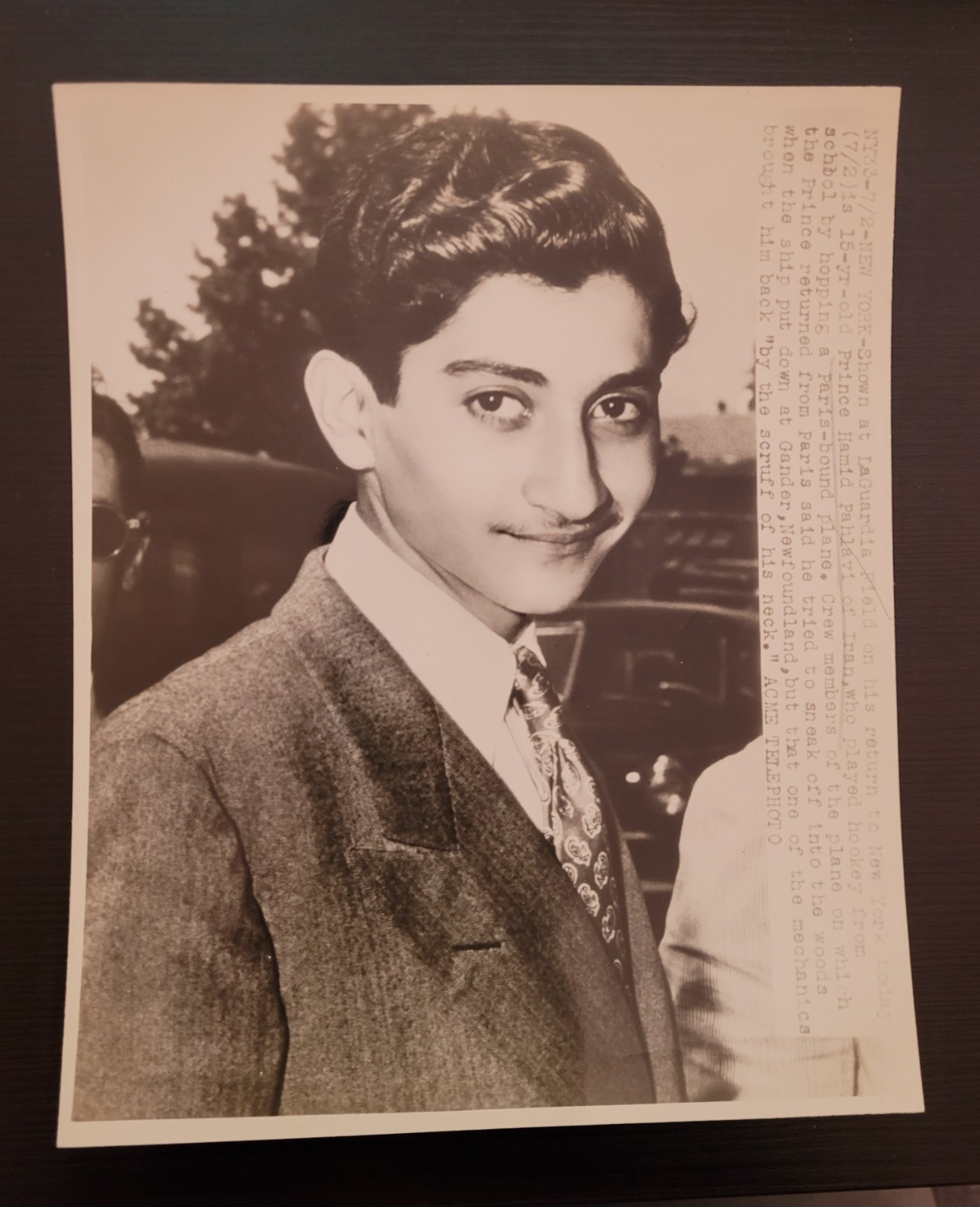
1947 Press Photo Prince Hamid Pahlavi of Iran LaGuardia Airport Runway Story 7x8 For Sale

When you click on links to various merchants on this site and make a purchase, this can result in this site earning a commission. Affiliate programs and affiliations include, but are not limited to, the eBay Partner Network.

1947 Press Photo Prince Hamid Pahlavi of Iran LaGuardia Airport Runway Story 7x8:
$222.00
This unique piece of photojournalism captures a charming, lesser-known moment in royal history. This 1947 ACME Telephoto depicts the "runaway" Prince of Iran after a schoolboy escapade that made international headlines.
Front of Photo (Typed Caption/Slug): NY33-7/2-NEW YORK-Shown at LaGuardia Field on his return to New York today (7/2) is 15-yr-old Prince Hamid Pahlavi of Iran, who played hookey from school by hopping a Paris-bound plane. Crew members of the plane on which the Prince returned from Paris said he tried to sneak off into the woods when the ship put down at Gander, Newfoundland, but that one of the mechanics brought him back "by the scruff of his neck." ACME TELEPHOTO Back of Photo (Markings and Stamps): Top Left: Handwritten "A77412" Center: Handwritten "818 pm" and an encircled "M" Right Side: Handwritten "rec Gervaia" Bottom Center (Stamp): "REF. DEPT. 7. 4 '47 N. E. A." (Newspaper Enterprise Association)
Historical Context & Biography This photograph captures Prince Hamid Pahlavi (born 1932) during a moment of youthful rebellion. The Subject: Prince Hamid was a member of the Qajar dynasty (his mother was a Qajar princess) and the Pahlavi dynasty (through his father, Prince Abdul Reza Pahlavi, the half-brother of the last Shah of Iran). The Incident: In July 1947, while attending school in the United States, the 15-year-old Prince famously "played hookey" by boarding a flight to Paris without permission. The Return: This photo was taken at LaGuardia Field (now LaGuardia Airport) upon his forced return. The caption hilariously notes that he attempted to escape again during a refueling stop in Gander, Newfoundland, by running into the woods, only to be caught by a mechanic.
Item Details & Keywords Format: Original ACME Telephoto / Wire Photo Size: Approximately 6 3/4 x 8 1/4 inches Date: July 2, 1947 (Stamped July 4, 1947) Condition: Excellent vintage condition with original typed caption integrated into the image. The reverse contains archival newspaper stamps and notations. Keywords: Iranian Royalty, Persian Empire, Pahlavi Dynasty, Vintage Aviation, LaGuardia Airport History, 1940s News Photo, Ephemera, Middle Eastern History, Collectible Reza PahlaviHamid Reza Pahlavi (Persian: حمیدرضا پهلوی; 4 July 1932 – 12 July 1992) was an Iranian prince and the youngest son of Reza Shah Pahlavi, the founder of Iran's Pahlavi dynasty, by his fourth wife, Esmat Dowlatshahi.[1][2] As the half-brother of Mohammad Reza Pahlavi, the last Shah of Iran, he belonged to the royal family but held no significant public or military roles, instead becoming known for his dissolute personal life.[3] After Reza Shah's abdication in 1941, Hamid Reza accompanied his father into exile in South Africa, later returning to Iran to complete his education in Tehran.[4]Throughout his adulthood, Hamid Reza Pahlavi earned a reputation as the "black sheep" of the Pahlavi family due to chronic opium addiction, promiscuity, and erratic behavior that led to his effective ostracism from court circles well before the 1979 Iranian Revolution.[3] His drug involvement extended to the illicit market, where premium heroin circulating in Tehran during the 1960s was dubbed "heroin-e hamid-reza" in reference to him, highlighting the scale of his consumption and associations.[5] Despite these controversies, he remained in Iran after the monarchy's fall, living privately until his death from natural causes at age 60.[3][2]Family and Early LifeBirth and ParentageHamid Reza Pahlavi was born on 4 July 1932 in Tehran, Iran.[6][4]He was the eleventh and youngest child of Reza Shah Pahlavi, founder of the Pahlavi dynasty and Shah of Iran from 1925 to 1941, and the latter's fourth wife, Esmat ol-Molouk Dowlatshahi, whom Reza Shah married in 1923 after his previous unions.[6][4] Esmat ol-Molouk bore Reza Shah five children, of whom Hamid Reza was the fifth and last; these included Abdul Reza, Ahmad Reza, Mahmoud Reza, and Fatemeh.[4] As a result, Hamid Reza was a full sibling to those four but a half-brother to Mohammad Reza Pahlavi, the eldest son from Reza Shah's second wife, Taj ol-Molouk, who succeeded their father as Shah in 1941.[7][4]Upbringing in the Pahlavi CourtHamid Reza Pahlavi, the youngest son of Reza Shah Pahlavi from his fourth marriage to Esmat ol-Molouk Dowlatshahi, spent his early childhood in the disciplined environment of the Pahlavi royal court in Tehran following his birth on 4 July 1932.[6][8] The court under Reza Shah emphasized modernization, strict discipline, and education for the royal children, reflecting the founder's authoritarian approach to family and state affairs; Reza Shah was known as a disciplinarian who provided appropriate care and schooling for his offspring while enforcing military-like rigor in their upbringing.[9] As one of eleven children and the seventh son overall, Hamid Reza was raised alongside half-siblings from his father's previous marriages, including the future Shah Mohammad Reza Pahlavi, in palaces that symbolized the dynasty's shift from Qajar traditions to Pahlavi centralization and Persian revivalism.[6]His primary education was completed in Tehran during Reza Shah's reign (1925–1941), aligning with the court's focus on preparing princes for roles in a modernizing Iran through formal schooling rather than traditional courtly idleness.[4] The Pahlavi court, centered in Tehran, operated under Reza Shah's direct oversight, prioritizing physical fitness, loyalty to the state, and exposure to Western-influenced reforms, though younger sons like Hamid Reza received less public prominence than the heir apparent.[9] Family dynamics were shaped by Reza Shah's multiple marriages and his emphasis on unity among heirs, yet underlying tensions from polygamous structure persisted, as evidenced in later accounts of sibling relations.[8]The abdication of Reza Shah in September 1941 amid Allied occupation marked the end of Hamid Reza's court upbringing at age nine; he accompanied his father into exile in South Africa, where Reza Shah died in July 1944, disrupting the continuity of royal life and shifting the family's focus to survival abroad.[4] This period exposed him to the vulnerabilities of dynastic power, contrasting the court's earlier stability under Reza Shah's iron rule.[9]Education and Early AdulthoodFormal EducationHamid Reza Pahlavi completed his primary education in Tehran prior to Reza Shah's abdication and exile in September 1941, after which he accompanied his father to South Africa.[4]Following the family's return to Iran after Reza Shah's death in 1944, Pahlavi pursued secondary education at St. George's School, a preparatory institution in Newport, Rhode Island, United States. He subsequently attended the Military Officers' Academy in Tehran and studied at the American University of Beirut in Lebanon, though no higher degree is documented.[8]Transition to AdulthoodFollowing his secondary education at St. George's School in Newport, Rhode Island, USA, Hamid Reza Pahlavi pursued studies at the American University of Beirut in Lebanon.[8] He subsequently attended the Military Officers' Academy in Tehran, reflecting the Pahlavi dynasty's emphasis on military preparation for male royals.[8]This phase, spanning the late 1940s to early 1950s, signified his shift from student life to adult status within Iran's imperial structure, though he held no documented command positions or extended service.[8] By 1951, at age 19, he had assumed responsibilities aligned with his princely rank, amid the broader context of Mohammad Reza Shah's consolidation of power post-1941 abdication of their father.[8]Personal LifeMarriage and OffspringHamid Reza Pahlavi married three times and fathered four children.[10][11]His first marriage was to Minou Dowlatshahi, daughter of Prince Abol Fath Mirza Dowlatshahi, in Tehran on March 19, 1951.[12][13] The union ended in divorce, and they had one daughter, Niloufar Pahlavi (born 1953).[1]In his second marriage, Pahlavi wed Homa Khameneh around 1953–1959, though exact dating varies across records; the couple divorced and produced two children: son Behzad Pahlavi (born 1957) and daughter Nazak Pahlavi (born February 12, 1958).[1][2]Pahlavi's third marriage occurred in 1974 to Houri Khameneh, with whom he had one son, Ja'afar Pahlavi (born 1975).[1]Lifestyle and Private PursuitsHamid Reza Pahlavi maintained a relatively secluded lifestyle away from official duties, focusing on personal associations that drew scrutiny from intelligence agencies. According to SAVAK reports documented in historical analyses, he established a headquarters on Takht-e Jamshid Street in Tehran that functioned as a gathering place for drug addicts, indicating involvement in circles centered around opiate use during the Pahlavi era.[14][5] This reflected a pattern of private pursuits tied to substance-related social activities, contrasting with the more public engagements of other royal family members. Limited verifiable details exist on other hobbies or interests, as his life remained largely shielded from broader documentation prior to the 1979 revolution.Life Under Mohammad Reza ShahRole Within the Royal FamilyHamid Reza Pahlavi, born on July 4, 1932, to Reza Shah Pahlavi and his second wife, Esmat Dowlatshahi, served as the half-brother to Mohammad Reza Shah, positioning him as a junior member of the extended Pahlavi royal family during the latter's reign from 1941 to 1979. Unlike elder siblings such as Gholam Reza Pahlavi, who held military commands, or Ashraf Pahlavi, who wielded political influence, Hamid Reza occupied no formal governmental, military, or advisory roles within the court or state apparatus. His status afforded him access to royal privileges, including residences in Tehran and financial support derived from family wealth, but these were curtailed by personal conduct rather than institutional duties.[3]Hamid Reza's integration into family dynamics was severely limited by a reputation for scandalous behavior, including chronic opium addiction, promiscuity, and rumored participation in black-market operations, which contrasted sharply with the Shah's emphasis on modernization and public decorum. Mohammad Reza Shah, seeking to preserve the monarchy's image amid domestic and international scrutiny, revoked Hamid Reza's princely title and formally banned him from court attendance, effectively exiling him from official royal circles by the 1960s. This ostracism transformed his role from potential insider to peripheral figure, reliant on private networks rather than familial authority, though he continued residing in Iran and maintaining loose ties through extended kin.[3][15]The Shah's decision reflected broader efforts to insulate the core dynasty from embarrassments that could fuel opposition narratives of corruption, as evidenced by consistent accounts of Hamid Reza's marginalization in contemporary reporting. While other family members contributed to patronage networks or symbolic representation, Hamid Reza's activities centered on personal enterprises, such as property dealings in Tehran, without exerting influence over policy or succession matters. This exclusion persisted until the 1979 Revolution, underscoring his anomalous position as the "black sheep" of the Pahlavi lineage.[3]Public Profile and Activities
Hamid Reza Pahlavi, the youngest son of Reza Shah and half-brother to Mohammad Reza Shah, held no formal governmental, military, or diplomatic positions during the Pahlavi dynasty's final decades. His public visibility remained limited, with activities primarily confined to personal and family affairs rather than state or societal contributions.[8]Educated at St. George's School in Newport, Rhode Island, USA; the Military Officers’ Academy in Tehran; and the American University of Beirut, Lebanon, Pahlavi's early adulthood focused on private pursuits following his studies. In 1962, he was deprived of his princely title Shahpur and adopted the surname Islami, a decision reflecting estrangement from the royal establishment, though specific reasons—potentially linked to personal scandals reported in later accounts—were not publicly detailed at the time.[8]His marital history underscored a tumultuous personal life: he married Shahzadi Minou Khanum on 19 March 1951 (divorced 1954); Huma Khamenei in 1955 (divorced 1959); Hourie Khamnei in 1968 (she died 16 August 2005); and Doris Thomas in 1974. These unions produced three sons and two daughters, but no evidence indicates they involved public or charitable endeavors. Post-title deprivation, his presence in official court or media depictions diminished, aligning with a profile of royal marginalization amid the dynasty's emphasis on disciplined public service from senior family members.[8]Post-1979 RevolutionDecision to Remain in IranHamid Reza Pahlavi, half-brother to Mohammad Reza Shah through their father Reza Shah's second marriage, opted to remain in Iran following the monarchy's collapse in February 1979, in contrast to the exodus of the Shah's immediate family and key courtiers who departed into exile by late January of that year.[4] His decision reflected a profound detachment from the Pahlavi court's inner circles, cultivated over years of personal indiscretions—including publicized affairs, financial improprieties, and reputed opium addiction—that eroded any privileged access to evacuation arrangements or foreign safe havens arranged for loyalists.[16] Lacking the political utility or familial bonds that propelled others abroad, Pahlavi resided in relative obscurity in Tehran, blending into civilian life without the resources or incentives for flight.[4]In the immediate aftermath of Ayatollah Ruhollah Khomeini's return on February 1, 1979, and the revolutionary government's consolidation by April 1, Pahlavi adopted the pseudonym "Fafar Islami" to obscure his identity amid purges targeting former regime affiliates.[16] This alias, derived from informal naming conventions, underscored his intent to sever ties to his princely heritage rather than contest the new order or join opposition networks overseas.[4] Contemporaneous accounts from Iranian exile communities note that his isolation predated the revolution, as he had been sidelined from official roles since the 1960s, rendering him an inconsequential figure unworthy of revolutionary reprisal in the eyes of some guards—until his background surfaced through investigative sweeps.[16]Arrest and Legal ProceedingsFollowing the 1979 Iranian Revolution, Hamid Reza Pahlavi adopted the assumed name "FaFar Islami" and maintained a reclusive life in Tehran to evade scrutiny from the new Islamic Republic authorities, who targeted prominent Pahlavi family members for association with the deposed monarchy. Unlike his exiled siblings, he was not immediately arrested amid the post-revolutionary purges but continued living obscurely, supported by minimal means and occasional aid from distant relatives.[17]On February 10, 1986, Pahlavi was apprehended by Iranian security forces in Tehran on initial charges of vagrancy after being found in a destitute state. He was transferred to Evin Prison, where subsequent investigations led to drug possession charges, consistent with his longstanding issues with opium and heroin addiction documented during the Pahlavi era. In a swift legal process typical of the revolutionary courts, he was convicted and sentenced to a lengthy prison term—reported as life imprisonment in some accounts—for these narcotics offenses, marking the formal culmination of proceedings against him under the Islamic Republic's penal system.[18][17][3]Imprisonment and DeathConditions of IncarcerationHamid Reza Pahlavi was held in Tehran's Evin Prison after his conviction on drug charges stemming from a 1986 arrest for vagrancy. He occupied a cramped 12-by-9-yard cell shared with 23 other convicts, including a former general and senior officials from the Pahlavi regime, where inmates slept on blankets laid directly on the floor due to the absence of beds or other furniture.[17]Pahlavi, then 58 years old, maintained some routines amid incarceration, such as gardening and tending roses to stay occupied. The cell included basic amenities like a television set, and prisoners had access to newspapers. During a 1989 visit by foreign journalists, he appeared in a simple white T-shirt and gray pajama trousers, offering a toothless smile.[17]Pahlavi described the treatment as relatively benign, stating that inmates were "well-treated" and that "things could be worse," while noting an absence of physical beatings in contrast to practices he attributed to his brother's era. He was serving a 10-year sentence, with about seven years remaining as of mid-1989, though his health had permitted a one-month postponement of initial imprisonment for pulmonary treatment.[17]Cause and Circumstances of DeathHamid Reza Pahlavi suffered a heart attack while serving a life sentence in Evin Prison in Tehran and died shortly thereafter in a hospital on or around 14 July 1992.[19][3] The Iranian state newspaper Jomhuri Eslami identified the cause of death as a heart attack, with Pahlavi having been transferred from the prison facility for medical treatment upon onset of symptoms.[19] His incarceration stemmed from a conviction on drug-related charges following the 1979 Islamic Revolution, though Pahlavi had maintained in a 1989 prison interview that the charges were politically motivated.[3] No independent autopsy or forensic verification of the cause has been publicly documented, amid broader reports of inadequate medical care and harsh conditions in Iranian prisons during that era.[3]Burial and Family ResponseHamid Reza Pahlavi died on July 12, 1992, while serving a life sentence in Tehran and was interred at Behesht-e Zahra Cemetery in the city.[3][7] His gravesite is situated in Section 76, Row 27, Number 64.[4]Given the exile of key Pahlavi family members abroad following the 1979 Islamic Revolution, no family representatives attended the burial, which occurred under the auspices of the Islamic Republic authorities.[3] Public responses from the exiled Pahlavi family to Hamid Reza's death were not prominently recorded in contemporary reports, reflecting the limited channels for communication and the regime's restrictions on former royals.[3] The Orlando Sentinel obituary described him as a "black sheep" in the royal family, noting his history of opium use and personal troubles, which may have influenced familial dynamics.[3]Legacy and Historical AssessmentSignificance in Pahlavi Dynasty ContextHamid Reza Pahlavi, born on July 4, 1932, in Tehran as the eleventh and youngest child of Reza Shah Pahlavi from his third wife, Esmat ol-Molouk Dowlatshahi, held a peripheral position within the Pahlavi dynasty's extended royal family.[6][4] As the seventh son and half-brother to Mohammad Reza Shah, he was never positioned for succession or assigned prominent governmental, military, or ceremonial roles, unlike elder siblings such as Ali Reza Pahlavi, who commanded air force units.[20] His status reflected the dynasty's expansion through Reza Shah's multiple marriages, which produced a large brood of eleven children, but also underscored the limited influence of junior members born later in the founder's reign, during a period of consolidating authoritarian modernization from 1925 to 1941.[21]Throughout Mohammad Reza Shah's rule from 1941 to 1979, Hamid Reza resided in Iran as a private citizen with access to royal privileges, engaging in aviation and business pursuits without formal dynastic responsibilities.[3] However, his personal conduct—marked by chronic opium addiction, promiscuity, and scandals—earned him a reputation as the "black sheep" of the family, with high-quality heroin in 1960s Tehran colloquially termed "heroin-e hamid-reza" after him, highlighting excesses that contrasted with the regime's public emphasis on discipline and progress.[3][5] This notoriety, while not central to the dynasty's governance, amplified criticisms of elite decadence and corruption, contributing to narratives of moral decay that eroded public support for the Pahlavis amid socioeconomic disparities, even as the shah pursued reforms like land redistribution and industrialization.[3] In essence, Hamid Reza embodied the dynasty's underbelly, where familial ties conferred wealth but also exposed vulnerabilities to personal failings that dynastic propagandists downplayed in favor of projecting unity and efficacy.Interpretations of Fate Under Islamic RepublicThe Islamic Republic's official account held that Hamid Reza Pahlavi died of a heart attack on July 12, 1992, while serving a life sentence in Evin Prison for drug trafficking charges stemming from activities uncovered after the 1979 revolution.[3][19] This interpretation framed his fate as a consequence of personal criminality emblematic of broader Pahlavi-era decadence, with imprisonment beginning shortly after the regime's establishment and extending over 13 years without reported appeal or release.[22] State-aligned narratives emphasized the charges as evidence of moral corruption within the monarchy, justifying detention as restorative justice under Islamic governance, though the revolutionary courts handling such cases were frequently criticized by international observers for lacking due process and independence.[23]Contemporary Western reporting accepted the heart attack as the cause without evidentiary challenge, attributing no foul play amid Pahlavi's documented pre-revolutionary lifestyle involving excess and reported substance issues.[3][24] Absent prominent counterclaims from Pahlavi family members or exiles—unlike disputes over other relatives' deaths—his case has been viewed by regime proponents as uncontroversial accountability, while skeptics of the Islamic Republic's judiciary interpret the extended solitary-like conditions at Evin as exacerbating health decline for political figures, potentially contributing causally to mortality even if not directly induced.[23] This duality reflects systemic tensions: empirical alignment on the medical cause contrasts with debates over incarceration's punitive intent, given Evin's history of harsh treatment for perceived monarchical holdovers.[25]In broader assessments, Pahlavi's trajectory—remaining in Iran post-revolution, facing arrest amid purges of elites, and perishing in custody—serves regime historiography as vindication of the revolution's purge of "degenerate" aristocracy, supported by his half-brother status to the deposed Shah and lack of flight with core family.[22] Critics, drawing from patterns in post-1979 detentions, contend the drug convictions, while possibly grounded in behavior, were amplified for symbolic retribution against Pahlavi remnants, rendering his fate a microcosm of selective justice in a theocratic system prone to conflating political lineage with criminality.[23] No forensic autopsy details were publicly released, limiting causal verification beyond official pronouncements from a judiciary with established opacity on high-profile prisoner deaths.[26]Reza Pahlavi[a] (born 31 October 1960) is an Iranian politician and dissident in exile in the United States. A member of the Pahlavi dynasty, he is the eldest son of Mohammad Reza Pahlavi, the last shah of Iran, and Farah Diba. He is one of the mainstream figures of the Iranian opposition to the government of the Islamic Republic of Iran.
Born in Tehran, Iran, Reza Pahlavi was officially named crown prince of Iran at the time of his father's coronation in 1967. As a cadet of the Imperial Iranian Air Force, he moved to the United States for pilot training at Reese Air Force Base in 1978. The next year, his father was overthrown and the monarchy was abolished in the wake of the Iranian Revolution led by Ruhollah Khomeini. In 1980, following the death of his father in exile in Cairo, Egypt, Reza Pahlavi declared himself shah of Iran, styling himself "Reza Shah II", and actively participated in political activities opposing the Islamic Republic from abroad.
In 2013, he co-founded the Iran National Council (INC). Ideologically, he has expressed support for a democratic transition in Iran and has advocated for a referendum to be held in Iran to determine the nature of the future government. Pahlavi has repeatedly called for protests against the Islamic Republic, and has called for the removal of the current government from power. He has also advocated for Iran to become an ally of the Western world, as well as Israel.
While some Iranians have voiced support for Pahlavi, his support inside Iran remains "unclear".[3][4][5]
Early life and educationReza Pahlavi was born in Tehran as the eldest son of Mohammad Reza Pahlavi, the Shah of Iran and Farah Pahlavi, the Shahbanu. Pahlavi's siblings include his sister Farahnaz, brother Ali Reza, and sister Leila, as well as a half-sister, Shahnaz.A ceremony at Pasargadae to mark the 2,500-year celebration of the Persian Empire in 1971. The Crown Prince is at the far right, age 10, standing next to his parents.When he was born, the Shah pardoned 98 political prisoners, and the government declared a 20 per cent reduction in income tax.[6] He studied at the eponymous "Reza Pahlavi School", a private school located in the royal palace and restricted to the imperial family and court associates.[7] He was trained as a pilot; his first solo flight was at the age of 11, and he obtained his license a year later.[8]
In his youth, he was a keen football player and spectator. He was a fan of the capital's football club Esteghlal, then known as Taj (lit. 'Crown'), and his support was even televised by the National Iranian Radio and Television. The club performed in annual rallies organized on his birthday, identifying the club with the Pahlavi regime.[9] He was also a supporter of Taj Abadan football club, another Iranian football team of the era.[10]
As a cadet of the Imperial Iranian Air Force, he was sent to the United States in August 1978 to continue his pilot training. He was one of 43 cadet pilots in the one-year pilot training program at the Reese Air Force Base near Lubbock, Texas, which included flying the Cessna T-37 Tweet and Northrop T-38 Talon. As a result of the Iranian Revolution, he left the base in March 1979, about four months earlier than planned.[8][11] He then joined his family in their travels, under tight security, from Morocco to the Bahamas to Mexico.[12]
Pahlavi began studies at Williams College in September 1979,[12] but dropped out in 1980.[13] He then enrolled at The American University in Cairo as a political science student, but his attendance was irregular.[14] In 1981, it was reported that he had dropped out of the program and continued his studies privately with Iranian professors, with a focus on Persian culture and history, philosophy, and oil in Iran.[15]
While living in Morocco, Pahlavi obtained a B.S. in political science by correspondence from the University of Southern California in 1985. He is fluent in English and French in addition to his native Persian.[12]
Political activities in exileReza Pahlavi came to Cairo, Egypt, in March 1980 with his family.[1] When his father Mohammad Reza Pahlavi was ill and in the last weeks of his life, media reported that some monarchist elements had advised the Shah to oust Reza in favor of his younger son Ali Reza (who was 13 at the time) and a regency council, suggesting that Reza's background, training and interest in public affairs were too limited to become his successor. The Shah was understood to have rejected the idea and abdicated himself in favor of one of his two sons.[16]
When the Shah died on 27 July 1980, Farah Pahlavi proclaimed herself as the regent, a title in pretense.[1] On his 20th birthday on 31 October, Reza Pahlavi declared himself to be the new king of Iran, Reza Shah II, and the rightful successor to the throne of the Pahlavi dynasty.[17] Immediately afterward a spokesman for the United States Department of State, John Trattner, disassociated the U.S. government from Reza Pahlavi by stating that the U.S. government did not intend to support Pahlavi, and assuring that the U.S. government recognized the newly established post-revolutionary Iranian government.[18]
In 1981, Pahlavi remained in the Koubbeh Palace and developed close ties to pro-monarchy groups while facing rejection from other opposition groups, including left-wing dissidents.[15] In March, he issued a statement for the Persian New Year. He urged all opponents of the Iranian government to unite behind him and wage a "national resistance". Still, he chose to remain silent and made no reaction when President Abolhassan Banisadr was deposed, and the assassination of tens of officials including Chief Justice Mohammad Beheshti took place in June.[15]
In August, Pahlavi announced that he had been secretly planning to overthrow the Iranian government, stating, "So far I have been unwilling to unveil the existence of the concerted plans for I do not wish to jeopardize the lives of some of our best children... many of our actions have been unknown to you, but I want to assure you that the necessary steps are being taken in the best orderly way to save Iran".[19]
In 1982, Yaakov Nimrodi told BBC in a radio interview that along with Adolph Schwimmer and Adnan Khashoggi, he was involved with Pahlavi and Gen. Said Razvani to scheme a coup d'état and install Pahlavi in Iran.[20] According to Samuel Segev, the plan had the approval of both the CIA and the Israeli cabinet, but it was abandoned when Israeli Prime Minister Menachem Begin resigned in 1983 and the new leadership under Yitzhak Shamir "thought Israel should not be involved in a new adventure".[20]
In May 1986, Pahlavi disclosed that he had recently formed a government-in-exile to establish a constitutional monarchy again in Iran.[21] In February 1989, he delivered an invited talk at Georgetown University's Walsh School of Foreign Service.[12] His political support base at the time was limited to upper-class Iranian Americans and he raised $1 million to finance his political activities over two months in the spring of 1989. He moved in a narrow circle of exiled government officials and academics, guarded by aides like his childhood bodyguard Ahmad Oveyssi.[12]
Pahlavi has used his high profile as an Iranian abroad to campaign for human rights, democracy, and unity among Iranians in and outside Iran.[22] On his website, he calls for a separation of religion and state in Iran and free and fair elections "for all freedom-loving individuals and political ideologies". He exhorts all groups dedicated to a democratic agenda to work together for a democratic and secular Iranian government.[23][24][25][26]Reza Pahlavi in 1973In a presentation at the Washington Institute for Near East Policy in December 2018, Pahlavi called for the non-military support of those in Iran who were trying to replace the Islamist regime with a secular democracy. According to a news report, he was "not openly calling for the restoration of the Peacock Throne ... He casts himself more as a symbol than a politician, but has called himself 'ready to serve my country'".[27]
During anti-government demonstrations in Iran in 2022 following the Abadan building collapse, Pahlavi predicted that the Islamic regime would collapse in the near future as events such as the shooting down of Ukraine International Airlines Flight 752, bans on importing foreign COVID-19 vaccines and tests into the country and rising food prices had led to unnecessary deaths and would provoke further anger at government mismanagement from the population. He also urged members of the Iranian armed forces who oppose the Islamic Republic but work for the government to engage in peaceful disruption and called for a coordinated front against the regime. While acknowledging support from Iranian demonstrators chanting for the return of the monarchy, he also stated, "The most important thing I do in response to the Iranian people's trust is to reinforce their voices. I don't tell them what to do. I'm not a political leader."[28]
In a February 2023 interview with The Daily Telegraph, Pahlavi called on the British and European governments to proscribe the Islamic Revolutionary Guard Corps (IRGC) arguing such a move would be "pulling out the biggest tooth the regime has". In the interview, he also argued his belief that the Islamic Republic was more likely to fall in the near future than it had been in previous decades as Iranian reformists had switched tactics to wanting to completely overthrow the regime as opposed to changing it. He acknowledged many Iranian dissidents wanted him to play a central role in creating a new government but reiterated that he would leave it to the people of Iran on whether to restore the throne and that he would not run for political office if the regime fell.[29]
Pahlavi also predicted that the greatest challenge for a new secular, liberal democratic Iran would be the question of controlling the military and seeking justice against officials in the regime. He concluded that higher-ranking members of the Islamic regime would face trials for human rights abuses but lower ranking members could be pardoned to allow reintegration into society, citing the Nuremberg trials in which top Nazi officials were prosecuted while lower ranking members were reintegrated back into Germany, and the Truth and Reconciliation Commission hearings in South Africa after the end of apartheid as examples to follow.[30]
In March 2023, Pahlavi embarked on a tour of the United Kingdom and gave a speech to the Oxford Union. During the speech, he argued that "secular[ism] is a prerequisite to democracy" and that Islamic regimes fail by not accepting freedom of religion. He called for the right to Internet access to be restored to Iran to help communication between dissident movements and for non-violent tactics to be used in bringing down the Iranian regime. During the speech, a large demonstration took place outside in support of Pahlavi calling for his restoration.[31][32]
On 17 April 2023, he and his wife Yasmine visited Israel in "an effort to rebuild the historic relations between Iran and Israel". Upon his arrival in Israel, he visited the Western Wall and Yad Vashem on the occasion of Yom HaShoah, and met with President of Israel Isaac Herzog and Prime Minister of Israel Benjamin Netanyahu.[33][34][35] He also paid a condolence call to the bereaved Dee family at their home in the West Bank settlement of Efrat, after the deaths of sisters Maia and Rina and their mother Lucy in a terror shooting during the Passover holiday.[36]
Succession
Reza Pahlavi's swearing in as the new king of Iran on 31 October 1980 at Koubbeh Palace, CairoReza Pahlavi II is first in the line of succession to his late father. His younger brother Ali-Reza Pahlavi II was second in line until his death by suicide in 2011.[37] Before Reza Pahlavi's birth, the presumptive heir was Patrick Ali Pahlavi, the crown prince's cousin.
In February 2019, Reza Pahlavi launched the Phoenix Project of Iran initiative. According to the National Interest, this is "designed to bring the various strains of the opposition closer to a common vision for a post-clerical Iran".[38]
Within IranA report published by the Brookings Institution in 2009 said that Pahlavi lacked an organized following within Iran since there was no serious monarchist movement in Iran itself. The report described Pahlavi as having "little in common with the intellectuals and students who make up the core of the reform movement".[39]
During 2017–18 Iranian protests, some videos on social media showed demonstrators chanting slogans in favor of Pahlavi's grandfather and calling for his return.[40][41] On many occasions the videos indicated the royalist slogans prompt others in the crowd to shout the slogans down.[42]
In January 2023, New York-based Iranian scholar and writer Arash Azizi noted that among younger Iranians on social media and at public demonstrations support for Pahlavi has become more visible and argued "To any fair observer of Iran, Pahlavi has a certain degree of support in Iranian society, although it is hard to discern just how wide this support is." He also noted that a number of Iranian dissident activists and celebrities including Dariush Eghbali (who had been imprisoned under the Shah's rule), actress Shohreh Aghdashloo, actor Hamid Farrokhnezhad and Olympian Kimia Alizadeh have come out in support of Pahlavi being a figurehead to unite anti-regime movements.[43]
The University of Navarra, a private Spanish Catholic research university founded by Opus Dei, published an article in 2023 in which they found there was support for Pahlavi within Iran.[44] In 2023, an online poll conducted by the Berlin-based[45] pro-Pahlavi[b] Empirical Research and Forecasting Institute (ERF.I, established by Taghi Alereza, Houshang Lahooti and Noah Farhadi), with the help of machine learning,[46] found that among the 9,000 respondents almost 80 percent preferred Pahlavi over the current Islamic Republic leadership.[47] The ERF.I poll result was cited by the conservative American think-tank Middle East Forum as an argument against "hesitation" in American government circles over backing efforts to restore Iranian monarchy.[48]
Among Iranian expatriatesIn 2006, Connie Bruck of The New Yorker wrote that Los Angeles is home to about 600,000 Iranian expatriates, and said it was a monarchist stronghold.[49]
A 2013 survey of Iranian-Americans conducted by George Mason University's Center for Social Science Research found that 85% of respondents did not support any Iranian opposition groups or figures. Of the remaining 15% who expressed support, 20% backed Pahlavi.[50]
Visit to and support from IsraelIn April 2023, Pahlavi made his first official visit to Israel, hosted by Israeli Intelligence Minister Gila Gamliel. In press conferences Pahlavi spoke of a desire for peace, democracy and human rights in Iran, and spoke in favour of the Abraham Accords normalising relations between regional Muslim states and Israel. The Israeli position was that the visit was evidence that there is no animosity between the Israeli and Iranian peoples, only their governments.[51][52] Haaretz reported, after speaking to five sources with direct knowledge, that a large-scale digital influence project in Persian calling for the restoration of the Iranian monarchy was operating in Israel funded privately but with government support.[51][53]
Pahlavi and his wife visited and prayed at the Western Wall of Temple Mount in East Jerusalem. In a tweet he wrote "It is with profound awe that I visit the Western Wall of that Temple and pray for the day when the good people of Iran and Israel can renew our historic friendship." He also attended a ceremony held at the National Holocaust Memorial and Museum with Israel's President Isaac Herzog and Prime Minister Benjamin Netanyahu.[54][52]
During the visit Pahlavi tweeted "Yasmine and I were very pleased to meet with @IsraeliPM and Sara @netanyahu. We expressed appreciation for Israel’s continued support for the Iranian people’s democratic aspirations". According to Sina Toossi, an expert on Iran with the Center for International Policy, the Iranian monarchy movement has a "very clear, evident and above-the-table alliance with Israel".[55]
In June 2025, amidst the Iran–Israel war, Pahlavi delivered a statement declaring that the Islamic Republic of Iran is "on the verge of collapse." He emphasized that internal divisions and defections within the regime signal its impending downfall. Pahlavi expressed confidence that the Iranian people, who have long resisted oppression, will soon achieve liberation. Pahlavi addressed the Iranian military and security forces, urging them to abandon the regime and join the people's movement for change.[56][57]
His stance during the Iran–Israel war, especially his presentation of the Israeli attacks as "an opportunity", has drawn strong criticism from many other Iranian opposition figures, including several high-profile political prisoners in Iran, labelling Pahlavi as a "traitor" to his country of birth,[58] with Al Jazeera saying “He was really the only opposition figure that was supportive of [Israel’s war]” and that he "may have squandered the little support he once had by choosing not to condemn Israel’s heavy bombardment of Iran".[55]
Support during the Mahsa Amini protestsIn a recent attempt in 2023 to garner support for Reza Pahlavi as a representative for transition, a petition was created on the platform Change.org that has amassed over 460,000 signatures.[59]
Reza Pahlavi asked Iranians worldwide to protest against the Islamic Republic on its 44th anniversary, February 11, 2023. As a result, people rallied in multiple cities in the US, Europe, Australia, and Canada.[60][61][62] Reza Pahlavi himself participated in a rally in Los Angeles attended by a crowd of more than 80,000 people.[63]
July 2024 speechIn July 2024, Pahlavi was invited to speak at the National Conservatism Conference in Washington, D.C. In his speech, Pahlavi blamed the Iranian regime for the spread of radical Islam to other nations in the Middle East and the West following the revolution and promised that Iranians will take Iran back in the near future. He also argued that Masoud Pezeshkian was not a "moderate" politician due to his friendship with Hezbollah. He warned the United States not to launch a military campaign against the regime, arguing "the problem that began in Iran must be ended in Iran" and concluded "the soon to be free Iran, doesn't seek your patronage. It seeks your partnership. It doesn't seek your funding. It seeks your friendship."[64]
In an essay for The Daily Telegraph, he called for the IRGC to be designated terror group by British government for its funding of Hezbollah, Hamas and the Houthis, as well as their suppression of Zan Zendegi Azadi.[65]
2024–2025In November 2024, Pahlavi called on Iranians to "reclaim and save our beloved Iran", offering to "guide this change and lead the transitional period",[66][67] but "did not directly address" how the Islamic Republic regime might be removed.[68]
In January and February 2025, he advised U.S. President Donald Trump against entering into an agreement with the Islamic Republic that would limit Iran's nuclear programme in exchange for sanctions relief.[69]
During the 2025 Iran–Israel war, following Iranian blackout of the internet, Pahlavi said the blackout "is a sign of panic not strength."[70] Pahlavi said in the same interview he viewed the destruction of Iran's military infrastructure and possessions such as airbases and fighter jets as a loss. Pahlavi said that the war was not that of the Iranian people but Khamenei's war and that it was the Iranian people who are paying the price.[70]
In February 2025, in an interview with The Daily Telegraph, Pahlavi called on Europe and Americans to prepare for impending collapse of regime in Tehran.[71]
Munich Conference and formation of the Iranian Transition GovernmentIn February 2025, the Munich Security Conference invited Reza Pahlavi to attend the event, but following pressure from the Islamic Republic, the invitation was withdrawn. Shortly after, he was again invited to participate in the conference, only for that invitation to be cancelled. Reza Pahlavi condemned this decision as "a betrayal of the Iranian people and the democratic values of Germany", stating, "the German government has not only silenced the voice of the Iranian people, but has also directly aligned itself with the Islamic Republic".[72][73][74][75]
At a "Munich Convergence Summit" in Munich on 18 February, with the participation of a number of Iranian opposition organizations, Reza Pahlavi stated, "Our goal today is solely the salvation of Iran, and in the future our mission is to hold free elections in Iran".[76][77] He added that "the collapse within the regime has begun and must be broadened". He stressed that "our goal" should be to "establish a mechanism for cooperation" among different groups, rather than to create another opposition organizations.[76]
He further emphasized, "Our future duty is to establish in the Constituent Assembly a democratic path based on the people's vote—and in contrast to the practices of 1978—wherein all possible options regarding the content and final form of Iran's new system are discussed transparently. The Constituent Assembly project will soon be presented to the people to outline how a national referendum via ballot boxes will be conducted for a democratic future and a secular system".[78]
At the same time, a group of Pahlavi's supporters organized a protest rally on the sidelines of the Munich Security Conference, protesting against the conciliatory policies of the European Union toward the Islamic Republic, particularly those of the German government.[79]
Pahlavi denounced inequalities and energy crises in Iran. He criticized the drying up of rivers and air pollution in Iran.[80][81]
2025–2026 protestsMain article: 2025–2026 Iranian protestsPahlavi expressed his support for the protesters, and called on all Iranians, including security and law enforcement forces, to join the protests.[82] At least some of the protesters heeded his call.[83][84] Associated Press noted that "Pahlavi had called for demonstrations at 8 p.m. local (1630 GMT) on Thursday and Friday. When the clock struck, neighborhoods across Tehran erupted in chanting, witnesses said. The chants included “Death to the dictator!” and “Death to the Islamic Republic!”. Others praised the shah, shouting: “This is the last battle! Pahlavi will return!”[83] Thousands could be seen on the streets before all communication to Iran cut out."[84]
Political viewsPart of a series onLiberalism in I (Hassan)Khomeini oppositionBashirtashBoniadiPahlavi topicsicon Liberalism portalflag Iran portalvtePart of a series onMonarchism in (Amir-Abbas)Hoveyda IPalevi IIPahlavi (Farah)Pahlavi topicsflag Iran portalicon Politics portalvteAccording to Australia's ABC News, Reza Pahlavi believes in the establishment of a secular, democratic and liberal Iran.[85]
Pahlavi has said that he has no intention to take a long-term leadership role in Iran should the current regime fall. He has said the Iranian people must choose the form of rule they prefer, whether constitutional monarchy or a republic,[85] and that a referendum should be held to decide.[85] Pahlavi has said that after the Islamic revolution in 1979, he concluded the merit of "separation of religion from state as a primordial principle and precondition to democratic order".[85]
In 2024, Pahlavi told the BBC that he prefers that Iran would choose to remain a republic, since he views this political system as more meritocratic.[86] According to an online poll of 200,000 Iranians, 158,000 inside Iran and 42,000 outside 40% of whom identified as Muslim, by the Netherlands-based non-profit[87][88] GAMAAN in December 2022, 81 percent of respondents inside the country rejected the Islamic Republic.[85][89] The GAMAAN poll also found Reza Pahlavi was by far the most popular first choice among 34 candidates to sit on the proposed "solidarity council" of the Iranian opposition, at 32.8 percent of support from respondents inside Iran.[85]
Pahlavi has advocated for increased tolerance within Iran, arguing for the establishment of watchdogs and the strengthening of civil society in order to avoid the concentration of power in one group.[85][90] Pahlavi is said to have defended a democratic vision for Iran, advocating for free elections in order to establish a constituent assembly.[44] According to the university of Navarra, Pahlavi "has refused to commit to the restoration of the monarchy".[44] Pahlavi told European members of parliament that Iran following the demise of the regime would be an ally of Europe and the West.[44]
Reza Pahlavi and the Iranian opposition has called for democratic countries to support the Iranian opposition's efforts in removing the Islamic regime and establishing a secular democracy in Iran.[85] Pahlavi says that he and the opposition are representatives of the Iranian democracy movement whose activists are jailed and also tortured by the Islamic regime in Iran.[85] Some Iranian activists are executed.[85] Pahlavi is in contact with dissidents within Iran.[85] The exact level of support Pahlavi has is not clear, with some sources stating he has little support from those "who make up the core of the reform movement", i.e. the Islamic liberal faction in Iranian to Iranian activist and journalist Homa Sarshar, Pahlavi "has been consistent in his messaging".[85] Sarshar believes Pahlavi should be part of a coalition. The Foundation for Defense of Democracies has said that one representative could assist in amplifying the Iranian message.[85]
Regarding the possibility of chaos if the Islamic regime collapses, Pahlavi said that unlike other countries who underwent a chaotic transition, Iran is an ancient civilization, saying "We are not Iraq or Afghanistan. We are a nation with millennia of unity. If there's rule of law and justice, there will be no anarchy."[70] Pahlavi stated in the interview that there will be no civil war.[70]
Reza Pahlavi promised in a June 2025 interview to Iran international that he would ensure "a lawful transition". Pahlavi stated that experts in transitional justice will ensure there are fair trials, promising every defendant the right to defend oneself in court. Pahlavi stated that unlike the 1979 revolution, no summary executions will be carried out. Pahlavi told Iran International that the transition will not be like the 1979 revolution. Pahlavi said they will ensure "equal rights for all Iranians—regardless of religion, ethnicity, or belief".[70]
Foreign supportBob Woodward wrote in 1986 that the Reagan administration authorized the Central Intelligence Agency (CIA) to support and fund Iranian exiles, including Pahlavi. The agency transmitted his 11-minute speech during which he vowed "I will return" to Iranian television by pirating its frequency.[93] The Tower Commission report, published in 1987, also acknowledged that the CIA was behind this event[94] while a group in Paris calling itself 'Flag of Freedom' had taken responsibility for the act in September 1986.[95]
James Mann wrote in February 1989 that when he asked the CIA about whether they helped Pahlavi, they refused to comment, and a spokesperson of the agency told him, "We would not confirm nor deny an intelligence matter".[96]
In 2006, Connie Bruck of The New Yorker wrote that "Pahlavi had CIA funding for several years in the eighties, but it ended after the Iran-Contra scandal".[49] Andrew Friedman of Haverford College states that Pahlavi began cooperation with the CIA after he met director William J. Casey and received a monthly stipend, citing Pahlavi's financial advisor and other observers. Friedman also connects his residence in Great Falls, Virginia to its proximity to George Bush Center for Intelligence, headquarters of the service.[97]
In 2009, Pahlavi denied receiving U.S. government or foreign aid in an interview with The New York Times. Pahlavi said "No, no. I don't rely on any sources other than my own compatriots" and denied allegations of working with the CIA, calling the allegations "absolutely and unequivocally false".[98] However, in 2017 he told Jon Gambrell of the Associated Press: "My focus right now is on liberating Iran, and I will find any means that I can, without compromising the national interests and independence, with anyone who is willing to give us a hand, whether it is the U.S. or the Saudis or the Israelis or whomever it is."[99]
Social media disinformation campaignInvestigations by Haaretz and TheMarker reported the existence of an Israeli-linked influence network aimed at shaping Iranian public opinion and promoting Pahlavi as a potential post–Islamic Republic leader. The reports claim the network was operated by a private entity funded by Israeli government resources, used artificial intelligence, and relied on fake online accounts, particularly Persian-language profiles. The network allegedly recruited Persian speakers who reposted content from Reza Pahlavi.[100]
In October 2025, an investigation by Haaretz in collaboration with the University of Toronto's Citizen Lab, reported that an Israeli-linked digital influence campaign was promoting Reza Pahlavi among Persian-speaking audiences. The investigation found that the operation used fake social media accounts and AI-generated videos to amplify pro-monarchist messaging. Citizen Lab's analysis suggested that the campaign's activities were synchronized with Israeli military operations in Iran.[51] A highly organised media network combining professional PR, diaspora activism, and what researchers describe as inauthentic online accounts, promoted Pahlavi across social media. While this increased his international visibility, investigations suggest it also blurred the true level of his grassroots support inside Iran and sparked controversy over foreign ties, online harassment, and a manufactured image of lifeRelationships and marriageAccording to a People article published in 1978, Pahlavi dated a "blond, blue-eyed Swedish model he met in Rome".[104] The same publication also reported that he lived with his girlfriend in Lubbock, Texas.[104] As of 1980, he had an Egyptian girlfriend who was a student of The American University in Cairo, reportedly "closely guarded" by bodyguards.[14]
Pahlavi began a relationship with Yasmine Etemad-Amini in 1985.[12] They married on June 12, 1986, in Greenwich, Connecticut; he was 25 and she was 17.[105] The couple have three daughters: Noor Zahra (born 3 April 1992), Iman Laya (born 12 September 1993), and Farah Mitra (born 17 January 2004).[106]
In 2004, Pahlavi was named the "unofficial godfather" of Princess Louise of Belgium, the eighth granddaughter of King Albert II of Belgium.[107]
Pahlavi is a resident of Potomac, Maryland.[108] During the 1980s, he had lived in Morocco and in Paris before settling in Great Falls in suburban Virginia.[12]
Religious beliefsWhen interviewed about religion in 2009, Pahlavi said, "That's a private matter, but if you must know, I am, of course, by education and conviction, a Shia Muslim. I am very much a man of faith."[98]
On April 6, 2024, Prince Reza Pahlavi and Princess Yasmine Pahlavi visited the Bhandara Atash Kadeh Zoroastrian temple in Houston, Texas, and actively participated in the Yasna ceremony.[109] During his visit, Reza Pahlavi stated:
"Zoroastrianism is intertwined with Iranian history and civilization. Yasmine and I visited the Zoroastrian fire temple in Houston to honor this indigenous Iranian faith and show solidarity with our Zoroastrian compatriots and the Parsi community. Zoroastrianism, this ancient Iranian faith, has had a critical role in the development and progress of our great civilization. And I am convinced that its influence will only continue to grow as we see among our youth today."[110][111]
|
|
Related Items:
1947 Press Photo Topeka KS Gov-Elect Frank Carlson & Mrs Carlson - ner7369 $24.99
1947 Overseas Press Club of America Pass of AP Photographer Thomas Fitzsimmons $60.00
1947 Press Photo Prince Hamid Pahlavi of Iran LaGuardia Airport Runway Story 7x8 $222.00
|
|
|
Shopping Cart  |

|
Recently Viewed |
|
Latest Items |
|
Facebook |
Secure Websites

|
