When you click on links to various merchants on this site and make a purchase, this can result in this site earning a commission. Affiliate programs and affiliations include, but are not limited to, the eBay Partner Network.
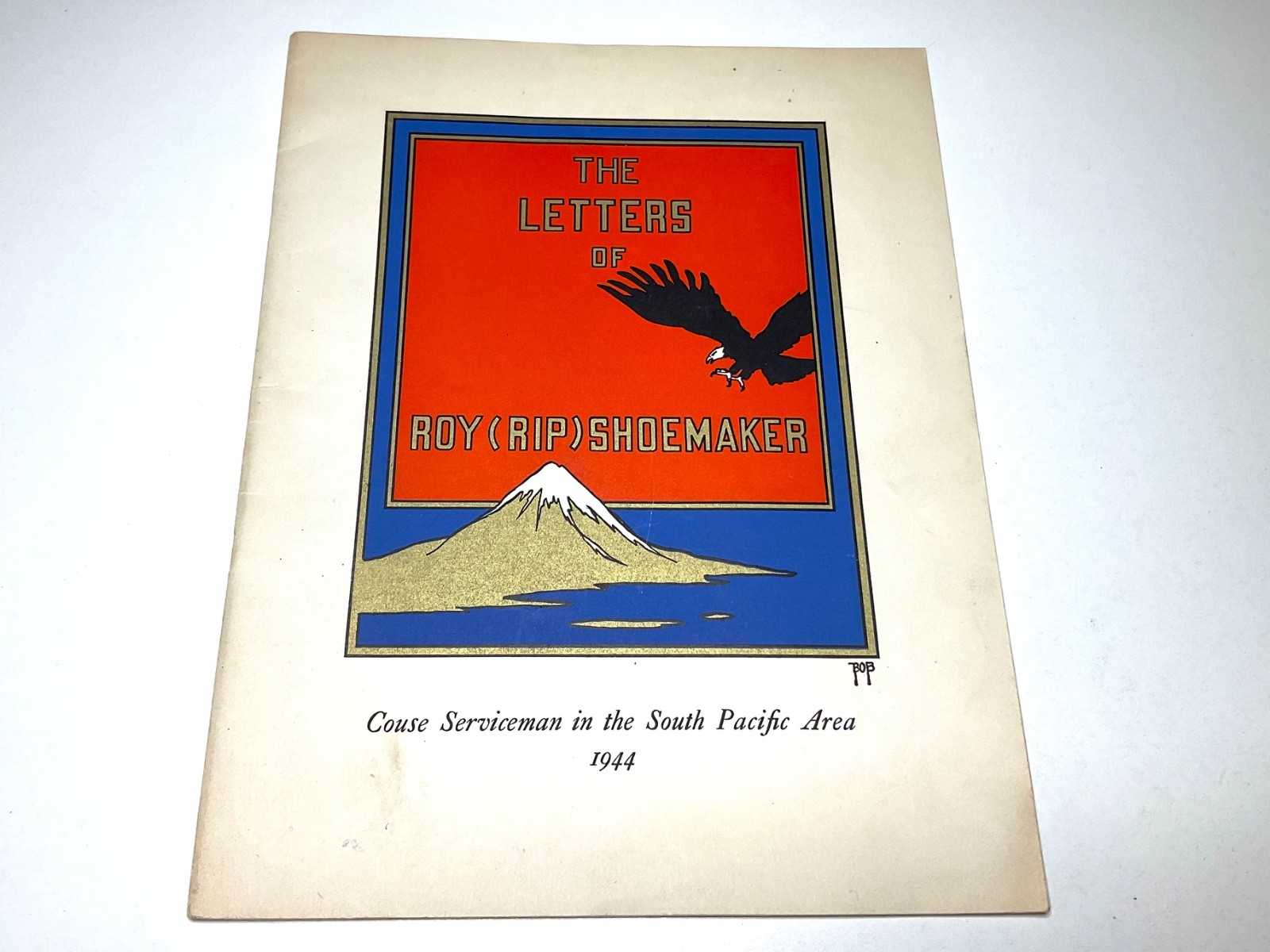
SCARCE ORIGINAL 1944 WWII SOUTHWEST PACIFIC PUBLICATION
THE LETTERS OFROY (RIP) SHOEMAKER
COUSE SERVICEMAN IN THE SOUTH PACIFIC AREA
1944
Published by:COUSE LABORATORIES300 PASSAIC STREETNEWARK, NEW JERSEYA FASCINATING FIRSTHAND WWII INDUSTRIAL / MILITARY FIELD ACCOUNT
This is an unusually interesting privately produced World War II booklet containing the wartime letters of Roy "Rip" Shoemaker, a Couse Laboratories serviceman/technical representative sent into the Southwest Pacific where U.S. Army units were operating Couse mobile machine-shop equipment.
Rather than a memoir written decades after the war, these are contemporary 1944 letters describing what Shoemaker was actually encountering in the Pacific.
The booklet was apparently produced by Couse Laboratories from letters Shoemaker sent back during his assignment.
The introductory page explains that when Rip's letters began arriving, the company was surprised by their quality and began publishing them without telling him, preserving the natural style of his correspondence.COUSE LABORATORIES & THE U.S. ARMY
Couse Laboratories of Newark, New Jersey was an important wartime manufacturer and developer of specialized mobile repair and machine-shop equipment.
Historical U.S. Army records confirm that Couse Laboratories provided expert assistance in developing light mobile repair shops used by Army engineer maintenance organizations.
Federal records also document major War Department contracts with Couse for mobile repair-shop equipment during WWII.
This makes Shoemaker's letters particularly important: he was seeing this equipment after it had reached the field and was being used under actual wartime conditions."SOMEWHERE IN NEW GUINEA"
One of the letters reproduced in the booklet is headed:
SOMEWHERE IN NEW GUINEAWednesday, May 18, 1944
Shoemaker describes working with the 1871st Aviation Battalion and instructing Army officers and troops in the use of equipment.
He discusses Couse Type "C" general-purpose shops, lathes, heavy machine-shop equipment and equipment produced by several wartime manufacturers.
He describes working as many as 12 to 14 hours a day:
instructing troops during the dayand officers at night.
The letter also contains remarkable firsthand descriptions of everyday conditions in New Guinea, including:
• Tropical climate• Clothing deteriorating in the environment• Insects• Mosquitoes• Malaria precautions• Mosquito bars• Insect repellent• Daily anti-malaria medication• Living and working conditions in the PacificSOUTHWEST PACIFIC – AUGUST 1944
Another letter is headed:
SOMEWHERE IN THE SOUTHWEST PACIFIC AREAAugust 14, 1944
Shoemaker discusses returning from approximately five weeks in a forward area and describes the improvisation necessary to keep military equipment operating.
He writes about generators, engines, machine-shop operations and field repairs.
Of particular historical interest is his description of visiting what he calls a "colored battalion" operating Couse "A" and "B" shops.
He praises the condition and operation of their equipment and records the very high number of operating hours accumulated by the shops.
This passage may be of particular research interest to collectors and historians studying African-American Army engineer and aviation units in the Pacific Theater.SIXTH ARMY CONNECTION
Later correspondence identifies Shoemaker as:
ROY SHOEMAKERA.P.O. 442HEADQUARTERSSIXTH ARMY ENGINEER SECTIONc/o POSTMASTERSAN FRANCISCO, CALIFORNIA
This provides an excellent direct connection between Shoemaker's technical assignment and the U.S. Army's engineering organization in the Southwest Pacific.ILLUSTRATED THROUGHOUT
This is not simply pages of typeset letters.
The booklet contains unusual wartime artwork, photographs and humorous illustrations relating to Shoemaker's experiences.
Among the most striking is a full-page color illustration portraying "Rip" in the style of a stained-glass saint, accompanied by a humorous mock "canonization" document referring to him as:
"Saint Ripius"
and joking about his mechanical miracles and engineering abilities.
These company-created illustrations give the publication tremendous personality and strongly suggest that this was produced for a relatively specialized audience associated with Couse Laboratories rather than for ordinary commercial bookstore distribution.AN UNUSUAL PIECE OF WWII HISTORY
The booklet crosses several highly collectible areas:
• WWII Pacific Theater• New Guinea Campaign• Southwest Pacific Area• U.S. Sixth Army• Army Engineers• Engineer aviation units• 1871st Aviation Battalion• Mobile machine shops• WWII field maintenance• Military vehicles and equipment• Wartime industrial history• Couse Laboratories• Newark, New Jersey• African-American Army unit history• APO postal history• WWII letters and correspondence• Home-front defense manufacturing• Original 1944 publicationsSCARCITY
Extensive searches were made for another copy of this exact publication under the title, author and Couse Laboratories information.
I was unable to locate another currently indexed copy of "The Letters of Roy (Rip) Shoemaker" for sale or a reliable exact sold-price record.
That does not establish how many copies were originally printed or how many survive, so I am not claiming that it is one-of-a-kind.
However, this appears to be a genuinely SCARCE privately produced WWII publication, and its highly specialized subject matter would have given it a much smaller original audience than a commercially published wartime book.HISTORICAL SIGNIFICANCE
What makes this publication particularly compelling is that independent historical records confirm the importance of the company behind it.
Couse Laboratories was directly involved in the development and manufacture of mobile repair-shop equipment for the U.S. military during WWII.
These letters therefore preserve the observations of one of the company's own technical men as he traveled among Army organizations in the Southwest Pacific seeing that equipment being operated, repaired and improvised upon under actual wartime conditions.
It is an extraordinary combination of:
MILITARY HISTORY+INDUSTRIAL HISTORY+FIRSTHAND WARTIME CORRESPONDENCE+PACIFIC THEATER HISTORY
A very unusual addition to an advanced WWII, Army Engineer, Pacific Theater, military vehicle or wartime industrial collection.
All photographs show the actual original booklet being offered and form an important part of the description.
Carefully researched and offered by Echoes of WWII, specializing in original vintage military, historical and period material.