When you click on links to various merchants on this site and make a purchase, this can result in this site earning a commission. Affiliate programs and affiliations include, but are not limited to, the eBay Partner Network.
Here is an -ready listing for these historically significant press photographs from the Second Italo-Ethiopian War.
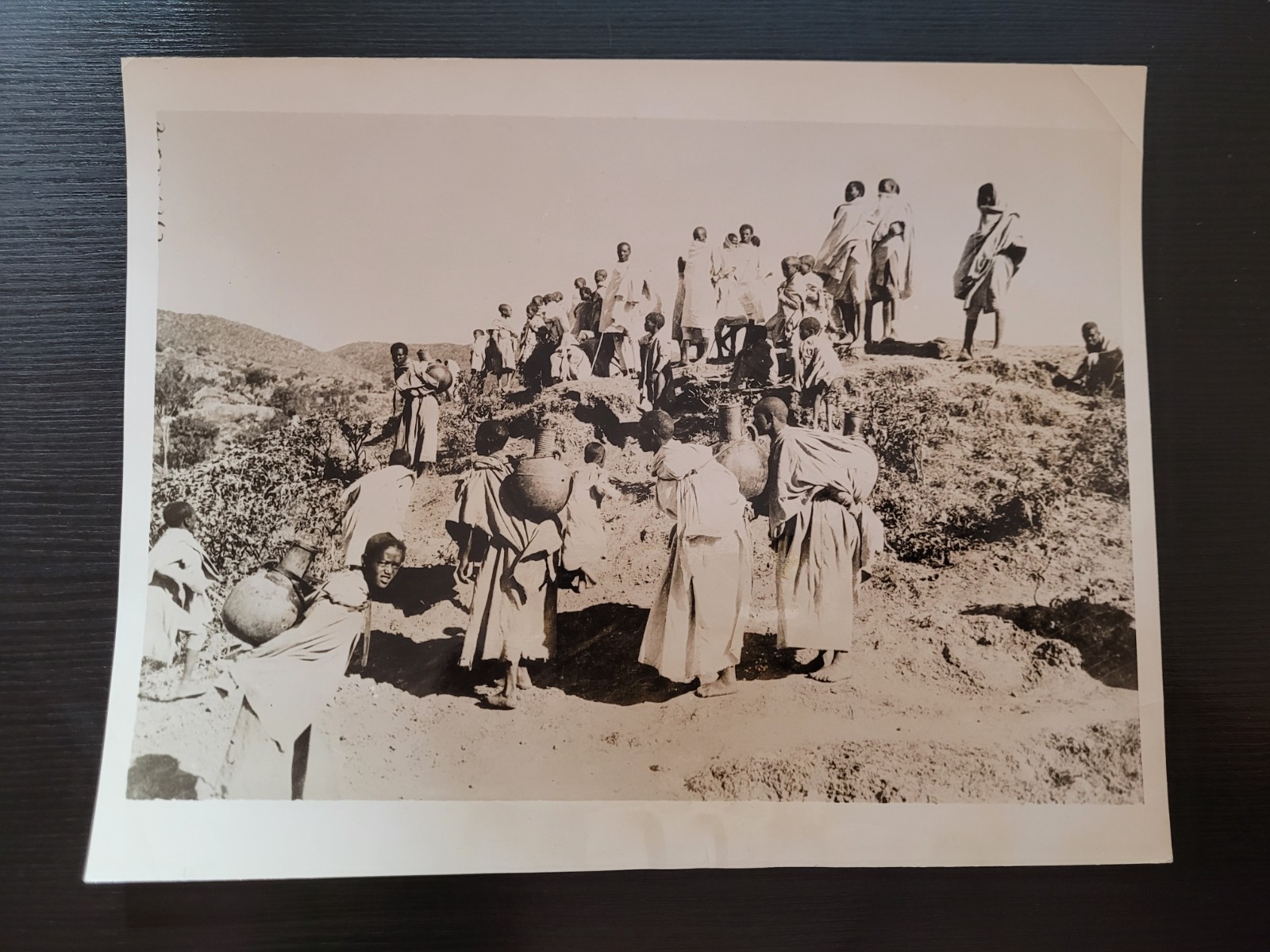
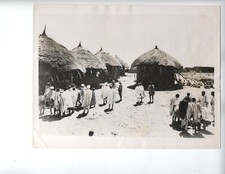
This original 7x9-inch black-and-white press photograph is a rare primary source documenting the Second Italo-Ethiopian War (1935–1937). Taken by embedded ACME Newspictures cameraman Ray Rousseau, these images capture the Italian Fascist occupation of East Africa just weeks after the initial invasion began in October 1935.
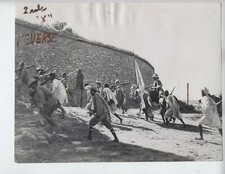
The photos provide a stark look at the \"Fortunes of War\" and the propaganda efforts of the Italian forces, showing native villagers being impressed into service or performing the Fascist salute under the Italian tricolor flag.
Full Transcription of Back Stamps & Snipe
Photo 1: The Salute (Ref: PLA 327143)
Top Snipe: \"ETHIOPIAN FASCISTS SALUTE FOR...\"
Main Caption: \"PLA 327143 ETHIOPIANS FASCIST SALUTE FOR ITALIAN FLAG NATIVES OF A CAPTURED ETHIOPIAN VILLAGE, TAKEN IN THE ITALIAN ADVANCE ON THE NORTHERN FRONT, GRAVELY GIVE THE FASCIST SALUTE TO THE ITALIAN FLAG AS IT FLUTTERS AT THE HEAD OF A TEMPORARY MAST. PHOTO MADE BY RAY ROUSSEAU, ACME STAFF CAMERAMAN WITH THE ITALIAN ARMY IN THE NORTH. CREDIT LINE (ACME) 11/25/35\"
Stamps: \"REF. DEPT. 12- 3 35 N. E. A.\"
Photo 2: Water Carriers (Ref: PLA 326367)
Main Caption: \"PLA326367 FORTUNES OF WAR CAPTURED ETHIOPIANS WERE IMPRESSED INTO SERVICE BY THEIR ITALIAN CONQUERORS AS WATER-CARRIERS. HERE THEY ARE CARRYING AQUA PURA TO ITALIAN TROOPS ON THE NORTHERN FRONT, NEAR MAKALE. PHOTO TAKEN BY RAY ROUSSEAU, ACME STAFF CAMERAMAN WITH THE ITALIANS. CREDIT LINE (ACME) 11/19/35\"
Stamps: \"REF. DEPT. 11- 26 35 N. E. A.\"
Key Features & Details
Dates: November 19 & 25, 1935.
Size: Approximately 7x9 inches.
Agency: ACME Newspictures / NEA (Newspaper Enterprise Association).
Condition: Authentic vintage press photos with original typed snipes, editorial stamps, and natural aging/minor corner wear.
Keywords for Search:Abyssinia Crisis, Mussolini, Benito Mussolini, Italian Colonialism, African History, Military History, WWII Prelude, Propaganda, Silver Gelatin, Makale Ethiopia, Photojournalism.
The Second Italo-Ethiopian War, also referred to as the Second Italo-Abyssinian War, was a war of aggression waged by Italy against Ethiopia, which lasted from October 1935 to February 1937. In Ethiopia it is often referred to simply as the Italian Invasion (Amharic: ጣልያን ወረራ, romanized: Ṭalyan warära; Oromo: Weerara Xaaliyaanii), and in Italy as the Ethiopian War (Italian: Guerra d\'Etiopia). It is seen as an example of the expansionist policy that characterized the Axis powers and the ineffectiveness of the League of Nations before the outbreak of World War II.
On 3 October 1935, two hundred thousand soldiers of the Italian Army commanded by Marshal Emilio De Bono attacked from Eritrea (then an Italian colonial possession) without prior declaration of war.[13] At the same time a minor force under General Rodolfo Graziani attacked from Italian Somalia. On 6 October, Adwa was conquered, a symbolic place for the Italian army because of the defeat at the Battle of Adwa by the Ethiopian army during the First Italo-Ethiopian War. On 15 October, Italian troops seized Aksum, and an obelisk adorning the city was torn from its site and sent to Rome to be placed symbolically in front of the building of the Ministry of Colonies.
Exasperated by De Bono\'s slow and cautious progress, Italian prime minister Benito Mussolini replaced him with General Pietro Badoglio. Ethiopian forces attacked the newly arrived invading army and launched a counterattack in December 1935, but their poorly armed forces could not resist for long against the modern weapons of the Italians. Even the communications service of the Ethiopian forces depended on foot messengers, as they did not have radio. It was enough for the Italians to impose a narrow fence on Ethiopian detachments to leave them unaware of the movements of their own army. Nazi Germany sent arms and munitions to Ethiopia because it was frustrated over Italian objections to its attempts to integrate Austria.[14] This prolonged the war and sapped Italian resources. It would soon lead to Italy\'s greater economic dependence on Germany and less interventionist policy on Austria, clearing the path for Adolf Hitler\'s Anschluss.[15]
The Ethiopian counteroffensive managed to stop the Italian advance for a few weeks, but the superiority of the Italians\' weapons (particularly heavy artillery and airstrikes with bombs and chemical weapons) prevented the Ethiopians from taking advantage of their initial successes. The Italians resumed the offensive in late January. On 31 March 1936, the Italians won a decisive victory at the Battle of Maychew, which nullified any possible organized resistance of the Ethiopians. Emperor Haile Selassie was forced to escape into exile on 2 May, and Badoglio\'s forces arrived in the capital Addis Ababa on 5 May. Italy announced the annexation of the territory of Ethiopia on 7 May and Italian King Victor Emmanuel III was proclaimed emperor on 9 May. The provinces of Eritrea, Italian Somaliland and Abyssinia (Ethiopia) were united to form the Italian province of East Africa. Fighting between Italian and Ethiopian troops persisted until 19 February 1937.[16] On the same day, an attempted assassination of Graziani led to the reprisal Yekatit 12 massacre in Addis Ababa, in which between 1,400 and 30,000 civilians were killed.[17][18][19] Italian forces continued to suppress rebel activity by the Arbegnoch until 1939.[20]
Italian troops used mustard gas in aerial bombardments (in violation of the Geneva Protocol and Geneva Conventions) against combatants and civilians in an attempt to discourage the Ethiopian people from supporting the resistance.[21][22] Deliberate Italian attacks against ambulances and hospitals of the Red Cross were reported.[23] By all estimates, hundreds of thousands of Ethiopian civilians died as a result of the Italian invasion, which have been described by some historians as constituting genocide.[24] Crimes by Ethiopian troops included the use of dumdum bullets (in violation of the Hague Conventions), the killing of civilian workmen (including during the Gondrand massacre) and the mutilation of captured Eritrean Ascari and Italians (often with castration), beginning in the first weeks of war.[25][26]
State of East Africa
Italy and its colonial possessions at the time of the outbreak of World War I
The Kingdom of Italy began its attempts to establish colonies in the Horn of Africa in the 1880s. The first phase of the colonial expansion concluded with the disastrous First Italo-Ethiopian War and the defeat of the Italian forces in the Battle of Adwa, on 1 March 1896, inflicted by the Ethiopian Army of Negus Menelik II.[27] In the following years, Italy abandoned its expansionist plans in the area and limited itself to administering the small possessions that it retained in the area: the colony of Italian Eritrea and the protectorate (later colony) of Italian Somaliland. For the next few decades, Italian-Ethiopian economic and diplomatic relations remained relatively stable.[28]
On 14 December 1925, Italy\'s fascist government signed a secret pact with Britain aimed at reinforcing Italian dominance in the region. London recognised that the area was of Italian interest and agreed to the Italian request to build a railway connecting Somalia and Eritrea. Although the signatories had wished to maintain the secrecy of the agreement, the plan soon leaked and caused indignation by the French and Ethiopian governments. The latter denounced it as a betrayal of a country that had been for all intents and purposes a member of the League of Nations.[29]
As fascist rule in Italy continued to radicalise, its colonial governors in the Horn of Africa began pushing outward the margins of their imperial foothold. The governor of Italian Eritrea, Jacopo Gasparini, focused on the exploitation of Teseney in an attempt to win over the leaders of the Tigre people against Ethiopia. The governor of Italian Somaliland, Cesare Maria de Vecchi, began a policy of repression that led to the occupation of the fertile Jubaland, and the cessation in 1928 of collaboration between the settlers and the traditional Somali chiefs.
Walwal Incident
Main article: Abyssinia Crisis
The Italo-Ethiopian Treaty of 1928 stated that the border between Italian Somaliland and Ethiopia was 21 leagues parallel to the Benadir coast (approximately 118.3 kilometres [73.5 miles]). In 1930, Italy built a fort at the Welwel oasis (also Walwal, Italian: Ual-Ual) in the Ogaden and garrisoned it with Somali dubats (irregular frontier troops commanded by Italian officers). The fort at Welwel was well beyond the 21-league limit and inside Ethiopian territory. On 23 November 1934, an Anglo–Ethiopian boundary commission studying grazing grounds to find a definitive border between British Somaliland and Ethiopia arrived at Welwel.[30]
The party contained Ethiopian and British technicians and an escort of around 600 Ethiopian soldiers. Both sides knew that the Italians had installed a military post at Welwel and were not surprised to see an Italian flag at the wells. The Ethiopian government had notified the Italian authorities in Italian Somaliland that the commission was active in the Ogaden and requested the Italians to co-operate. When the British commissioner Lieutenant-Colonel Esmond Clifford, asked the Italians for permission to camp nearby, the Italian commander, Captain Roberto Cimmaruta, rebuffed the request.[30]
Fitorari Shiferra, the commander of the Ethiopian escort, took no notice of the 150 Italian and Somali troops and made camp. To avoid being caught in an Italian–Ethiopian incident, Clifford withdrew the British contingent to Ado, about 20 mi (32 km) to the north-east, and Italian aircraft began to fly over Welwel. The Ethiopian commissioners retired with the British, but the escort remained. For ten days both sides exchanged menaces, sometimes no more than 2 m apart. Reinforcements increased the Ethiopian contingent to about 1,500 men and the Italians to about 500, and on 5 December 1934, shots were fired. The Italians were supported by an armoured car and bomber aircraft. The bombs missed, but machine gunfire from the car caused about 110 Ethiopian casualties.[31] 30 to 50 Italians and Somalis were killed. The incident led to the Abyssinia Crisis at the League of Nations.[32] On 4 September 1935, the League of Nations exonerated both parties for the incident.[33]
Ethiopian isolation
Britain and France, preferring Italy as an ally against Germany, did not take strong steps to discourage an Italian military buildup on the borders of Italian Eritrea and Italian Somaliland. Because of the German Question, Mussolini needed to deter Hitler from annexing Austria while much of the Italian Army was being deployed to the Horn of Africa, which led him to draw closer to France to provide the necessary deterrent.[34] King Victor Emmanuel III shared the traditional Italian respect for British sea power and insisted to Mussolini that Italy must not antagonise Britain before he assented to the war.[34] In that regard, British diplomacy in the first half of 1935 greatly assisted Mussolini\'s efforts to win Victor Emmanuel\'s support for the invasion.[34]
On 7 January 1935, a Franco-Italian Agreement was made that gave Italy essentially a free hand in Africa in return for Italian co-operation in Europe.[35] Pierre Laval told Mussolini that he wanted a Franco-Italian alliance against Nazi Germany and that Italy had a \"free hand\" in Ethiopia.[34] In April, Italy was further emboldened by participation in the Stresa Front, an agreement to curb further German violations of the Treaty of Versailles.[36] The first draft of the communique at Stresa Summit spoke of upholding stability all over the world, but British Foreign Secretary, Sir John Simon, insisted for the final draft to declare that Britain, France and Italy were committed to upholding stability \"in Europe\", which Mussolini took for British acceptance of an invasion of Ethiopia.[34]
In June, non-interference was further assured by a political rift, which had developed between the United Kingdom and France, because of the Anglo-German Naval Agreement.[37] As 300,000 Italian soldiers were transferred to Eritrea and Italian Somaliland over the spring and the summer of 1935, the world\'s media was abuzz with speculation that Italy would soon be invading Ethiopia.[34] In June 1935, Anthony Eden arrived in Rome with the message that Britain opposed an invasion and had a compromise plan for Italy to be given a corridor in Ethiopia to link the two Italian colonies in the Horn of Africa, which Mussolini rejected outright.[34] As the Italians had broken the British naval codes, Mussolini knew of the problems in the British Mediterranean Fleet, which led him to believe that the British opposition to the invasion, which had come as an unwelcome surprise to him, was not serious and that Britain would never go to war over Ethiopia.[38]
The prospect that an Italian invasion of Ethiopia would cause a crisis in Anglo-Italian relations was seen as an opportunity in Berlin. Although Hitler did not want to see Haile Selassie win, Germany provided some weapons to Ethiopia out of fear of quick victory for Italy.[39] The German perspective was that if Italy was bogged down in a long war in Ethiopia, that would probably lead to Britain pushing the League of Nations to impose sanctions on Italy, which the French would almost certainly not veto out of fear of destroying relations with Britain; that would cause a crisis in Anglo-Italian relations and allow Germany to offer its \"good services\" to Italy.[39] In that way, Hitler hoped to win Mussolini as an ally and to destroy the Stresa Front.[39]
A final possible foreign ally of Ethiopia was Japan, which had served as a model to some Ethiopian intellectuals. After the Welwel incident, several right-wing Japanese groups, including the Great Asianism Association and the Black Dragon Society, attempted to raise money for the Ethiopian cause. The Japanese ambassador to Italy, Dr. Sugimura Yotaro, on 16 July assured Mussolini that Japan held no political interests in Ethiopia and would stay neutral in the coming war. His comments stirred up a furor inside Japan, where there had been popular affinity for the fellow nonwhite empire in Africa,[40] which was reciprocated with similar anger in Italy towards Japan combined with praise for Mussolini and his firm stance against the \"gialli di Tokyo\" (\"Tokyo Yellows\").[40] Despite popular opinion, when the Ethiopians approached Japan for help on 2 August, they were refused, and even a modest request for the Japanese government for an official statement of its support for Ethiopia during the coming conflict was denied.[41]
Armies
Ethiopian forces
Main articles: Ethiopian order of battle in the Second Italo-Ethiopian War and List of Second Italo-Ethiopian War weapons of Ethiopia
Medical supplies for the front in Addis Ababa.
With war appearing inevitable, the Ethiopian Emperor Haile Selassie ordered a general mobilisation of the Army of the Ethiopian Empire:
All men and boys able to carry a spear go to Addis Ababa. Every married man will bring his wife to cook and wash for him. Every unmarried man will bring any unmarried woman he can find to cook and wash for him. Women with babies, the blind, and those too aged and infirm to carry a spear are excused. Anyone found at home after receiving this order will be hanged.[42][43]
Selassie\'s army consisted of around 500,000 men, some of whom were armed with spears and bows. Other soldiers carried more modern weapons including rifles, but many of them were equipment from before 1900 and so were obsolete.[3] According to Italian estimates, on the eve of hostilities, the Ethiopians had an army of 350,000–760,000 men. Only about 25% of the army had any military training, and the men were armed with a motley collection of 400,000 rifles of every type and in every condition.[5] The Ethiopian Army had about 234 antiquated pieces of artillery mounted on rigid gun carriages as well as a dozen 3.7 cm PaK 35/36 anti-tank guns.[44]
The army had about 800 light Colt and Hotchkiss machine-guns and 250 heavy Vickers and Hotchkiss machine guns, about 100 .303-inch Vickers guns on AA mounts, 48 20 mm Oerlikon S anti-aircraft guns and some recently purchased Canon de 75 CA modèle 1917 Schneider 75 mm field guns. The arms embargo imposed on the belligerents by France and Britain disproportionately affected Ethiopia, which lacked the manufacturing industry to produce its own weapons.[44] The Ethiopian army had some 300 trucks, seven Ford A-based armoured cars and four World War I era Fiat 3000 tanks.[5]
The best Ethiopian units were the emperor\'s \"Kebur Zabagna\" (Imperial Guard), which were well-trained and better equipped than the other Ethiopian troops. The Imperial Guard wore a distinctive greenish-khaki uniform of the Belgian Army, which stood out from the white cotton cloak (shamma), which was worn by most Ethiopian fighters and proved to be an excellent target.[5] The skills of the Rases, the Ethiopian generals armies, were reported to rate from relatively good to incompetent. After Italian objections to the Anschluss, the German annexation of Austria, Germany sent three aeroplanes, 10,000 Mauser rifles and 10 million rounds of ammunition to the Ethiopians.[44]
The serviceable portion of the Ethiopian Air Force was commanded by a Frenchman, André Maillet, and included three obsolete Potez 25 biplanes.[45] A few transport aircraft had been acquired between 1934 and 1935 for ambulance work, but the Air Force had 13 aircraft and four pilots at the outbreak of the war.[7] Airspeed in England had a surplus Viceroy racing plane, and its director, Neville Shute, was delighted with a good offer for the \"white elephant\" in August 1935. The agent said that it was to fly cinema films around Europe. When the client wanted bomb racks to carry the (flammable) films, Shute agreed to fit lugs under the wings to which they could attach \"anything they liked\". He was told that the plane was to be used to bomb the Italian oil storage tanks at Massawa, and when the CID enquired about the alien (ex-German) pilot practices in it Shute got the impression that the Foreign Office did not object. However, fuel, bombs and bomb racks from Finland could not reach Ethiopia in time, and the paid-for Viceroy stayed at its works. The emperor of Ethiopia had £16,000 to spend on modern aircraft to resist the Italians and planned to spend £5000 on the Viceroy and the rest on three Gloster Gladiator fighters.[46]
There were 50 foreign mercenaries who joined the Ethiopian forces, including French pilots like Pierre Corriger, American pilot John Robinson (aviator), the Trinidadian pilot Hubert Julian, an official Swedish military mission under Captain Viking Tamm, the White Russian Feodor Konovalov and the Czechoslovak writer Adolf Parlesak. Several Austrian Nazis, a team of Belgian fascists, and the Cuban mercenary Alejandro del Valle also fought for Haile Selassie.[47] Many of the individuals were military advisers, pilots, doctors or supporters of the Ethiopian cause; 50 mercenaries fought in the Ethiopian army and another 50 people were active in the Ethiopian Red Cross or nonmilitary activities.[48] The Italians later attributed most of the relative success achieved by the Ethiopians to foreigners, or ferenghi.[49] (The Italian propaganda machine magnified the number to thousands to explain away the Ethiopian Christmas Offensive in late 1935.)[50]
A former Ottoman general named Wehib Pasha also served as a military advisor with the Ethiopian army during the war, notably designing a defensive line for Ethiopian troops known as the \"Hindenburg Wall\", which was broken through by Italian troops during the Battle of the Ogaden in 1936.
Haile Selassie
Haile Selassie
Ras Kassa Haile Darge
Ras Kassa Haile Darge
Imru Haile Selassie
Imru Haile Selassie
Italian forces
Main articles: Italian order of battle for the Second Italo-Ethiopian War and List of Second Italo-Ethiopian War weapons of Italy
Italian soldiers recruited in 1935 in Montevarchi to fight the Second Italo-Abyssinian War.
There were 400,000 Italian soldiers in Eritrea and 285,000 in Italian Somaliland with 3,300 machine guns, 275 artillery pieces, 200 tankettes and 205 aircraft. In April 1935, the reinforcement of the Royal Italian Army (Regio Esercito) and the Regia Aeronautica (Royal Air Force) in East Africa (Africa Orientale) accelerated. Eight regular, mountain and blackshirt militia infantry divisions arrived in Eritrea, and four regular infantry divisions arrived in Italian Somaliland, about 685,000 soldiers and a great number of logistical and support units; the Italians included 200 journalists.[51] The Italians had 6,000 machine guns, 2,000 pieces of artillery, 599 tanks and 390 aircraft. The Regia Marina (Royal Navy) carried tons of ammunition, food and other supplies, with the motor vehicles to move them, but the Ethiopians had only horse-drawn carts.[8]
The Italians placed considerable reliance on their Corps of Colonial Troops (Regio Corpo Truppe Coloniali, RCTC) of indigenous regiments recruited from the Italian colonies of Eritrea, Somalia and Libya. The most effective of the Italian commanded units were the Eritrean native infantry (Ascari), which was often used as advanced troops. The Eritreans also provided cavalry and artillery units; the \"Falcon Feathers\" (Penne di Falco) was one prestigious and colourful Eritrean cavalry unit. Other RCTC units during the invasion of Ethiopia were irregular Somali frontier troops (dubats), regular Arab-Somali infantry and artillery and infantry from Libya.[52]
The Italians had a variety of local semi-independent \"allies\" in the north, and the Azebu Galla were among several groups induced to fight for the Italians. In the south, the Somali sultan Olol Dinle commanded a personal army, which advanced into the northern Ogaden with the forces of Colonel Luigi Frusci. The sultan was motivated by his desire to take back lands that the Ethiopians had taken from him. The Italian colonial forces even included men from Yemen, across the Gulf of Aden.[53]
The Italians were reinforced by volunteers from the so-called Italiani all\'estero, members of the Italian diaspora from Argentina, Uruguay and Brazil; they formed the 221st Legion in the Divisione Tevere, which a special Legione Parini fought under Frusci near Dire Dawa.[54] On 28 March 1935, General Emilio De Bono was named the commander-in-chief of all Italian armed forces in East Africa.[55] De Bono was also the commander-in-chief of the forces invading from Eritrea on the northern front. De Bono commanded nine divisions in the Italian I Corps, the Italian II Corps and the Eritrean Corps. General Rodolfo Graziani was commander-in-chief of forces invading from Italian Somaliland on the southern front.[56]
Initially, he had two divisions and a variety of smaller units under his command: a mixture of Italians, Somalis, Eritreans, Libyans and others. De Bono regarded Italian Somaliland as a secondary theatre, whose primary need was to defend itself, but it could aid the main front with offensive thrusts if the enemy forces were not too large there.[56] Most foreigners accompanied the Ethiopians, but Herbert Matthews, a reporter and historian who wrote Eyewitness in Abyssinia: With Marshal Bodoglio\'s forces to Addis Ababa (1937), and Pedro del Valle, an observer for US Marine Corps, accompanied the Italian forces.[57]
Benito Mussolini
Benito Mussolini
Emilio De Bono
Emilio De Bono
Pietro Badoglio
Pietro Badoglio
Italian invasion
Main articles: De Bono\'s invasion of Ethiopia and Christmas Offensive
A map showing the military actions from 1935 to February 1936
A map showing the military actions from February to May 1936
Italian notice, signed by general Emilio De Bono, proclaiming the abolishment of slavery in Tigray in Italian and Amharic. The abolition of slavery was one of the first measures taken by the Italian occupation government in Ethiopia.
At 5:00 am on 3 October 1935, De Bono crossed the Mareb River and advanced into Ethiopia from Eritrea without a declaration of war.[58] General De Bono\'s attack force included I East African Army Corps, under General Ruggero Santini, on the left; II East African Army Corps, under Lieutenant General Pietro Maravigna, on the right, and the Eritrean Army Corps (Corpo d\'Armata Indigeni), under General Alessandro Pirzio Biroli, in the center. On De Bono\'s flanks, the eastern lowlands included the 13th and 26th Colonial battalions, a Libyan battalion, and three irregular bands in the regions of Massawa, northern Danakil, and southern Danakil. The western lowlands included the 27th and 28th Colonial battalions, a unit of irregulars and Libyan volunteers supported by the 17th Colonial Battalion.[59]
At this point in the campaign, the lack of roads represented a serious hindrance for the Italians as they crossed into Ethiopia. On the Eritrean side, roads had been constructed right up to the border. On the Ethiopian side, these roads often transitioned into vaguely defined paths,[58] and the Italian army used aerial photography[60] to plan its advance, as well as mustard gas attacks.
On 5 October the Italian I Corps took Adigrat, and by 6 October, Adwa (Adowa) was captured by the Italian II Corps. Haile Selassie had ordered Duke (Ras) Seyoum Mangasha, the Commander of the Ethiopian Army of Tigre, to withdraw a day\'s march away from the Mareb River. Later, the Emperor ordered his son-in-law and Commander of the Gate (Dejazmach) Haile Selassie Gugsa, also in the area, to move back 89 and 56 km (55 and 35 mi) from the border.[58]
On 11 October, Gugsa surrendered with 1,200 followers at the Italian outpost at Idaga Hamus. Italian propagandists lavishly publicised the surrender but fewer than a tenth of Gugsa\'s men defected with him.[61] On 14 October, De Bono proclaimed the end of slavery in Ethiopia but this liberated the former slave owners from the obligation to feed their former slaves, in the unsettled conditions caused by the war.[b] Much of the livestock in the area had been moved to the south to feed the Ethiopian army and many of the emancipated people had no choice but to appeal to the Italian authorities for food.[61] By 15 October, De Bono\'s forces had advanced from Adwa and occupied the holy capital of Axum. De Bono entered the city riding on a white horse and then looted the Obelisk of Axum.[63] To Mussolini\'s dismay, the advance was methodical and on 8 November, the I Corps and the Eritrean Corps captured Mekelle. The Italian advance had added 56 mi (90 km) to the line of supply and De Bono wanted to build a road from Adigrat before continuing.[64][65]
In early October 1935, Rodolfo Graziani began the southern campaign by deploying mobile columns of motorized troops supported by tanks and the Regia Aeronautica. The Italians faced steady Ethiopian resistance by the troops of Afawarq Walda Samayat in the valley of River Fafan, at Gorahai. Only after Afawarq was mortally wounded on 7 November, the Italians captured Gorahai, a victory that facilitated the future advance on Harar and Jijiga. Graziani hoped that the occupation of these two towns would allow his soldiers to prevent weapons’ shipments destined for the Emperor’s forces from entering Ethiopia from British Somaliland. From Gorahai, the Italians deployed 120 miles up the Fafan valley to Degehabur. Attacks of the troops of Nasibu Zeamanuel against Graziani’s rear units forced the column to return to Gorahai. Meanwhile, another Italian column advanced to Degehabur but had to withdraw just north of Gorahai. By late 1935, Graziani, disposing over a small number of troops, remained largely on the defensive, also being effectively blocked by the army of Nasibu in Hararghe and the army of Desta Damtew in Dolo. Heavy rains also contributed to Graziani’s lack of progress.[66]
In November 1935, Brigadier General Oreste Mariotti penetrated the Danakil Desert from Kulul after being assembled at the Eritrean port of Fatima Eri. Securing the left flank of the Italian army, Mariotti and his troops marched across the desert, ascended up the Tigrean plateau, where they repelled an attack of Dejazmach Kasa Sebhat’s troops on 12–13 November at Atsbi. The force then continued to Mekelle, where it joined the troops of I Corps.[67]
In early December 1935, the Hoare–Laval Pact was proposed by Britain and France. Italy would gain the best parts of Ogaden and Tigray and economic influence over all the south. Abyssinia would have a guaranteed corridor to the sea at the port of Assab; the corridor was a poor one and known as a \"corridor for camels\".[68] Mussolini was ready to play along with considering the Hoare-Laval Pact, rather than rejecting it outright, to avoid a complete break with Britain and France, but he kept demanding changes to the plan before he would accept it as a way to stall for more time to allow his army to conquer Ethiopia.[69] Mussolini was not prepared to abandon the goal of conquering Ethiopia, but the imposition of League of Nations sanctions on Italy caused much alarm in Rome.[70]
The war was wildly popular with the Italian people, who relished Mussolini\'s defiance of the League as an example of Italian greatness. Even if Mussolini had been willing to stop the war, the move would have been very unpopular in Italy.[69] Kallis wrote, \"Especially after the imposition of sanctions in November 1935, the popularity of the Fascist regime reached unprecedented heights\".[69] On 13 December, details of the pact were leaked by a French newspaper and denounced as a sellout of the Ethiopians. The British government disassociated itself from the pact and British Foreign Secretary Sir Samuel Hoare was forced to resign in disgrace.[71]
Haile Selassie with Red Cross members
In December 1935, the Ethiopian army completed its mobilization and prepared to launch the Christmas Offensive. The Christmas Offensive was intended to split the Italian forces in the north with the Ethiopian centre, crushing the Italian left with the Ethiopian right and to invade Eritrea with the Ethiopian left. Ras Seyum Mangasha held the area around Abiy Addi with about 30,000 men. Selassie with about 40,000 men advanced from Gojjam toward Mai Timket to the left of Ras Seyoum. Ras Kassa Haile Darge with around 40,000 men advanced from Dessie to support Ras Seyoum in the centre in a push towards Warieu Pass. Ras Mulugeta Yeggazu, the Minister of War, advanced from Dessie with approximately 80,000 men to take positions on and around Amba Aradam to the right of Ras Seyoum. Amba Aradam was a steep sided, flat topped mountain directly in the way of an Italian advance on Addis Ababa.[72] The four commanders had approximately 190,000 men facing the Italians. Ras Imru and his Army of Shire were on the Ethiopian left. Ras Seyoum and his Army of Tigre and Ras Kassa and his Army of Beghemder were the Ethiopian centre. Ras Mulugeta and his \"Army of the Center\" (Mahel Sefari) were on the Ethiopian right.[72]
On 15 December, a battle took place in the region of May Timket, not far from Tekeze River, where the soldiers of Ras Imru advancing from Begemder attacked a unit of Camicie Nere led by Major Criniti. In the following days, there were fierce battles at the Dembeguina Pass along the Gondar-Adwa track, with heavy losses for both sides (the Italians lost some 15 tankettes). Ras Imru\'s troops failed to widen the assault; however, the Italians also had to withdraw from large territory, withdrawing closer to their main positions at Aksum. Ras Seyoum\'s army attempted an assault in Tembien, at Abiy Addi, which the Italians repelled thanks to their superior fire power, but they had to withdraw their positions to the north again.[73]
The Ethiopian counteroffensive managed to stop the Italian advance for a few weeks, but the superiority of the Italian\'s weaponry (artillery and machine guns) as well as aerial bombardment with chemical weapons, at first with mustard gas prevented the Ethiopians from taking advantage of their initial successes. The Ethiopians in general were very poorly armed, with few machine guns. Having spent a decade accumulating poison gas in East Africa, Mussolini gave Badoglio authority to resort to Schrecklichkeit (frightfulness), which included destroying villages and using gas (OC 23/06, 28 December 1935). Mussolini was even prepared to resort to bacteriological warfare as long as these methods could be kept quiet. Some Italians objected when they found out but the practices were kept secret, the government issuing denials or spurious stories blaming the Ethiopians.[74][c]
Second Italian advance
Main articles: First Battle of Tembien, Battle of Amba Aradam, Second Battle of Tembien, Battle of Shire (1936), and Battle of Maychew
Italian soldiers with a field gun
As the progress of the Christmas Offensive slowed, Italian plans to renew the advance on the northern front began as Mussolini had given permission to use poison gas (but not mustard gas) and Badoglio received the Italian III Corps and the Italian IV Corps in Eritrea during early 1936. Late in the year, Ras Desta Damtu assembled up his army in the area around Dolo to invade Italian Somaliland. Between 12 and 16 January 1936, the Italians defeated the Ethiopians at the Battle of Genale Doria. The Regia Aeronautica destroyed the army of Ras Desta, Ethiopians claiming that poison gas was used.[76] On 20 January, the Italians resumed their northern offensive at the First Battle of Tembien (20 to 24 January) in the broken terrain between the Warieu Pass and Makale. The forces of Ras Kassa were defeated, the Italians using phosgene gas and suffering 1,082 casualties against 8,000 Ethiopian casualties according to an Ethiopian wireless message intercepted by the Italians.[77] Despite these impressive victories, on 30 January 1936, Mussolini warned the Italian public that at least another year would be required to complete the conquest of Ethiopia.[78]
[It]...was at the time when the operations for the encircling of Makale were taking place that the Italian command, fearing a rout, followed the procedure which it is now my duty to denounce to the world. Special sprayers were installed on board aircraft so that they could vaporize, over vast areas of territory, a fine, death-dealing rain. Groups of nine, fifteen, eighteen aircraft followed one another so that the fog issuing from them formed a continuous sheet. It was thus that, as from the end of January 1936, soldiers, women, children, cattle, rivers, lakes, and pastures were drenched continually with this deadly rain. To systematically kill all living creatures, to more surely poison waters and pastures, the Italian command made its aircraft pass over and over again. That was its chief method of warfare.
— Haile Selassie[79]
From 10 to 19 February, the Italians captured Amba Aradam and destroyed Ras Mulugeta\'s army in the Battle of Amba Aradam (Battle of Enderta). The Ethiopians suffered massive losses and poison gas destroyed a small part of Ras Mulugeta\'s army, according to the Ethiopians. During the slaughter following the attempted withdrawal of his army, both Ras Mulugeta and his son were killed. The Italians lost 800 killed and wounded while the Ethiopians lost 6,000 killed and 12,000 wounded. From 27 to 29 February, the armies of Ras Kassa and Ras Seyoum were destroyed at the Second Battle of Tembien. Ethiopians again argued that poison gas played a role in the destruction of the withdrawing armies.[80]
In early March, the army of Ras Imru was attacked, bombed and defeated in what was known as the Battle of Shire. In the battles of Amba Aradam, Tembien and Shire, the Italians suffered about 2,600 casualties and the Ethiopians about 15,000; Italian casualties at the Battle of Shire being 969 men. The Italian victories stripped the Ethiopian defences on the northern front, Tigré province had fallen most of the Ethiopian survivors returned home or took refuge in the countryside and only the army guarding Addis Ababa stood between the Italians and the rest of the country.[80]
On 20 March the East African Fast Column (Colonna Celere dell\'Africa Orientale) of General Achille Starace, composed of some 3,000 troops on more than 400 vehicles, entered Ethiopia from Omhajer. After a difficult 380 km march, on 1 April the Italians occupied Gondar without a fight, and soon took the region around Lake Tana. Another Italian column went along the Sudanese border, closing British supply routes. The troops of II Corps reached Gondar via May Timket and Debarq. Additionally, an Italian column of 17,000 men deployed from Assab captured Aussa on the same day, a town that controlled one of the main caravan routes to Addis Ababa.[81]
Italian artillery operated by Somali Ascari troops
On 31 March 1936 at the Battle of Maychew, the Italians defeated an Ethiopian counter-offensive by the main Ethiopian army commanded by Selassie. The Ethiopians launched near non-stop attacks on the Italian and Eritrean defenders but could not overcome the well-prepared Italian defences. When the exhausted Ethiopians withdrew, the Italians counter-attacked. The Regia Aeronautica attacked the survivors at Lake Ashangi with mustard gas. The Italian troops had 400 casualties, the Eritreans 874 and the Ethiopians suffered 8,900 casualties from 31,000 men present according to an Italian estimate.[82] The defeat at Maychew caused the Ethiopian army to disintegrate, the demoralized troops began to desert in large numbers, and various tribal chiefs accepted Italian bribes and turned against the Imperial forces.[83]
Column of Italian colonial troops and vehicles in Ethiopia
After a lull in the Southern front, the Italians in the south prepared an advance towards the city of Harar. On 22 March, the Regia Aeronautica bombed Harar and Jijiga, reducing them to ruins even though Harar had been declared an \"open city\".[84] On 14 April, Graziani launched his attack against Ras Nasibu Emmanual to defeat the last Ethiopian army in the field at the Battle of the Ogaden. The Ethiopians were drawn up behind a defensive line that was termed the \"Hindenburg Wall\", designed by the chief of staff of Ras Nasibu, and Wehib Pasha, a seasoned ex-Ottoman commander. After ten days, the last Ethiopian army had disintegrated; 2,000 Italian soldiers and 5,000 Ethiopian soldiers were killed or wounded.[85]
Fall of Addis Ababa
Main article: March of the Iron Will
Column of Italian troops marching
Italian colonial troops advance on Addis Ababa
On 7 April 1936, an increasingly desperate Haile Selassie issued a proclamation that called to arms all Ethiopian males capable of military service. However, most of those who responded lacked military training and, at best, had antiquated weapons. This disparity was coupled with vicious Italian tactics like mass executions of Ethiopian soldiers and civilians and the use of chemical weapons. On 26 April 1936, Badoglio began the \"March of the Iron Will\" from Dessie to Addis Ababa, an advance with a mechanised column against slight Ethiopian resistance.[86][87]
Meanwhile, Selassie conducted a disorganized retreat towards the capital. There, government officials operated without leadership, unable to contact the Emperor and unsure of his whereabouts.[88] Realizing that Addis Ababa would soon fall to the Italians, Ethiopian administrators met to discuss a possible evacuation of the government to the west. After several days, they decided that they should relocate to Gore, though actual preparations for their departure were postponed.[89] Addis Ababa became crowded with retreating soldiers from the front while its foreign residents sought refuge at various European legations.[90] Selassie reached the capital on 30 April. That day his Council of Ministers resolved that the city should be defended and a retreat to Gore conducted only as a last resort.[90]
The following day an ad hoc council of Ethiopian nobles convened to re-examine the decision, where Ras Aberra Kassa suggested that the Emperor should go to Geneva to appeal to the League of Nations for assistance before returning to lead resistance against the Italians. The view was subsequently adopted by Selassie and preparations were made for his departure.[91] On 2 May, Selassie boarded a train from Addis Ababa to Djibouti, with the gold of the Ethiopian Central Bank. From there he fled to the United Kingdom, with the tacit acquiescence of the Italians who could have bombed his train, into exile (Mussolini had refused a request from Graziani to mount such an attack.[92])
Before he departed, Selassie ordered that the government of Ethiopia be moved to Gore and directed the mayor of Addis Ababa to maintain order in the city until the Italians\' arrival. Imru Haile Selassie was appointed Prince Regent during his absence. The city police, under Abebe Aregai and the remainder of the Imperial Guard did their utmost to restrain a growing crowd but rioters rampaged throughout the city, looting and setting fire to shops owned by Europeans. Most of the violence occurred between looters, fighting over the spoils and by 5 May, much of the city lay in ruins.[93] At 04:00 Badoglio drove into the city at the head of 1,600 lorries and patrols of Italian tanks, troops and Carabinieri were sent to occupy tactically valuable areas in the city, as the remaining inhabitants watched sullenly.[94]
Subsequent operations
Main article: Arbegnoch
Italian troops in Addis Ababa, 1936
After the occupation of Addis Ababa, nearly half of Ethiopia was still unoccupied and the fighting continued for another three years until nearly 90% was \"pacified\" just before World War II, although censorship kept this from the Italian public.[1] Ethiopian commanders withdrew to nearby areas to regroup; Abebe Aregai went to Ankober, Balcha Safo to Gurage, Zewdu Asfaw to Mulo, Blatta Takale Wolde Hawariat to Limmu and the Kassa brothers—Aberra, Wondosson and Asfawossen—to Selale. Haile Mariam conducted hit-and-run attacks around the capital.[95] About 10,000 troops remaining under the command of Aberra Kassa had orders from Selassie to continue resistance.[95]
On 10 May 1936, Italian troops from the northern front and from the southern front met at Dire Dawa.[96] The Italians found the recently released Ethiopian Ras, Hailu Tekle Haymanot, who boarded a train back to Addis Ababa and approached the Italian invaders in submission.[97] Imru Haile Selassie fell back to Gore in southern Ethiopia to reorganise and continue to resist the Italians. In early June, the Italian government promulgated a constitution for Africa Orientale Italiana (AOI, Italian East Africa) bringing Ethiopia, Eritrea and Italian Somaliland together into an administrative unit of six provinces. Badoglio became the first Viceroy and Governor General but on 11 June, he was replaced by Marshal Graziani.[98]
On 21 June Kassa held a meeting with Bishop Abune Petros and several other Patriot leaders at Debre Libanos, about 70 km (43 mi) north of Addis Ababa. Plans were made to storm parts of the capital but a lack of transport and radio equipment prevented a co-ordinated attack.[95] In July, Ethiopian forces attacked Addis Ababa and were routed. Numerous members of Ethiopian royalty were taken prisoner and others were executed soon after they surrendered.[98] The exiled government in Gore was never able to provide any meaningful leadership to the Patriots or remaining military formations but sporadic resistance by independent groups persisted around the capital.[95]
Memorial in Nekemte
On the night 26 June, members of the Arbegnoch destroyed three Italian aircraft in Nekemte and killed twelve Italian officials, including Air Marshal Vincenzo Magliocco and aviator Antonio Locatelli, after the Italians had sent the party to parley with the local populace. Graziani ordered the town to be bombed in retaliation for the killings (Magliocco was his deputy). Local hostility forced out the Patriots and Desta Damtew, commander of the southern Patriots, withdrew his troops to Arbegona. Surrounded by Italian forces, they retreated to Butajira, where they were eventually defeated. An estimated 4,000 Patriots were reportedly killed in both engagements, 1,600 of whom—including Damtew—after being taken prisoner.[99] On 19 December, Wondosson Kassa was executed near Debre Zebit and on 21 December, Aberra Kassa and Asfawossen Kassa were executed in Fikke. In late 1936, after the Italians tracked him down in Gurage, Dejazmach Balcha Safo was killed in battle.[98] On 19 December, Ras Imru surrendered at the Gojeb river.[100]
After the end of the rainy season, an Italian column left Addis Ababa in September and occupied Gore a month later. The forces of Ras Imru were trapped between the Italians and the Sudan border and Imru surrendered on 19 December. Imru was flown to Italy and imprisoned on the Island of Ponza, while the rest of the Ethiopian prisoners taken in the war were dispersed in camps in East Africa and Italy. A second column went south-west to attack Ras Desta and the Dejasmatch Gabre Mariam who had assembled military forces in the Great Lakes district. The Ethiopians were defeated on 16 December and by January, the Italians had established a measure of control over the provinces of Jimma, Kafa and Arusi. After another two months, the remaining Ethiopians were surrounded and fought on, rather than surrender. Mariam was killed.[101] On 19 February 1937 the last battle of the war occurred when remnants of the Armies of Sidamo and Bale clashed with Italian forces at Gogetti, and were defeated.[2]
Addis Ababa massacre
Main article: Yekatit 12
That same date, 19 February 1937 – Yekatit 12 according to the Ge\'ez calendar – saw the attempted assassination of Marshal Graziani by Eritrean rebels Abraham Deboch and Mogos Asgedom in Addis Ababa. The campaign of reprisals visited by the Italians upon the population of Addis Ababa has been described as the worst massacre in Ethiopian history.[102] Estimates vary on the number of people killed in the three days that followed the attempt on Graziani\'s life. Ethiopian sources estimated that 30,000 people were killed by the Italians, while Italian sources claimed that only a few hundred were killed. A 2017 history of the massacre estimated that 19,200 people were killed, 20 percent of the population of Addis Ababa.[17] Over the following week, numerous Ethiopians suspected of opposing Italian rule were rounded up and executed, including members of the Black Lions and other members of the aristocracy. Many more were imprisoned, even collaborators such as Ras Gebre Haywot, the son of Ras Mikael of Wollo, Brehane Markos, and Ayale Gebre, who had helped the Italians identify the two men who made the attempt on Graziani\'s life.[103]
According to Mockler, \"Italian carabinieri had fired into the crowds of beggars and poor assembled for the distribution of alms; and it is said that the Federal Secretary, Guido Cortese, even fired his revolver into the group of Ethiopian dignitaries standing around him.\"[104] Hours later, Cortese gave the fatal order:
Comrades, today is the day when we should show our devotion to our Viceroy by reacting and destroying the Ethiopians for three days. For three days I give you \'\'carte blanche\'\' to destroy and kill and do what you want to the Ethiopians.[104]
Italians doused native houses with petrol and set them on fire. They broke into the homes of local Greeks and Armenians and lynched their servants. Some even posed on the corpses of their victims to have their photographs taken.[104] The first day of the massacre has been commemorated as \"Yekatit 12\" (19 February) by Ethiopians ever since. There is a Yekatit 12 monument in Addis Ababa in memory of these Ethiopian victims of Italian aggression.
In 1968, Colonel A. J. Barker wrote that from 1 January 1935 to 31 May 1936, the Italian army and Blackshirt units lost 1,148 men killed, 125 men died of wounds and thirty-one missing; about 1,593 Eritrean troops and 453 civilian workmen were also killed, a total of 3,319 casualties.[18] In a 1978 publication, Alberto Sbacchi wrote that these official Italian casualty figures of about 3,000 were an underestimate.[105] Sbacchi wrote that the official total of Italian casualties was unreliable, because the regime desired to underestimate Italian losses.[106] Angelo Del Boca estimates the total Italian losses up to 31 December 1936 (including more than six months of guerrilla warfare after the end of the conflict) speak of 2,317 dead for the Italian army, 1,165 for the Blackshirts, 193 from the air force, 56 from the navy, 78 civilians in the Gondrand shipyard massacre, 453 factory workers and 88 merchant marines, for a total of 4,350 Italians killed.[9] To these figures must be added approximately 9,000 injured and 18,200 repatriated due to illness.[10] Estimates on the losses of the askaris, however very vague, he puts it at 4,500 killed.[9] From 1936 to 1940, there was an additional 9,555 men killed and 144,000 sick and wounded.[107] Total Italian casualties from 1935 to 1940 according to these calculations were about 208,000 killed or wounded. Based on 1,911 Italians killed in the first six months of 1940, Ministry of Africa figures for 6 May 1936 to 10 June 1940 are 8,284 men killed, which Sbacchi considered to be fairly accurate.[25]
There was a lack of reliable statistics because confusion during the invasion made it difficult to keep accurate records and the Statistical Bulletin had ceased to provide data on fatalities. Field hospital records had been destroyed, inventories dispersed, individual deaths were not reported and bodies were not repatriated to Italy. Unpublished reports listed 3,694 military and civilian fatalities among 44,000 casualties and from May 1936 to June 1940, there were another 12,248 military and civilian fatalities in 144,000 casualties.[108] The Italian estimation of Ethiopian losses are 50,000 men killed in the Northern front and 20,000 men killed in the Southern front for a total of 70,000 battle deaths. Conversely, in a memorandum submitted to the Paris conference in 1946, the Ethiopian government enumerated 275,000 men killed in action, 78,500 Patriots killed in hostilities during the occupation from 1936 to 1941, 17,800 women and children killed by bombing, 30,000 people killed in the massacre of February 1937, 35,000 people died in concentration camps, 24,000 Patriots killed in obedience to orders from summary courts, 300,000 people died after their villages had been destroyed, a total of 760,300 deaths.[109] However, Del Boca claims that these figures are unreliable and were likely exaggerated to extract more reparations. He asserts that the Italian estimation is more accurate.[9]
War crimes
Rome brings black culture to the Abbysians, caricature by Adolf Hoffmeister, 1936.
Use of chemical weapons
Italian military forces used between 300 and 500 tons of mustard gas to attack both military and civilian targets,[110] despite being a signatory to the 1925 Geneva Protocol banning the practice. This gas had been produced during World War I and subsequently transported to East Africa. J. F. C. Fuller, who was present in Ethiopia during the conflict, stated that mustard gas \"was the decisive tactical factor in the war.\"[111] Historian Walter Laqueur estimates that up to one-third of Ethiopian casualties of the war were caused by chemical weapons.[112]
The Italians claimed that their use of gas was justified by the execution of Tito Minniti and his observer in Ogaden by Ethiopian forces.[113] However, the use of gas was authorized by Mussolini nearly two months before Minniti\'s death on 26 December 1935, as evidenced by the following order:
Rome, October 27, 1935. To His Excellency Graziani. The use of gas as an ultima ratio to overwhelm enemy resistance and in case of counter-attack is authorized. Mussolini.[22]
After Minniti\'s death, the order was expanded to use of gas \"on a vast scale\":
Rome, December 28, 1935. To His Excellency Badoglio. Given the enemy system I have authorized Your Excellency the use even on a vast scale of any gas and flamethrowers. Mussolini.[22]
Military and civilian targets were gas bombed and on 30 December, a Red Cross unit was bombed at Dolo and an Egyptian ambulance was attacked at Bulale; a few days later an Egyptian medical unit was bombed at Daggah Bur. There were more attacks in January and February, then on 4 March 1936, a British Red Cross camp near Quoram appeared to be subject to the most deliberate attack of all, when low-flying Italian aircraft crews could not have missed the big Red Cross signs.[57] Mustard gas was also sprayed from above on Ethiopian combatants and villages. The Italians tried to keep their resort to chemical warfare secret but were exposed by the International Red Cross and many foreign observers. The Italians claimed that at least 19 bombardments of Red Cross tents \"posted in the areas of military encampment of the Ethiopian resistance\", had been \"erroneous\".[citation needed]
The Italians delivered poison gas by gas shell and in bombs dropped by the Regia Aeronautica. Though poorly equipped, the Ethiopians had achieved some success against modern weaponry but had no defence against the \"terrible rain that burned and killed\".[114]
In general, historians concluded that the use of chemical weapons was effective and devastating to morale and manpower, though some disagree and argue that they had negligible effect in battle.[115] Historian Angelo Del Boca condemned the use of gas, but argued that it had only a minimal effect on Italian war aims.[116] An analysis by the Stockholm International Peace Research Institute argued that the use of chemical weapons shifted the war in favor of the Italians, and dealt a major blow to Ethiopian morale.[117]
American and British military analysis came to similar conclusions. The US military concluded that \"Chemical weapons were devastating against the unprepared and unprotected Ethiopians.\"[118] British Major General J. F. C. Fuller, assigned to the Italian army, noted that \"In place of the laborious process of picketing the heights, the heights sprayed with gas were rendered unoccupiable by the enemy, save at the gravest risk. It was an exceedingly cunning use of this chemical.\"[118]
Haile Selassie in his report to the League of Nations described it:
....Special sprayers were installed on board aircraft so they could vaporize over vast areas of territory a fine, death-dealing rain. Groups of 9, 15, or 18 aircraft followed one another so that the fog issuing from them formed a continuous sheet. It was thus that, as from the end of January 1936, soldiers, women, children, cattle, rivers, lakes, and pastures were drenched continually with this deadly rain. In order more surely to poison the waters and pastures, the Italian command made its aircraft pass over and over again. These fearful tactics succeeded. Men and animals succumbed. The deadly rain that fell from the aircraft made all those whom it touched fly shrieking with pain. All those who drank poisoned water or ate infected food also succumbed in dreadful suffering. In tens of thousands the victims of Italian mustard gas fell.
Dum-dum rounds and atrocities against prisoners of war
Ethiopian troops used dum-dum bullets, which had been banned by declaration IV, 3 of the Hague Convention (1899) and began mutilating captured Eritrean Askari (often with castration) beginning in the first weeks of war.[26] Some hundreds of colonial Eritrean Ascari and dozens of Italians suffered these amputations, often done before death as allegedly happened to 17 Italian workers emasculated in Gondrand in February 1936.[119]
During the first months of the invasion, Italian forces adopted an unofficial policy of \"take no prisoners\" and frequently executed surrendering enemy combatants, including their commanders. In May 1936, Mussolini issued an order to Graziani stating that “all rebels taken prisoner must be shot,\" which he followed up weeks later with further instructions to commit mass murder of \"rebels\" by saying “I repeat my authorization to Your Excellency to initiate and systematically conduct a policy of terror and extermination.”[120]
Public and international reaction
Medal commemorating the role of the Italian Eritrean colonial troops in the war
Haile Selassie\'s resistance to the Italian invasion made him Time Man of the Year 1935.
Italy\'s military victory overshadowed concerns about the economy.[121][122] Mussolini was at the height of his popularity in May 1936 with the proclamation of the Italian empire.[69] His biographer, Renzo De Felice, called the war \"Mussolini\'s masterpiece\" as for a brief moment he had been able to create something resembling a national consensus both in favor of himself and his regime.[123] When Badoglio returned to Italy, he received a snub, as Mussolini made certain that the honours bestowed on Badoglio received fell short of those granted to an Italian \"national hero\", in order to present the victory as an achievement of the Fascist system rather than as an achievement of the traditional Italian elites, of which Badoglio was a member.[124] A sign of Mussolini\'s increased power and popularity after the war was his creation of a new military rank; First Marshal of the Italian Empire, to which he promoted both himself and King Victor Emmanuel III, thus putting the prime minister on a theoretical level of equality with the king.[124]
Haile Selassie passes through Jerusalem on his way to exile in Britain.
Haile Selassie sailed from Djibouti in the British cruiser HMS Enterprise. From Mandatory Palestine Selassie sailed to Gibraltar en route to Britain. While still in Jerusalem, Haile Selassie sent a telegram to the League of Nations:
We have decided to bring to an end the most unequal, most unjust, most barbarous war of our age, and have chosen the road to exile in order that our people will not be exterminated and in order to consecrate ourselves wholly and in peace to the preservation of our empire\'s independence... we now demand that the League of Nations should continue its efforts to secure respect for the covenant, and that it should decide not to recognize territorial extensions, or the exercise of an assumed sovereignty, resulting from the illegal recourse to armed force and to numerous other violations of international agreements.[125]
The Ethiopian Emperor\'s telegram caused several nations to temporarily defer recognition of the Italian conquest.[125]
How the Italian public felt about being against or for the war has a degree of uncertanty surrounding it as the general public did not have freedom of expression and censorship was practiced. Punishments for speaking out against the war varied. No sizeable resistance movement developed in Italy toward the war although a number of acts of resistance did occur with several mutinies and acts of sabotage happening. Initially the public was concerned about the risk of the British intervening in the conflict.[126]
On 30 June, Selassie spoke at the League of Nations and was introduced by the President of the Assembly as \"His Imperial Majesty, the Emperor of Ethiopia\" (\"Sa Majesté Imperiale, l\'Empereur d\'Ethiopie\"). A group of jeering Italian journalists began yelling insults and were expelled before he could speak. In response, the Romanian chairman, Nicolae Titulescu, jumped to his feet and shouted \"Show the savages the door!\" (\"À la porte les sauvages!\").[127] Selassie denounced Italian aggression and criticised the world community for standing by. At the conclusion of his speech, which appeared on newsreels throughout the world, he said \"It is us today. It will be you tomorrow\". France appeased Italy because it could not afford to risk an alliance between Italy and Germany; Britain decided that its military weakness meant that it had to follow France\'s lead.[128][129] Selassie\'s resolution to the League to deny recognition of the Italian conquest was defeated and he was denied a loan to finance a resistance movement.[130] On 4 July 1936, the League voted to end the sanctions imposed against Italy in November 1935. By 15 July, the sanctions were at an end.[131][d]
On 18 November 1936, the Italian Empire was recognised by the Empire of Japan and Italy recognised the Japanese occupation of Manchuria, marking the end of the Stresa Front.[133][134] Hitler had supplied the Ethiopians with 16,000 rifles and 600 machine guns in the hope that Italy would be weakened when he moved against Austria.[14] By contrast, France and Britain recognised Italian control over Ethiopia in 1938. Mexico was the only country to strongly condemn Italy\'s sovereignty over Ethiopia, respecting Ethiopian independence throughout. Including Mexico, only six nations in 1937 did not recognise the Italian occupation: China, New Zealand, the Soviet Union, Republican Spain and the United States.[135][136] Three years later, only the USSR officially recognised Selassie and the United States government considered recognising the Italian Empire with Ethiopia included.[137] The invasion of Ethiopia and its general condemnation by Western democracies isolated Mussolini and Fascist Italy until 1938. From 1936 to 1939, Mussolini and Hitler joined forces to support the fascist camp during the Spanish Civil War. In April 1939, Mussolini launched the Italian invasion of Albania. In May, Italy and Nazi Germany joined in the Pact of Steel. In September 1940, both nations signed the Tripartite Pact along with the Empire of Japan.[citation needed]
The conflict has been described by historian Brenda Plummer as triggering the first \"great manifestation\" of African American interest in foreign affairs, despite the financial limitations imposed by the Great Depression and the US government\'s interwar commitment to neutrality.[138][139] Largescale organised responses to Italy\'s attack on Ethiopia included a peaceful demonstration in New York City on 18 August 1935 and Chicago on 1 September.[139][140] Historian Jacquelyn Dowd Hall situates these developments in her chronology of a \"long civil rights movement\" in which she traces the emergence of a black popular front in the 1930s.[141]
Main articles: Italian East Africa and Italian Empire
The six provinces of Italian East Africa.
On 10 May 1936, Italian troops from the northern front and from the southern front met at Dire Dawa.[96] The Italians found the recently released Ethiopian Ras, Hailu Tekle Haymanot, who boarded a train back to Addis Ababa and approached the Italian invaders in submission.[97] On 21 December 1937, Rome appointed Amedeo, 3rd Duke of Aosta, as the new Viceroy and Governor General of Italian East Africa with instructions to take a more conciliatory line.
Areas of Arbegnoch resistance in 1937
Aosta instituted public works projects including 3,200 km (2,000 mi) of new paved roadways, 25 hospitals, 14 hotels, dozens of post offices, telephone exchanges, aqueducts, schools and shops. The Italians decreed miscegenation to be illegal.[142] Racial separation, including residential segregation, was enforced as thoroughly as possible and the Italians showed favouritism to non-Christian groups.
To isolate the dominant Amhara rulers of Ethiopia, who supported Selassie, the Italians granted the Oromos, the Somalis and other Muslims, many of whom had supported the invasion, autonomy and rights. The Italians also definitively abolished slavery and abrogated feudal laws that had been upheld by the Amharas. Early in 1938, a revolt broke out in Gojjam, led by the Committee of Unity and Collaboration, made up of some of the young, educated elite who had escaped reprisals after the assassination attempt on Graziani. The general oversaw another wave of reprisals and had all Ethiopians in administrative jobs murdered, some by being thrown from aircraft, after being taken on board under the pretext of visiting the King in Rome, leading to the saying \"He went to Rome\".[143]
Duke of Aosta
The army of occupation had 150,000 men but was spread thinly; by 1941 the garrison had been increased to 250,000 soldiers, including 75,000 Italian civilians. The former police chief of Addis Ababa, Abebe Aregai, was the most successful leader of the Ethiopian guerrilla movement after 1937, using units of fifty men. On 11 December, the League of Nations voted to condemn Italy and Mussolini withdrew from the League.[144] Along with world condemnation, the occupation was expensive, the budget for AOI from 1936 to 1937 required 19,136 billion lire for infrastructure, when the annual revenue of Italy was only 18,581 billion lire.[145]
East African campaign, 1940–1941
Main article: East African Campaign (World War II)
Soldiers of the West African Frontier Force removing Italian frontier markers from the Kenya–Italian Somaliland border, 1941
While in exile in the United Kingdom, Haile Selassie had sought the support of the Western democracies for his cause but had little success until the Second World War began. On 10 June 1940, Mussolini declared war on France and Britain and attacked British and Commonwealth forces in Egypt, Sudan, Kenya and British Somaliland. In August 1940, the Italian conquest of British Somaliland was completed. The British and Selassie incited Ethiopian and other local forces to join a campaign to dislodge the Italians from Ethiopia. Selassie went to Khartoum to establish closer liaison with the British and resistance forces within Ethiopia. On 18 January 1941, Selassie crossed the border into Ethiopia near the village of Um Iddla and two days later rendezvoused with Gideon Force. The Allied East Africa Command and Ethiopian patriots had largely succeeded in their operations by 6 April 1941, when Addis Ababa was occupied by Harry Wetherall, Dan Pienaar and Charles Christopher Fowkes, who received the surrender of the city; on 5 May, exactly five years after the fall of the capital, Selassie made a formal entry in Addis Ababa.[146] After the Italian defeat, the Italian guerrilla war in Ethiopia was carried out by remnants of Italian troops and their allies, which lasted until the Armistice between Italy and Allied armed forces in September 1943.[147]
Peace treaty, 1947
Main article: Treaty of Peace with Italy, 1947
The treaty signed in Paris by the Italian Republic (Repubblica Italiana) and the victorious powers of World War II on 10 February 1947, included formal Italian recognition of Ethiopian independence and an agreement to pay $25,000,000 (equivalent to $352,049,000 in 2024) in reparations. Since the League of Nations and most of its members had never officially recognized Italian sovereignty over Ethiopia, Haile Selassie had been recognized as the restored emperor of Ethiopia following his formal entry into Addis Ababa in May 1941. Ethiopia presented a bill to the Economic Commission for Italy of £184,746,023 for damages inflicted during the course of the Italian occupation. The list included the destruction of 2,000 churches, 535,000 houses, the slaughter or theft of 5,000,000 cattle, 7,000,000 sheep and goats, 1,000,000 horses and mules and 700,000 camels.[18]
Use of chemical weapons
Ethiopian veterans are seeking an apology and compensation from Italy for war crimes committed during the Second Italo-Ethiopian War, particularly the use of chemical weapons like mustard gas.[148] While there is no record of a formal, official apology, Italy did acknowledge the use of chemical weapons in a 1996 statement.[149]
Ethiopian War Crimes Commission, 1946
On 20 May 1946, an Ethiopian War Crimes Commission was appointed to investigate and prosecute Italian war crimes committed during the Second Italo-Ethiopian War. The Ethiopian War Crimes Commission under President Ambaye Wolde Mariam began obtaining evidence to justify the trial of Marshal Badoglio and Marshal Graziani among other high ranking Italian officials.[150]
Ethiopia’s efforts to submit cases to the UN War Crimes Commission (UNWCC) raised a question of whether the Italo-Ethiopian conflict fell within its jurisdiction, as both Italian and British perspectives held that the war had effectively ended with Italy’s annexation by 1936—or at the latest before 1939—thereby framing any subsequent Italian violence as part of colonial administration rather than wartime conduct subject to UNWCC scrutiny.[151] Ethiopia’s Swedish legal adviser, Baron Erik Leijonhufvud, proposed a compromise in which an Ethiopian tribunal would include a majority of foreign judges and follow procedures and legal standards similar to those of the Nuremberg International Military Tribunal.[152][153]
Unlike in the Nuremberg Trials in post-Nazi Germany, few Italians were tried for war crimes after 1945. Critically, whatever the position taken by the UNWCC on individual cases, prosecution would require extradition of suspects, and Allied pressure on Italy to achieve this. Thus the Ethiopian War Crimes Commission limited itself to the prosecution of two persons, Badoglio and Graziani.[150] However, Badoglio was never formally tried for war crimes, as the British government, in particular, saw Badoglio as a valuable asset for maintaining order in Italy.[154] Graziani was tried for Nazi collaborationism at the Supreme Court in 1948, but his colonial conduct was left unquestioned.[155]
See also
List of Second Italo-Ethiopian War weapons of Ethiopia
Ethiopian Air Force
List of Second Italo-Ethiopian War weapons of Italy
Censorship in Italy
Faccetta Nera
First Italo-Ethiopian War
Paris Peace Treaties, 1947
Timeline of the Second Italo-Ethiopian War
The Ethiopian Empire,[a] historically known as Abyssinia or simply Ethiopia,[b] was a sovereign state[17] that encompassed the present-day territories of Ethiopia and Eritrea. It existed from the establishment of the Solomonic dynasty by Yekuno Amlak around 1270 until the 1974 coup d\'état by the Derg, which ended the reign of the final Emperor, Haile Selassie. In the late 19th century, under Emperor Menelik II, the empire expanded significantly to the south, and in 1952, Eritrea was federated under Selassie\'s rule. Despite being surrounded by hostile forces throughout much of its history, the empire maintained a kingdom centered on its ancient Christian heritage.[18]
Founded in 1270 by Yekuno Amlak, who claimed to descend from the last Aksumite king and ultimately King Solomon and the Queen of Sheba, it replaced the Agaw kingdom of the Zagwe. While initially a rather small and politically unstable entity, the Empire managed to expand significantly under the crusades of Amda Seyon I (1314–1344) and Dawit I (1382–1413), temporarily becoming the dominant force in the Horn of Africa.[19] The Ethiopian Empire would reach its peak during the long reign of Emperor Zara Yaqob (1434–1468). He consolidated the conquests of his predecessors, built numerous churches and monasteries, encouraged literature and art, centralized imperial authority by substituting regional warlords with administrative officials, and significantly expanded his hegemony over adjacent Islamic territories.[20][21][22]
The neighboring Muslim Adal Sultanate began to threaten the empire by repeatedly attempting to invade it, finally succeeding under Imam Mahfuz.[23] Mahfuz\'s ambush and defeat by Emperor Lebna Dengel brought about the early 16th-century jihad of the Ottoman-supported Adalite Imam Ahmed Gran, who was defeated in 1543 with the help of the Portuguese.[24] Greatly weakened, much of the Empire\'s southern territory and vassals were lost due to the Oromo migrations. In the north, in what is now Eritrea, Ethiopia managed to repulse Ottoman invasion attempts, although losing its access to the Red Sea to them.[25] Reacting to these challenges, in the 1630s Emperor Fasilides founded the new capital of Gondar, marking the start of a new golden age known as the Gondarine period. It saw relative peace, the successful integration of the Oromo and a flourishing of culture. With the deaths of Emperor Iyasu II (1755) and Iyoas I (1769) the realm eventually entered a period of decentralization, known as the Zemene Mesafint where regional warlords fought for power, with the emperor being a mere puppet.[26]
Emperor Tewodros II (r. 1855–1868) put an end to the Zemene Mesafint, reunified the Empire and led it into the modern period before dying during the British Expedition to Abyssinia. His successor Yohannes IV engaged primarily in war and successfully fought the Egyptians and Mahdists before dying against the latter in 1889. Emperor Menelik II, now residing in Addis Ababa, subjugated many peoples and kingdoms in what is now western, southern, and eastern Ethiopia, like Kaffa, Welayta, Harar, and other kingdoms. Thus, by 1898 Ethiopia expanded into its modern territorial boundaries. In the northern region, he confronted Italy\'s expansion. Through a resounding victory over the Italians at the Battle of Adwa in 1896, utilizing modern imported weaponry, Menelik ensured Ethiopia\'s independence and confined Italy to Eritrea.
Later, after the Second Italo-Ethiopian War, Benito Mussolini\'s Italian Empire occupied Ethiopia and established Italian East Africa, merging it with neighboring Eritrea and the Italian Somaliland colonies to the south-east. During World War II, the Italians were driven out of Ethiopia with the help of the British army. The Emperor returned from exile and the country became one of the founding members of the United Nations. However, the 1973 Wollo famine and domestic discontent led to the fall of the Empire in 1974 and the rise of the Derg.[27]
History
Main article: History of Ethiopia
After the fall of the Kingdom of Aksum in the 10th century AD, the Ethiopian Highlands would fall under the rule of the Zagwe Dynasty. The new rulers were Agaws that had come from the Lasta region, later ecclesiastical texts accused this dynasty of not having pure \"Solomonic\" stock and derided their achievements. Even at the zenith of their power, most Christians would consider them to be usurpers. However, the architecture of the Zagwe shows a connotation of earlier Aksumite traditions, among those can be seen in Lalibela, the building of rock hewn churches first appeared in the late Aksumite era and reached its peak under the Zagwe.[28]
The Zagwe were not able to stop squabbling over the throne, diverting men, energy and resources that could have been used to affirm the dynasty\'s authority. By the late 13th century, a young Amhara nobleman named Yekuno Amlak rose to power in Bete Amhara. He was strongly supported by the Orthodox Church as he promised to make the church a semi independent institution, he had also enjoyed support from the neighboring Muslim Makhzumi dynasty. Yekuno Amlak then rebelled against the Zagwe king and defeated him at the Battle of Ansata. Taddesse Tamrat argued that this king was Yetbarak, but due to a local form of damnatio memoriae, his name was removed from the official records.[29] A more recent chronicler of Wollo history, Getatchew Mekonnen Hasen, states that the last Zagwe king deposed by Yekuno Amlak was Na\'akueto La\'ab.[30][31]
Early Solomonic Period
Main article: Solomonic Dynasty
Yekuno Amlak would rise to the throne by 1270 AD. He was allegedly a descendant of the last king of Aksum, Dil Na\'od, and hence the royal kings of Aksum. Through the Aksumite royal lineage, it was also claimed that Yekuno Amlak was a descendant of the biblical king Solomon. The canonical form of the claim was set out in legends recorded in the Kebra Nagast, a 14th century text. According to this, the Queen of Sheba, who supposedly came from Aksum, visited Jerusalem where she conceived a son with King Solomon. On her return to her homeland of Ethiopia, she gave birth to the child, Menelik I. He and his descendants (which included the Aksumite royal house) ruled Ethiopia until overthrown by the Zagwe usurpers. Yekuno Amlak, as a supposed direct descendant of Menelik I, was therefore claimed to have \"restored\" the Solomonic line.[32]
Throughout Yekuno Amlak\'s reign he would enjoy friendly relations with the Muslims. He not only had established close ties with the neighboring Makhzumi dynasty but had also made contact with the Rasulids in Yemen and the Egyptian Mamluk Sultanate. In a letter sent to the Mamluke Sultan Baybars, he would state his intention of friendly cooperation with the Muslims of Arabia, and described himself as being a protector of all Muslims in Abyssinia. A devout Christian, he would order the construction of the church of Genneta Maryam, commemorating his work with an inscription that reads, \"By the grace of God, I king Yekuno Amlak, after I had come to the throne by the will of God, built this church.\"[32][33]
In 1285 Yekuno Amlak was succeeded by his son Yagbe\'u Seyon, who wrote a letter the Mamluke Sultan, Qalawun asking him to allow the patriarch of Alexandria to send an abuna or metropolitan for the Ethiopian Orthodox Church, but also protesting the Sultan\'s treatment of his Christian subjects in Egypt, stating that he was a protector of his own Muslim subjects in Ethiopia.[34] Towards the end of his reign, Yagbe\'u refused to appoint one of his sons to be his successors and instead decreed that each of them should rule for one year, he was succeeded by his sons in 1294 but this agreement immediately broke down, by 1299 one of his sons Wedem Arad seized the throne. Wedem Arad seems to have been in conflict with the neighbouring Sultanate of Ifat who were trying to expand in eastern Shewa.[35]
Amda Seyon\'s Conquests
Main articles: Amda Seyon I and Amda Seyon I\'s Expansions
The Ethiopian Empire under Emperor Amda Seyon I
Wedem Arad was succeeded by his son, Amda Seyon I, whose reign witnessed the composition of a very detailed and seemingly accurate account of the monarch\'s various campaigns against his Muslim enemies. This was the first of a series of royal chronicles which were written for the Ethiopian Emperors until modern times. These royal chronicles provided an unbroken chronological record of the entire medieval period in the Horn of Africa. A no less important work produced during his reign was the Fetha Nagast or \"Law of the Kings,\" which served as the country\'s legal code. Largely based on biblical principles, it codified the legal and social ideas of the time and remained in use until the early 20th century.[33]
The warlike emperor of Amda Seyon I conducted many campaigns in Gojjam, Damot and Eritrea, but his most important campaigns were against his Muslim enemies to the east, which shifted the balance of power in favour of the Christians for the next two centuries. Around 1320, Sultan an-Nasir Muhammad of the Mamluk Sultanate based in Cairo began persecuting Copts and destroying their churches. Amda Seyon then threatened to divert the flow of the Nile if the sultan did not stop his persecution. Haqq ad-Din I, sultan of Ifat, seized and imprisoned an Ethiopian envoy on his way back from Cairo. Amda Seyon responded by invading the Sultanate of Ifat, killing the sultan, sacking the capital and ravaging the Muslim territories, taking livestock, killing many inhabitants, destroying towns and mosques, and taking slaves.[36]
The Ifat sultan was succeeded by Sabr ad-Din I who rallied the Muslims and waged a rebellion against the Ethiopian occupation. Amda Seyon responded by launching another campaign against his Muslim adversaries to the east, killing the Sultan and campaigning as far as Adal, Dawaro and Bali in present day eastern Ethiopia. Amda Seyon\'s conquests significantly expanded the territory of the Ethiopian Empire, more than doubling it by size and establishing complete hegemony over the region. Relations between the Muslims of the Horn and the Ethiopian Empire seems to have broken down completely around this era, with the chronicler referring to the Muslims in the east and along the coast as \"liars, hyenas, dogs, children of evil who deny the son of Christ.\"[37][38]
Golden age of Solomonic Rule
Painting of Emperor Zara Yaqob at his coronation
Following Amda Seyon\'s campaigns to the east. Most of the Muslims in the Horn would become tributaries to the Ethiopian Empire, among them being the Ifat Sultanate. Amda Seyon was succeeded by his son Newaya Krestos in 1344. Newaya Krestos would put down several Muslim revolts in Adal and Mora. Towards the end of his reign he aggressively helped the Patriarch of Alexandria Mark IV, who had been imprisoned by As-Salih Salih, the Sultan of Egypt. One step Newaya Krestos took was to imprison the Egyptian merchants in his kingdom. The Sultan was forced to back down.[39]
In 1382, Dawit I succeeded the son of Newaya Krestos, Newaya Maryam, as Emperor of Ethiopia. The tributary state of the Ifat Sultanate had begun to resist Ethiopian hegemony and assert their independence under Sultan Sa\'ad ad-Din II. Sultan Sa\'ad as-Din would then raid the Ethiopian frontier provinces capturing much loot and slaves. This resulted in Emperor Dawit I declaring all the Muslims of the surrounding region to be \"enemies of the Lord\" and invading the Ifat Sultanate. After a battle between Sa\'ad ad-Din and the Emperor, in which the Ifat army was defeated and \"no less [sic] than 400 elders, each of whom carried an iron bar as his insignia of office\" were killed, Sa\'ad ad-Din with his remaining supporters were chased to as far as Zeila on the coast of Somaliland. There, the Ethiopian army besieged Zeila, finally capturing the city and killing Sultan Sa\'ad ad-Din, ending the Ifat Sultanate. After Sa\'ad ad-Din\'s death \"the strength of the Muslims was abated\", as Egyptian historian al-Maqrizi states, and then the Amhara settled in the Muslim territories \"and from the ravaged mosques they made churches\". The followers of Islam were said to have been harassed for over twenty years.[40] Following this victory, Ethiopian power would reach its zenith and this era would become legendary as a golden age of peace and stability for the Ethiopian Empire.[41]
However, the remaining Walashma returned from their exile in 1415 and established the Adal Sultanate centred around the Harar region. The Muslims then began to harass Christian held territories in the east prompting Emperor Yeshaq I to dedicate much of his time to defending his eastern peripheral territories. He seems to have employed several Egyptian Christian advisors to drill his army and teach them how to make Greek fire. These advances were not enough to keep the Muslims at bay, and Emperor Yeshaq was soon killed fighting the Adalites in 1429. Yeshaq\'s death was followed by several years of dynastic confusion during which 5 emperors succeeded each other in 5 years. However in 1434, Zara Yaqob of Ethiopia would establish himself on the throne.[42]
During his first years on the throne, Zara Yaqob launched a strong campaign against survivals of pagan worship and \"un-Christian practices\" within the church. He also took measures to greatly centralize the administration of the country, bringing regions under much tighter imperial control. After hearing about the demolition of the Egyptian Debre Mitmaq monastery, he ordered a period of national mourning and built a church of the same name in Tegulet. He then sent envoys to Egyptian Sultan, Sayf ad-Din Jaqmaq strongly protesting against the persecution of Egyptian Copts and threatening to divert the flow of the Nile. The Sultan then encouraged the Adal Sultanate to invade the province of Dawaro to distract the Emperor. However, this invasion was repulsed by the Emperor who defeated and killed the Adalite Sultan Badlay ibn Sa\'ad ad-Din at the Battle of Gomit.[43][44] The Egyptian sultan then had the Patraich of Alexandria severely beaten and threatened to execute him. The new Adalite sultan Muhammad ibn Badlay, son of the slain sultan, agreed to pay an annual tribute to the Emperor Zara Yaqob in the same year.[45] Zara Yaqob persecuted those who admitted to worshipping pagan gods, many of whom were decapitated in public. Zara Yaqob later founded Debre Berhan after seeing a miraculous light in the sky. Believing this was a sign from God showing approval for his persecution of pagans, the emperor ordered a church built on the site, and later constructed an extensive palace nearby, and a second church dedicated to Saint Cyriacus.[39][46]
Zara Yaqob was succeeded by Baeda Maryam I. Emperor Baeda Maryam would give the title of the Queen Mother to Eleni of Ethiopia, one of his father\'s wives. She proved to be an effective member of the royal family; Paul B. Henze comments that she \"was practically co-monarch\" during his reign. After the death of Baeda Maryam in 1478 he was succeeded by his 7-year-old son Eskender, whom Eleni would serve as his regent. She attempted to establish peace with the Adal Sultan Muhammad, but could not prevent Mahfuz the Emir of Harar from making raids into Ethiopian territory. When Eskender was of age, he invaded Adal and sacked its capital, Dakkar, but was defeated in an ambush returning home although he was able to escape. In 1517 Mahfuz invaded the Ethiopian province of Fatager but was killed by a soldier of Emperor Dawit II (Lebna Dengel) in a Single combat.[47] His chronicles state that the Muslim threat was finished and the Emperor returned to the highlands as a hero.[48]
Invasion of Ahmad Gragn
Further information: Ethiopian-Adal War
Emperor Dawit II (Lebna Dengel)
In 1527 a young imam by the name of Ahmad ibn Ibrahim al-Ghazi rose to power in Adal after years of internal strife. The Adal Sultanate stockpiled imported firearms, cannons and other advanced weaponry from Arabia and the Ottoman Empire, and invaded Ethiopia in 1529, inflicting a heavy defeat on Emperor Dawit II, but later withdrew. He returned two years later to begin a definite invasion of the empire, burning churches, forcibly converting Christians and massacring the inhabitants. According to the chroniclers, everywhere he went his men \"slew every adult Christian they found, and carried off the youths and the maidens and sold them as slaves.\" By the mid 1530s most of Ethiopia was under Adalite occupation and Lebna Dengel fled from mountain fortress to mountain fortress until he finally died of natural causes in Debre Damo.[49][50]
The Emperor was succeeded by his 18-year-old son, Gelawdewos, who faced a desperate situation but rallied his soldiers and people to resist the Muslim invasion. By 1540 Gelawdewos led a small force of around 70 men resisting in the highlands of Shewa. However, in 1541 four hundred well armed Portuguese musketeers had arrived in Massawa where they were reinforced by small contingents of Ethiopian warriors. This modest force made their way across Tigray where they would defeat much larger contingents of Adalite men. Alarmed by the success of the Portuguese, Gragn sent a petition to the Ottoman Empire and received 2,900 musket-armed reinforcements. Together with his Turkish allies Gragn attacked the Portuguese camp at Wofla, killing 200 of their rank and file, including their commander, Cristóvão da Gama.[51]
After the catastrophe at Wofla, the surviving Portuguese were able to meet up with Gelawdewos and his army in the Semien Mountains. The Emperor did not hesitate to take the offensive and won a major victory at the Battle of Wayna Daga, when the fate of Abyssinia was decided by the death of the Imam and the flight of his army. The invasion force collapsed and all the Abyssinians who had been cowed by the invaders returned to their former allegiance. The reconquest of Christian territories proceeded without encountering any effective opposition.[52]
In 1559 Gelawdewos was killed by invading forces Adal Sultanate at the Battle of Fatagar, and his severed head was paraded in Adal\'s capital Harar.[53] Simultaneously, his cousin Hamlamal sacked Harar, the capital of the Adal Sultanate, and killed the Adalite Sultan Barakat ibn Umar Din. The last known member of the Walasma dynasty was executed.[54][55]
Early modern period
The Fasil Ghebbi in Gonder
Further information: Ottoman-Ethiopian War (1557-1589), Oromo migrations, and Gondarine period
The Ottoman Empire occupied parts of Ethiopia, from 1557, establishing Habesh Eyalet, the province of Abyssinia, by conquering Massawa, the Empire\'s main port and seizing Suakin from the allied Funj Sultanate in what is now Sudan. In 1573 the Adal Sultanate attempted to invade Ethiopia again; however, Sarsa Dengel successfully defended the Ethiopian frontier at the Battle of Webi River, where he defeated, captured and executed the Adalite Sultan Muhammad ibn Nasir along with the core of the Adalite nobility.[56] This marked the end of Adal as a military power.[57]
The Ottomans were checked by Emperor Sarsa Dengel\'s victory and sacking of Arqiqo in 1589, thus containing them on a narrow coastline strip. The Afar Sultanate maintained the remaining Ethiopian port on the Red Sea at Baylul.[58] Oromo migrations through the same period occurred, with the movement of a large pastoral population from the southeastern provinces of the Empire. A contemporary account was recorded by the monk Abba Bahrey from the Gamo region. Subsequently, the empire organization changed progressively, with faraway provinces taking more independence. A remote province such as Bale is last recorded paying tribute to the imperial throne during Yaqob\'s reign (1590–1607).[59]
In 1636, Emperor Fasilides founded Gondar as a permanent capital, which became a highly stable, prosperous commercial center. This period saw profound achievements in Ethiopian art and architecture, and innovations such as the construction of the royal complex Fasil Ghebbi, and 44 churches[60] that were established around Lake Tana. In the arts, the Gondarine period saw the creation of diptychs and triptychs, murals and illuminated manuscripts, mostly with religious motifs. The reign of Iyasu the Great (1682-1706) was a major period of consolidation. It also saw the dispatching of embassies to Louis XIV\'s France and to Dutch India. The Early Modern period was one of intense cultural and artistic creation. Notable philosophers from that area are Zera Yacob and Walda Heywat. After the death of Iyasu I the empire fell into a period of political turmoil. From 1769 to 1855, the Ethiopian empire passed through a period known as the Princes Era (in Amharic: Zemene Mesafint). This was a period of Ethiopian history with numerous conflicts between the various Ras (equivalent to the English dukes) and the Emperor, who had only limited power and only dominated the area around the contemporary capital of Gondar. The development of society and culture stagnated in this period. Religious conflict, both within the Ethiopian Orthodox Church and between them and the Muslims, was often used as a pretext for mutual strife. The Princes Era ended with the reign of Emperor Tewodros II.
Modern era
Main article: First Italo-Ethiopian War
Menelik II at the Battle of Adwa
In 1868, following the imprisonment of several missionaries and representatives of the British government, the British engaged in the punitive Expedition to Abyssinia against Emperor Tewodros. With the backing of most nobles in Ethiopia, the campaign was a success for Britain, and the Ethiopian Emperor committed suicide rather than surrender. Beginning in the 1860s, under Menelik II, the empire\'s forces set off from the central province of Shewa to incorporate through conquest inhabited lands to the west, east and south of its realm.[61] The territories that were annexed included those of the western Oromo (non-Shoan Oromo), Sidama, Gurage, Wolayta,[62] and Dizi.[63] Among the imperial troops was Ras Gobena\'s Shewan Oromo militia. Many of the lands that they annexed had never been under the empire\'s rule, with the newly incorporated territories resulting in the modern borders of Ethiopia.[64]
From 1874 to 1876, the Empire re-expanded into Eritrea, under Yohannes IV King of Tembien, whose forces led by Ras Alula won the Ethiopian-Egyptian War, decisively beating the Egyptian forces at the Battle of Gundet in Hamasien. In 1887 Menelik, king of Shewa, invaded the Emirate of Harar after his victory at the Battle of Chelenqo.[65] In 1889 Menelik\'s general Gobana Dacche also defeated the Hadiya leader Hassan Enjamo and annexed Hadiya territory.[66]
The 1880s were marked by the Scramble for Africa. Italy, seeking a colonial presence in Africa, was awarded Eritrea by Britain, which led to the Italo-Ethiopian War of 1887–1889 and the scramble for Eritrea\'s coastal regions between King Yohannes IV of Tembien and Italy. After the death of Emperor Yohannes IV, Italy signed a treaty with Shewa (an autonomous kingdom within the empire), creating the protectorate of Abyssinia.
Due to significant differences between the Italian and Amharic translations of the treaty, Italy believed they had subsumed Ethiopia as a protectorate, while Menelik II of Shewa repudiated the protectorate status in 1893. Insulted, Italy declared war on Ethiopia in 1895. The First Italo-Ethiopian War resulted in the 1896 Battle of Adwa, in which Italy was decisively defeated by the numerically superior Ethiopians. As a result, the Treaty of Addis Ababa was signed in October, which strictly delineated the borders of Eritrea and forced Italy to recognize the independence of Ethiopia. Delegations from the United Kingdom and France – European powers whose colonial possessions lay next to Ethiopia – soon arrived in the Ethiopian capital to negotiate their own treaties with this newly-proven power.
As Ethiopia entered the 20th century, the imperial nobility embraced isolationism and resisted any forms of modernization, during this time, European travelers identified Ethiopia as a backwards and socially conservative country that was hostile to foreigners. Among them was Herbert Vivian, who in 1899 described the empire as an untamed land that was home to wild animals such as lions, elephants and crocodiles, and roads that consist of little more then caravan tracks, with \"regulations as vexatious as though Abyssinia was a civilized country\".[67] He describes the inhabitants as being hostile to foreign travelers, especially European missionaries who they view as the \"abomination of abominations\". Doctors are the only foreigners that are accepted.[68]
During the reign of Empress Zewditu, a modernizing faction within the imperial elite under Ras Tafari began to challenge the reactionary faction. After the Gugsa Wale\'s rebellion, the reactionary faction was defeated and Haile Selassie was coronated as Emperor of Ethiopia on 2 November 1930. A year later, Selassie introduced Ethiopia\'s first written constitution on 16 July 1931,[69] providing for a bicameral legislature.[70] The constitution kept power in the hands of the nobility, but it did establish democratic standards among the nobility, envisaging a transition to democratic rule: it would prevail \"until the people are in a position to elect themselves.\"[70]
Italian invasion and World War II
Further information: Second Italo-Ethiopian War, East African Campaign (World War II), and Haile Selassie § Exile
The Emperor\'s palace, 1934
In 1935, Italian soldiers under the command of Marshal Emilio De Bono began what is known as the Second Italo-Ethiopian War. During the conflict, both Ethiopian and Italian troops committed war crimes. Ethiopian troops are known to have made use of Dum-Dum bullets (in violation of the Hague Conventions) and mutilated captured soldiers (often with castration).[71] Italian troops used sulfur mustard in chemical warfare, ignoring the Geneva Protocol that it had signed seven years earlier. The Italian military dropped mustard gas in bombs, sprayed it from airplanes and spread it in powdered form on the ground. 150,000 chemical casualties were reported, mostly from mustard gas.
On May 1, 1936, Haile Selassie took a train to Djibouti and then boarded a British ship to Jerusalem,[72] spending the majority of his time in the city with Ethiopian monks, praying with them at the Church of the Holy Sepulchre.[73][74] He then fled to Bath, where he was granted asylum by British authorities who did not want him to stay in London, due to this being perceived as \"politically embarrassing\". Upon arrival, he stayed at a hotel, purchasing Fairfield House shortly afterward to spend the remainder of his time.[75] He was accompanied by his children, grandchildren, servants and others. In Bath, Haile Selassie became accustomed to the \"army of servants\" and living in a single house as he was financially restricted. He was seen getting rid of jewelry on a couple of occasions. Upon leaving England, he left the house for the elderly, not visiting again until 1954.[76]
The war lasted seven months, during which Addis Ababa was occupied on May 5, 1936, before an Italian victory was declared on May 9, 1936. Italy proclaimed the establishment of the Italian Empire in East Africa, with King Victor Emmanuel III as Emperor of Ethiopia, which was united with other Italian colonies in eastern Africa to form the new colony of Italian East Africa on June 1. The invasion was condemned by the League of Nations, though not much was done to end the hostility.
On June 30, 1936, Selassie traveled once to Geneva to plead with the League of Nations that Ethiopia not be officially recognized as part of the Italian Empire. He also had European allies who traveled to Ethiopia to report the news about the Ethiopian Army struggling with Italy. This helped Britain\'s later entry into Ethiopia.[76][77][78]
On 10 June 1940, Italy declared war on the United Kingdom and France, as the latter was in the process of being conquered by German forces at the time, and Benito Mussolini wished to expand Italy\'s colonial holdings. The Italian conquest of British Somaliland in August 1940 was successful, but the war turned against Italy afterward. The British accompanied Haile Selassie to Sudan and helped him organise his army within seven months,[79] finally launching a military campaign in January 1941, which returned him to the throne on May 5 of the same year.[76][80][81]
Post War Ethiopia
Main article: Haile Selassie
Haile Selassie with President Lyndon B. Johnson at the White House
On 27 August 1942, Haile Selassie abolished the legal basis of slavery throughout the empire and imposed severe penalties, including death, for slave trading.[82] After World War II, Ethiopia became a charter member of the United Nations. In 1948, the Ogaden, a region disputed with Somalia, was granted to Ethiopia.[83] On 2 December 1950, the UN General Assembly adopted Resolution 390 (V), establishing the federation of Eritrea (the former Italian colony) into Ethiopia.[84] Eritrea was to have its own constitution, which would provide for ethnic, linguistic, and cultural balance, while Ethiopia was to manage its finances, defense, and foreign policy.[84]
Despite his centralization policies that had been made before World War II, Haile Selassie still found himself unable to push for all the programs he wanted. In 1942, he attempted to institute a progressive tax scheme, but this failed due to opposition from the nobility, and only a flat tax was passed; in 1951, he agreed to reduce this as well.[85] Ethiopia was still \"semi-feudal\",[86] and the emperor\'s attempts to alter its social and economic form by reforming its modes of taxation met with resistance from the nobility and clergy, which were eager to resume their privileges in the postwar era.[85] Where Haile Selassie actually did succeed in effecting new land taxes, the burdens were often passed by the landowners to the peasants.[85] Despite his wishes, the tax burden remained primarily on the peasants.
Between 1941 and 1959, Haile Selassie worked to establish the autocephaly of the Ethiopian Orthodox Church.[87] The Ethiopian Orthodox Church had been headed by the abuna, a bishop who answered to the Patriarchate in Egypt. Haile Selassie applied to Egypt\'s Holy Synod in 1942 and 1945 to establish the independence of Ethiopian bishops, and when his appeals were denied he threatened to sever relations with the See of St. Mark.[87] Finally, in 1959, Pope Kyrillos VI elevated the Abuna to Patriarch-Catholicos.[87] The Ethiopian Church remained affiliated with the Alexandrian Church.[85] In addition to these efforts, Haile Selassie changed the Ethiopian church-state relationship by introducing taxation of church lands, and by restricting the legal privileges of the clergy, who had formerly been tried in their own courts for civil offenses.[85][88]
During the celebrations of his Silver Jubilee in November 1955, Haile Selassie introduced a revised constitution,[89] whereby he retained effective power, while extending political participation to the people by allowing the lower house of parliament to become an elected body. Party politics were not provided for. Modern educational methods were more widely spread throughout the Empire, and the country embarked on a development scheme and plans for modernization, tempered by Ethiopian traditions, and within the framework of the ancient monarchical structure of the state. Haile Selassie compromised when practical with the traditionalists in the nobility and church. He also tried to improve relations between the state and ethnic groups, and granted autonomy to Afar lands that were difficult to control. Still, his reforms to end feudalism were slow and weakened by the compromises he made with the entrenched aristocracy. The Revised Constitution of 1955 has been criticized for reasserting \"the indisputable power of the monarch\" and maintaining the relative powerlessness of the peasants.[90]
On 13 December 1960, while Haile Selassie was on a state visit to Brazil, his Imperial Guard forces staged an unsuccessful coup, briefly proclaiming Haile Selassie\'s eldest son Asfa Wossen as emperor. The coup d\'état was crushed by the regular army and police forces. The coup attempt lacked broad popular support, was denounced by the Ethiopian Orthodox Church, and was unpopular with the army, air force and police. Nonetheless, the effort to depose the emperor had support among students and the educated classes.[91] The coup attempt has been characterized as a pivotal moment in Ethiopian history, the point at which Ethiopians \"for the first time questioned the power of the king to rule without the people\'s consent\".[92] Student populations began to empathize with the peasantry and poor, and to advocate on their behalf.[92] The coup spurred Haile Selassie to accelerate reform, which was manifested in the form of land grants to military and police officials.
The emperor continued to be a staunch ally of the West, while pursuing a firm policy of decolonization in Africa, which was still largely under European colonial rule. The United Nations conducted a lengthy inquiry regarding the status of Eritrea, with the superpowers each vying for a stake in the state\'s future. Britain, the administrator at the time, suggested the partition of Eritrea between Sudan and Ethiopia, separating Christians and Muslims. A UN plebiscite voted 46 to 10 to have Eritrea be federated with Ethiopia, which was later stipulated on 2 December 1950 in resolution 390 (V). Eritrea would have its own parliament and administration and would be represented in what had been the Ethiopian parliament and would become the federal parliament.[93] However, Haile Selassie would have none of European attempts to draft a separate Constitution under which Eritrea would be governed, and wanted his own 1955 Constitution to apply in both Ethiopia and Eritrea. In 1961, tensions between independence-minded Eritreans and Ethiopian forces culminated in the Eritrean War of Independence. The emperor declared Eritrea the fourteenth province of Ethiopia in 1962.[94]
In 1963, Haile Selassie presided over the formation of the Organisation of African Unity (OAU), the precursor of the continent-wide African Union (AU). The new organization would establish its headquarters in Addis Ababa. In May of that year, Haile Selassie was elected as the OAU\'s first official chairperson, a rotating seat. Along with Modibo Keïta of Mali, the Ethiopian leader would later help successfully negotiate the Bamako Accords, which brought an end to the border conflict between Morocco and Algeria. In 1964, Haile Selassie would initiate the concept of the United States of Africa, a proposition later taken up by Muammar Gaddafi.[95]
Student unrest became a regular feature of Ethiopian life in the 1960s and 1970s. Marxism took root in large segments of the Ethiopian intelligentsia, particularly among those who had studied abroad and had thus been exposed to radical and left-wing sentiments that were becoming popular in other parts of the globe.[91] Resistance by conservative elements at the Imperial Court and Parliament, and by the Ethiopian Orthodox Church, made Haile Selassie\'s land reform proposals difficult to implement, and also damaged the standing of the government, costing Haile Selassie much of the goodwill he had once enjoyed. This bred resentment among the peasant population. Efforts to weaken unions also hurt his image. As these issues began to pile up, Haile Selassie left much of domestic governance to his Prime Minister, Aklilu Habte Wold, and concentrated more on foreign affairs.
Fall of monarchy
Main article: Ethiopian Revolution
Haile Selassie I was the last Emperor of the Ethiopian Empire.
The government\'s failure to adequately respond to the 1973 Wollo famine, the growing discontent of urban interest groups, and high fuel prices due to the 1973 oil crisis led to a revolt in February 1974 by the army and civilian populace. In June, a group of military officers formed the Coordinating Committee of the Armed Forces, Police, and Territorial Army also known as the Derg to maintain law and order due to the powerlessness of the civilian government following the widespread mutiny.
In July, Emperor Haile Selassie gave the Derg key concessions to arrest military and government officials at every level. Soon both former Prime Ministers Tsehafi Taezaz Aklilu Habte-Wold and Endelkachew Makonnen, along with most of their cabinets, most regional governors, many senior military officers and officials of the Imperial court were imprisoned. In August, after a proposed constitution creating a constitutional monarchy was presented to the Emperor, the Derg began a program of dismantling the imperial government to forestall further developments in that direction. The Derg deposed and imprisoned the Emperor on 12 September 1974 and chose Lieutenant General Aman Andom, a popular military leader and a Sandhurst graduate, to be acting head of state. This was pending the return of Crown Prince Asfaw Wossen from medical treatment in Europe when he would assume the throne as a constitutional monarch. However, General Aman Andom quarrelled with the radical elements in the Derg over the issue of a new military offensive in Eritrea and their proposal to execute the high officials of Selassie\'s former government. After eliminating units loyal to him: the Engineers, the Imperial Bodyguard and the Air Force, the Derg removed General Aman from power and executed him on 23 November 1974, along with some of his supporters and 60 officials of the previous Imperial government.[96]
Brigadier General Tafari Benti became the new chairman of the Derg and the head of state. The monarchy was formally abolished in March 1975, and Marxism-Leninism was proclaimed the new ideology of the state. Emperor Haile Selassie died under mysterious circumstances on 27 August 1975 while his personal physician was absent. It is commonly believed that Mengistu Haile Mariam killed him, either by ordering it done or by his own hand although the former is more likely.[97]
Society
According to Bahrey,[98] there were ten social groups in the feudal Ethiopia of his time, i.e. at the end of the 16th century. These social groups consisted of the monks; the debtera; lay officials (including judges); men at arms giving personal protection to the wives of dignitaries and to princesses; the shimaglle, who were the lords and hereditary landowners; their farm labourers or serfs; traders; artisans; wandering singers; and the soldiers, who were called chewa. According to modern thinking, some of these categories are not true classes. But at least the shimaglle, the serfs, the chewa, the artisans and the traders constitute definite classes. Power was vested in the Emperor and those aristocrats he appointed to execute his power, and the power enforcing instrument consisted of a class of soldiers, the chewa.[99]
In 1899, English explorer Herbert Vivian described Ethiopia as a diverse empire consisting of five distinct races. The main race are the Amharic speakers (Amharas), who he regards as the \"true Abyssinians\", Vivian describes them as being primarily sharpshooters and militiamen, whose irregular form of mountain warfare is the main reason for the country\'s independence. He also describes their women as being \"remarkedly pretty\" and notes that according to the Arab settlers who live in the country, \"they make the best of housewives\". Below the Amharic speakers are the Oromos, who are serfs to the aristocratic elite and lives under a form of military dictatorship. Vivian describes the Oromos as being excellent warriors who formerly dominated the region: \"Such fine fighters are the Gallas that, if they could get their hands on firearms they might have the Abyssinians again as their serfs\". Vivian regards the Oromos as being nominally Christian or Muslim, but states that the vast majority still retain their original pagan beliefs. In the eastern fringes of the empire are the nomadic Danakils and the Somalis, who Vivian regards as wild and fanatic nomads inhabiting a \"remarkable poor stretch of territory\". In the western borderlands are the negroes (Shanqella), which Vivian views as a collection of very primitive tribes who are regularly enslaved by the Abyssinians. Lastly are the Falashas, who he claims are the descendants of an indigenous tribe that adopted Judaism and live in relative isolation from the surrounding Christian and Muslim populations.[100]
Military
Main article: Army of the Ethiopian Empire
See also: Territorial Army (Ethiopia)
From the reign of Amde Tseyon, Chewa regiments, or legions, formed the backbone of the Empire military forces. The Ge\'ez term for these regiments is ṣewa (ጼዋ) while the Amharic term is č̣äwa (ጨዋ). The normal size of a regiment was several thousand men.[101] Each regiment was allocated a fief (Gult), to ensure its upkeep ensured by the land revenue.[102]
In 1445, following the Battle of Gomit, the chronicles record that Emperor Zara Yaqob started garrisoning the provinces with Chewa regiments.
Imperial Ethiopian Army: Summary of known deployments c. 15th century
Name of regiment[103] Region Translation
Bäṣär waǧät Serae, Dawaro, Menz, Gamo Enemy of the waǧät
Ǧan amora Dobe\'a, Tselemt, Gedem Eagle of the majesty
Ǧan sagana Dawaro, Dobe\'a, Angot
č̣äwa Bale Bali
č̣äwa Maya Medre Bahr
Bäṣur amora Gamo Spear of the eagle
Bäṣär šotäl Damot Spear of the foe
č̣äwa Begemder Begemder
č̣äwa Ifat Ifat
Major divisions of the military were :
Regiments at the court, under high court officials
Regiments in the provinces, under regional Rases or other officials
Regiments in border regions, or more autonomous provinces, such as Hadiya, Bahir Negash, Bale, under azmač who were military officials appointed by the king.[104]
One of the Chewa regiments, known as the Abe Lahm in Geez, or the Weregenu, in Oromo, lasted, and participated to the Battle of Adwa, only to be phased out in the 1920s.[105]
The modern army was created under Ras Tafari Makonnen, in 1917, with the formation of the Kebur Zabagna, the imperial guard.
Economy
Main article: Economy of the Ethiopian Empire
Bank of Abyssinia in 1934
The economy consisted of centuries old barter system with \"primitive money\" and currency of various kinds until the 20th century in the framework of feudal system.[106][107] Peasants worked to produce and fixated their activities to taxation, marketing infrastructure and agrarian production.[108][109] One form of currency was gold cubes. Excavations near Mount Yerer, by Lanfranco Ricci and Fattovich uncovered 5.5 mm gold cubes weighing 3.2 grams each, dated to medieval period. Lacking jewelry features, these cubes likely standardized gold value for trade, with some possibly bearing marks indicating official currency status. In 1699, gold wedges in Gondar, potentially over 10 grams were used as currency according to the French traveler Charles Poncet.[110]
In 1905, Menelik II established the first bank, Bank of Abyssinia following concession from British occupied National Bank of Egypt in December 1904, that used to monopolize all government public funds, loans, print banknotes, mint coins and other privileges.[111] It expanded branches to Harar, Dire Dawa, Gore and Demofferolo and agencies in Gambela and transit office in Djibouti.[112] In 1932, it was renamed as \"Bank of Ethiopia\" following paid compensation by Emperor Haile Selassie. To promote industrial and manufacturing expansion, Haile Selassie, with assistance of National Economic Council, embarked development plan encompassing three Five-Years Master Plan from 1957 to 1974.[113][114][115] Between 1960 and 1970, Ethiopia enjoyed an annual 4.4% growth rate in per capita and gross domestic product (GDP). There was an increase of manufacturing growth rate from 1.9% in 1960/61 to 4.4% in 1973/74, with wholesale, retail trade, transportation, and communication sectors increased from 9.5% to 15.6%.[116] Ethiopia exported around 800,000 bushels of wheat, mainly to the Kingdom of Egypt, The Dutch East Indies, and Greece. The GDP of Ethiopia around 1934 was $1.3 billion, before dropping drastically due to the Second Italo-Ethiopian War.
Currency
The most common currency of the earlier periods of Ethiopian history were essential items such as, \"amole\" (salt bars), pieces of cloth or iron and later cartridges. It\'s only in the 19th century that the Maria Theresa Thaler had become the medium of exchange for large transactions until Menelik finally started minting local currency around the turn of the century.[117]
Main article: Government of the Ethiopian Empire
As feudalism became the central tenet in the Ethiopian Empire, it developed into an authoritarian system with institutionalized social inequality. As land became the prime commodity, its acquisition became the main driving force behind imperialism, especially from the reign of Menelik II onwards.[118]
As part of Emperor Haile Selassie\'s modernization efforts, the traditional monarchical regime was reformed through the introduction of the 1931 and 1955 constitutions, which introduced a unitary parliamentary system with two legislative bodies: the Chamber of Senate (Yeheggue Mewossegna Meker Beth) and Chamber of Deputies (Yeheggue Memeriya Meker Beth).[119][120] Under the 1956 constitution Article 56, no one can be simultaneously a member of both chambers, who meet at the beginning or ending of each session.[121]
In the parliamentary structure, the Chamber of Deputies consisted of 250 members elected every four years, whereas the Senate consisted of one-half of the Deputies (125) and were appointed by the Emperor in every six years.[122]
See also
Part of a series on the
History of Ethiopia
Map of Abyssinia and Nubia 1774
Early history
Middle Ages
Early modern history
Modern history
Recent history
Topics
vte
Part of a series on the
History of Eritrea
Arms of the flag of Eritrea
Colonial
State of Eritrea
flag Eritrea portal
vte
History of Ethiopia
Ethiopian historiography
Emperor of Ethiopia
List of emperors of Ethiopia
Crown Council of Ethiopia
Army of the Ethiopian Empire
Sultanate of Ifat
Sultanate of Shewa
Zemene Mesafint (1755–1855)
First Italo-Ethiopian War (1895–1896)
Second Italo-Ethiopian War (1935–1936)
Italian East Africa (1936–1941)
Arbegnoch (1936–1941)
East African campaign (World War II) (1941)
Italian guerrilla war in Ethiopia (1941–1943)
Ethiopian Revolution (1974)
history of Ethiopia, a survey of notable events and people in the history of Ethiopia, from the prehistoric era to the present day. Ethiopia is the largest and most populated country in the Horn of Africa. It is also one of the world’s oldest countries (sometimes referred to as Abyssinia in previous historical periods), its territorial extent having varied over the millennia of its existence. In ancient times it remained centerd on Aksum, an imperial capital whose remains are located in the northern part of the modern state, about 100 miles (160 km) from the Red Sea coast. The present territory was consolidated during the 19th and 20th centuries.
EthiopiaEthiopiaEthiopia lies completely within the tropical latitudes. It is also landlocked, having become so following the 1993 secession of Eritrea, its former province along the Red Sea. Ethiopia’s capital city, Addis Ababa, lies near the center of the country.
From Ethiopia’s prehistory to the Aksumite kingdom“Lucy”“Lucy” “Lucy,” a 3.2-million-year-old Australopithecus afarensis skeleton found by anthropologist Donald Johanson in 1974 at Hadar, Ethiopia.That the human lineage is of great antiquity in Ethiopia is indicated by the Hadar remains, a group of skeletal fragments found in the lower Awash River valley. The bone fragments, thought to be 3.4 to 2.9 million years old, belong to Australopithecus afarensis, an apelike creature that may have been an ancestor of modern humans.How Everything Works LogoDiscover how ordinary objects work, and expand your understanding of the familiar.Email AddressSIGN UPHow Everything Works ImageBy clicking \"Sign Up\", you consent to the Britannica Privacy Policy and Terms of Use.Sometime between the 8th and 6th millennia bce, pastoralism and then agriculture developed in northern Africa and southwestern Asia, and, as the population grew, an ancient tongue spoken in this region fissured into the modern languages of the Afro-Asiatic (formerly Hamito-Semitic) family. This family includes the Cushitic, Semitic, and Omotic languages now spoken in Ethiopia. During the 2nd millennium bce, cereal grains and the use of the plow were introduced into Ethiopia, possibly from the region of the Sudan, and peoples speaking Geʿez (a Semitic language) came to dominate the rich northern highlands of Tigray. There, in the 7th century bce, they established the kingdom of Dʾmt (Daʾamat). This kingdom dominated lands to the west, obtaining ivory, tortoiseshell, rhinoceros horn, gold, silver, and slaves and trading them to South Arabian merchants.
Obelisk at AksumObelisk at AksumAn obelisk from the ancient Ethiopian kingdom of Aksum, in the modern town of the same name.After 300 bce, Dʾmt deteriorated as trade routes were diverted eastward for easier access to coastal ports, and a number of smaller city-states arose in its place. Subsequent wars of aggrandizement led to unification under the inland state of Aksum, which, from its base on the Tigray Plateau, controlled the ivory trade into the Sudan, other trade routes leading farther inland to the south, and the port of Adulis on the Gulf of Zula. Aksum’s culture comprised Geʿez, written in a modified South Arabian alphabet, sculpture and architecture based on South Arabian prototypes, and an amalgam of local and Middle Eastern deities. Thus, evidence exists of a close cultural exchange between Aksum and the Arabian Peninsula, but the traditional scholarly view, that South Arabian immigrants actually peopled and created pre-Aksumite northern Ethiopia, is increasingly under siege. Nevertheless, the ancient cultural exchange across the Red Sea became enshrined in Ethiopian legend in the persons of Makeda—the Queen of Sheba—and the Israelite king Solomon. Their mythical union was said to have produced Menilek I, the progenitor of Ethiopia’s royal dynasty.
By the 5th century ce, Aksum was the dominant trading power in the Red Sea region. Commerce rested on sound financial methods, attested to by the minting of coins bearing the effigies of Aksumite emperors. In the anonymous Greek travel book Periplus Maris Erythraei, written in the 1st century ce, Adulis is described as an “open harbour” containing a settlement of Greco-Roman merchants. It was through such communities, established for the purposes of trade, that the Christianity of the eastern Mediterranean reached Ethiopia during the reign of the emperor Ezanas (c. 303–c. 350). By the mid-5th century, monks were evangelizing among the Cushitic-speaking Agau (Agaw, or Agew) people to the east and south. The Ethiopian church opted to follow the leadership of the Coptic church (in Alexandria, Egypt) in rejecting the Christology proposed at the Council of Chalcedon in 451 and breaking with the bishops of Rome and Constantinople (relations would not resume until the second half of the 20th century).
At its height, Aksum extended its influence westward to the kingdom of Meroe, southward toward the Omo River, and eastward to the spice coasts on the Gulf of Aden. Even the South Arabian kingdom of the Himyarites, across the Red Sea in what is now Yemen, came under the suzerainty of Aksum. In the early 6th century, the emperor Caleb (Ella-Asbeha; reigned c. 500–534) was strong enough to reach across the Red Sea in order to protect his coreligionists in Yemen against persecution by a Jewish prince. However, Christian power in South Arabia ended after 572, when the Persians invaded and disrupted trade. They were followed 30 years later by the Arabs, whose rise in the 7th and 8th centuries cut off Aksum’s trade with the Mediterranean world.
Explore Britannica Premium!The trusted destination for professionals, college students, and lifelong learners.
Penguin, ship, mountain, atlasshohei ohtani, plants, andy wharhol artThe Zagwe and Solomonic dynastiesBete Giyorgis (House of St. George)Bete Giyorgis (House of St. George)Bete Giyorgis (House of St. George), one of the rock-hewn churches in Lalībela, Ethiopia, designated a World Heritage site in 1978.As Christian shipping disappeared from the Red Sea, Aksum’s towns lost their vitality. The Aksumite state turned southward, conquering adjacent grain-rich highlands. Monastic establishments moved even farther to the south; for example, a major church was founded near Lake Hayk in the 9th century. Over time, one of the subject peoples, the Agau, learned Geʿez, became Christian, and assimilated their Aksumite oppressors to the point that Agau princes were able to transfer the seat of the empire southward to their own region of Lasta. Thus the Zagwe dynasty appeared in Ethiopia. Later ecclesiastical texts accused this dynasty of not having been of pure “Solomonic” stock (i.e., not being descended from the union of Solomon and the Queen of Sheba), but it was in the religious plane that the Zagwe nonetheless distinguished themselves. At the Zagwe capital of Roha (modern-day Lalībela), the emperor Lalībela (reigned c. 1185–1225) directed the hewing of 11 churches out of living rock—a stupendous monument to Christianity, which he and the other Zagwes fostered along with the Ethiopianization of the countryside.
However, Zagwe hegemony was never complete, and opposition continued among the Semitic-speaking elite of Tigray, to the north, and the newly emergent Amhara people, to the south. The opposition increasingly focused on questions of “Solomonic” legitimacy. In 1270 a leading nobleman of the province of Shewa, Yekuno Amlak, rebelled. He was supported by an influential faction of monastic churchmen, who condoned his regicide of the emperor Yitbarek and legitimated his descent from Solomon. The genealogy of the new Solomonic dynasty was published in the early 14th century in the Kebra nagast (“Glory of the Kings”), a collection of legends that related the birth of Menilek I, associated Ethiopia with the Judeo-Christian tradition, and provided a basis for Ethiopian national unity through the Solomonic dynasty, Semitic culture, and the Amharic language. Well-armed ideologically, the Ethiopian state was prepared for a struggle impending in its eastern and southern provinces, where Christianity was meeting increasing resistance from the forces of Islam.
Islamic preaching had converted many of the people living on the peripheries of Ethiopian rule. In the late 13th century, various Muslim sultanates on Ethiopia’s southern border fell under the hegemony of Ifat, located on the eastern Shewan Plateau and in the Awash valley. The Ethiopian emperor Amda Tseyon proved a vigorous campaigner, waging wars in all directions—to the Red Sea in the north, unincorporated areas in the south, and eastward against the Muslim state of Ifat. He established strategic garrisons to consolidate the newly conquered regions, creating a system of gults, or fiefs, in which the holders of a gult were paid tribute by the gult’s inhabitants. His heavy taxation of exports, especially of gold, ivory, and enslaved people that were transshipped from Ifat to Arabia, met with resistance. Amda Tseyon and his successors replied with brutal pacification campaigns that carried Solomonic power into the Awash valley and even as far as Seylac (Zeila) on the Gulf of Aden.
Aggrandizement into non-Christian areas was accompanied by internal reform and consolidation of the Christian state. As heads of the church, the Solomonic monarchs actively participated in the development of religious culture and discipline by building and beautifying churches, repressing “pagan” practices, and promoting the composition of theological and doctrinal works. Nevertheless, the relations between church and state were marked by conflict as well as cooperation. The rise of the Shewan Solomonics had been preceded by a revival of monasticism in the Amhara areas, and the monks had an uneasy relationship with the new dynasty. The bolder ones among them condemned the dynasty’s practice of polygyny, and not until the late 14th century was the conflict resolved, the royal court having won over the monks with rich grants of land. Other conflicts also arose. The monk Ewostatewos (c. 1273–1352) preached isolation from corrupting state influences and a return to biblical teachings—including observance of the Judaic Sabbath on Saturday in addition to the Sunday observance, an idea apparently already widely diffused in Ethiopia. The great emperor Zara Yaqob (Zara Yakob; reigned 1434–68) conceded the latter point in 1450 at the Council of Debre Mitmaq, but he also initiated severe reforms in the church, eliminating abuses by strong measures and executing the leaders of heretical sects. In addition, Zara Yaqob conducted an unsuccessful military campaign against the Beta Israel, a group of Agau-speaking Jews who practiced a non-Talmudic form of Judaism.
Aḥmad ibn Ibrāhīm al-GhāzīAḥmad ibn Ibrāhīm al-GhāzīStatue of the 16th-century Muslim leader Aḥmad ibn Ibrāhīm al-Ghāzī (also known as Sahib al-Fath and Aḥmad Grāñ), Mogadishu, Somalia.Zara Yaqob valued national unity above all and feared Muslim encirclement. In 1445 he dealt Ifat such a crushing military defeat that hegemony over the Muslim states passed to the sultans of Adal, in the vicinity of Harer. About 1520 the leadership of Adal was assumed by Aḥmad ibn Ibrāhīm al-Ghāzī, a Muslim reformer who became known as Sahib al-Fath (“the Conqueror”) to the Muslims and Aḥmad Grāñ (“Ahmad the Left-Handed”) to the Christians. Aḥmad drilled his men in modern Ottoman tactics and led them on a jihad, or holy war, against Ethiopia, quickly taking areas on the periphery of Solomonic rule. In 1528 the emperor Lebna Denegel was defeated at the battle of Shimbra Kure, and the Muslims pushed northward into the central highlands, destroying settlements, churches, and monasteries. In 1541 the Portuguese, whose interests in the Red Sea were imperiled by Muslim power, sent 400 musketeers to train the Ethiopian army in European tactics. The emperor Galawdewos (reigned 1540–59) opted for a hit-and-run strategy and on February 21, 1543, caught Aḥmad in the open near Lake Tana and killed him in action. The Muslim army broke, leaving the field and north-central Ethiopia to the Christians.
Challenge, revival, and decline (16th–19th century)Meanwhile, population pressures had mounted among the Oromo, a pastoral people who inhabited the upper basin of the Genalē (Jubba) River in what is now southern Ethiopia and northern Kenya. Oromo society was based upon an “age-set” system known as gada, in which all males born into an eight-year generation moved together through all the stages of life. The warrior classes (luba) raided and rustled in order to prove themselves, and in the 16th century they began to undertake long-distance expeditions, availing themselves of the collapse of the frontier defenses of both the Christian and the Muslim states. By 1600 the Oromo had spread so widely in Ethiopia that the emperor Sarsa Dengel (reigned 1563–97) limited his government to what are now Eritrea, the northern regions of Tigray and Gonder, and parts of Gojam, Shewa, and Welo—areas that included the bulk of the Christian Semitic-speaking agriculturalists. Meanwhile, the church had barely revived following the destruction and mass apostasy of the jihad era, when it found itself facing a different kind of threat, from Roman Catholicism.
Following close upon the Portuguese musketeers were missionaries who, sent by the Jesuit founder St. Ignatius of Loyola, sought to convert Ethiopia to the Western church. The most successful of these was the Jesuit Pedro Páez. His personal authority and eminent qualities were such that the emperor Susenyos (reigned 1607–32) was persuaded to accept the doctrine of the dual nature of Christ and to notify the pope of his submission. This apostasy was joined by many in the royal court but met with violent resistance from the provincial nobles, the church, and the people at large. Susenyos was forced to abdicate in favour of his son Fasilides (reigned 1632–67).
Fasilides\' castle in GonderFasilides\' castle in GonderFasilides\' castle in Gonder, Ethiopia.Fasilides established a new capital at Gonder, a trading center north of Lake Tana that connected the interior to the coast. At its height, about 1700, the city supported the arts and educational, religious, and social institutions as well as Beta Israel craftspeople, Muslim traders, and a large population of farmers, day laborers, students, and soldiers. Fasilides was succeeded by his son, Yohannes, and then by a grandson, Iyasu the Great. The court sponsored secular and religious construction, manuscript writing and copying, the verbal arts, and painting. A second wave of cultural productivity followed, in the middle decades of the 18th century, under the sponsorship of the empress Mentewwab (reigned 1730–69), a remarkable woman who ruled jointly with her son and grandson. However, ethnic, regional, and religious factionalism undermined the kingdom and led in 1769 to its collapse. The Zamana Masafent (“Age of the Princes”; 1769–1855), an era of feudal anarchy, had commenced.
For most Ethiopians, life during the Age of the Princes was difficult. Power had shifted from the central court to the courts of regional princes, and they vied with one another in battle. There were no significant changes in the social order, but the oppression of the farming population increased as armies traversed the highlands, ruining the countryside and plundering the harvests of farmers. Nevertheless, significant developments were taking place in the south.
Agricultural development in the Gībē River basin led to the formation of Oromo states to the southwest of Shewa; the Gonga people developed their own states in the Kefa highlands on the west bank of the Omo River; and a line that claimed Solomonic descent established a formidable regional kingdom in northern Shewa. Shewa prospered in the growing trade of the Gībē states, and Shewa’s self-proclaimed king, Sahle Selassie (reigned 1813–47), and his successors expanded southward; by 1840 they controlled most of Shewa to the Awash River and enjoyed suzerainty as far south as Guragē.
To the north, Kassa Hailu was in the process of ending the Age of the Princes. After serving as a mercenary in Gojam, Kassa returned to his native Qwara on the extreme edge of the western highlands, where he prospered as a highwayman and built a good small army. By 1847 he had monopolized the lowlands’ revenues from trade and smuggling, forcing Gonder’s leading magnates to integrate him into the establishment. Finally, in April 1853 at Takusa, Kassa defeated Ras (Prince) Ali, the last of a succession of the Oromo lords who had played a central role in the Age of the Princes. After defeating the ruler of northern Ethiopia, Kassa was crowned Emperor Tewodros II on February 11, 1855. Later that year he marched south and forced the submission of Shewa. His consolidation of power over the formerly separate states established the modern Ethiopian country.
Emergence of modern Ethiopia (1855–1916)Tewodros II (1855–68)Although Tewodros’s first years were marked by attempts at social reform, his effort to establish garrisons nationwide lost the allegiance of the already heavily taxed peasantry, and he alienated parish clergy by converting “excess” church land to military and secular tenure. Such measures gave heart to the regional aristocrats, who returned to rebellion. The emperor held Ethiopia together only through coercion. In 1861 he conceived a bold foreign policy to bolster his kingdom and promote his reforms. In 1862 Tewodros offered Britain’s Queen Victoria an alliance to destroy Islam. The British ignored the scheme, and, when no response came, Tewodros imprisoned the British envoy and other Europeans. This diplomatic incident led to an Anglo-Indian military expedition in 1868. Sir Robert Napier, the commander, paid money and weapons to Kassa, a dejazmatch (earl) of Tigray, in order to secure passage inland, and on April 10, on the plains below Āmba Maryam (or Mekʾdela), British troops defeated a small imperial force. In order to avoid capture, Tewodros committed suicide two days later.
Yohannes IV (1872–89)After a period of conflict that saw the brief and self-proclaimed rule of Tekle Giorgis (1868–72), the Tigrayan Kassa took the imperial crown as Yohannes IV on January 21, 1872. After ejecting two Egyptian armies from the highlands of Eritrea in 1875–76, Yohannes moved south, forcing Shewa’s king Sahle Mariam to submit and to renounce imperial ambitions. Yohannes thus became the first Ethiopian emperor in 300 years to wield authority from Tigray south to Guragē. He then sought to oust the Egyptians from coastal Eritrea, where they remained after the Mahdists had largely taken over the Sudan, but he was unable to prevent Italy from disembarking troops at Mitsiwa (now Massawa) in February 1885. In order to weaken the emperor, Rome tried to buy Sahle Mariam’s cooperation with thousands of rifles. The Shewan king remained faithful to Yohannes but took the opportunity in January 1887 to incorporate Harer into his kingdom. Meanwhile, Yohannes repulsed Italian forays inland, and in 1889 he marched into the Sudan to avenge Mahdist attacks on Gonder. On March 9, 1889, with victory in his grasp, he was shot and killed at Metema.
Menilek II (1889–1913)Sahle Mariam declared himself emperor of Ethiopia on March 25, taking the name Menilek II, and at Wichale (or Ucciali, as the Italians called it) in Wallo on May 2 he signed a treaty of amity and commerce granting Italy rule over Eritrea. The Italian version of Article XVII of the Treaty of Wichale made Rome the medium for Ethiopia’s foreign relations, whereas the Amharic text was noncommittal. Both texts agreed that, in the case of differences, the Amharic text was to prevail. Learning that Rome had used the mistranslation to claim a protectorate over all of Ethiopia, Menilek first sought a diplomatic solution. Meanwhile, during 1891–93 he sent expeditions south and east to obtain gold, ivory, musk, coffee, hides, and enslaved people to trade for modern weapons and munitions. In December 1895, after two years of good harvests had filled Ethiopia’s granaries, Menilek moved his army into Tigray.
Rome believed that as few as 35,000 soldiers could control Ethiopia, but it was proved wrong on March 1, 1896, at the Battle of Adwa, where Gen. Oreste Baratieri led 14,500 Italian troops on a poorly organized attack against Menilek’s well-armed host of some 100,000 fighters. The Italian lines crumbled, and at noon retreat was sounded. The emperor retired into Ethiopia to await negotiations, and on October 26, 1896, he signed the Treaty of Addis Ababa, which abrogated the Treaty of Wichale.
Ethiopia, c. 1902Ethiopia, c. 1902Map of northeastern Africa, with Ethiopia (as Abyssinia) shown in the lower right corner, as depicted in the 10th edition of the Encyclopædia Britannica, published in 1902.Menilek subsequently directed the Solomonic state into areas never before under its rule. Between 1896 and 1906 Ethiopia expanded to its present size, taking in the highlands, the key river systems, and a buffer of low-lying zones around the state’s central core. Revenues from the periphery were used to modernize the new capital of Addis Ababa, to open schools and hospitals, and to build communication networks. Menilek contracted with a French company to construct a railway between Addis Ababa and Djibouti, which thus spurred the exploitation of the country’s produce by foreign merchants in cooperation with the ruling elites.
Iyasu (1913–16)Imperial partitions of eastern Africa, 1881–1925Imperial partitions of eastern Africa, 1881–1925As Menilek aged, he appointed a cabinet to act for his grandson and heir designate, Iyasu (Lij Yasu), a son of the Muslim Oromo ruler of Wallo. Upon the emperor’s death in 1913, Iyasu took power in his own right. Seeking a society free of religious and ethnic divisions, he removed many of Menilek’s governors and integrated Muslims into the administration, outraging Ethiopia’s Christian ruling class. During World War I, Iyasu dallied with Islam and with the Central Powers in the hope of regaining Eritrea and freeing himself still further from the dominance of the Shewan aristocrats. After the Allied powers formally protested, the Shewan aristocrats met, accused Iyasu of apostasy and subversion, and deposed him on September 27, 1916.
The rise and reign of Haile Selassie I (1916–74)Regent and heir apparentIyasu was replaced by Menilek’s daughter, Zauditu. Since it was considered unseemly for a woman to serve in her own right, Ras Tafari, the son of Ras Makonnen and a cousin of Menilek, served as Zauditu’s regent and heir apparent. The prince developed the rudiments of a modern bureaucracy by recruiting the newly educated for government service. He also engineered Ethiopia’s entry into the League of Nations in 1923, reasoning that collective security would protect his country from aggression. To brighten Ethiopia’s external image, he hired foreign advisers for key departments and set about abolishing slavery—a process possibly helped by the stirrings in Ethiopia of a market economy.
By 1928, when Zauditu named Tafari king, the economy was booming, thanks mainly to the export of coffee. In the countryside, local officials built roads and improved communications, facilitating the penetration of traders and entrepreneurs. Ethiopians remained in charge of the economy, since Tafari forced foreigners to take local partners and maintained tight control over concessions.
EmperorEmperor Haile Selassie I of Ethiopia stands in an ornate ceremonial uniform beside a table with a crownHaile Selassie IEthiopian Emperor Haile Selassie I posing in ceremonial uniform, c. 1930.On April 1, 1930, Zauditu died, and Tafari declared himself emperor. He was crowned Haile Selassie I (“Power of the Trinity”; his baptismal name) on November 2. In July 1931 the emperor promulgated a constitution that enshrined as law his prerogative to delegate authority to an appointed and indirectly elected bicameral parliament, among other modern institutions. During 1931–34 Haile Selassie instituted projects for roads, schools, hospitals, communications, administration, and public services. The combined effect of these projects was to increase the country’s exposure to the world economy. By 1932, revenues were pouring into Addis Ababa from taxes applied to 25,000 tons of coffee exported each year.
Conflict with ItalyItalian soldiers in the Italo-Ethiopian WarItalian soldiers in the Italo-Ethiopian WarItalian soldiers being transported by truck during the Italo-Ethiopian War in Ethiopia.Haile Selassie’s success persuaded Italy’s ruler Benito Mussolini to undertake a preemptive strike before Ethiopia grew too strong to oppose Italian ambitions in the Horn of Africa. After an Ethiopian patrol clashed with an Italian garrison at the Welwel oasis in the Ogaden in November–December 1934, Rome began seriously preparing for war. Haile Selassie continued to trust in the collective security promised by the League of Nations. Only on October 2, 1935, upon learning that Italian forces had crossed the frontier, did he order mobilization. During the subsequent seven-month Italo-Ethiopian War, the Italian command used air power and poison gas to separate, flank, and destroy Haile Selassie’s poorly equipped armies. The emperor went into exile on May 2, 1936.
For five years (1936–41) Ethiopia was joined to Eritrea and Italian Somaliland to form Italian East Africa. During this period Italy carried out a program of public works, concentrating especially on highways and on agricultural and industrial development. Resistance to the occupation continued, however. The Italians dominated the cities, towns, and major caravan routes, while Ethiopian patriots harried the occupiers and sometimes tested the larger garrison towns. When Italy entered World War II in June 1940, the United Kingdom recognized Haile Selassie as a full ally, and the emperor was soon in Khartoum, Sudan, to help train a British-led Ethiopian army. This joint force entered Gojam on January 20, 1941, and encountered an enemy quick to surrender. On May 5 the emperor triumphantly returned to Addis Ababa. Defying the British occupation authorities, he quickly organized his own government.
Return to powerIn February 1945 at a meeting with U.S. Pres. Franklin D. Roosevelt, Haile Selassie submitted memoranda stressing the imperative for recovering Eritrea and thereby gaining free access to the sea. In 1948 and again in 1949 two commissions established by the wartime Allied powers and by the United Nations (UN) reported that Eritrea lacked national consciousness and an economy that could sustain independence. Washington, wishing to secure a communications base in Asmara (Asmera) and naval facilities in Massawa—and also to counter possible subversion in the region—supported Eritrea’s federation with Ethiopia. The union took place in September 1952.
During the 1950s Ethiopia’s coffee sold well in world markets. Revenues were used to centralize the government, to improve communications, to develop a national system of education based on the western model, and to modernize urban centers. In November 1955 the emperor promulgated a revised constitution, which permitted the parliament to authorize finances and taxes, to question ministers, and to disapprove imperial decrees. The constitution also introduced an elected lower house of parliament, a theoretically independent judiciary, separation of powers, a catalog of human rights, and a mandate for bureaucratic responsibility to the people. At the same time, the emperor retained his power of decree and his authority to appoint the government. Among his ministers, he subtly established competing power factions—a stratagem that had the ultimate effect of retarding governmental functioning and bureaucratic modernization.
Internal conflicts and the fall of the monarchySome officials concluded that the country would move ahead only when the imperial regime was destroyed. In December 1960, while the emperor was abroad, members of the security and military forces attempted a coup d’état. The coup rapidly unraveled, but not before the country’s social and economic problems had been described in radical terms. Even then, the emperor ignored the coup’s significance; in February 1961 he began to name a new government, which reflected the status quo ante by depending on the landowning military, aristocracy, and oligarchy for authority. Haile Selassie showed himself unable to implement significant land reform, and, as a result, progressives and students opposed the regime. The monarchy gradually lost its credibility, especially as it became embroiled in intractable conflicts in Eritrea and with Somalia.
Somalia’s independence in 1960 stimulated Somali nationalists in Ethiopia’s Ogaden to rebel in February 1963. When Somalia joined the fighting, the Ethiopian army and air force smashed its enemy. Somalia’s consequent military alliance with the Soviet Union upset the regional balance of power, driving up Ethiopia’s arms expenditures and necessitating more U.S. assistance. Meanwhile, an insurrection in Eritrea, which had begun in 1960 mainly among Muslim pastoralists in the western lowlands, came to attract highland Christians disaffected by the government’s dissolution of the federation in 1962 and the imposition of Amharic in the schools. At the same time, an increasingly radical student movement in Addis Ababa identified Haile Selassie as an agent of U.S. imperialism and his landowning oligarchs as the enemy of the people. Under the motto “Land to the tiller,” the students sought to limit property size and rights, and, by fostering debate on the issue of ethnicity, they confronted a problem marginalized by Haile Selassie. Some students espoused the Leninist notion that nationalities had the right to secede and, in so doing, gave strength and ideological justification to the Eritrean rebellion.
By the early 1970s one-third of Ethiopia’s 45,000 soldiers were in Eritrea, and others were putting down rebellions in Balē, Sīdamo, and Gojam. In January 1974 there began a series of mutinies led by junior officers and senior noncommissioned officers, who blamed the imperial elites for their impoverishment and for the country’s economic and social ills. For the government the situation was greatly worsened by drought and famine in the north, the denial of which became an international scandal. In June, representatives of the mutineers constituted themselves as the Coordinating Committee (Derg; also spelled Dergue) of the Armed Forces, Police, and Territorial Army. Maj. Mengistu Haile Mariam, of Harer’s 3rd Division, was elected chairman. The Derg proceeded to dismantle the monarchy’s institutions and to arrest Haile Selassie’s cronies, confidantes, and advisers. It then campaigned against the old and senile emperor, who was deposed on September 12, 1974. The Provisional Military Administrative Council (PMAC) was established. The PMAC was administered by the Derg and assumed the functions of government, with Lieut. Gen. Aman Andom as chairman and head of state and Mengistu as the first vice chairman. Tensions within the Derg soon fueled a power struggle and led to Bloody Saturday (November 23, 1974), when as many as 60 leaders, including Andom, were executed. Andom was replaced by Brig. Gen. Teferi Banti. The new government issued a Declaration of Socialism on December 20, 1974.
Socialist Ethiopia (1974–91)The Derg borrowed its ideology from competing Marxist parties, all of which arose from the student movement. One of them, the Ethiopian People’s Revolutionary Party (EPRP), believed so strongly in civilian rule that it undertook urban guerrilla war against the military rulers, and anarchy ensued in the following years.
In February 1977 Mengistu (now a lieutenant colonel) survived a battle between his supporters and those of rivals on the PMAC. Banti and several other members were killed, and Mengistu seized complete power as chairman and head of state. A series of EPRP attacks against Derg members and their supporters, known as the White Terror, was countered by Mengistu’s Red Terror, a bloody campaign that crushed armed opponents among the EPRP and other groups, as well as members of the civilian populace. As a result of the campaign, which continued into 1978, thousands of Ethiopia’s best-educated and idealistic young people were killed or exiled; in all, as many as 100,000 people were killed, and thousands more were tortured or imprisoned.
Mengistu Haile MariamMengistu Haile MariamEthiopian army officer and head of state Mengistu Haile Mariam delivering a speech in Addis Ababa, Ethiopia, May 1977.Meanwhile, in May and June 1977, Somalia’s army advanced into the Ogaden. The U.S.S.R. labeled Somalia the aggressor and diverted arms shipments to Ethiopia, where Soviet and allied troops trained and armed a People’s Militia, provided fighting men, and reequipped the army. Unable to entice the United States into resupplying its troops and faced with renewed Ethiopian military vigor, Somalia withdrew in early 1978. Mengistu quickly shifted troops to Eritrea, where by year’s end the Eritrean nationalists had been pushed back into mountainous terrain around Nakʾfa.
Land reform and famineMengistu sought to transform Ethiopia into a command state led by a disciplined and loyal party that would control all organs of authority. To this end, a land-reform proclamation of 1975 transferred ownership of all land to the state and provided allotments of no more than 25 acres (10 hectares) to individual peasants who farmed the land themselves. Extensive nationalization of industry, banking, insurance, large-scale trade, and urban land and extra dwellings completed the reforms and wiped out the economic base of the old ruling class. To implement the reforms, adjudicate disputes, and administer local affairs, peasants’ associations were organized in the countryside and precinct organizations (kebele) in the towns. In 1984 the Workers’ Party of Ethiopia was formed, with Mengistu as secretary-general, and in 1987 a new parliament inaugurated the People’s Democratic Republic of Ethiopia, with Mengistu as president.
Despite initial expectations, farmers failed to generate the high yields expected from the land reform, for there was little incentive for them to do so. Moreover, their plots were tiny, rendering the legal limit of 25 acres irrelevant. Holdings varied according to the country’s different regions, but overall probably averaged not much more than 3.7 acres (1.5 hectares). In order to feed Ethiopia’s cities and the army, the government tried to force the peasants’ associations to deliver grain at below-market prices, a measure that alienated the peasants and did nothing to stimulate production. Meanwhile, drought intensified yearly from 1980, building to a climax in 1984, when the small rains were scanty and the main rains failed altogether. Famine ensued, government controls having limited the mobility with which peasants had responded to previous shortfalls. Ideological suspicions precluded the West from responding to alarms that the Ethiopian government put forward in the spring of 1984 following the small rains, and its own preoccupation with celebrating its 10th anniversary and founding the Workers’ Party led the government to cover up the developing famine in the fall of that same year. With one-sixth of Ethiopia’s people at risk of starvation, Western countries made available enough surplus grain to end the crisis by mid-1985. Donors were not so forthcoming for a mammoth population-resettlement program that proposed to move people from the drought-prone and crowded north to the west and south, where supposedly surplus lands were available. The Mengistu regime handled the shift callously and did not have the necessary resources to provide proper housing, tools, medical treatment, or food for the 600,000 farming families it moved. Resources were also lacking for a related villagization program, which had the putative aim of concentrating scattered populations into villages where they might receive modern services. As late as 1990 most villages lacked the promised amenities, in part because of resource-draining civil strife in the north.
Challenges to the regimeBy 1985–86 the government was embattled in most of Eritrea and Tigray, but Mengistu simply stepped up recruitment and asked the U.S.S.R. for more arms. In December 1987 the Eritrean People’s Liberation Front (EPLF) broke through the Ethiopian lines before Nakʾfa and waged increasingly successful war with weapons captured from demoralized government troops. In early 1988 the EPLF began to coordinate its attacks with the Tigray People’s Liberation Front (TPLF), which had long been fighting for the autonomy of Tigray and for the reconstitution of Ethiopia on the basis of ethnically autonomous regions. The Soviets refused to ship more arms, and in February 1989 a series of defeats and a worsening lack of weaponry forced the Ethiopian government to evacuate Tigray. The TPLF then organized the largely Amhara Ethiopian People’s Democratic Movement. Together, these two groups formed the Ethiopian People’s Revolutionary Democratic Front (EPRDF), and their forces easily advanced into Gonder and Welo provinces. The following year the EPLF occupied Massawa, which broke the Ethiopian stranglehold on supplies entering the country and demonstrated that the government no longer ruled in Tigray and Eritrea. Shortly thereafter, when the TPLF cut the Addis Ababa–Gonder road and put Gojam at risk, Mengistu announced the end of many of the regime’s most unpopular socialist measures.
The peasants immediately abandoned their new villages for their old homesteads, dismantled cooperatives, and redistributed land and capital goods. They ejected or ignored party and government functionaries, in several cases killing recalcitrant administrators. The regime was thus weakened in the countryside—not least in southern Ethiopia, where the long-dormant Oromo Liberation Front (OLF) became active. By May 1991, with EPRDF forces controlling Tigray, Welo, Gonder, Gojam, and about half of Shewa, it was obvious that the Ethiopian army did not have sufficient morale, manpower, weapons, munitions, and leadership to stop the rebels’ advance on Addis Ababa. Mengistu fled to Zimbabwe, and on May 28 the EPRDF took power.
Ethiopian transition (1991–95)The new government, led by a Tigrayan, the EPRDF chairman Meles Zenawi, claimed that it would democratize Ethiopia through recognition of the country’s ethnic heterogeneity. No longer would Ethiopia be maintained by force; rather, it would be a voluntary federation of its many peoples. To this end, the EPRDF and other political groups, including the OLF, agreed to the creation of a transitional government that would engineer a new constitution and elections, to a national charter that recognized an ethnic division of political power, and to the right of nationalities to secede from Ethiopia—thus paving the way for Eritrea’s legal independence, which became official on May 24, 1993.
The new regime began to lay the foundations for Ethiopia’s first federal administrative structure, the component units consisting of ostensibly ethnically homogeneous regions. There was little lessening of control from the center, however, as the ruling parties of the regional governments intimately affiliated politically and ideologically with the EPRDF. Many of the country’s elite feared that the regime was weakening the country’s unity. The Amhara, identified by the EPRDF as colonizers and unaccustomed to thinking of themselves as but one of the country’s many different ethnic groups, were particularly affronted by the apparent fragmentation of the country. The government fought back by denouncing Amhara leaders as antidemocratic chauvinists and by muzzling the press through the application of a new law, which, ironically, primarily served to end decades of systematic censorship under previous regimes but also established media regulations and penalties. In the provinces, the government did not bother to maintain even the guise of freedom: there the suppression of anti-EPRDF forces, especially the OLF, was so blatant as to be noticed by the members of an international team sent to observe hastily called regional elections in June 1992. The OLF left the government over the conduct of these elections and has been in increasingly armed opposition ever since.
Throughout 1992–93 the transitional government worked with donor governments and the World Bank to forge a structural-adjustment program. This program devalued the Ethiopian currency, sharply reduced government intervention in the economy, dictated redundancies in the civil service, and made it easier for foreign companies to invest in Ethiopia and repatriate their profits. However, the government refused to denationalize land, and foreign investment was slow to return. The economy grew modestly but experienced no structural transformations. Yet another famine, stemming from a lack of national integration and the stifling overregulation of business, and again accompanied by drought, was signaled in 1994. Millions of Ethiopians were put at risk, largely in the north and east. The government called upon the international donor community for help, but, by failing to find measures to stimulate agricultural production, Ethiopia remained unable to finance its own development and to create the surplus needed to relieve its own population. Meanwhile, population growth had reduced the size of the average Ethiopian farm to under 2.5 acres (1 hectare).
Harold G. Marcus Donald Edward CrummeyFederal Democratic Republic of EthiopiaPolitical and economic reformsIn 1994 the EPRDF adopted Ethiopia’s third constitution in 40 years; it was promulgated in 1995, creating the Federal Democratic Republic of Ethiopia. This constitution enshrined the principles of regionalism and ethnic autonomy, devolving power to regional states, several of them coalitions of smaller ethnic groups. It also enshrined, for the first time as a constitutional principle, national ownership of land. The country’s first multiparty elections were also held in 1995, but they were boycotted by most opposition groups in protest against harassment, arrests, and other actions instigated by the EPRDF-led government. As a result, the multiethnic EPRDF easily retained control of the federal government and most of the regional states. Negasso Gidada, a Christian Oromo who had served as minister of information in the transitional government, became president, and Meles became prime minister. The ethnic balance of the country was reflected in the careful selection of members for the Council of Ministers.
The economic-reform efforts that had begun in 1991 were somewhat successful, as the economy showed improvement in the mid-1990s. However, some aspects of reform, such as privatization of state-owned enterprises, progressed slowly, and the government’s cautious approach to economic liberalization remained an obstacle for foreign investment, as did the issue of nationalized property, which continued to be a source of consternation.
War with EritreaIn 1998 simmering border tensions between Eritrea and Ethiopia erupted into war. At the heart of the dispute was some 250 square miles (640 square km) of land near Badme, but the conflict quickly spread to two other areas, Zela Ambesa and the important Eritrean port city of Assab. A cease-fire signed in June 2000 provided for a UN mission (United Nations Mission in Eritrea and Ethiopia; UNMEE) to monitor the cease-fire and deploy troops in a buffer zone between the two countries while the border was being demarcated. A peace agreement signed in Algeria in December ended the conflict, although relations between Ethiopia and Eritrea remained tense, and UNMEE troops stayed to monitor the truce and supervise the withdrawal of Ethiopian troops from Eritrean territory. The Ethiopian government was not pleased with the border demarcation proposed in 2002, as the town of Badme was awarded to Eritrea, and Meles protested this decision. Discussions continued during the next few years. UNMEE troops remained until July 2008 but ultimately left with the issue of demarcation still unsettled.
Dissent, protests, and increasing oppressionMeanwhile, the EPRDF remained in power into the 2000s, although it was weakened by internal dissent in 2001 when the EPRDF’s TPLF faction split over the government’s anticorruption policies and Meles’s embrace of more-liberal economic policies. The TPLF members who opposed Meles were purged from the party and held under house arrest. President Negasso sided with the TPLF splinter group, and, as a result, he was ousted from the leadership of his own party, the Oromo People’s Democratic Organization (OPDO). He did, however, keep his position as federal president until his term was up in September 2001. He was succeeded by Girma Wolde-Giorgis, who, like Negasso, was an Oromo, although he was not affiliated with the OPDO. Against the backdrop of political infighting, drought and famine continued to periodically plague the country, particularly in 2003, when the crisis was exacerbated by widespread incidence of waterborne illnesses and a malaria epidemic.
A strong performance by opposition parties in the May 2005 elections greatly increased the number of seats they held in the legislature. The EPRDF remained in power but with less of a majority and amid questionable circumstances. Although the elections were initially found to have been generally credible, there were reports of voter intimidation and other problems, and allegations of irregularities from more than half the country’s electoral constituencies delayed the announcement of the results for eight weeks. Accusations of fraud, as well as the final outcome of the elections, led to considerable protests and demonstrations in Addis Ababa; ensuing clashes between protesters and security forces left more than three dozen people dead, hundreds injured, and 3,000 arrested. This was followed in November by additional rioting, which left dozens more dead. Some of the victorious opposition candidates refused to take their legislative seats, in protest against the questionable circumstances surrounding the elections and aftermath; some were arrested for “violent activities aimed at subverting the constitutional order.” Tensions continued into the next year, as thousands of Ethiopians—including activists, journalists, and other legislators—were detained across the country. However, many detainees were released periodically throughout 2006, often without having had any charges filed against them. In May 2006 the EPRDF reached an agreement with the two primary opposition political parties, which then took their seats in the legislature.
More than a decade after his ouster, former Derg ruler Mengistu and his legacy still weighed heavily in the Ethiopian consciousness. To the dismay of many, Mengistu continued to live in exile in Zimbabwe, despite the Ethiopian government’s repeated attempts since the 1990s to lobby for his extradition. Nevertheless, he was tried, in absentia, on charges of genocide for his role in the Red Terror campaign. In December 2006 he was found guilty, and the next year he was given a life sentence. Following a successful appeal from the prosecution, he was sentenced to death in May 2008.
Also in 2006, Ethiopia sent troops to neighboring Somalia to defend that country’s beleaguered transitional government against rebel forces, and in December Ethiopia began a coordinated air and ground war there. Ethiopian troops had withdrawn from the country by January 2009, although they remained close to the Ethiopian-Somali border in case future intervention was deemed necessary. The intervention in the Somali crisis heightened the existing tensions with Eritrea, which supported Somalia’s rebels.
General elections were held in Ethiopia in May 2010. With the memories of the protests, violence, and deaths that followed the 2005 general elections still fresh in the minds of many Ethiopians, the political climate prior to the 2010 elections was somewhat subdued, although not free of controversy. Opposition groups complained that they were not given as much media coverage as the ruling EPRDF and that the government was harassing some opposition leaders. Those claims were supported by some international observers, who noted that not all political groups participating in the elections were afforded the same campaigning opportunities. Some international observers also noted evidence of voter intimidation and violence, although it was not considered to be enough of a factor to affect the final outcome of the elections, which were held on May 23. The EPRDF was overwhelmingly victorious in securing the majority of legislative seats, allowing Meles to remain prime minister. International observers deemed the electoral process to have been organized and largely peaceful overall, yet some also noted that it had not quite met international standards.
Meles’s health became the target of speculation in mid-2012, after he was conspicuously absent from the public eye. After weeks of such speculation, the government issued a comment in July, noting that Meles was doing well as he recuperated from an illness, which was not disclosed. Meles died on August 20, 2012, while he was abroad for medical treatment. He was succeeded by the deputy prime minister and minister of foreign affairs, Hailemariam Desalegn.
The next year saw the regularly scheduled end of Girma’s second presidential term. On October 7, 2013, the parliament elected veteran diplomat Mulatu Teshome Wirtu to succeed him. Prior to his election as president, Mulatu had served as ambassador to Turkey since 2006. He had held other ambassadorships and ministerial posts as well.
Although Ethiopia had seen considerable economic growth under EPRDF rule—the country’s economy was among the fastest growing in the world—that was contrasted by a worsening human rights record. In 2009 a harsh antiterrorism law had been passed, and in the following years it was one of the tools the EPRDF-led government used to suppress dissent. Numerous journalists and opposition activists were arrested, many of whom were charged with having violated that law; many others fled the country. In 2011 the government declared that two armed opposition groups as well as an opposition movement, Ginbot 7, were terrorist organizations and banned them, which led to a slew of arrests and antiterrorism charges against those accused of having interviewed or otherwise interacted with members of the proscribed groups. Prominent among those charged under the antiterrorism law was journalist Eskinder Nega, who was arrested in 2011 and later sentenced to 18 years in prison.
As the May 2015 general election approached, opposition groups complained of harassment by the government. The government was also criticized for stifling the independent media and preventing any meaningful political discourse prior to the election. The ruling EPRDF and its affiliates won every legislative seat in the May 24 vote, and on October 5 Hailemariam was unanimously reelected prime minister by the lower legislative house.
Meanwhile, a highly controversial plan by the government to expand Addis Ababa by linking it with areas in the neighboring Oromia region generated months of protest by the Oromo people in 2015; the plan was abandoned in January 2016. More protests occurred in 2016—primarily in the Oromia and Amhara regional states and, to a lesser extent, in the Southern Nations, Nationalities, and Peoples’ region—fueled by issues such as the government’s questionable detentions of activists and journalists, feelings of political marginalization, and general discontent with the government. Security forces often responded harshly to protests and demonstrations, killing or wounding some of the protesters and arbitrarily arresting thousands more, which elicited condemnation from human rights groups. In October 2016 the government declared a state of emergency, which it did not rescind until August 2017.
Winds of changeIn early 2018 the government surprised many by releasing thousands of prisoners, including Eskinder as well as other well-known individuals who had been detained for speaking out against the current administration. The government also announced that it was closing a notorious detention center. The moves were intended to ease tensions and allow for political dialogue between the government and the opposition. Those events were followed by the equally surprising resignation of Hailemariam, which he announced on February 15, 2018; he agreed to stay on until a new prime minister could be appointed. Hailemariam stated that he hoped his resignation would help usher in political reform. The next day the government declared another state of emergency; it was expected to last six months and was intended to limit the ongoing unrest. On March 25 Eskinder and several other journalists and activists who had been recently released from prison were rearrested, allegedly for holding a gathering in violation of the declared state of emergency and having an older, prohibited version of the country’s flag.
Abiy AhmedAbiy AhmedAbiy Ahmed, 2018.The ruling EPRDF selected a successor to Hailemariam in late March. Abiy Ahmed, of the Oromo ethnic group, was first elected as chair of the ruling coalition on March 27, and he was then elected as prime minister by the lower legislative house on April 2 and was sworn in on the same day. Abiy was the first Oromo to hold the position of prime minister, and it was hoped that his ascent to the post would help calm the ongoing tensions between that group and the government. In his inaugural address, Abiy promised to improve conditions in the country, including strengthening the democratic process, fighting corruption, and growing the economy. He also vowed to work toward resolving the long-standing conflict with Eritrea.
In the months after his inauguration, Abiy quickly made efforts to fulfill his vows. Domestically, thousands more political prisoners were pardoned and released, including Eskinder and prominent opposition leader Andargachew Tsige. The government lifted its latest state of emergency ahead of schedule, on June 5. It also removed Ginbot 7, the Ogaden National Liberation Front (ONLF), and the OLF from its list of organizations deemed to be terrorist groups. In August the ONLF declared a cease-fire, and in October the government and the group signed a peace agreement that was intended to end the hostilities that had plagued the Ogaden region for more than 30 years. On the economic front, Abiy announced that the government would allow for some degree of privatization of some state-owned industries, such as the national airlines and the country’s telecommunications provider, in an effort to encourage domestic and foreign investment and to spur economic growth. The new developments as well as the pace at which they were being unveiled surprised Ethiopians and the international community alike.
Perhaps nothing was as astonishing as the efforts of Abiy and the EPRDF-led government to achieve peace with Eritrea and the swiftness with which they moved. On June 5 Abiy announced that Ethiopia would finally honor the terms of the 2000 peace agreement that was meant to end its war with Eritrea. The agreement’s terms included accepting and implementing the controversial 2002 ruling that demarcated the border between the two countries. That announcement led to a flurry of diplomatic overtures, and in early July Abiy and Eritrean Pres. Isaias Afwerki met in Eritrea. The two agreed to reopen their borders and reestablish ties between the two countries in the areas of diplomacy, trade, communications, and transportation. Most stunning was the joint statement from Abiy and Isaias on July 9 announcing that the state of war that had existed between their two countries for 20 years had come to an end.
Abiy formed a new cabinet in October 2018. It was notable not only for its smaller size—Abiy cut the number of posts in the cabinet from 28 to 20—but, more strikingly, for Abiy’s appointment of women to half of the positions, providing the country with its first gender-balanced cabinet. Later that month President Mulatu resigned before the end of his six-year term, paving the way for a new president to be selected by lawmakers. On October 25 the parliament elected Sahle-Work Zewde to succeed him; she was sworn in the same day, becoming the first woman to serve as president of Ethiopia. Sahle-Work was an accomplished diplomat who had served as an ambassador for Ethiopia and had held several positions with the United Nations.
In October 2019 Abiy was awarded the Nobel Prize for Peace. The Nobel Committee highlighted his actions in resolving Ethiopia’s long-running border dispute with Eritrea as an example of his efforts to attain peace.
In November 2019 the Sidamo people held a referendum to determine if there was enough support to create a new ethnic-based regional state for themselves, an option provided to all ethnic groups under the country’s constitution. The referendum passed, with more than 98 percent of Sidamo voters supporting the measure.
Challenges, ethnic tensions, and the Tigrayan conflictAbiy’s reforms and changes, while welcomed and lauded by many in Ethiopia and abroad, were criticized by others for their scope and the speed at which they occurred. One of the consequences of the loosening of restrictions was that existing ethnic tensions that had been held to a simmer under the previous administration could now rise to the surface, the repercussions of which were sometimes violent, as were the actions of some who felt threatened by the rapid reforms. In June 2018, shortly after Abiy took office, a grenade was detonated near him at a rally; while he was not hurt, two others were killed and many more injured. A year later several high-ranking officials were killed in what the government alleged was a failed coup attempt in the Amhara regional state. The murder in June 2020 of Oromo activist and songwriter Hachalu Hundessa, presumed by many to have been politically motivated. sparked weeks of protests and ethnic violence that led to more than 280 deaths.
Abiy’s reforms also had the effect of sidelining the TPLF—despite Tigrayans’ constituting less than 10 percent of the country’s population, the TPLF had previously been the dominant member of the ruling EPRDF coalition—and led to growing resentment from that party. Furthermore, many Tigrayan officials and military officers were caught in a crackdown on corruption during Abiy’s administration.