When you click on links to various merchants on this site and make a purchase, this can result in this site earning a commission. Affiliate programs and affiliations include, but are not limited to, the eBay Partner Network.
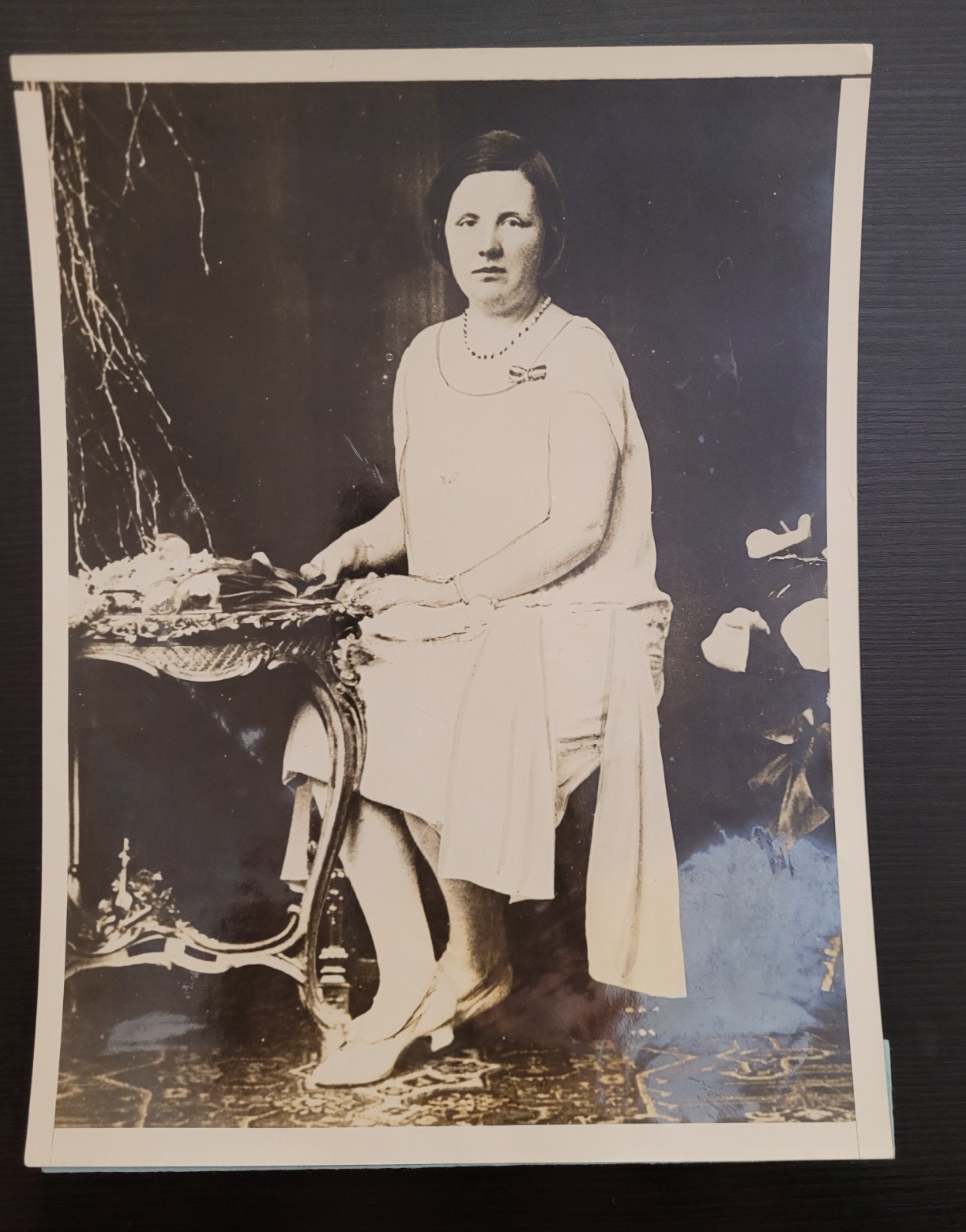
This is a fantastic piece of royal history. The \"bobbed hair\" news was a significant cultural marker in the 1920s, signaling a shift toward modernity even within the conservative Dutch monarchy.
Subject: Princess Juliana of the Netherlands (later Queen Juliana)
Date of Image: April/May 1927
Type: Original ACME News Pictures Press Photo
Size: Approx. 6.5 x 8.5 inches
Condition: Vintage condition with natural age toning, press stamps, and original news snippet attached to the reverse.
Transcription of Text
Front:(No text on front)
Back (Blue Typed Snippet):
Back (Stamps & Handwriting):
Stamp: N. E. A. REFERENCE DEPT. MAY 9 1927
Side Notation: \"Same subject used N.Y.\"
Faint Red Stamp: ACME NEWS PICTURES (with New York address)
Historical Background & Biography
Princess Juliana (1909–2004):This photograph captures Juliana at a pivotal turning point in Dutch history. On her 18th birthday (April 30, 1927), she was officially installed as a member of the Council of State, marking her readiness to eventually take the throne. The \"bobbed hair\" mentioned in the caption was a major news story at the time; it was a daring, modern style that contrasted with her mother Queen Wilhelmina\'s more traditional image. Juliana went on to reign as Queen of the Netherlands from 1948 until her abdication in 1980.
The University of Leiden:As noted in the snippet, Juliana broke tradition by attending university. She studied sociology, economics, and law, becoming one of the first Dutch royals to fully immerse themselves in a standard academic environment, which greatly influenced her \"people\'s queen\" persona later in life.
Search Keywords
Dutch Royal Family, House of Orange-Nassau, Queen Wilhelmina, Vintage Royalty Ephemera, 1920s Fashion, Flapper Era, Netherlands History, Photojournalism, ACME Newspictures, Collectible Photography.
Juliana (Dutch pronunciation: [jyliˈjaːnaː] ⓘ; Juliana Louise Emma Marie Wilhelmina; 30 April 1909 – 20 March 2004) was Queen of the Netherlands from 1948 until her abdication in 1980.
Juliana was the only child of Queen Wilhelmina and Duke Henry of Mecklenburg-Schwerin. She received a private education and studied international law at the University of Leiden. In 1937, she married Prince Bernhard of Lippe-Biesterfeld with whom she had four daughters: Beatrix, Irene, Margriet, and Christina. During the German invasion of the Netherlands in the Second World War, the royal family was evacuated to the United Kingdom. Juliana then relocated to Canada with her children, while Wilhelmina and Bernhard remained in Britain. The royal family returned to the Netherlands after its liberation in 1945.
Due to Wilhelmina\'s failing health, Juliana took over royal duties briefly in 1947 and 1948. In September 1948, Wilhelmina abdicated and Juliana ascended to the Dutch throne. Her reign saw the decolonization and independence of the Dutch East Indies and Suriname. Despite a series of controversies involving the royal family, Juliana remained a popular figure among the Dutch.
In April 1980, Juliana abdicated in favour of her eldest daughter, Beatrix. Upon her death in 2004 at the age of 94, she was the longest-lived former reigning monarch in the world.
Early life and education
icon
This section needs additional citations for verification. Please help improve this article by adding citations to reliable sources in this section. Unsourced material may be challenged and removed. (September 2016) (Learn how and when to remove this message)
29-year-old Queen Wilhelmina with the long-awaited heir presumptive, Princess Juliana
Juliana was born on 30 April 1909 at Noordeinde Palace in The Hague, the only child of the reigning Dutch monarch, Queen Wilhelmina. Her father was Duke Henry of Mecklenburg-Schwerin.[1] She was the first Dutch royal baby since Wilhelmina herself was born in 1880. Wilhelmina had suffered two miscarriages and had given birth to a premature and stillborn son, raising the prospect of a succession crisis.
The Queen\'s nearest relative was Prince Heinrich XXXII Reuss of Köstritz, whose close ties to Germany made him unpopular in the Netherlands, leading to concerns that if Wilhelmina died without an heir, he would turn the Netherlands into a puppet state of Germany. Juliana\'s birth thus assured the royal family\'s survival. Her mother suffered two further miscarriages after her birth, leaving Juliana as the royal couple\'s only child. According to several sources Juliana was happy to be an only child because that meant she did not have to fight for attention.[2]
Juliana spent her childhood at Het Loo Palace in Apeldoorn, and at Noordeinde Palace and Huis ten Bosch Palace in The Hague. A small school class was formed at Noordeinde Palace on the advice of the educator Jan Ligthart so that, from the age of six, the Princess could receive her primary education with children of her own age. These children were Baroness Elise Bentinck, Baroness Elisabeth van Hardenbroek and Jonkvrouwe Miek (Mary) de Jonge.
Princess Juliana in an Axel costume in 1922
As the Dutch constitution specified that Princess Juliana should be ready to succeed to the throne by the age of eighteen, her education proceeded at a faster pace than that of most children. After five years of primary education, the Princess received her secondary education (to pre-university level) from private tutors.
On 30 April 1927, Princess Juliana celebrated her eighteenth birthday. Under the constitution, she had officially come of age and was entitled to assume the royal prerogative, if necessary. Two days later her mother installed her in the \"Raad van State\" (\"Council of State\").
In the same year, the Princess enrolled as a student at the University of Leiden. In her first years at university, she attended lectures in sociology, jurisprudence, economics, history of religion, parliamentary history, and constitutional law. In the course of her studies, she also attended lectures on the cultures of Suriname and the Netherlands Antilles, international affairs, international law, history, and European law. She graduated from the university in 1930 with a bachelor\'s degree in international law.[3] She was taught Greek literature by Sophia Antoniadis, the university\'s first female professor.
Marriage
Princess Juliana and Prince Bernhard celebrate their engagement announcement in Amsterdam
In the 1930s, Queen Wilhelmina began a search for a suitable husband for her daughter. At the time, the House of Orange-Nassau was one of the most strictly religious royal families in the world, and it was very difficult to find a Protestant prince who suited their standards. Princes from the United Kingdom and Sweden were \"vetted\" but either declined or were rejected by the princess.
At the 1936 Winter Olympics in Bavaria, she met Prince Bernhard of Lippe-Biesterfeld, a young German Prince who was her 7th cousin, as both descended from Lebrecht, Prince of Anhalt-Zeitz-Hoym.[3] His rank and religion were suitable; so Princess Juliana\'s royal engagement was arranged by her mother. Princess Juliana fell deeply in love with her fiancé, a love that was to last a lifetime and that withstood separation during the war and Bernhard\'s extramarital affairs and illegitimate children. Queen Wilhelmina, by then the richest woman in the world, left nothing to chance. Wilhelmina had her lawyers draw up a prenuptial agreement that specified exactly what the German-born prince could and could not do, and what money he would receive from the royal estate. The couple\'s engagement was announced on 8 September 1936.
Queen Juliana signing the marriage register
The wedding announcement divided a country that mistrusted Germany under Adolf Hitler. Prior to the wedding, on 24 November 1936, Prince Bernhard was granted Dutch citizenship and changed the spelling of his names from German to Dutch. They married in The Hague on 7 January 1937, the date on which Princess Juliana\'s grandparents, King William III and Queen Emma, had married fifty-eight years earlier. The civil ceremony was held in the Town Hall of The Hague and the marriage was blessed in the Great Church (St. Jacobskerk), also located in The Hague. Juliana\'s chosen bridesmaids were either relatives or family friends. These included Duchess Woizlawa Feodora of Mecklenburg-Schwerin (her first cousin), Duchess Thyra of Mecklenburg-Schwerin (her second cousin), Grand Duchess Kira Kirillovna of Russia (her first cousin once removed), Princess Sophie of Saxe-Weimar-Eisenach (her second cousin), and two of Bernhard\'s first cousins, Princess Sieglinde of Lippe and Princess Elisabeth of Lippe.[4]
A wedding gift was the royal yacht, Piet Hein. The young couple moved into Soestdijk Palace in Baarn.
The first of their four daughters, Princess Beatrix, was born on 31 January 1938, followed by Princess Irene on 5 August 1939.
Canadian exile
Duration: 14 minutes and 58 seconds.14:58
Princess Juliana and Prince Bernhard giving an interview for Radio Oranje in 1941
On 12 May 1940, during the invasion of the Netherlands by Germany in the Second World War, Prince Bernhard and Princess Juliana were evacuated to the United Kingdom to be followed the next day by Queen Wilhelmina and the Dutch Government, who set up a government in exile. The princess remained there for a month before taking the children to Ottawa, the capital of Canada, where she resided at Stornoway in the suburb of Rockcliffe Park. Her mother and husband remained in Britain with the Dutch government-in-exile.[5]
Juliana with her husband and daughters in Ottawa in 1943
When her third child, Princess Margriet, was born on 19 January 1943, Governor General Lord Athlone granted royal assent to a special law declaring Princess Juliana\'s rooms at the Ottawa Civic Hospital to be extraterritorial in order that the infant would have exclusively Dutch, not dual nationality.[6] Had these arrangements not been made, Princess Margriet would not be in the line of succession. The Canadian government flew the Dutch tricolour flag on parliament\'s Peace Tower while its carillon rang out with Dutch music at the news of Princess Margriet\'s birth. Prince Bernhard, who had remained in London to assist his mother in law Queen Wilhelmina and the government with operating in exile, was able to visit his family in Canada and be there for Margriet\'s birth. Princess Juliana\'s genuine warmth and the gestures of her Canadian hosts created a lasting bond, which was reinforced when Canadian soldiers fought and died by the thousands in 1944 and 1945 to liberate the Netherlands from the Nazis. She returned with Queen Wilhelmina by a military transport plane to the liberated part of the Netherlands on 2 May 1945, rushing to Breda to set up a temporary Dutch government. Once home, she expressed her gratitude to Canada by sending the city of Ottawa 100,000 tulip bulbs. Juliana erected a wooden lectern and brass plaque which is dedicated in thanks to the St. Andrew\'s Presbyterian Church (Ottawa) for their hospitality during her residence in Ottawa.
Juliana meets RAF pilot Kees van Eendenburg at Deanland in 1944
On 24 June 1945, she sailed on the RMS Queen Elizabeth from Gourock, Scotland, to the United States, listing her last permanent residence as London, England. The following year (1946), Juliana donated another 20,500 bulbs, with the request that a portion of these be planted at the grounds of the Ottawa Civic Hospital where she had given birth to Margriet. At the same time, she promised Ottawa an annual gift of tulips during her lifetime to show her lasting appreciation for Canada\'s war-time hospitality. Each year Ottawa hosts the Canadian Tulip Festival in celebration of this gift.
On 2 May 1945, Princess Juliana was returned with her mother to Dutch soil. Initially they lived in temporary quarters at Anneville just south of Breda. Juliana took part in the post-war relief operation for the people in the northern part of the country who had suffered through starvation during the Hunger Winter of 1944–1945, which had taken the lives of many of her countrymen. She was very active as the president of the Dutch Red Cross and worked closely with the National Reconstruction organization. Her down-to-earth manner endeared her to her people so much that a majority of the Dutch people would soon want Queen Wilhelmina to abdicate in favour of her daughter. In the spring of 1946 Princess Juliana and Prince Bernhard visited the countries that had helped the Netherlands during the occupation.
During her pregnancy with her last child, Marijke Christina, Princess Juliana contracted rubella. The girl was born in 1947 with cataracts in both eyes and was soon diagnosed as almost totally blind in one eye and severely limited in the other. Despite her blindness, Christina, as she was called, was a happy and gifted child with a talent for languages and an ear for music. Over time, and with advances in medical technology, her eyesight did improve such that with thick glasses, she could attend school and even ride a bicycle. However, before that happened, her mother, the Princess, clinging to any thread that offered some hope for a cure, came under the strong influence of Greet Hofmans, a faith healer with heterodox beliefs, who was considered by \"her many detractors\" to be a sham.[5]
Reign
Regency and early reign
Celebration of Queen Juliana\'s inauguration, 1948
Wilhelmina\'s increasingly precarious health made it increasingly difficult for her to perform her duties. Juliana was forced to take over as regent from 14 October to 1 December 1947. Wilhelmina seriously considered abdicating in favour of Juliana at the end of 1947, but Juliana urged her mother to stay on the throne so she could celebrate her golden jubilee in 1948. However, Wilhelmina was forced by further health problems to relinquish her royal duties to Juliana once again on 4 May 1948.
Juliana swearing the royal oath during her Inauguration
The independence of Indonesia, which saw more than 150,000 Dutch troops stationed there as decolonization force, was regarded as an economic disaster for the Netherlands. With the certain loss of the prized colony, the queen announced her intention to abdicate, doing so on 4 September 1948. Two days later, with the eyes of the world upon her, Juliana was sworn in and inaugurated as monarch during a joint session of the States General at a ceremony held in the Nieuwe Kerk in Amsterdam, becoming the 12th member of the House of Orange to rule the Netherlands.
Queen Juliana signing Indonesian sovereignty papers, 1949
On 27 December 1949 at Dam Palace in Amsterdam, Queen Juliana signed the papers that recognised Indonesian sovereignty over the former Dutch colony. She became Hoofd der Unie (Head of the Union) of the Netherlands-Indonesian Union (1949–1956). On 15 December 1954, the Queen announced that the nation\'s Caribbean possessions of the Netherlands Antilles and Suriname were to be reconstituted as constituent countries of the Kingdom of the Netherlands, making them equal partners with the mainland.
The near-blindness of her daughter Christina and the increasing influence of Hofmans, who had moved into a royal palace, severely affected the queen\'s marital relationship. Over the next few years, the controversy surrounding the faith healer, at first kept out of the Dutch media, erupted into a national debate over the competency of the queen. However, the debate subsided in part due to Juliana\'s efforts to connect with her people. She often appeared in public dressed like any ordinary Dutch woman, and preferred to be addressed as \"Mevrouw\" (Dutch for \"Mrs.\") rather than her formal title of \"majesty\". She also began riding a bicycle for exercise and fresh air.
Although the bicycle and the down-to-earth manners suggest a simple life style, the Dutch royal court of the 1950s and 1960s was still an opulent affair with chamberlains in magnificent uniforms, gilded state coaches, visits to towns in open carriages and lavish entertaining in the huge palaces. At the same time the queen began visiting the citizens of the nearby towns and, unannounced, would drop in on social institutions and schools like her mother before her insisting on seeing reality rather than a prepared show. On the international stage, Queen Juliana was interested in the problems of developing countries, the refugee problem,[which?] and particularly child welfare in developing countries. Together with her daughters Beatrix and Irene, she took part in the ship tour organized by Queen Frederica and her husband King Paul of Greece in 1954, which became known as the “Cruise of the Kings” and was attended by over 100 royals from all over Europe. Francis of Bavaria, a participant, reports in his memoirs the anecdote that the queens of Greece, the Netherlands and Italy went ashore in a harbor in the middle of a crowd of nephews and nieces, and a waiting journalist called out to them: \"What is the purpose of this trip?\", whereupon Queen Juliana replied with a friendly smile: \"Oh, you know, this is our union’s company outing.\"[7]
Crises and recovery
On the night of 31 January 1953, the Netherlands was hit by the most destructive storm in more than five hundred years. Thirty breaches of dunes and dikes occurred and many towns were swept away by twelve-foot storm surges. More than 1800 people drowned and tens of thousands were trapped by the floodwaters. Dressed in boots and an old coat, Queen Juliana waded through water and slopped through deep mud all over the devastated areas to bring desperate people food and clothing. Showing compassion and concern, reassuring the people, her tireless efforts would permanently endear her to the citizens of the Netherlands.
Queen Juliana with Brazilian President Juscelino Kubitschek at Soestdijk Palace, 1956
In 1956, the influence of Hofmans on Juliana\'s political views almost brought down the monarchy in a constitutional crisis; this caused the court and the royal family to split into a \"Bernhard faction\", set on removing a queen considered a religious fanatic and a threat to NATO, and the queen\'s pious and pacifist courtiers. Prime Minister Willem Drees resolved the crisis. However, Juliana lost out to her powerful husband and his friends. Hofmans was banished from the court and Juliana\'s supporters were sacked or pensioned. Prince Bernhard planned to divorce his wife but decided against it when he, as he told an American journalist, \"found out that the woman still loved him\" [citation needed].
Queen Juliana inspecting the troops, 1959
Queen Juliana faced another crisis among her Protestant citizens in 1963, when her second daughter Irene secretly converted to Roman Catholicism and, without government approval, on 29 April 1964 married Prince Carlos Hugo of Bourbon, Duke of Parma, a claimant to the Spanish throne and also a leader in Spain\'s Carlist party. Given the history of the Dutch struggle for independence from Roman Catholic Spain, and with fascist German oppression still fresh in the minds of the Dutch people, the events leading to the marriage were played out in all the newspapers and a storm of hostility erupted against the monarchy for allowing it to happen—a matter so serious that the queen\'s abdication became a real possibility. She survived, however, thanks to the underlying devotion she had earned over the years.
Another crisis developed as a result of the announcement in July 1965 of the engagement of Princess Beatrix, heir to the throne, to German diplomat Claus von Amsberg. The future husband of the future queen had been a member of the Nazi Wehrmacht and the Hitler Youth movement. Many angry Dutch citizens demonstrated in the streets, and held rallies and marches against the \"traitorous\" affair. While this time there were no calls for the queen\'s abdication—because the true object of the people\'s wrath, Princess Beatrix, would then be queen—they did start to question the value of having a monarchy at all. After attempting to have the marriage cancelled, Queen Juliana acquiesced and the marriage took place under a continued storm of protest; an almost certain attitude pervaded the country that Princess Beatrix might be the last member of the House of Orange to ever reign in the Netherlands. Despite all these difficulties, Queen Juliana\'s personal popularity suffered only temporarily.
Queen Juliana and Princess Beatrix serving cocoa and buns to their staff on Christmas 1960
The queen was noted for her courtesy and kindness. In May 1959, for example, Polish-American ufologist George Adamski received a letter from the head of the Dutch Unidentified Flying Objects Society, Rey d\'Aquilla, informing him that she had been contacted by Queen Juliana\'s palace and \"that the Queen would like to receive you\".[8] Adamski informed a London newspaper about the invitation, which prompted the court and cabinet to request that the queen cancel her meeting with Adamski, but the queen went ahead with the meeting, saying that \"A hostess cannot slam the door in the face of her guests.\"[8] After the meeting, Dutch Aeronautical Association president Cornelis Kolff said: \"The Queen showed an extraordinary interest in the whole subject.\"[8] The Dutch press put it more straightforwardly. According to Time magazine, newspaper de Volkskrant said: \"The Dutch press could hardly be accused of concealing the facts last week. Once again, Queen Juliana\'s weakness for the preternatural had landed her back in the headlines: she had invited to the palace a crackpot from California who numbered among his friends men from Mars, Venus and other solar-system suburbs.\"[9]
An event in April 1967, helped by an improving Dutch economy, brought an overnight revitalization of the royal family: the first male heir to the Dutch throne in 116 years, Willem-Alexander, was born to Princess Beatrix. This time, the demonstrations in the street were of love and enthusiasm.
Later reign
Reception of Queen Juliana in Bali, September 1971. On the left the ambassador\'s wife, Mrs. Scheltema. In the middle adjutant Louise Elisabeth Coldenhoff of the Indonesian Navy
Queen Juliana and Prince Bernhard met with Hamengkubuwono IX during her visit to Yogyakarta, August 1971
In the spring of 1975, members of the Free South Moluccan Youths were caught conspiring to steal a heavy truck and ram the gates of Soestdijk Palace to kidnap the Queen. Ten members of the group in a vehicle full of firearms were arrested.[10] Their alleged aim was to force the Dutch government to recognize the Republik Maluku Selatan (RMS) as an independent state and try to make the Indonesian government do the same.[11] Seventeen South Moluccan youngsters were tried and convicted and sentenced to up to six years imprisonment.[citation needed] This was one of a series of actions for this cause during the 1970s, including the 1975 Dutch train hijacking, the 1975 Indonesian consulate hostage crisis, the 1977 Dutch train hijacking, the 1977 Dutch school hostage crisis, and the 1978 Dutch province hall hostage crisis.
On 25 November 1975, Suriname seceded from the Dutch Kingdom and became independent. Representing the Queen at the independence ceremony in the Surinamese capital, Paramaribo, were the heir presumptive Princess Beatrix, and her husband Prince Claus.
Queen Juliana, Prince Bernhard, Princess Beatrix and Prince Claus on holiday in Porto Ercole.
Scandal rocked the royal family again in 1976, when it was revealed that Prince Bernhard had accepted a US$1.1 million bribe from U.S. aircraft manufacturer Lockheed Corporation to influence the Dutch government\'s purchase of fighter aircraft in what became known as the Lockheed Scandal.
Prime Minister Joop den Uyl ordered an inquiry into the affair, while Prince Bernhard refused to answer reporters\' questions, stating: \"I am above such things.\" Rather than calling on the Queen to abdicate, the Dutch people were this time fearful that their beloved Juliana might abdicate out of shame or because of a criminal prosecution conducted in her name against her consort.
On 26 August 1976, a censored and toned-down yet devastating report on Prince Bernhard\'s activities was released to a shocked Dutch public. The prince resigned his various high-profile positions as a lieutenant admiral, a general, and an Inspector General of the Armed Forces. He resigned from his positions on the boards of many businesses, charities, the World Wildlife Fund, and other institutions. The prince also accepted that he would have to give up wearing his beloved uniforms. In return, the States-General accepted that there was to be no criminal prosecution.
Queen Juliana on the day of her abdication, 1980
On her Silver Jubilee in 1973, Queen Juliana donated all of the money that had been raised by the National Silver Jubilee Committee to organizations for children in need throughout the world. She donated the gift from the nation which she received on her seventieth birthday, in 1979, to the \"International Year of the Child\". As a reigning European monarch, she was given supernumerary membership of the British Order of the Garter as the 922nd inductee, with the rank of Stranger Lady Companion, in 1958.
On 30 April 1980, her 71st birthday, Queen Juliana abdicated and her eldest daughter succeeded her.[12] Juliana remained active in numerous charitable causes until well into her eighties.
Queen Juliana was very attached to Monte Argentario, in Tuscany, a favorite place for the Dutch royal family for their summer holidays for more than 40 years.[13][14]
Illness and death
Duration: 1 minute and 34 seconds.1:34
Video of Juliana\'s funeral procession, 2004
From the mid-1990s, Juliana\'s health declined as she suffered the progressive onset of dementia. Juliana did not appear in public after this time. At the order of the Royal Family\'s doctors, Juliana was placed under 24-hour care. Prince Bernhard said in a television interview in 2001 that the former Queen was no longer able to recognise her family and that she had been suffering from Alzheimer\'s disease for several years.[15]
Juliana died in her sleep on 20 March 2004 at the age of 94, at Soestdijk Palace in Baarn, from complications of pneumonia, seventy years to the day after her grandmother, Queen Emma.[3] She was embalmed, unlike her mother Wilhelmina, who chose not to be, and on 30 March 2004 interred beside her mother in the royal vaults under the Nieuwe Kerk in Delft. The memorial service made her ecumenical and often highly personal views on matters of religion public. The late Princess, a Pastor said in her sermon, was interested in all religions and in reincarnation. Juliana\'s husband Prince Bernhard died about nine months later aged 93, on 1 December 2004; his remains were placed next to hers.
In 2009, an exhibition of portraits of Juliana, and objects from her life, was held at the Het Loo Palace to mark the centenary of her birth.[16]
Titles, styles, and arms
Juliana\'s full title and style as an unmarried woman was: Her Royal Highness Princess Juliana Louisa Emma Marie Wilhelmina of the Netherlands, Princess of Orange-Nassau, Duchess of Mecklenburg, etc.[17][18]
Her mother issued a decree allowing her to adopt her husband\'s princely title as customary, providing that it be preceded by the title she held as a member of the House of Mecklenburg.[19] The decree became effective upon her marriage, and changed her full title and style to: Her Royal Highness Princess Juliana of the Netherlands, Princess of Orange-Nassau, Duchess of Mecklenburg, Princess of Lippe-Biesterfeld, etc.[17]
After her accession to the throne, Juliana\'s official title was: \"Her Majesty, Juliana, Queen of the Netherlands, Princess of Orange-Nassau, Duchess of Mecklenburg, Princess of Lippe-Biesterfeld, etc, etc, etc\". Upon her abdication, she resumed her pre-regnal marital title and style.[17][20]
Arms
Coat of arms of Juliana of the Netherlands
Notes
As Queen of the Netherlands (1948–1980), Juliana used the Greater Coat of Arms of the Realm, (or \"Grote Rijkswapen\").
Quarterly, 1 and 3, Azure, billetty Or a lion with a coronet Or armed and langued Gules holding in his dexter paw a sword Argent hilted Or and in the sinister paw seven arrows Argent pointed and bound together Or (royal arms of the Netherlands, i.e. that of her mother, Queen Wilhelmina), 2 and 4, Or, a horn azure, langued gules (arms of the former Principality of Orange), on an inescutcheon argent, a Bull\'s head sable (for her father\'s House of Mecklenburg).
Banner
As Princess, Juliana used a square and swallow tailed flag, with the Royal standard colours and their maternal arms (the horn of Orange) in the upper hoist and their paternal arms (the Bull head of Mecklenburg) in the lower hoist. The arms of the Netherlands (which originates from Nassau) without the insignia of the Order of Willem within an orange circle.
Previous versions
Juliana as monarch bore the Greater Coat of Arms of the Realm, (or \"Grote Rijkswapen\"). The components of the coats of arms were regulated by Queen Wilhelmina in a royal decree of 10 July 1907 and were affirmed by Juliana in a royal decree of 23 April 1980:
Azure, billetty Or a lion with a coronet Or armed and langued Gules holding in his dexter paw a sword Argent hilted Or and in the sinister paw seven arrows Argent pointed and bound together Or.
Issue
Name Birth-death Marriage
Date Spouse Issue
Beatrix of the Netherlands 31 January 1938 10 March 1966
(widowed in 2002) Jonkheer Claus van Amsberg Willem-Alexander of the Netherlands
Prince Friso
Prince Constantijn
Princess Irene 5 August 1939 29 April 1964
(divorced in 1981) Carlos Hugo, Duke of Parma Carlos, Duke of Parma
Princess Margarita, Countess of Colorno
Prince Jaime, Count of Bardi
Princess Carolina, Marchioness of Sala
Princess Margriet 19 January 1943 10 January 1967 Pieter van Vollenhoven Prince Maurits
Prince Bernhard
Prince Pieter-Christiaan
Prince Floris
Princess Christina 18 February 1947 –
16 August 2019 (aged 72) 28 June 1975
(divorced in 1996) Jorge Pérez y Guillermo Bernardo Guillermo
Nicolás Guillermo
Juliana Guillermo
Ancestry
Ancestors of Juliana of the Netherlands
8. Paul Frederick, Grand Duke of Mecklenburg-Schwerin
4. Frederick Francis II, Grand Duke of Mecklenburg-Schwerin
9. Princess Alexandrine of Prussia
2. Duke Henry of Mecklenburg-Schwerin
10. Prince Adolph of Schwarzburg-Rudolstadt
5. Princess Marie of Schwarzburg-Rudolstadt
11. Princess Mathilde of Schönburg-Waldenburg
1. Juliana of the Netherlands
12. William II of the Netherlands
6. William III of the Netherlands
13. Grand Duchess Anna Pavlovna of Russia
3. Wilhelmina of the Netherlands
14. George Victor, Prince of Waldeck and Pyrmont
7. Princess Emma of Waldeck and Pyrmont
15. Princess Helena of Nassau
Legacy
Shortly after her birth, the inhabitants of a small village near Den Helder asked permission from Queen Wilhelmina to name their village after the young princess. They received permission and they named their village Julianadorp.[21]
Princess Juliana Park in Ottawa, Ontario, Canada is named after her.
Princess Juliana International Airport in St. Maarten is named after her.
Queen Juliana Bridge in Willemstad, Curaçao is named after her.
She is commemorated in space, in the name of the asteroid 816 Juliana.
This is a list of monarchs of the Netherlands (Dutch: Koningen der Nederlanden). By practical extension, the list includes the stadtholders of the House of Orange Nassau since 1556. However, they were voted into office by, and were civil servants and generals of, the semi-independent provinces of the Dutch Republic and cannot be seen as monarchs. From William IV they were the direct male line ancestors of later monarchs when the monarchy was established in 1813 (first as a Sovereign Principality, but in 1815 as a Kingdom).
Dutch Republic (1581–1795)
Further information: List of stadtholders in the Netherlands
See also: List of Grand Pensionaries
The origin of the Dutch monarchy can be traced back to the appointment of William I, Prince of Orange as stadtholder of Holland, Zeeland and Utrecht in 1559 by Philip II of Spain. However, he was removed from office and became the leader of the Dutch Revolt. Consequently, the States-General appointed him as stadtholder of both rebelling provinces, Holland and Zeeland, in 1572. During the Dutch Revolt, most of the Dutch provinces declared their independence with the Act of Abjuration, signed on 26 July 1581 in The Hague in conformation with the decision made by the States-General. The representative function of the stadtholder became obsolete in the rebellious northern Netherlands – the feudal Lord himself having been abolished – but the office nevertheless continued in these provinces who now united themselves into the Republic of the Seven United Netherlands. All stadtholders after William I were drawn from his descendants or the descendants of his brother, who were also the descendants of his granddaughter Albertina Agnes of Nassau-Orange.
In 1795 the Republic was overthrown by the French Republic and replaced with the Batavian Republic. In 1806 Napoleon abolished the new republic and made his brother King of Holland. However, in 1810 Napoleon invaded the Netherlands and annexed them to France. In 1813, Allied forces drove out the French. The Dutch called back William Frederick, the son of the last stadtholder, to head the new government. He was proclaimed \"sovereign prince\". In 1815, he raised the Netherlands to the status of a kingdom and proclaimed himself King William I. The kingdom was enlarged with the Southern Netherlands, now Belgium and Luxembourg, soon after.
Stadtholderate under the House of Orange-Nassau
Further information: List of stadtholders in the Netherlands
Name Lifespan Reign start Reign end Notes Family Image
William I
the Silent
Willem I
24 April 1533 – 10 July 1584 (aged 51) 26 July 1581 10 July 1584 Stadtholder,[a] son of William I, Count of Nassau-Siegen and Juliana of Stolberg Orange-Nassau
William, Prince of Orange
Maurice
Maurits
14 November 1567 – 23 April 1625 (aged 57) 14 November 1585[1] 23 April 1625 Stadtholder,[b] son of William I and Anna of Saxony Orange-Nassau
Frederick Henry
Frederik Hendrik
29 January 1584 – 14 March 1647 (aged 63) 23 April 1625 14 March 1647 Stadtholder,[c] son of William I and Louise de Coligny Orange-Nassau
William II
Willem II
27 May 1626 – 6 November 1650 (aged 24) 14 March 1647 6 November 1650 Stadtholder,[d] son of Frederick Henry and Amalia of Solms-Braunfels Orange-Nassau
William III
Willem III
4 November 1650 – 8 March 1702 (aged 51) 4 July 1672 8 March 1702 Stadtholder,[e] son of William II and Mary, Princess Royal and Princess of Orange also King of England, Scotland and Ireland Orange-Nassau
William IV
Willem IV
1 September 1711 – 22 October 1751 (aged 40) 4 May 1747 22 October 1751 First formally hereditary Stadtholder of the United Netherlands,[f] son of John William Friso and Marie Louise of Hesse-Kassel Orange-Nassau
William V
Willem V
8 March 1748 – 9 April 1806 (aged 58) 22 October 1751 19 January 1795 Hereditary Stadtholder of the United Netherlands, son of William IV and Anne, Princess Royal and Princess of Orange, deposed by the Batavian Revolution Orange-Nassau
When William III died childless, the patrilineal ancestry of Orange-Nassau became extinct. In contrast to other provinces of the Dutch Republic, Friesland, Groningen and Drenthe had mostly drawn its stadtholders from the House of Nassau, that starting with John VI, the brother of William of Orange, and comprises in addition a matrilineal ancestry with the house of Orange-Nassau.
Stadtholderate under the House of Nassau
Further information: List of stadtholders in the Netherlands
Name Lifespan Reign start Reign end Notes Family Image
John VI
the Elder
Jan VI
22 November 1536 – 8 October 1606 (aged 69) 1578 1581 Stadtholder,[g] son of William I, Count of Nassau-Siegen and Juliana of Stolberg, brother of William I Nassau
William Louis
Our Father
Willem Lodewijk
13 March 1560 – 31 May 1620 (aged 60) 1584 1620 Stadtholder,[h] son of John VI and Countess Elisabeth of Leuchtenberg Nassau
Ernest Casimir I
Ernst Casimir I
22 December 1573 – 2 June 1632 (aged 58) 1620 1632 Stadtholder,[i] son of John VI and Countess Elisabeth of Leuchtenberg Nassau
Henry Casimir I
Hendrik Casimir I
21 January 1612 – 13 July 1640 (aged 28) 1632 1640 Stadtholder,[j] son of Ernest Casimir I and Sophia Hedwig of Brunswick-Lüneburg Nassau
William Frederick
Willem Frederik
7 August 1613 – 31 October 1664 (aged 51) 1640 1664 Stadtholder,[k] son of Ernest Casimir I and Sophia Hedwig of Brunswick-Lüneburg Nassau
Henry Casimir II
Hendrik Casimir II
18 January 1657 – 25 March 1696 (aged 39) 18 January 1664 25 March 1696 Hereditary Stadtholder,[l] son of William Frederick and Albertine Agnes of Nassau, maternal grandson of Frederick Henry Nassau
John William Friso
Johan Willem Friso
4 August 1687 – 14 July 1711 (aged 23) 25 March 1696 14 July 1711 Hereditary Stadtholder,[m] son of Henry Casimir II and Princess Henriëtte Amalia of Anhalt-Dessau, succeeded by his son William IV of Orange-Nassau, Hereditary Stadtholder of the United Netherlands Nassau
Kingdom of Holland (1806–1810)
Name Lifespan Reign start Reign end Notes Family Image
Louis I
the Good
Lodewijk I
2 September 1778 – 25 July 1846 (aged 67) 5 June 1806 1 July 1810 Son of Carlo Buonaparte and Letizia Bonaparte, brother of Napoleon Bonaparte
Louis I of Holland
Louis II
Lodewijk II
11 October 1804 – 17 March 1831 (aged 26) 1 July 1810 13 July 1810 Son of Louis I and Hortense de Beauharnais Bonaparte
Louis II of Holland
Sovereign Principality of the United Netherlands (1813–1815)
Name Lifespan Reign start Reign end Notes Family Image
William Frederick
Willem Frederik
24 August 1772 – 12 December 1843 (aged 71) 6 December 1813 16 March 1815 Son of the last Stadtholder William V and Wilhelmina of Prussia, Princess of Orange, raised the Netherlands to a Kingdom status in 1815 Orange-Nassau
Coat of Arms of Sovereign Prince William I of Orange William Frederick of the Netherlands
Kingdom of the Netherlands (1815–present)
Name Lifespan Reign start Reign end Notes Family Image
William I
Willem I
24 August 1772 – 12 December 1843 (aged 71) 16 March 1815 7 October 1840 Son of the last Stadtholder William V and Wilhelmina of Prussia, Princess of Orange
Abdicated Orange-Nassau
William I of the Netherlands
William II
Willem II
6 December 1792 – 17 March 1849 (aged 56) 7 October 1840 17 March 1849 Son of William I and Wilhelmine of Prussia Orange-Nassau
William II of the Netherlands
William III
Willem III
19 February 1817 – 23 November 1890 (aged 73) 17 March 1849 23 November 1890 Son of William II and Anna Pavlovna of Russia Orange-Nassau
William III of the Netherlands
Wilhelmina 31 August 1880 – 28 November 1962 (aged 82) 23 November 1890 4 September 1948 Daughter of William III and Emma of Waldeck and Pyrmont
Abdicated Orange-Nassau
Wilhelmina of the Netherlands
Juliana 30 April 1909 – 20 March 2004 (aged 94) 4 September 1948 30 April 1980 Daughter of Wilhelmina and Duke Henry of Mecklenburg-Schwerin
Abdicated Orange-Nassau
Juliana of the Netherlands
Beatrix 31 January 1938 (age 87) 30 April 1980 30 April 2013 Daughter of Juliana and Prince Bernhard of Lippe-Biesterfeld
Abdicated Orange-Nassau
Beatrix of the Netherlands
27 April 1967 (age 58) 30 April 2013 Incumbent Son of Beatrix and Prince Claus, Jonkheer van Amsberg Orange-Nassau
William-Alexander of the Netherlands
See also
Style of the Dutch sovereign
Regalia of the Netherlands
Royal Standard of the Netherlands
The Republic of the Seven United Netherlands (Dutch: Republiek der Zeven Verenigde Nederlanden), also known as the United Provinces (of the Netherlands), and referred to in historiography as the Dutch Republic, was a confederation and great power that existed from 1588 until the Batavian Revolution in 1795. It was a predecessor state of the present-day Netherlands and the first independent Dutch nation state. The republic was established after seven Dutch provinces in the Spanish Netherlands revolted against Spanish rule, forming a mutual alliance against Spain in 1579 (the Union of Utrecht) and declaring their independence in 1581 (the Act of Abjuration), after which they confederated in 1588 (the Instruction of 12 April 1588) after the States General could not agree on a new monarch. The seven provinces it comprised were Groningen (present-day Groningen), Frisia (present-day Friesland), Overijssel (present-day Overijssel), Guelders (present-day Gelderland), Utrecht (present-day Utrecht), Holland (present-day North Holland and South Holland), and Zeeland (present-day Zeeland).
Although the state was small and had only around 1.5 million inhabitants,[when?] it controlled a worldwide network of seafaring trade routes. Through its trading companies, the Dutch East India Company (VOC) and the Dutch West India Company (GWC), it established a Dutch colonial empire. The income from this trade allowed the Dutch Republic to compete militarily against much larger countries. Major conflicts were fought in the Eighty Years\' War against Spain (from the foundation of the Dutch Republic until 1648), the Dutch–Portuguese War (1598–1663), four Anglo-Dutch Wars (1652–1654, 1665–1667, 1672–1674, and 1780–1784), the Franco-Dutch War (1672–1678), War of the Grand Alliance (1688–1697), the War of the Spanish Succession (1702–1713), the War of Austrian Succession (1744–1748), and the War of the First Coalition (1792–1795) against the Kingdom of France.
The republic was more tolerant of different religions and ideas than contemporary states, allowing freedom of thought to its residents. Artists flourished under this regime, including painters such as Rembrandt, Johannes Vermeer, and many others. So did scientists, such as Hugo Grotius, Christiaan Huygens, and Antonie van Leeuwenhoek. Dutch trade, science, armed forces, and art were among the most acclaimed in the world during much of the 17th century, a period which became known as the Dutch Golden Age.
The republic was a confederation of provinces, each with a high degree of independence from the federal assembly: the States General. In the Peace of Westphalia (1648), the republic gained approximately 20% more territory, located outside the member provinces, which was ruled directly by the States General as Generality Lands. Each province was led by a stadtholder (Dutch for \'steward\'); this office was nominally open to anyone, but most provinces appointed a member of the House of Orange. The position gradually became hereditary, with the Prince of Orange simultaneously holding most or all of the stadtholderships, making him effectively the head of state. This created tension between political factions: the Orangists favoured a powerful stadtholder, while the Republicans favoured a strong States General. The Republicans forced two Stadtholderless Periods, 1650–1672 and 1702–1747, with the latter causing national instability and the end of great power status.
Economic decline led to the 1780–1787 Patriottentijd, a period of political instability.[3] This unrest was temporarily suppressed by a Prussian invasion in support of the stadtholder. The French Revolution and subsequent War of the First Coalition reignited these tensions. Following military defeat by France, the stadtholder was expelled in the Batavian Revolution of 1795, ending the Dutch Republic, which was succeeded by the Batavian Republic.
History
William of Orange, by Adriaen Thomasz Key.
Part of the Politics series on
Concepts
Schools
Types
Theoretical works
History
National variants
Republic days
Related topics
icon Politics portal
vte
Until the 16th century, the Low Countries—corresponding roughly to the present-day Netherlands, Belgium, and Luxembourg—consisted of a number of duchies, counties, and prince-bishoprics, almost all of which were under the supremacy of the Holy Roman Empire, with the exception of the County of Flanders, most of which was under the Kingdom of France.
Most of the Low Countries had come under the rule of the House of Burgundy and subsequently the House of Habsburg. In 1549, Holy Roman Emperor Charles V issued the Pragmatic Sanction, which further unified the Seventeen Provinces under his rule. In 1568, the Netherlands, led by William I of Orange, together with Philip de Montmorency, Count of Hoorn, and Lamoral, Count of Egmont revolted against Charles\'s successor, Philip II of Spain, because of high taxes, persecution of Protestants by the government, and Philip\'s efforts to modernize and centralize the devolved-medieval government structures of the provinces.[4] This was the start of the Eighty Years\' War. During the initial phase of the war, the revolt was largely unsuccessful. Spain regained control over most of the rebelling provinces. This period is known as the \"Spanish Fury\" due to the high number of massacres, instances of mass looting, and total destruction of multiple cities, in particular Antwerp between 1572 and 1579.
In 1579, a number of the northern provinces of the Low Countries signed the Union of Utrecht, in which they promised to support each other in their defence against the Army of Flanders. This was followed in 1581 by the Act of Abjuration, the declaration of independence of the provinces from Philip II. Dutch colonialism began at this point, as the Netherlands was able to capture a number of Portuguese and Spanish colonies, particularly in the Asia-Pacific region. After the assassination of William of Orange on 10 July 1584, both Henry III of France and Elizabeth I of England declined offers of sovereignty. However, the latter agreed to turn the United Provinces into a protectorate of England (Treaty of Nonsuch, 1585), and sent the Earl of Leicester as governor-general. This was unsuccessful, and with the instruction of 12 April 1588, the United Provinces became a republic. The Union of Utrecht is regarded as the foundation of the Republic of the Seven United Provinces, which was not recognized by Spain until the Peace of Westphalia in 1648.
Religious toleration and refugees
See also: History of the Jews in the Netherlands
Anonymous portrait of the Dutch philosopher Baruch Spinoza. He was of Portuguese-Jewish origin.
An important factor in the growth of the Netherlands as an economic power was the influx of groups seeking religious toleration of the Dutch Republic. In particular, it became the destination of Portuguese and Spanish Jews fleeing the Inquisitions in Iberia in the sixteenth and seventeenth centuries.[5] and later, poorer German Jews. The Portuguese Jewish community had many wealthy merchants who, both lived openly as Jews and participated in the thriving economy on a par with wealthy Dutch merchants. The Netherlands became home to many other notable refugees, including Protestants from Antwerp and Flanders, which remained under Spanish Catholic rule; French Huguenots; and English Dissenters, including the Pilgrim Fathers. Many immigrants came to the cities of Holland in the 17th and 18th century from the Protestant parts of Germany and elsewhere. The number of first-generation immigrants from outside the Netherlands in Amsterdam was nearly 50% in the 17th and 18th centuries. Amsterdam, which was a hub of the Atlantic world, had a population primarily of immigrants and others not considered Dutch, if one includes second and third generation immigrants. There were also migrants from the Dutch countryside. People in most parts of Europe were poor and many were unemployed. But in Amsterdam there was always work. Religious toleration was important, because a continuous influx of immigrants was necessary for the economy. Travellers visiting Amsterdam reported their surprise at the lack of control over the influx.[citation needed]
Economic growth
Main article: Economic history of the Netherlands (1500–1815)
The Amsterdam Stock Exchange, by Job Adriaenszoon Berckheyde
The era of explosive economic growth is roughly coterminous with the period of social and cultural bloom that has been called the Dutch Golden Age, and that actually formed the material basis for that cultural era. Amsterdam became the hub of world trade, the center into which staples and luxuries flowed for sorting, processing, and distribution, and then reexported around Europe and the world.[6]
During 1585 through 1622 there was the rapid accumulation of trade capital, often brought in by refugee merchants from Antwerp and other ports. The money was typically invested in high-risk ventures like pioneering expeditions to the East Indies to engage in the spice trade. These ventures were soon consolidated in the Dutch East India Company (VOC). There were similar ventures in different fields however, like the trade on Russia and the Levant. The profits of these ventures were ploughed back in the financing of new trade, which led to its exponential growth.[7]
Rapid industrialization led to the rapid growth of the nonagricultural labor force and the increase in real wages during the same time. In the half-century between 1570 and 1620 this labor supply increased 3 percent per annum, a truly phenomenal growth. Despite this, nominal wages were repeatedly increased, outstripping price increases. In consequence, real wages for unskilled laborers were 62 percent higher in 1615–1619 than in 1575–1579.[8]
Main article: History of Amsterdam
Dam Square in the late 17th century: painting by Gerrit Adriaenszoon Berckheyde
By the mid-1660s Amsterdam had reached the optimum population (about 200,000) for the level of trade, commerce and agriculture then available to support it. The city contributed the largest quota in taxes to the States of Holland which in turn contributed over half the quota to the States General. Amsterdam was also one of the most reliable in settling tax demands and therefore was able to use the threat to withhold such payments to good effect.[9][10]
Amsterdam was governed by a body of regents, a large, but closed, oligarchy with control over all aspects of the city\'s life, and a dominant voice in the foreign affairs of Holland. Only men with sufficient wealth and a long enough residence within the city could join the ruling class. The first step for an ambitious and wealthy merchant family was to arrange a marriage with a long-established regent family. In the 1670s one such union, that of the Trip family (the Amsterdam branch of the Swedish arms makers) with the son of Burgomaster Valckenier, extended the influence and patronage available to the latter and strengthened his dominance of the council. The oligarchy in Amsterdam thus gained strength from its breadth and openness. In the smaller towns family interest could unite members on policy decisions but contraction through intermarriage could lead to the degeneration of the quality of the members.
In Amsterdam the network was so large that members of the same family could be related to opposing factions and pursue widely separated interests. The young men who had risen to positions of authority in the 1670s and 1680s consolidated their hold on office well into the 1690s and even the new century.[11]
Amsterdam\'s regents provided good services to residents. They spent heavily on the water-ways and other essential infrastructure, as well as municipal almshouses for the elderly, hospitals and churches.[12]
A view of Amsterdam, by Jacob van Ruisdael
Amsterdam\'s wealth was generated by its commerce, which was in turn sustained by the judicious encouragement of entrepreneurs whatever their origin. This open door policy has been interpreted as proof of a tolerant ruling class. But tolerance was practiced for the convenience of the city. Therefore, the wealthy Sephardic Jews from Portugal were welcomed and accorded all privileges except those of citizenship, but the poor Ashkenazi Jews from Eastern Europe were far more carefully vetted and those who became dependent on the city were encouraged to move on.[13] Similarly, provision for the housing of Huguenot immigrants was made in 1681 when Louis XIV\'s religious policy was beginning to drive these Protestants out of France; no encouragement was given to the dispossessed Dutch from the countryside or other towns of Holland. The regents encouraged immigrants to build churches and provided sites or buildings for churches and temples for all except the most radical sects and the Catholics by the 1670s[14] (although even the Catholics could practice quietly in a chapel within the Beguinhof).[15]
First Stadtholderless Period (1650–1675)
Main article: First Stadtholderless Period
Johan de Witt, Grand Pensionary of Holland, by Caspar Netscher
During the wars a tension had arisen between the Orange-Nassau leaders and the patrician merchants. The former—the Orangists—were soldiers and centralizers who seldom spoke of compromise with the enemy and looked for military solutions. They included many rural gentry as well as ordinary folk attached to the banner of the House of Orange. The latter group were the Republicans, led by the Grand Pensionary (a sort of prime minister) and the regents stood for localism, municipal rights, commerce, and peace.[16] In 1650, the stadtholder William II, Prince of Orange suddenly died; his son was a baby and the Orangists were leaderless. The regents seized the opportunity: there would be no new stadtholder in Holland for 22 years. Johan de Witt, a brilliant politician and diplomat, emerged as the dominant figure. Princes of Orange became the stadtholder and an almost hereditary ruler in 1672 and 1748. The Dutch Republic of the United Provinces was a true republic from 1650 to 1672 and 1702–1748. These periods are called the First Stadtholderless Period and Second Stadtholderless Period.
First and Second Anglo-Dutch wars
The Battle of Scheveningen, 10 August 1653
Main articles: Anglo-Dutch wars, First Anglo-Dutch War, and Second Anglo-Dutch War
The Dutch and English were major rivals in world trade and naval power. Halfway through the 17th century the Dutch States Navy was the rival of the English Royal Navy as the most powerful navy in the world. The Republic fought a series of three naval wars against England from 1652 to 1674.[17]
In 1651, the Parliament of England introduced the Navigation Act, which restricted Dutch trade with English colonies. An incident at sea concerning the Act resulted in the First Anglo-Dutch War, which lasted from 1652 to 1654, ending in the Treaty of Westminster (1654), which left the Navigation Act in effect.
After the Stuart Restoration in 1660, Charles II tried to serve his dynastic interests by attempting to make Prince William III of Orange, his nephew, stadtholder of the Republic, using some military pressure. King Charles thought a naval war would weaken the Dutch traders and strengthen the English economy and empire, so the Second Anglo-Dutch War was launched in 1665. At first many Dutch ships were captured and the English scored great victories. However, the Raid on the Medway, in June 1667, ended the war with a Dutch victory. The Dutch recovered their trade, while the English economy was seriously hurt and its treasury nearly bankrupt.[18] The greatly expanded Dutch navy was for years after the world\'s strongest. The Dutch Republic was at the zenith of its power.[19]
Franco-Dutch War and Third Anglo-Dutch War (1672–1702)
Main articles: Franco-Dutch War, Rampjaar, and Third Anglo-Dutch War
Stadtholder William III, Prince of Orange, also reigned as William III of England from 1689 to 1702 after the Glorious Revolution.
The year 1672 is known in the Netherlands as the \"Disaster Year\" (Rampjaar). England declared war on the Republic, (the Third Anglo-Dutch War), followed by France, Münster and Cologne, which had all signed alliances against the Republic. France, Cologne and Münster invaded the Republic. Johan de Witt and his brother Cornelis, who had accomplished a diplomatic balancing act for a long time, were now the obvious scapegoats. They were lynched, and a new stadtholder, William III, was appointed.[20]
An Anglo-French attempt to land on the Dutch shore was barely repelled in three desperate naval battles under command of Admiral Michiel de Ruyter. The advance of French troops from the south was halted by a costly inundation of its own heartland, by breaching river dikes. With the aid of friendly German princes, the Dutch succeeded in fighting back Cologne and Münster, after which the peace was signed with both of them, although some territory in the east was lost forever. Peace was signed with England as well, in 1674 (Second Treaty of Westminster). In 1678, peace was made with France at the Treaty of Nijmegen, although the Spanish and German allies of the Dutch Republic felt betrayed by this.
In 1688, at the start of the Nine Years\' War with France, the relations with England reached crisis level once again. Convinced that he needed English support against France and that he had to prevent a second Anglo-French alliance, Stadtholder William III decided he had to take a huge gamble and invade England. To this end he secured the support from the Dutch States-General and from Protestant English nobles opposed to William\'s Catholic father-in-law James II of England. This led to the Glorious Revolution and cemented the principle of parliamentary rule and Protestant ascendency in England. James fled to France, and William ascended to the English throne as co-monarch with his wife Mary, James\' eldest daughter. This manoeuvre secured England as a critical ally of the United Provinces in its ongoing war with Louis XIV of France. William was the commander of the Dutch and English armies and fleets until his death in 1702. During William\'s reign as King of England, his primary focus was leveraging English manpower and finances to aid the Dutch against the French. The combination continued during the War of the Spanish Succession after his death as the combined Dutch, English, and Imperial armies conquered Flanders and Brabant, and invaded French territory before the alliance collapsed in 1713 due to British political infighting.
Second Stadtholderless Period (1702–1747)
Main article: Second Stadtholderless Period
The Inspectors of the Collegium Medicum in Amsterdam, by Cornelis Troost, 1724. This period is known as the \"Periwig Era\".
The Second Stadtholderless Period (Dutch: Tweede Stadhouderloze Tijdperk) is the designation in Dutch historiography of the period between the death of stadtholder William III on 19 March[21] 1702 and the appointment of William IV, Prince of Orange as stadtholder and captain general in all provinces of the Dutch Republic on 2 May 1747. During this period the office of stadtholder was left vacant in the provinces of Holland, Zeeland, and Utrecht, though in other provinces that office was filled by members of the House of Nassau-Dietz (later called Orange-Nassau) during various periods.
During the period, the Republic lost its Great-Power status and its primacy in world trade, processes that went hand-in-hand, the latter causing the former. Though the economy declined considerably, causing deindustrialization and deurbanization in the maritime provinces, a rentier-class kept accumulating a large capital fund that formed the basis for the leading position the Republic achieved in the international capital market. A military crisis at the end of the period caused the Orangist revolution and the restoration of the Stadtholderate in all provinces.
Economic decline after 1730
The slow economic decline after 1730 was relative: other countries grew faster, eroding the Dutch lead and surpassing it. Wilson identifies three causes. Holland lost its world dominance in trade as competitors emerged and copied its practices, built their own ships and ports, and traded on their own account directly without going through Dutch intermediaries. Second, there was no growth in manufacturing, due perhaps to a weaker sense of industrial entrepreneurship and to the high wage scale. Third the wealthy turned their investments to foreign loans. This helped jump-start other nations and provided the Dutch with a steady income from collecting interest, but leaving them with few domestic sectors with a potential for rapid growth.[22][23]
After the Dutch fleet declined, merchant interests became dependent on the goodwill of Britain. The main focus of Dutch leaders was reducing the country\'s considerable budget deficits. Dutch trade and shipping remained at a fairly steady level through the 18th century, but no longer had a near monopoly and also could not match growing British and French competition. The Netherlands lost its position as the trading centre of Northern Europe to Britain.
Although the Netherlands remained wealthy, investments for the nation\'s money became more difficult to find. Some investment went into purchases of land for estates, but most went to foreign bonds and Amsterdam remained one of Europe\'s banking capitals.
Culture and society
Winter landscape with skaters near the city of Kampen, by Hendrick Avercamp
The Doctor\'s Visit , by Jan Steen
Dutch culture also declined both in the arts and sciences. Literature for example largely imitated English and French styles with little in the way of innovation or originality. The most influential intellectual was Pierre Bayle (1647–1706), a Protestant refugee from France who settled in Rotterdam where he wrote the massive Dictionnaire Historique et Critique (Historical and Critical Dictionary, 1696). It had a major impact on the thinking of The Enlightenment across Europe, giving an arsenal of weapons to critics who wanted to attack religion. It was an encyclopaedia of ideas that argued that most \"truths\" were merely opinions, and that gullibility and stubbornness were prevalent.[24] [page needed] Religious life became more relaxed as well. Catholics grew from 18% to 23% of the population during the 18th century and enjoyed greater tolerance, even as they continued to be outside the political system. They became divided by the feud between moralistic Jansenists (who denied free will) and orthodox believers. One group of Jansenists formed a splinter sect, the Old Catholic Church in 1723. The upper classes willingly embraced the ideas of the Enlightenment, tempered by the tolerance that meant less hostility to organized religion compared to France.[25]
Dutch universities declined in importance, no longer attracting large numbers of foreign students. The Netherlands remained an important hub of intellectual exchange, creating reviews of foreign publications that made scholars aware of new works in French, German, and English. Dutch painting declined, no longer being innovative, with painters pursuing the styles of the old masters.
Life for the average Dutchman became slower and more relaxed in the 18th century. The upper and middle classes continued to enjoy prosperity and high living standards. The drive to succeed seemed less urgent. Unskilled laborers remained locked in poverty and hardship. The large underclass of unemployed required government and private charity to survive.
The Orangist revolution (1747–1751)
Main article: Orangist revolution
Second Stadtholderless Period Batavian Republic class-skin-invert-image
William IV, Prince of Orange, stadholder from 1747 to 1751 CE
Willem V of Orange, stadholder from 1751 to 1806, and Wilhelmina of Prussia with three of their five children. From left to right: the future William I of the Netherlands, Frederick, and Frederica Louise Wilhelmina.
During Anthonie van der Heim\'s tenure as Grand Pensionary (1737–1746), the Dutch Republic was reluctantly drawn into the War of Austrian Succession, despite efforts to remain neutral. French attacks on Dutch fortresses in the Spanish Netherlands and occupation of the Dutch Zeelandic Flanders led to the Republic joining the Quadruple Alliance, which suffered a significant defeat at the Battle of Fontenoy. The French invasion exposed the weaknesses of Dutch defenses, leading to memories of \"Disaster Year\" of 1672 and widespread calls for the restoration of the stadtholderate.[26] William IV, Prince of Orange, seized this opportunity to consolidate power and place loyal officials in strategic government positions to wrest control from the regenten.[26] The struggle involved religious, anti-Catholic, and democratic elements, as well as mob violence and political agitation. The war concluded with the Treaty of Aix-la-Chapelle (1748), and the French voluntarily retreated from the Dutch frontier. However, William IV died unexpectedly in 1751 at the age of 40.[26]
Regency and indolent rule (1752–1779)
His son, William V, was 3 years old when his father died, and a long regency characterised by corruption and misrule began. His mother delegated most of the powers of the regency to Bentinck and her favorite, Duke Louis Ernest of Brunswick-Lüneburg. All power was concentrated in the hands of an unaccountable few, including the Frisian nobleman Douwe Sirtema van Grovestins.[26] Still a teenager, William V assumed the position of stadtholder in 1766, the last to hold that office. In 1767, he married Princess Wilhelmina of Prussia, the daughter of Augustus William of Prussia, niece of Frederick the Great.
The position of the Dutch during the American War of Independence (1775–1783) was one of neutrality. William V, leading the pro-British faction within the government, blocked attempts by anti-Orangist, and later pro-French, elements to drag the government to war. However, things came to a head with the Dutch attempt to join the Russian-led League of Armed Neutrality, leading to the outbreak of the disastrous Fourth Anglo-Dutch War in 1780. After the signing of the Treaty of Paris (1783), the impoverished nation grew restless under William\'s rule.
An English historian summed him up uncharitably as \"a Prince of the profoundest lethargy and most abysmal stupidity.\"[27] And yet he would guide his family through the difficult French-Batavian period and his son would be crowned king.
Fourth Anglo-Dutch War (1780–1784)
Main article: Fourth Anglo-Dutch War
Battle of Dogger Bank (1781) by Thomas Luny
The Fourth Anglo–Dutch War (1780–1784) was a conflict between the Kingdom of Great Britain and the Dutch Republic. The war, tangentially related to the American Revolutionary War, broke out over British and Dutch disagreements on the legality and conduct of Dutch trade with Britain\'s enemies in that war.
Although the Dutch Republic did not enter into a formal alliance with the United States and their allies, U.S. ambassador (and future President) John Adams managed to establish diplomatic relations with the Dutch Republic, making it the second European country to diplomatically recognize the Continental Congress in April 1782. In October 1782, a treaty of amity and commerce was concluded as well.
Most of the war consisted of a series of largely successful British operations against Dutch colonial economic interests, although British and Dutch naval forces also met once off the Dutch coast. The war ended disastrously for the Dutch and exposed the weakness of the political and economic foundations of the country.[28] The Treaty of Paris (1784), according to Fernand Braudel, \"sounded the knell of Dutch greatness.\"[29]
Patriot rebellion and its suppression (1785–1795)
Main article: Batavian Revolution
Firefight on the Vaartse Rijn at Jutphaas on 9 May 1787. The pro-revolutionary Utrecht Patriots are on the right; the troops of stadholder William V, Prince of Orange on the left. (Painted by Jonas Zeuner, 1787)
After the war with Great Britain ended disastrously in 1784, there was growing unrest and a rebellion by the anti-Orangist Patriots. Influenced by the American Revolution, the Patriots sought a more democratic form of government. The opening shot of this revolution is often considered to be the 1781 publication of a manifesto called Aan het Volk van Nederland (\"To the People of the Netherlands\") by Joan van der Capellen tot den Pol, who would become an influential leader of the Patriot movement. Their aim was to reduce corruption and the power held by the stadtholder, William V, Prince of Orange.[30]
Support for the Patriots came mostly from the middle class. They formed militias called exercitiegenootschappen. In 1785, there was an open Patriot rebellion, which took the form of an armed insurrection by local militias in certain Dutch towns, Freedom being the rallying cry. Herman Willem Daendels attempted to organise an overthrow of various municipal governments (vroedschap). The goal was to oust government officials and force new elections. \"Seen as a whole this revolution was a string of violent and confused events, accidents, speeches, rumours, bitter enmities and armed confrontations\", wrote French historian Fernand Braudel, who saw it as a forerunner of the French Revolution.[citation needed] The Patriot movement focused more on local political power, where they had no say in their towns\' governance. Although they were able to curtail the power of the stadholder, and hold democratic elections in select towns, they were divided in their political vision, which was more local than national. Supporters were drawn from religious dissenters and Catholics in particular places, while pro-stadholder Orangists had more widespread geographical support of sections of the lower classes, the Dutch Reformed clergy, and the Jewish community.[31]
In 1785 the stadholder left The Hague and moved his court to Nijmegen in Guelders, a city remote from the heart of Dutch political life. In June 1787, his energetic wife Wilhelmina (the sister of Frederick William II of Prussia) tried to travel to The Hague. Outside Schoonhoven, she was stopped by Patriot militiamen and taken to a farm near Goejanverwellesluis. She was forced to return to Nijmegen. She appealed to her brother for help, and he sent some 26,000 troops to invade, led by Charles William Ferdinand, Duke of Brunswick, to suppress the rebellion. The Patriot militias could not contend with these forces, melting away.[32] Dutch banks at this time still held much of the world\'s capital. Government-sponsored banks owned up to 40% of Great Britain\'s national debt and there were close connections to the House of Stuart. The stadholder had supported British policies after the American Revolution and in foreign policy, the stadholder was \"little more than a pawn of the British and Prussians\", so that Patriot pressure was ignored by William.[33]
This severe military response overwhelmed the Patriots and put the stadholder firmly back in control. A small unpaid Prussian army was billeted in the Netherlands and supported themselves by looting and extortion. The exercitiegenootschappen continued urging citizens to resist the government. They distributed pamphlets, formed \"Patriot Clubs\" and held public demonstrations. The government responded by pillaging those towns where opposition continued. Five leaders were sentenced to death, forcing them to flee. Lynchings also occurred. For a while, no one dared appear in public without an orange cockade to show their support for Orangism. Many Patriots, perhaps around 40,000 in all, fled to Brabant, France (especially Dunkirk and St. Omer) and elsewhere. Before long the French became involved in Dutch politics and the tide turned toward the Patriots.
The French Revolution was popular, and numerous underground clubs were promoting it when in January 1795 the French army invaded. The underground rose up, overthrew the municipal and provincial governments, and proclaimed the Batavian Republic in Amsterdam. Stadtholder William V fled to England and the States General dissolved itself.[34]
Economy
Main articles: Economic history of the Netherlands (1500–1815), Financial history of the Dutch Republic, Dutch colonial empire, and Dutch guilder § History
Amsterdam Stock Exchange courtyard, 1653
During the Dutch Golden Age in the late-16th and 17th centuries, the Dutch Republic dominated world trade, conquering a vast colonial empire and operating the largest fleet of merchantmen of any nation. When Southern Europe was experiencing poor harvests, the Dutch very profitably exported surplus grain from Poland.[35] The County of Holland was the wealthiest and most urbanized region in the world. In 1650 the urban population of the Dutch Republic as a percentage of total population was 31.7 percent, while that of the Spanish Netherlands was 20.8 percent, of Portugal 16.6 percent, and of Italy 14 percent.[36][37] In 1675 the urban population density of Holland alone was 61 percent, compared to the rest of the Dutch Republic, where 27 percent lived in urban areas.[clarification needed][38][39]
The free trade spirit of the time was augmented by the development of a modern, effective stock market in the Low Countries.[40] The Netherlands has the oldest stock exchange in the world, founded in 1602 by the Dutch East India Company, while Rotterdam has the oldest bourse in the Netherlands. The Dutch East-India Company exchange went public in six different cities. Later, a court ruled that the company had to reside legally in a single city, so Amsterdam is recognized as the oldest such institution based on modern trading principles. While the banking system evolved in the Low Countries, it was quickly incorporated by the well-connected English, stimulating English economic output.[41][42][43][44]
The Dutch Republic was a master of banking, often compared to 14th century Florence.
Politics
Main article: Politics and government of the Dutch Republic
The republic was a confederation of seven provinces, which had their own governments and were very independent, and a number of so-called Generality Lands. The latter were governed directly by the States General, the federal government. The States General were seated in The Hague and consisted of representatives of each of the seven provinces. The provinces of the republic were, in official feudal order:
Duchy of Guelders (corresponding to the modern province of Gelderland)
County of Holland (corresponding to the modern provinces of North Holland and South Holland)
County of Zeeland (corresponding to the modern province of Zeeland)
Lordship of Utrecht (corresponding to the modern province of Utrecht)
Lordship of Overijssel (corresponding to the modern province of Overijssel)
Lordship of Frisia (corresponding to the modern province of Friesland)
Lordship of Groningen (corresponding to the modern province of Groningen)
There was an eighth province, the County of Drenthe (corresponding to the modern province of Drenthe), but this area was so poor that it was exempt from paying federal taxes, and as a consequence, it was denied representation in the States General, which is why the official name of the state was the \"Seven United Netherlands\" and not the \"Eight United Netherlands\".
Each province was governed by the Provincial States, their main executive official (though not the official head of state) being a raadpensionaris or landsadvocaat. In times of war, the stadtholder, who commanded the army, would have more power than the raadpensionaris. In theory, the stadtholders were freely appointed by and subordinate to the states of each province. However, in practice the princes of Orange of the House of Orange-Nassau, beginning with William the Silent, were always chosen as stadtholders of most of the provinces.
Zeeland and usually Utrecht had the same stadtholder as Holland. There was a constant power struggle between the Orangists, who supported the stadtholders and specifically the princes of Orange, and the Republicans, who supported the States General and hoped to replace the semi-hereditary nature of the stadtholdership with a true republican structure.
After the Peace of Westphalia, several border territories were assigned to the United Provinces. They were federally governed Generality Lands. These were Staats-Brabant, Staats-Vlaanderen, Staats-Overmaas, and (after the Treaty of Utrecht) Staats-Opper-Gelre. The States General of the United Provinces were in control of the Dutch East India Company and the Dutch West India Company, but some shipping expeditions were initiated by some of the provinces, mostly Holland and Zeeland.
The framers of the United States Constitution were influenced by the Constitution of the Republic of the United Provinces, as Federalist No. 20, by James Madison, shows.[45] The United States did not intend to emulate the United Provinces; Madison describes the Dutch confederacy as exhibiting \"Imbecility in the government; discord among the provinces; foreign influence and indignities; a precarious existence in peace, and peculiar calamities from war.\" However, the 1776 American Declaration of Independence is similar to the 1581 Act of Abjuration, essentially the declaration of independence of the United Provinces,[46] although there is no evidence of direct influence.
Map of the Republic of the Seven United Netherlands with colonies, c. 1707–1729
Map of the Republic of the Seven United Netherlands with colonies, c. 1707–1729
The united provinces, with Drenthe and the Generality Lands
The united provinces, with Drenthe and the Generality Lands
Religion
Main article: Dutch Reformed Church
See also: Arminianism, Remonstrants, and History of the Netherlands § Refugees
Sermon at the Oude Kerk at Delft, 1651
In the Union of Utrecht of 20 January 1579, Holland and Zeeland were granted the right to accept only one religion (in practice, Calvinism). Every other province had the freedom to regulate the religious question as it wished, although the Union stated every person should be free in the choice of personal religion and that no person should be prosecuted based on religious choice.[47] William of Orange had been a strong supporter of public and personal freedom of religion and hoped to unite Protestants and Catholics in the new union, and, for him, the Union was a defeat.[clarification needed] In practice, Catholic services in all provinces were quickly forofferden, and the Dutch Reformed Church became the \"public\" or \"privileged\" church in the republic.[48][page needed]
During the republic, any person who wished to hold public office had to conform to the Reformed Church and take an oath to this effect. The extent to which different religions or denominations were persecuted depended much on the time period and regional or city leaders. In the beginning, this was especially focused on Roman Catholics, being the religion of the enemy. In 17th-century Leiden, for instance, people opening their homes to services could be fined 200 guilders (a year\'s wage for a skilled tradesman) and banned from the city.[49] Throughout this, however, personal freedom of religion existed and was one factor—along with economic reasons—in causing large immigration of religious refugees from other parts of Europe.[48][page needed]
In the first years of the republic, controversy arose within the Reformed Church, mainly around the subject of predestination. This has become known as the struggle between Arminianism and Gomarism, or between Remonstrants and Contra-Remonstrants. In 1618, the Synod of Dort tackled this issue, which led to the banning of the Remonstrant faith.
Beginning in the 18th century, the situation changed from more or less active persecution of religious services to a state of restricted toleration of other religions, as long as their services took place secretly in private churches.
Decline
Dutch troops led by the Prince of Orange assault the French at the battle of Malplaquet
Long-term rivalry between the two main factions in Dutch society, the Staatsgezinden (Republicans, Dutch States Party) and the Prinsgezinden (Royalists or Orangists), sapped the strength and unity of the country. Johan de Witt and the Republicans did reign supreme for a time at the middle of the 17th century (the First Stadtholderless Period) until his overthrow and murder in 1672. Subsequently, William III of Orange became stadtholder. After a 22-year stadtholderless era, the Orangists regained power, and his first problem was to survive the Franco-Dutch War (with the derivative Third Anglo-Dutch War), when France, England, Münster, and Cologne united against his country.
Wars to contain the expansionist policies of France in various coalitions after the Glorious Revolution burdened the republic with huge debts, although little of the fighting after 1673 took place on Dutch territory. The necessity to maintain a vast army against France meant that less money could be spent on the navy, weakening the republic\'s economy. After William III\'s death in 1702 the Second Stadtholderless Period was inaugurated. Despite having contributed much in the War of the Spanish Succession, the Dutch Republic gained little from the peace talks in Utrecht (1713). However, the Dutch had over a period of forty years successfully defended their positions in the Southern Netherlands and their troops were central in the alliances which had halted French territorial expansion in Europe until 1792.[50] The end of the War of the Austrian Succession in 1748, and Austria becoming allies with France against Prussia, marked the end of the republic as a major military power.[51]
Fierce competition for trade and colonies, especially from France and England, furthered the economic downturn of the country. The three Anglo-Dutch Wars and the rise of mercantilism had a negative effect on Dutch shipping and commerce.[citation needed]
See also
List of countries that have gained independence from Spain
Dutch colonial empire
Dutch East India Company
Dutch West India Company