When you click on links to various merchants on this site and make a purchase, this can result in this site earning a commission. Affiliate programs and affiliations include, but are not limited to, the eBay Partner Network.
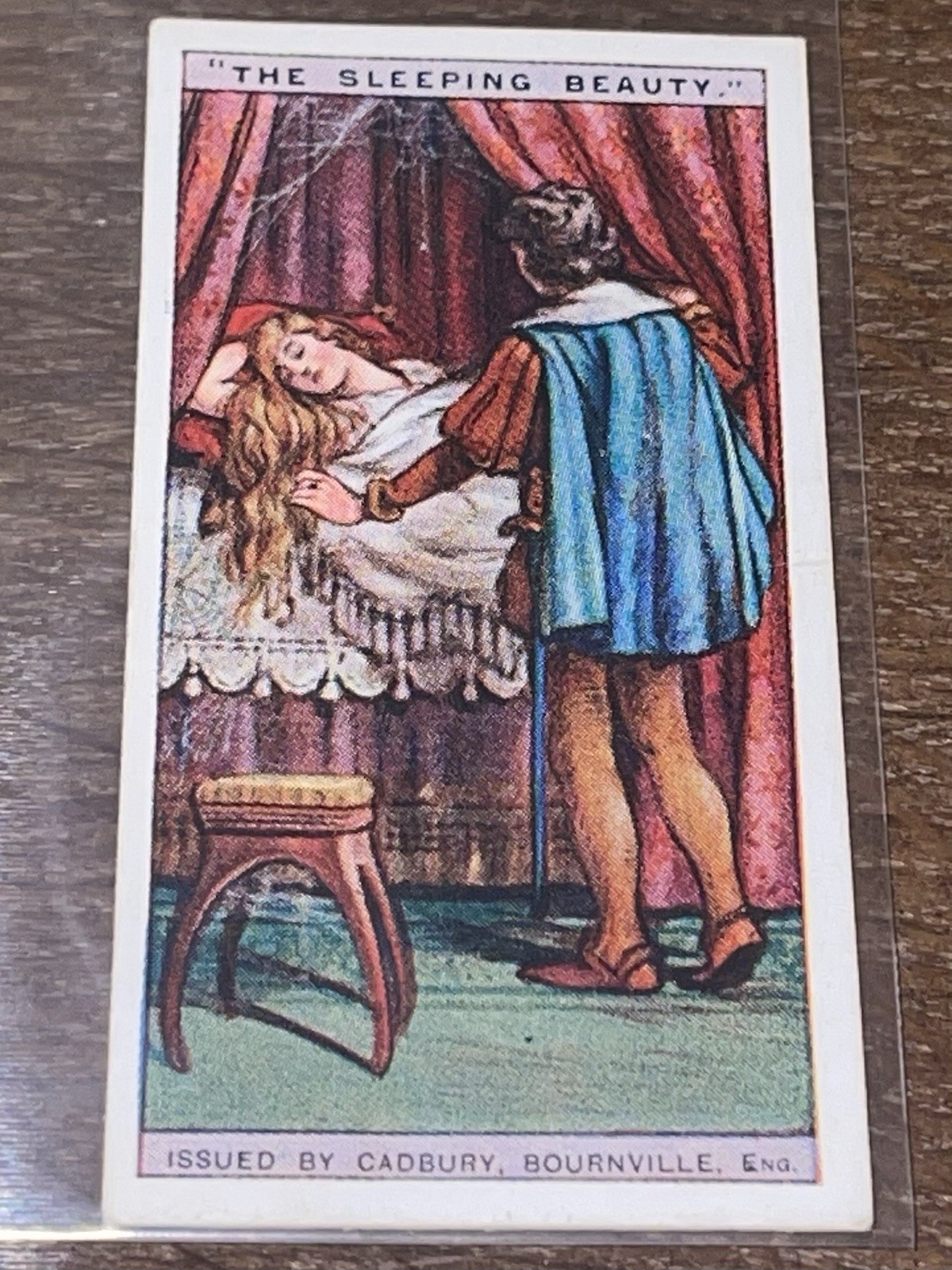
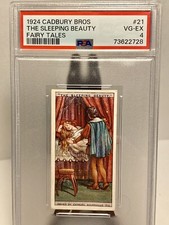
1924 Cadbury Bros. Ltd. Fairy Tales - Sleeping Beauty
*** ONE OF SLEEPING BEAUTY FIRST CARDS EVER PRINTED!!! ***
*** MORE 1924 CADBURY BROS. LTD. FAIRY TALES CARDS LISTED FOR SALE IN OUR STORE!!! ***
*** EXCEEDINGLY RARE CARD!!! ***
"Sleeping Beauty" (French: La Belle au bois dormant, or The Beauty Sleeping in the Wood; German: Dornröschen, or Little Briar Rose), also titled in English as The Sleeping Beauty in the Woods, is a fairy tale about a princess cursed by an evil fairy to sleep for a hundred years before being awakened by a handsome prince. A good fairy, knowing the princess would be frightened if alone when she wakes, uses her wand to put every living person and animal in the palace and forest asleep, to awaken when the princess does.
The earliest known version of the tale is found in the French narrative Perceforest, written between 1330 and 1344. Another was the Catalan poem Frayre de Joy e Sor de Paser. Giambattista Basile wrote another, "Sun, Moon, and Talia" for his collection Pentamerone, published posthumously in 1634–36 and adapted by Charles Perrault in Histoires ou contes du temps passé in 1697. The version collected and printed by the Brothers Grimm was one orally transmitted from the Perrault version, while including own attributes like the thorny rose hedge and the curse.
The Aarne-Thompson classification system for fairy tales lists "Sleeping Beauty" it includes a princess who is magically forced into sleep and later woken, reversing the magic. The fairy tale has been adapted countless times throughout history and retold by modern storytellers across various media.
The folktale begins with a princess whose parents are told by a wicked fairy that their daughter will die when she pricks her finger on a particular item. In Basile's version, the princess pricks her finger on a piece of flax. In Perrault's and the Grimm Brothers' versions, the item is a spindle. The parents rid the kingdom of these items in the hopes of protecting their daughter, but the prophecy is fulfilled regardless. Instead of dying, as was foretold, the princess falls into a deep sleep. After some time, she is found by a prince and is awakened.
In Giambattista Basile's version of Sleeping Beauty, Sun, Moon, and Talia, the sleeping beauty, Talia, falls into a deep sleep after getting a splinter of flax in her finger. She is discovered in her palace by a wandering prince, who "carrie[s] her to a bed, where he gather[s] the first fruits of love." He abandons her there after the assault and she later gives birth to twins while still unconscious.
According to Maria Tatar, there are versions of the story that include a second part to the narrative that details the couple's troubles after their union; some folklorists believe the two parts were originally separate tales.
The second part begins after the prince and princess have had children. Through the course of the tale, the princess and her children are introduced in some way to another woman from the prince's life. This other woman is not fond of the prince's new family, and calls a cook to kill the children and serve them for dinner. Instead of obeying, the cook hides the children and serves livestock. Next, the other woman orders the cook to kill the princess. Before this can happen, the other woman's true nature is revealed to the prince and then she is subjected to the very death that she had planned for the princess. The princess, prince, and their children live happily ever after.
iCOLLECTCARDS