When you click on links to various merchants on this site and make a purchase, this can result in this site earning a commission. Affiliate programs and affiliations include, but are not limited to, the eBay Partner Network.
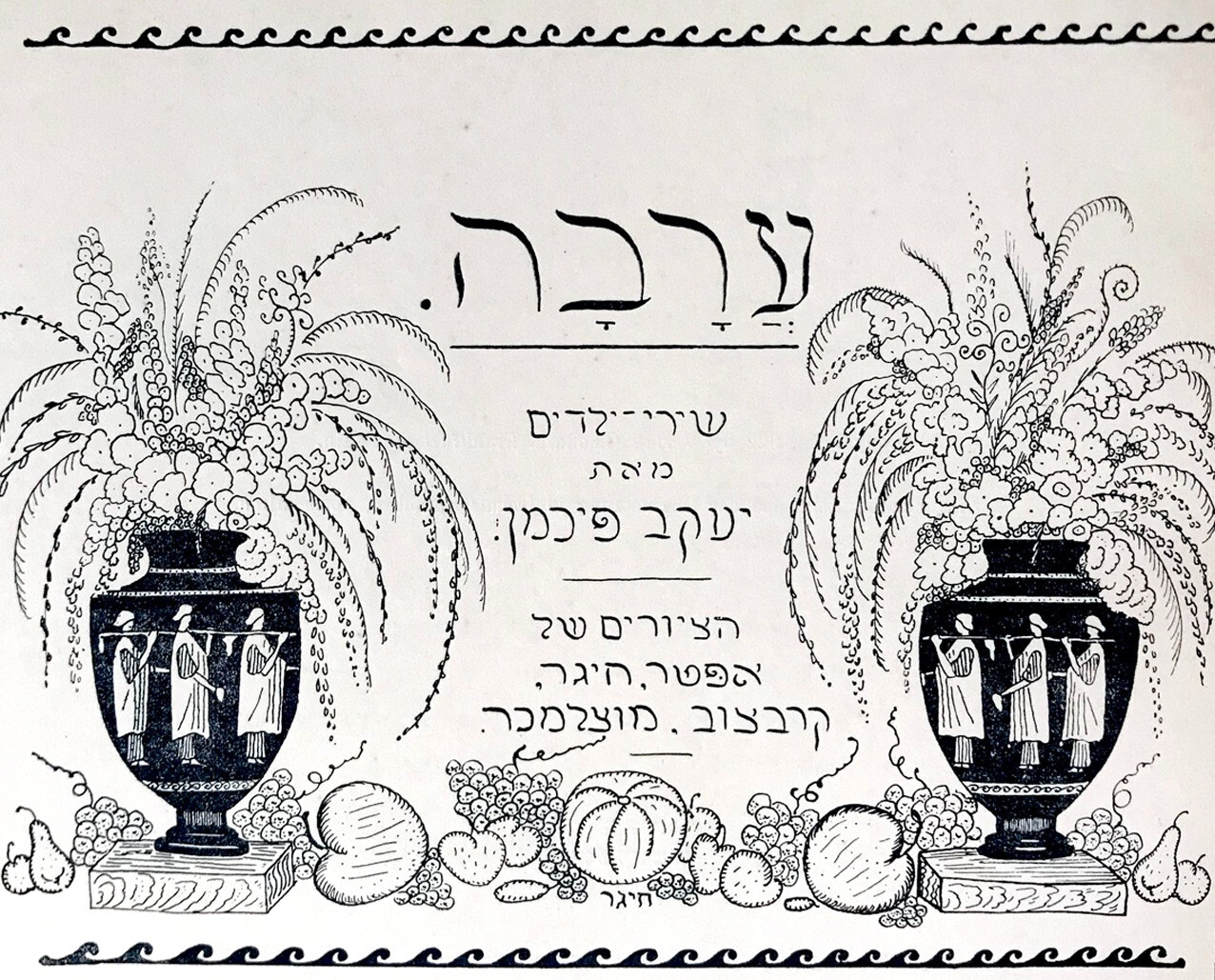
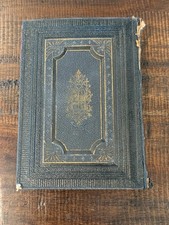
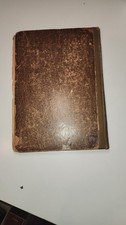
DESCRIPTION : Here for sale is an EXTREMELY RAREover 100 years old HEBREW - RUSSIAN illustrated CHILDREN ART BOOK which was published IN 1922 in ODESSA RUSSIA by AMANUT - OMANUTH - אמנות art publishing house. Numerous Hebrew CHILDREN SONGS and POEMS by the acclaimed JEWISH POET Jacob PHICHMAN are accompanied by NUMEROUS DRAWINGS and ILLUSTRATIONS by the acclaimed JEWISH RUSSIAN art group - CHAVURAT TZAYARIM - GRUOP OF PAINTERES , Namely YAFIM HIGAR , JACOB APTER , KRABTZOV and MOTZELMACHER .Original illustrated cloth HC. Cloth spine.Size around8.5 x 9.5 \" . Oblong. 84 throughout illustrated extremely thick PP.Verygood used condition. Tightly bound. Entirely clean and fresh. Slight foxing on end pages. ( Pls look atscan for accurate AS ISimages ) . Will be sent in a protective rigid sealed packaging.
AUTHENTICITY : This is anORIGINALvintage 1922 ( dated )Russian BOOK, NOT a reproduction or a reprint ,It holds a life long GUARANTEE forits AUTHENTICITY and ORIGINALITY.
PAYMENTS : Payment method accepted : Paypal & All credit cards.SHIPPMENT : Shipp worldwide via registered airmail is $ 35 .( Domestic $15 only with buy it now ). Will be sent in a protective rigid sealed packaging. Handling around 5-10 days after payment.
**** Jacob Fichman (Hebrew: יעקב פיכמן; 25 November 1881 – 18 May 1958), also transliterated as Yakov Fichman, was an acclaimed Hebrew poet, essayist and literary critic.BiographyFichman was born in Bălți, Bessarabia, Moldova in 1881. He initially emigrated to Ottoman Palestine in 1912, but returned temporarily to Europe and was stranded there until after World War I, not returning to the then Mandate Palestine, later Israel, until 1919. where he died in 1958.Fichman\'s poetry followed a traditional lyric Romantic style. His poetic background is reflected in his works of prose, which were sometimes seen as being nearly works of poetry in themselves. His other work included textbooks, articles in periodicals and introductions in literary anthologies. His critical essays focused heavily on the lives of the authors rather than on focusing directly on their work, giving the reader a holistic view of the author and the work.AwardsIn 1945, Fichman received the Bialik Prize for his book of poetry Peat Sadeh (\"A Corner of a Field\"),[1] published in 1943.In 1953, Fichman again received the Bialik Prize, this time in respect of several of his works.[1]In 1957, Fichman was awarded the Israel Prize, for literature.[2] **** Jacob Fichman (1881-1958) was born in Belz, Bessarabia. He left home at the age of fourteen to travel to Odessa, Warsaw and Vilnius. Fichman settled in Palestine in 1912 but visited Europe several times to carry out editorial assignments. He taught, published textbooks and worked at several publishing houses. He was also on the staff of a Warsaw Hebrew newspaper. In Palestine he edited several journals, and from 1936 to 1942 he was editor of Moznaim, the journal of the Hebrew Writers Association. His first book of poems was published in Warsaw in 1911, and his first collection of essays in Odessa in 1919. Belonging to a transitional generation, his attitude towards the new landscape is basically secular, defining him as a forerunner of the changes in Hebrew poetry, some of which he witnessed in his own lifetime. Fichman received the Aharonovich Prize (1942), the Bialik Prize twice (1945; 1953), the Ussishkin Prize (1947), the Ramat Gan Prize (1956) and the Israel Prize for Literature (1957). **** Fikhman, Yankev (Yaakov, Jacob Fichman) (November 25, 1881–May 18, 1958)November 25, 1881–May 18, 1958YANKEV FIKHMAN (YAAKOV, JACOB FICHMAN) (November 25, 1881-May 18, 1958) He was born in Belz (Bălți), Bessarabia. His father Elye, a simple Jew, made a living by producing sheep’s milk cheese. Fikhman’s Jewish education did not go beyond Torah with Rashi’s commentary and a smattering of Talmud. Already from his early youth, he was reading a variety of storybooks and poetry from the generation of the Jewish Enlightenment writers. Life in a small town was too crowded for him, and he left Belz and roamed about in the areas of Kherson and Podolia, searching for a footing in all manner of work and jobs: journeyman baker, helping out as an assistant in a shop, testing out to be a waiter, a coachman, a porter, and for a certain period of time he was an attendant to a traveling organ-grinder. He also found the time to learn Russian and German and acquainted himself with a series of books from world literature. He attempted at one point to compose a poem by himself. At age fourteen he reached Kishinev with the determination to study in a systematic manner. In the Bessarabian capital, he had to take up teaching, although he still threw himself into the study of history and culture. He particularly became very familiar with Russian literature. His first works (including his translation of a poem by Lermontov) were published in Avrom-Mortkhe Pyurko’s children’s magazine Gan shaashuim (Garden of delights). In 1901 he came to Odessa. He had fallen under the influence at this time of Ḥ. N. Bialik. The first lengthy series of his poetry nonetheless appeared in the second center of Hebrew creation—in Warsaw. Dovid Frishman published his poems in Hador (The generation), and Sh. L. Gordon published his children’s verse in Olam katan (Small world). Fikhman moved in 1903 to Warsaw, and there he was heartily welcomed: “Warsaw opened its gates, called out for freedom.” He was impressed there by the “sparkling feuilletons, the rapidity of reception, and the speed of orientation.” Jewish Warsaw was full of literary activity and accomplishment, with book publishers and Hebrew newspapers and journals. He was soon lured to be a regular contributor to Hatsfira (The siren). In 1905 the revolution erupted in Russia, and the Tsarist authorities shut down all at once all social and literary activities. Fikhman was forced to return to Bessarabia. He settled in Kishinev and took up teaching there. Then, the second pogrom (the first had transpired in 1903) broke out in Kishinev, and he moved to the nearby town of Lyeve (Leova). Living there was Yude Shteynberg, already at the time a well-known writer. Fikhman spent three years in Leova. It was from there that he began his first association with Y. Ḥ. Brenner, then living in London, England, and editing the monthly Hameorer (The awakening). Fikhman later prepared for publication works by Yude Shteynberg, Mortkhe-Arn Gintsburg, Hillel Tsaytlin, and Konstantin Abe Shpiro (Warsaw, 1911), Naḥum Sokolov (1935), and Goldenberg (1946), among others. He provided each of these publications with a comprehensive preface. Concerning Fikhman’s criticism, Shmuel Niger wrote: “Through the half-opened door of his own world, he opens wide for us that world. His criticism, his essays, as well as his poems in a brightly illuminated landscape.” In 1910 he attended pedagogical courses in Grodno. He was later in Warsaw, and at the suggestion of Ben-Avigdor, he began to work in publishing books from his [Ben-Avigdor’s] “Groyse biblyotek” (Great Library). In 1912 he made aliya for the first time to the land of Israel at the invitation of the local teachers’ union to undertaking editorial duties of the monthly youth journal Moledet (Homeland), earlier edited by Sh. Ben-Tsiyon. At this time there appeared in print his nature poems, which sang of the beauty of the Israeli landscape. Such poetry with Israeli motifs—especially the cycles “Yehuda” (Judea), “Yerushalaim” (Jerusalem), “Basharon” (On the Sharon plain), and “Rut” (Ruth)—belong to his essential work. The same is true of his poems from earlier periods, when he painted the Bessarabian landscape with such precision, he was equally here a master of quiet and restrained lyricism. In 1914 he traveled to Europe, and the outbreak of WWI found him in Berlin, Germany. He had earlier contemplated publishing a monthly journal there. Because of his suddenly changed circumstances, he had no choice but to slip across the border, and he was able to reach Odessa. Already there at the time were Bialik and Y. Ḥ. Ravnitski. Fikhman became editor of their press, “Moriya” (Moriah). He later moved to Moscow, where he became literary editor of Shtibl’s publishing house. He wrote there a series of historical poems on biblical themes and longer prose works on the same topics. Fikhman’s first essay collection of criticism, Bavuot (Reflections), was published by Moriya. Included in it were his essays concerning Job, Kohelet (Ecclesiastes), Esther, Abraham Mapu, Yehuda Leyb Gordon, and Konstantin Abe Shpiro. When the war ended, Fikhman returned in 1919 to Israel to take over once again the editorship of Moledet (1920-1927, with a break at one point). He also edited the new, serious, community-literary journal Meuberet (Pregnant) for Zionist youth, and he prepared a string of textbooks for Israeli schools. In 1922 he came to Warsaw, and there he continued his activities with Shtibl publishers which, because of the Bolshevik upheaval in Russia, had moved to the Polish capital city. He was also co-editing the quarterly volume Hatekufa (The epoch). He prepared for publication a Hebrew reader, Lashon vesefer (Language and book) in seven parts, for the study of the Hebrew language and literature in elementary and middle school. The reader was a magnificently edited school anthology, which served as a literary source for the emerging interwar Jewish generation. He also edited the literary supplement of Haatid (The future), organ of the pioneer movement in Poland. In 1924 he was living in Kishinev where he was a member of the editorial board of the Yiddish newspaper Unzer tsayt (Our time). He returned to Israel in 1925. Under his editorship, he again brought out a number of literary publications—journals, anthologies, and the like. He published his own books—poetry and criticism; his Sefer haarets (Book of the land), concerning Israel and its place in the history of the Jewish people with emphasis on the importance of agriculture, with time became one of the foundational texts for preparatory aliya training in agriculture around the world. Until the final days of his life, Fikhman contributed to the literary supplement of the daily newspaper for workers Davar (Word) in Tel Aviv, and was in charge of the column “Shira veproza” (Poetry and prose). Among his Hebrew-language works: Givolim (Stalks) (Warsaw, 1913), 143 pp.; Bavuot (Odessa, 1918/1919), 143 pp.; Arava, shire yeladim (Wilderness, children’s poems) (Frankfurt, 1922), 83 pp.; Ḥayim naḥman byalik, halakha veagada (Ḥaim Naḥman Bialik, Jewish law and homiletics) (Tel Aviv: Devir, 1932/1933), 22 pp.; Ḥayim naḥman byalik, ḥayav umaasaṿ (Ḥaim Naḥman Bialik, his life and work) (Tel Aviv, 1933), 46 pp.; Yeme shemesh, poimot (Days of sun, poems) (Tel Aviv, 1934), 222 pp.; Al hayam, sipurim (By the sea, stories) (Tel Aviv, 1934), 127 pp.; Tselalim al sadot, shirim (Shadows on fields, poems) (Tel Aviv, 1935), 262 pp.; Yaktan betel aviv, sipur (Yaktan in Tel Aviv, a story) (Tel Aviv, 1935), 112 pp.; Anshe beshura, sheva masot (Ordinary people, seven essays) (Tel Aviv, Mosad Bialik, 1938), 319 pp.; Ayelet haemek, sipurim (Doe of the valley, stories) (Tel Aviv, 1941/1942; 1966 rpt.), 178 pp.; Aviv beshomron (Spring in Shomron) (Tel Aviv, 1943), 66 pp.; Yosi bagalil, sipurim (Yosi of the Galilee, stories) (Tel Aviv, 1943/1944), 207 pp.; Peat sade (Edge of a field) (Tel Aviv, 1944), 239 pp.; Shirat byalik (The poetry of Bialik) (Jerusalem: Mosad Bialik, 1944), 464 pp.; Demuyot kedumim (Figures from antiquity) (Jerusalem: Mosad Bialik, 1948), 359 pp.; Amat habinyan (The builder’s cubit) (Jerusalem: Mosad Bialik, 1951), 518 pp.; Bevdet hayotser (In the workshop) (Tel Aviv, 1951); Bene hador (A generation: storytellers, poets, people) (Tel Aviv: Am oved, 1952), 360 pp.; Afule hahaskala, avraham mapu, yehuda leyb gordon, perets smolenskin (Champions of the [Jewish] Enlightenment: Avraham Mapu, Yehuda Leyb Gordon, Perets Smolenskin) (Tel Aviv: Tverski, 1952), 282 pp.; Ruḥot menagnot (Winds playing) (Jerusalem, 1952), 402 pp.; Arugot (Garden beds) (Jerusalem: Mosad Bialik, 1954), 399 pp. He translated into Hebrew works by Goethe, Heine, Bunin, Herzl, Anatole France, F. Yakubson, Hesse, and others. He was a bilingual but mainly a Hebrew writer. In Yiddish he wrote rarely and little. Almost all of his Yiddish works were collected in Regnboygn, zikhroynes, eseyen un lider (Rainbow, memoirs, essays, and poems) (Buenos Aires, 1953), 348 pp., edited by Yankev Botoshanski and Y. L. Gruzman, a volume which his fellow Bessarabians presented to him on his seventieth birthday. The book includes a small number of poems, essays, travel narratives, and several short pieces in other genres. In 1908 he published poetry, articles, and essays in Dos yidishe folk (The Jewish people) in Vilna, and he compiled the first anthology of Yiddish poetry, Di yudishe muze (The Yiddish muse) (Warsaw: Velt biblyotek, 1911), 240 pp. In 1913 there was published Fikhman’s reader for Yiddish language and literature, Far shul un folk, khrestomatye, bashtimt far geveynlekhe un ovnt-shuln (For school and the people, a reader, designated for regular and evening schools) (Warsaw: A Gitlin), 203 pp. He published poems in: Yud (Jew) and Yidishe velt (Jewish world), and his extraordinary children’s poetry in Yiddish appeared in book form in Vos der kval zingt (What the source sings) (Kiev, 1918). A special edition of his children’s booklet was called Shabes in vald (Sabbath in the woods) (Kiev, 1918; Warsaw: Kultur lige, 1924), 15 pp. In Morris Basin’s Antologye, 500 yor yidishe poezye (Anthology, 500 years of Yiddish poetry) (New York, 1917), three of his poems appear, and in the short biography of him, it notes of him: “the Hebrew-Yiddish poet and critic.” According to Zalmen Reyzen’s Leksikon (Biographical dictionary), Fikhman prepared for publication in Yiddish a partial edition of his writings, and his book on the poetry of the Bible had already gone to press. At different times, his essays and criticism were published in Yiddish in: Bikher-velt (Book world), Literarishe bleter (Literary leaves) in Warsaw, and in other anthologies and collections, mainly in Warsaw, Odessa, and Bessarabia. In 1930 a pamphlet of his was published in Yiddish: Erets yisroel un dos yudishe kind, a vort tsu unzer ertsihungs-frage (The land of Israel and the Jewish child, a word on our educational problem) (Warsaw: Youth division, Jewish National Fund), 16 pp. Living in Israel, Fikhman remained a devoted friend of the Yiddish language, its literature, and its writers. Together with Bialik he came out sharply opposed to “Gedud megine hasafa” (Legion of defenders of the [Hebrew] language), the militant opponents of Yiddish. He enthusiastically responded to the initiative on the part of the “Histadrut haovdim” (Federation of labor) to publish a quarterly periodical in Yiddish entitled Di goldene keyt (The golden chain), and his essay in its first number (Winter 1949) spoke of his own ties to the Yiddish language: “Even today, when Hebrew as a vernacular possesses thousands of living sources, when we have the honor of being able to hear Hebrew from the sweet mouths of young Jewish children, we still very much need the influx and influence of Yiddish—from its generations of cultivated melodiousness and graphicness which carries with it such an abundance of Hebrew creativeness and our great poetry.” To stimulate Yiddish and Hebrew literary work throughout all Jewish communities around the world, the Association of Bessarabian Jews established in 1964 a literary prize in Fikhman’s name; it is awarded each year to writers who compose in Yiddish and Hebrew. “He was a poet in the tradition of the French lyrical poets,” noted Froym Oyerbakh, “whom he loved dearly. However, to the French poetic tradition, he added the Jewish piety and light touch of the Bessarabian steppe. The combination gave form to his poetry, with the addition of a mood that shuddered to its depths with graceful ease. His poetry does not incite, does not demand, does not argue, but in pastel colors it paints and with thin features it shivers in the reader’s sensibility.” “Yankev Fikhman,” wrote Meylekh Ravitsh, “he was a poet and literary critic, mainly of Hebrew [literature], but his literary essays were not criticism in the ordinary sense of the word. He was a builder of bridges between hearts, the great heart of the poet and the heart of the reader. Although quantitatively Yankev Fikhman belonged mainly to Hebrew literature—qualitatively, he belonged to both of our languages: one literature. His poetry and essays in Yiddish were of the finest quality, an integral part of Yiddish literature.” “We are with Yankev Fikhman before a world,” noted Yoysef Likhtenboym, “whose mystical beauty he captured as something absolute; as a spiritual harmony was manifest in one and only one image. In other words, his was a poetry which obeyed a single will—the will of the artist. A refined atmosphere predominates here, a harmony of thought and feeling. The language of this atmosphere hovers continually between vision and concrete image, employing examples from the Roman world, in which painting, relief, and music combine as one.” “If Fikhman…enriched Hebrew literature with a full storehouse,” wrote Moyshe Shtarkman, “he gave to Yiddish literature only a measure of his creative copiousness. This Yiddish measure, however small in quantity, was artistically rich in quality. His Yiddish poetry and essays have artistic attributes of Fikhman’s Hebrew…. He edited the first anthology of Yiddish poetry, Di yudishe muze, and the textbook, Far shul un folk, which appeared shortly before WWI. When Yiddish children’s literature was still in diapers, Fikhman brought it artistic gifts of poetry and prose…. His works for children in Yiddish in book form include: Shabes in vald and Vos der kval zingt (Kiev, 1918). Fikhman also enriched Hebrew with the beauty of Yiddish works through translations which he published in volumes he edited or to which he contributed…. Fikhman’s introduction to the anthology Di yudishe muze was one of his very first efforts to give an aesthetic appreciation to the Yiddish lyric and to its development.” He died in Tel Aviv. ***** The song \"The Rain\" is taken from the book Araba, children\'s songs by Yaakov Fichman. \"Art\" publishing house, Frankfurt am Main (Moscow-Odessa), 1922.The illustrations are by After, Higar, Krabtsov and Motzelmacher (\"a bunch of painters\"), the cover is designed by Yafim Higar. 83 pages, 25x22 cm.All the illustrators who were included in the \"group of painters\", After, Higar, Krabtsov and Motzelmacher, who among other things illustrated Jacob Fichman\'s Arabah, were apprentices of the Odessa School of Arts in 1918-1915 and belong to one school. According to Ila Gordon [1]All were to some extent students of Ivan Yekilevich Bilbin (1876 - 1942), the greatest of Russian illustrators (pages 102-3).Yafim Higar (Chaim) (1899 - 1955) designed the cover of the Araba book as well as some of the poems in it. In this book, some of the illustrations are signed by the members of the group, in contrast to the anonymity they assumed in the other books. Gordon notes (p. 107) that the illustrations of Yafim Higar excel in their airiness and lightness more than the illustrations of Jacob After, the leader of the group, for example, and his decorative illustration is also open and light.In any case, it seems that the book was illustrated in an art nouveau style, since in many of the illustrations decorative elements and frills appear, which do not appear in other books illustrated by the members of the group 6458 folder 221