When you click on links to various merchants on this site and make a purchase, this can result in this site earning a commission. Affiliate programs and affiliations include, but are not limited to, the eBay Partner Network.
Overstock from Pioneer Village.
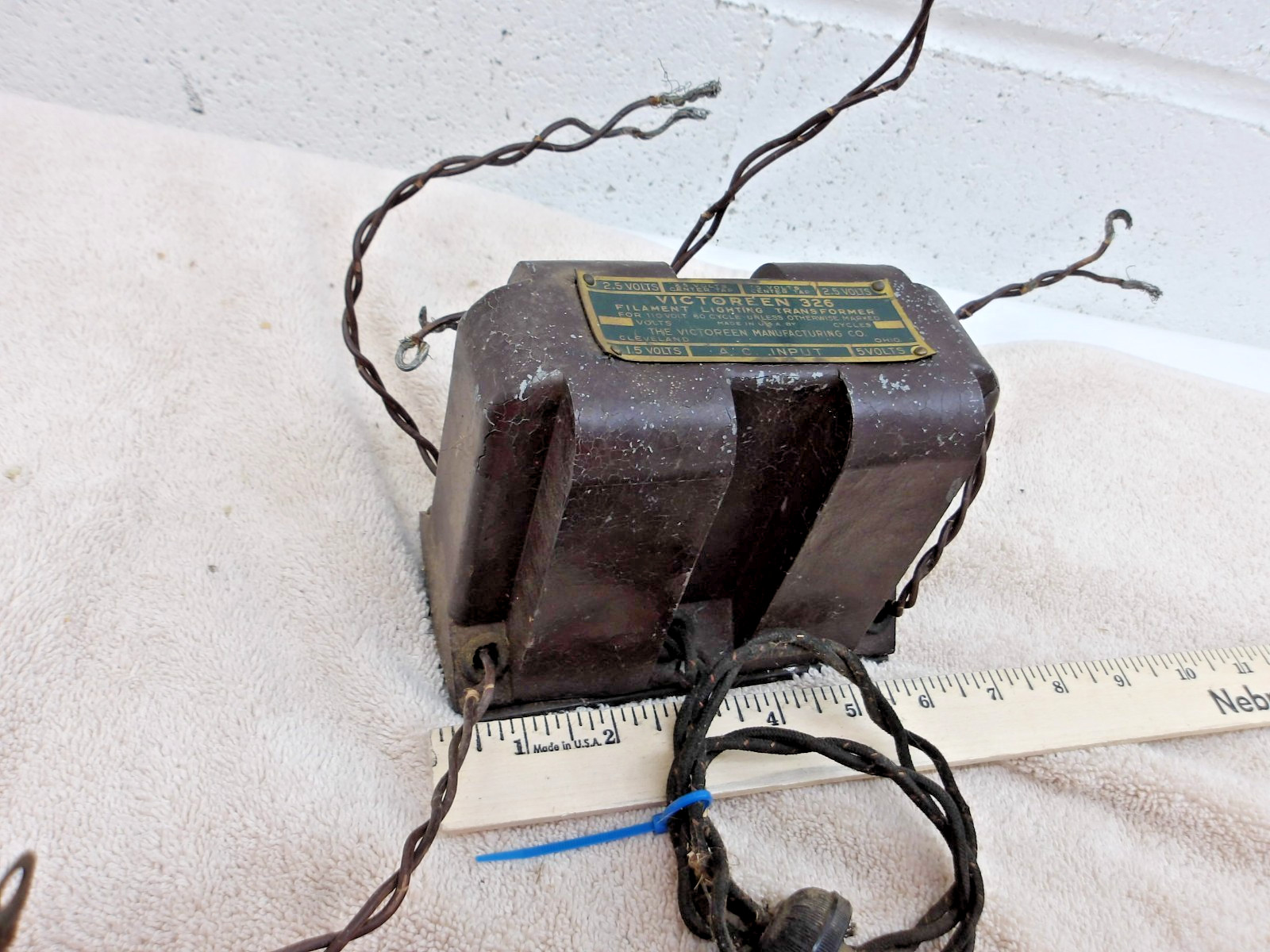
The Victoreen Manufacturing Company was established in Cleveland, Ohio, during the early decades of the twentieth century by brothers John and Arthur Williams. The company originally produced high-quality radio parts and electronic components before expanding into radiation measurement instruments and scientific equipment. Their early radio accessories were built with heavy metal housings and durable finishes to withstand the continuous heat generated by early valve electronics.
These filament lighting transformers were used by radio builders and early enthusiasts to power the delicate vacuum tubes in custom receivers and amplifiers. They stepped down standard household alternating current to the precise low voltages needed to heat the glowing filaments inside radio valves safely. As factory-built radios with internal power supplies became standard in the 1930s, separate heavy component transformers like this were phased out of home use.
Harold Warp (December 21, 1903 – April 8, 1994) was an American businessman who invented Flex-O-Glass. He also founded Pioneer Village in Minden, Nebraska. [1] [2] [3]
Harold Warp was born in a sod house on a farm near Minden, Nebraska. He was the youngest of twelve children born to an immigrant family from Norway. When he was three years old, his father died; his mother died when he was eleven. In 1924, he and two of his brothers moved to Chicago with a patent for a plastic window material he had developed. Their business became successful and in time its product line grew to include many other plastic products. Harold Warp was the recipient of numerous awards including the Horatio Alger Award in 1979 and the Distinguished Nebraskalander Award in 1984.[4][5][6]
He opened Pioneer Village in 1953 in Minden, Nebraska. Most of the objects on display were personally collected by him in his lifetime. In 1983, Warp donated the museum to the nonprofit Harold Warp Pioneer Village Foundation.