When you click on links to various merchants on this site and make a purchase, this can result in this site earning a commission. Affiliate programs and affiliations include, but are not limited to, the eBay Partner Network.
🚂 Original 1913 New York Central Railroad $1,000 Gold Bond — Series A, With Coupons
This is a genuine, original New York Central Railroad Company bond certificate from the golden age of American railroad finance — a $1,000 gold-denomination security dated October 1, 1913, the year Grand Central Terminal opened. It is offered as a collectible piece of scripophily and railroad history, not a modern reproduction, and it comes with an uncut sheet of its original engraved interest coupons. What follows is a plain, detailed accounting of exactly what the document is, what it says, and why it matters — so you can buy with confidence.
📋 What This Certificate Is — The Specifics
Issuer: The New York Central Railroad Company. Instrument: Refunding and Improvement Mortgage Bond, Series A — specifically the Refunding and Improvement series, not the company’s Consolidation Mortgage. Denomination: $1,000, payable in gold coin of the United States. Interest rate: four and one-half per cent (4½%). Maturity: due October 1, 2013. Interest dates: payable April 1 and October 1. Place of payment: the Borough of Manhattan, City of New York. Trustee: Guaranty Trust Company of New York, whose trustee’s certificate is countersigned on the face. Engraver/printer: American Bank Note Company. Approximate size: 15 x 10 inches (about 38 x 25.5 cm).
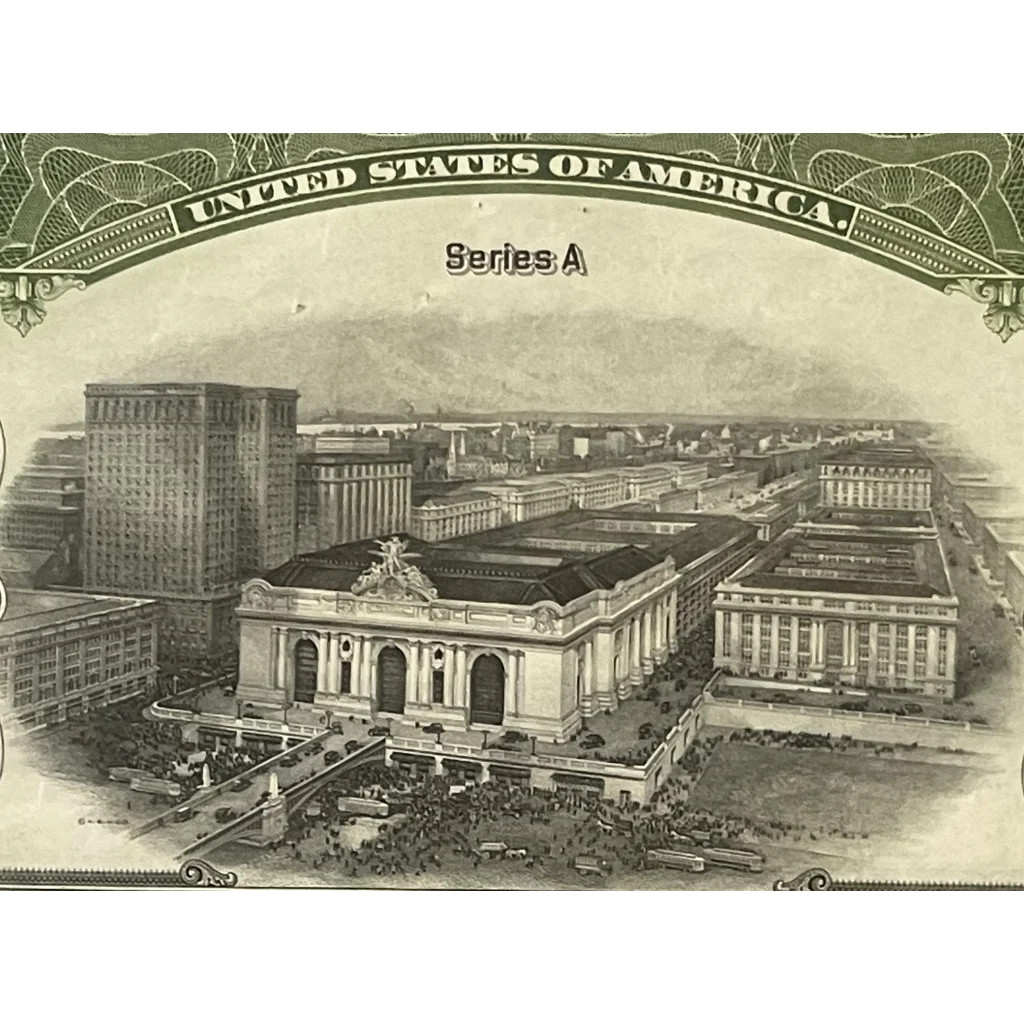
The certificate is printed in a deep olive-green engraved border framing a cream body of obligation text, with “UNITED STATES OF AMERICA” and “Series A” arched across the top, the ornamental “1000” medallion at center, and the full company title in bold block lettering. A line in the lower margin records that the U.S. revenue tax on the issue was paid by stamps affixed to the governing indenture. It is an issued bearer bond, punch-cancelled as retired securities were, with its registration table left blank by design — a bearer instrument was payable to whoever held it, so no registered owner was ever entered. The blank table is original and correct; it does not mean the bond is unissued.
🏛️ The Grand Central Terminal Vignette
The certificate’s central engraving is a period vignette of Grand Central Terminal — the stone façade, crowning statuary, and the plaza and skyline around it — rendered in the fine line-work of the American Bank Note Company. The terminal had opened to the public in February 1913, so this bond, dated that same autumn, effectively carries a portrait of the building in its opening year, printed by the railroad that built it. For collectors of Grand Central, of New York City history, or of the New York Central system, that vignette is the centerpiece of the piece and displays superbly under glass.
The New York Central was one of the largest corporations in the world when this series was drawn — the trunk line assembled by Cornelius “Commodore” Vanderbilt from the smaller railroads along the Hudson and the old Erie Canal route, and expanded by his successors into the electrified Park Avenue empire that made Grand Central possible. The bond’s promise of principal and interest in gold coin is a direct artifact of that era’s confidence, and of the enormous sums it took to build a terminal designed to last forever.
💰 The Gold Clause — Why “Gold” Is Printed Everywhere
In 1913 the United States was on the gold standard, and a “gold bond” promised repayment specifically in gold coin — a clause that protected the investor against any weakening of the paper dollar. The face and every coupon repeat the phrase “gold coin of the United States of America.” That promise is also what dates the document so precisely: in 1933 the federal government abrogated the gold clauses in public and private contracts, so the literal gold-payment language on this bond became a historical relic even as the bond itself kept running. Buying this certificate, you are buying a printed promise from the last era in which an American corporation would swear to pay a bondholder in gold — a genuine monetary-history artifact, not just a railroad souvenir.
🦅 Embossed Corporate Seal — Read It Closely
The lower certificate carries the company’s embossed corporate seal: an American eagle above a striped shield, encircled by the names of six states the system served — New York, Pennsylvania, Ohio, Illinois, Indiana, and Michigan — and inscribed “Consolidated Dec. 23, 1914.” This is the railroad’s own corporate seal, not a national emblem, and it is a point buyers should note: its 1914 consolidation date, set against the mortgage’s October 1, 1913 series date, shows the certificate was executed under the reorganized New York Central Railroad Company after the consolidation while carrying the earlier series date. That combination lets a knowledgeable collector place the document precisely and confirms it as an authentic product of the post-1914 company.
🏦 The Trustee & the Manhattan Payment Office
Beneath the main obligation runs the trustee’s certificate, countersigned by Guaranty Trust Company of New York. On a corporate bond the trustee is the independent party that holds the mortgage indenture on behalf of every bondholder and authenticates each certificate as part of the properly authorized issue — a guarantee of legitimacy that a knowledgeable buyer looks for and that is clearly present here. The obligation also fixes the place of payment: principal and interest were payable at the company’s office in the Borough of Manhattan, City of New York, in gold coin. Together the trustee’s signature and the Manhattan payment clause anchor the document firmly in the machinery of early-20th-century Wall Street finance and confirm it as a fully executed instrument, not a specimen or proof.
💵 The Uncut Coupon Sheet — $22.50 in Gold, Semiannual
Attached is an uncut sheet of the bond’s engraved interest coupons. Each coupon reads “THE NEW YORK CENTRAL RAILROAD COMPANY — will pay to bearer — twenty-two and 50/100 dollars, gold coin of the United States,” being six months’ interest on the Series A Refunding and Improvement Mortgage Bond, due October 1, 2013. Each carries an allegorical female vignette, an American Bank Note Company imprint, and its own semiannual date in April and October. The surviving coupons run from 1970 forward — 1970 being the year the Penn Central, the successor into which the New York Central had merged in 1968, entered what was then the largest corporate bankruptcy in American history. That collapse is precisely why the coupons still on this sheet were never clipped or redeemed. An uncut coupon sheet is the single feature advanced scripophily collectors most look for.
Coupons were made to be clipped away, and most bonds of this age lost theirs one payment at a time until only the certificate was left, so a sheet that came through the decades still attached is the exception rather than the rule. When a road went under, holders commonly taped the last coupon back onto the bond and held on in hope of collecting what they were owed, so a bond that still carries that taped final coupon is the better one to end up with. The coupon count can run a few more or a few fewer than what is pictured.
An issued certificate picks up the marks of its working life: endorsements and signatures on the reverse, transfer-agent and registrar stamps, revenue or documentary tax stamps, punch or cut cancellations at redemption, staple holes from being bound into a transfer book, and pencil ledger notations. Those marks are the paper trail of a financial instrument that actually did its job.
Each individual coupon is, in effect, its own small engraved bearer instrument — which is part of what makes an uncut sheet so satisfying to own and to display.
📐 Engraving, Printing & Security Detail
Collectors of scripophily buy engraving as much as history, and this certificate delivers on that front. The American Bank Note Company was one of the foremost security printers in the world, and its work here is textbook: intaglio steel-plate engraving in olive-green ink, guilloché lathe-lines woven so tightly they were meant to be impossible to copy, a fine ornamental medallion cradling the “1000” denomination, and lettering cut with machine precision. The Grand Central Terminal vignette is a true engraved illustration, not a halftone, so it holds its detail even under magnification. The embossed corporate seal stands physically up out of the paper and catches the light. These are exactly the qualities that make an antique bond worth framing rather than filing, and they are all present and sharp on this example.
📦 What You Receive & How It Displays
You receive one genuine, original New York Central Railroad Company $1,000 gold bond certificate of the Refunding and Improvement Mortgage, Series A, as described and photographed, together with its attached uncut coupon sheet. At roughly 15 x 10 inches the certificate is large enough to command a wall on its own; matted and framed behind UV glass, with the coupon sheet displayed alongside, it becomes a striking two-part conversation piece. It suits a study, a library, a law or finance office, a boardroom, or the home of any collector of trains, New York City history, or American financial engraving. Handle by the edges and keep it out of direct sunlight and it will outlast its next several owners, just as it has outlasted the railroad that signed it.
🔍 Condition & Authenticity
This is an authentic, original early-20th-century engraved security — not a copy, reprint, or facsimile. The engraving is deep and legible, the vignette and embossed seal are crisp, and the coupon sheet is uncut. The bank’s punch cancellation is present, as it should be on a retired bond of this kind, and the registration table is blank by design for a bearer instrument. The photographs form part of the description; please review them closely, as they show the actual type of item offered. This piece frames beautifully and displays as museum-grade railroadiana, whether matted with the coupon sheet alongside the certificate or shown on its own.
🏛️ Grand Central’s Architects and the Trains It Ran
Grand Central Terminal opened in 1913 — the same year as this bond — designed by Reed & Stem (its ramps and circulation) together with Warren & Wetmore (its Beaux-Arts grandeur). From its platforms the New York Central ran the famous 20th Century Limited all-Pullman express to Chicago, and marketed its gentle riverside grade as the “Water Level Route — You Can Sleep.” The system itself dated to Erastus Corning’s 1853 consolidation of ten upstate lines into the New York Central.
🎁 A Standout Collectible & Gift
A $1,000 New York Central gold bond with a Grand Central Terminal vignette and its coupon sheet is a genuine conversation piece — ideal for the scripophily collector, the railroad enthusiast, the New York City history buff, or as a distinctive framed gift for anyone in finance, law, architecture, or model railroading. It links three great subjects in a single sheet of paper: the terminal, the railroad, and the vanished world of the gold standard. It belongs on a wall, telling its story, rather than in a drawer.