When you click on links to various merchants on this site and make a purchase, this can result in this site earning a commission. Affiliate programs and affiliations include, but are not limited to, the eBay Partner Network.
1912 MIT Letter Signed Robert H. Richards – Single Tax Movement – Boston
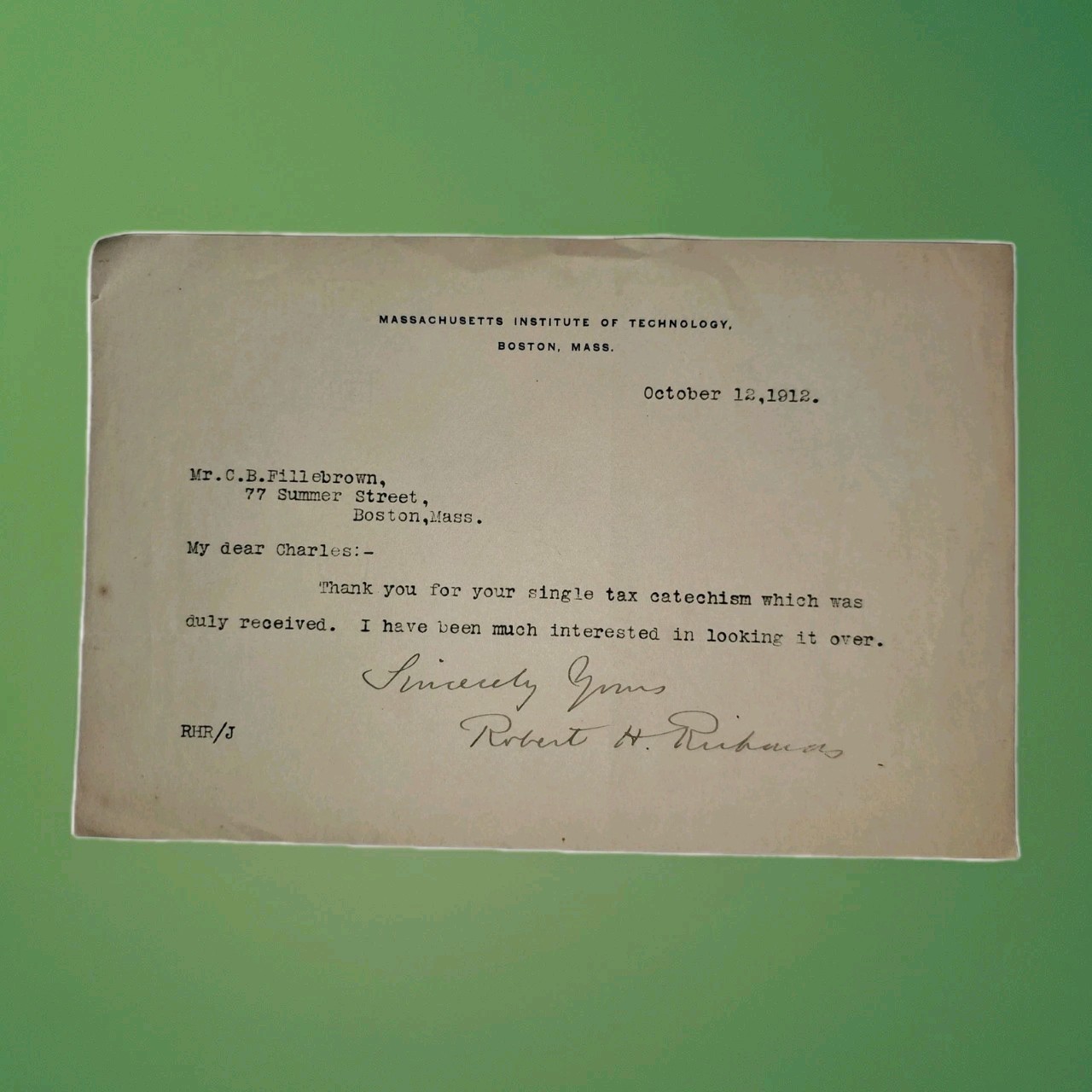
Offered here is an original typed letter dated October 12, 1912, on official Massachusetts Institute of Technology (MIT) letterhead, signed by Robert Hallowell Richards, a foundational figure in American mining engineering and longtime MIT professor.
The letter is addressed to C. B. Fillebrown (Charles Bowdoin Fillebrown) of Boston, a noted advocate of the Single Tax movement inspired by economist Henry George.
📜 Content
In this brief but historically interesting note, Richards writes:
“Thank you for your single tax catechism which was duly received. I have been much interested in looking it over.”
The correspondence reflects the intersection of early 20th-century academic thought and progressive economic reform movements.
👤 Robert Hallowell Richards (1844–1945)
Richards was a pioneering American mining engineer and metallurgist, widely regarded as one of the founders of modern ore processing in the United States. He served for decades at MIT, helping establish its reputation as a leading technical institution. He was also the husband of Ellen Swallow Richards, the first woman admitted to MIT and a major figure in environmental chemistry and home economics.
👤 Charles Bowdoin Fillebrown (1842–1917)
Fillebrown was a Boston businessman and prominent supporter of the Single Tax movement, which advocated for land value taxation as a means of economic reform. He was active in intellectual and reformist circles and contributed to the spread of Henry George’s ideas in the United States.
📌 Details
- Date: October 12, 1912
- Location: MIT, Boston, Massachusetts
- Format: Typed letter signed (TLS)
- Signature: “Robert H. Richards” (clear and legible)
- Condition: Light toning and handling wear; overall clean and well-preserved
📖 Historical Significance
A compelling piece connecting MIT’s early academic leadership with one of the most influential economic reform movements of the Progressive Era. Material linking scientific figures to broader social and political ideas remains highly collectible.