When you click on links to various merchants on this site and make a purchase, this can result in this site earning a commission. Affiliate programs and affiliations include, but are not limited to, the eBay Partner Network.
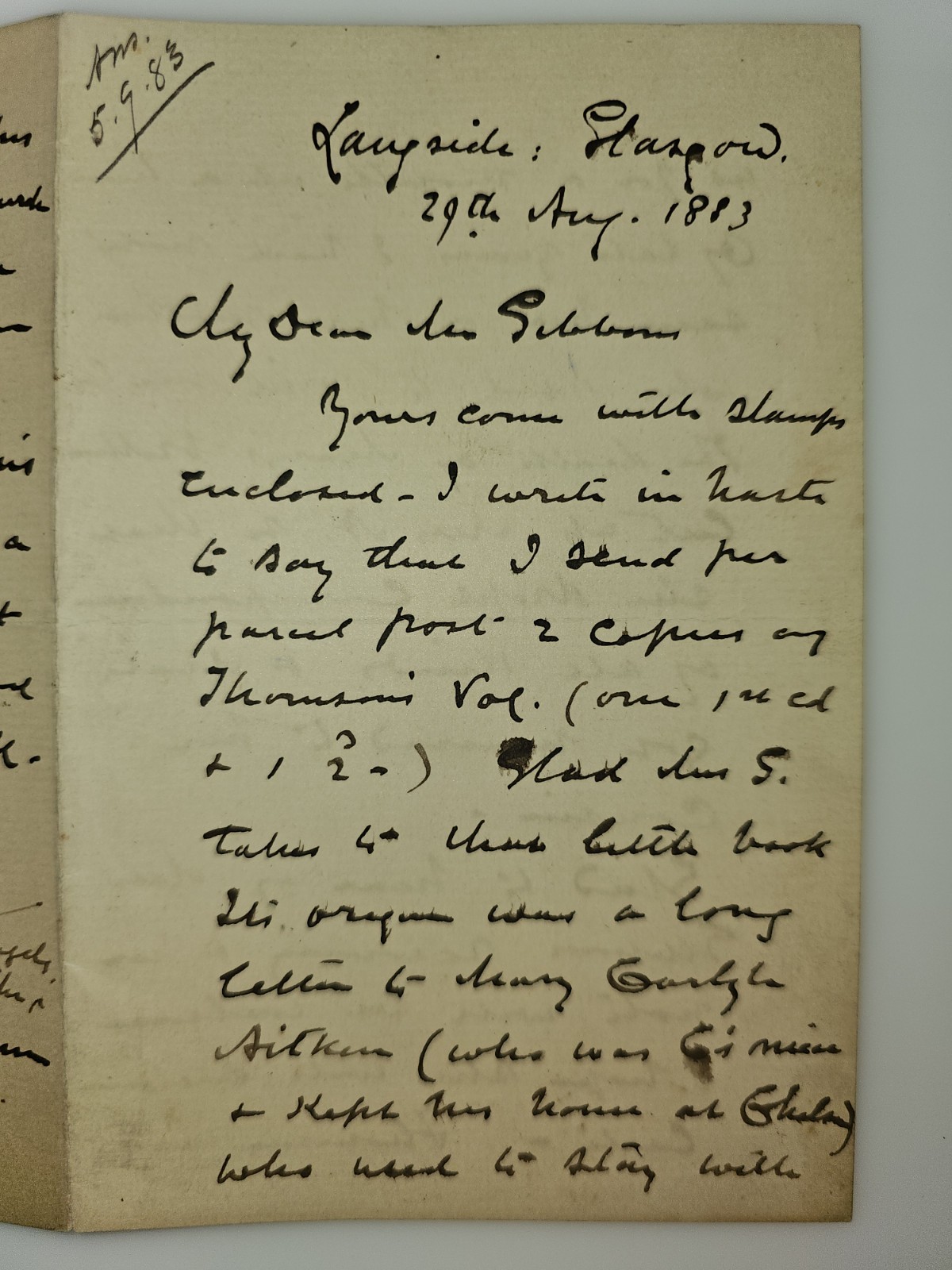
Offered here is an exceptional four-letter archive (1883–1884) written by Rev. Alexander Hamilton Fleming (1824–1907) of Langside, Glasgow.
All letters are signed A. H. Fleming in his sweeping, distinctive hand. The archive spans major personal events: illness, family estrangement, bereavement, literary projects, friendships with leading Scottish and English intellectuals, and observations on clergy life in late-Victorian Scotland.
Three letters (26 July 1883, 29 Aug 1883, 22 May 1884) are complete, multi-page ALS. One is written on black-bordered mourning stationery, reflecting the death of Fleming’s son, Eric. The fourth letter (1883–84) is a lengthy, multi-page personal report filled with literary and biographical value.
All four letters are addressed to Thomas Gibbon, Esq., a close friend and correspondent who exchanged books, papers, and news with Fleming.
This is the most substantial A. H. Fleming archive I have seen on the market, rich with emotional content, literary references, and genealogical connections.
---
🟦 ARCHIVE CONTENT — LETTER SUMMARIES
LETTER 1 — August 29, 1883 (multi-page)
A deeply emotional account of:
The death of Thomson, whom Fleming visited the day before his passing.
A vivid scene of the father checking on his son at 4 a.m. only to find “the spirit had fled quietly & peacefully.”
Updates on Mary Carlyle Aitken and her mother’s grief.
Fleming's concern for his troubled son, who has “walked into a trap.”
His work on revising his book Hints to Our Boys.
The funeral of Provost William Graham, D.D., at Bellshill.
Thanks and warm wishes for Gibbon and his wife.
This is the most personal and vivid narrative of the set.
---
LETTER 2 — July 26, 1883 (4 pages)
A friendly and reflective travel letter:
Fleming’s illness and recovery during a trip to Oban with the Buchans and Wilkins.
Thomson’s worsening condition.
Mentions of Tenniel’s “Sketch of Kent.”
Publication of Modern Scottish Poets including sketches of Fleming and his wife (with “several serious misprints”).
Correspondence with J. C. Hale.
Oliver Wendell Holmes sending two volumes for Thomson and The Autocrat of the Breakfast Table for Fleming.
A rich window into Fleming’s literary and social circle.
---
LETTER 3 — May 22, 1884 (black-bordered mourning paper)
An important mourning letter:
Fleming’s son Eric died in February.
His sister Mary (who kept house for him) died 6 years earlier.
He has now lost his “dear old friend,” Dr. R. Angus Smith, chemist and pioneer of environmental science (“acid rain”).
Details on Smith’s executorship and the settlement of his estate.
Offers to look out autographs for Gibbon.
Asks for 6 copies of the American Literary World (Boston), May 3 issue, containing a sketch of Fleming.
A poem enclosed from Mr. Wilkie.
A rare personal response to the famous Dr. Angus Smith’s death.
---
LETTER 4 — 1883–84 (multi-page personal report)
This long, intimate letter includes:
Painful details of family estrangement, including two little girls prevented from writing him after the death of his son Austin.
His younger boy at home is “a great comfort.”
A day with Richard Anthony Proctor, the astronomer, and a gift from Proctor’s daughter Adelaide.
Notes on Rev. R. R. Haweis, his “most intimate friend,” and the astonishing number of letters Fleming preserved (“between 3000 and 4000”).
Comments on editors, finances, and lost savings.
Proposal that Gibbon visit via Clyde steamer and enjoy the scenery.
Discussion of Japan and a professor at the “College of Yorkshire.”
Mentions of ongoing work on “Campfire” for the “Fireside” series, intended for book publication.
Comments on Philip B. (likely poet Philip Bourke Marston) and melancholy among literary men.
Warm wishes to Mrs. Gibbon.
This letter alone is a treasure of 1880s literary and clerical social history.
---
🟩 Biographical Notes
Rev. Alexander Hamilton Fleming (1824–1907)
A prominent Scottish Presbyterian minister based in Glasgow, known for devotional writings and youth instruction texts, including Hints to Our Boys and numerous contributions to Scottish and American periodicals. Fleming maintained friendships with major intellectuals, including Dr. R. Angus Smith and Richard A. Proctor. His surviving manuscript letters are scarce, and multi-letter archives rarer still.
Dr. Robert Angus Smith (1817–1884)
Scottish chemist and environmental pioneer, best known as the discoverer of “acid rain.” Inspector of Alkali Works and an important figure in Victorian environmental regulation. Fleming’s mourning letter is historically significant, giving contemporary personal reactions to Smith’s death.
Richard Anthony Proctor (1837–1888)
British astronomer and prolific writer (The Moon, The Sun). His daughter Adelaide appears in the correspondence. Fleming’s notes on spending a day with Proctor and receiving books from the family show close connection.
Rev. Hugh Reginald Haweis (1838–1901) (“R. R. Haweis”)
Anglo-Scottish clergyman, author, music historian, and prominent Victorian intellectual. Fleming’s claim of possessing “between 3000 & 4000” letters from Haweis is extraordinary and suggests a formerly substantial literary archive.