When you click on links to various merchants on this site and make a purchase, this can result in this site earning a commission. Affiliate programs and affiliations include, but are not limited to, the eBay Partner Network.
The writer’s surname has not yet been conclusively identified, so no unsupported attribution is being made. However, several individuals and locations mentioned in the letter have been identified or narrowed considerably through period records.
Highlights of the Letter
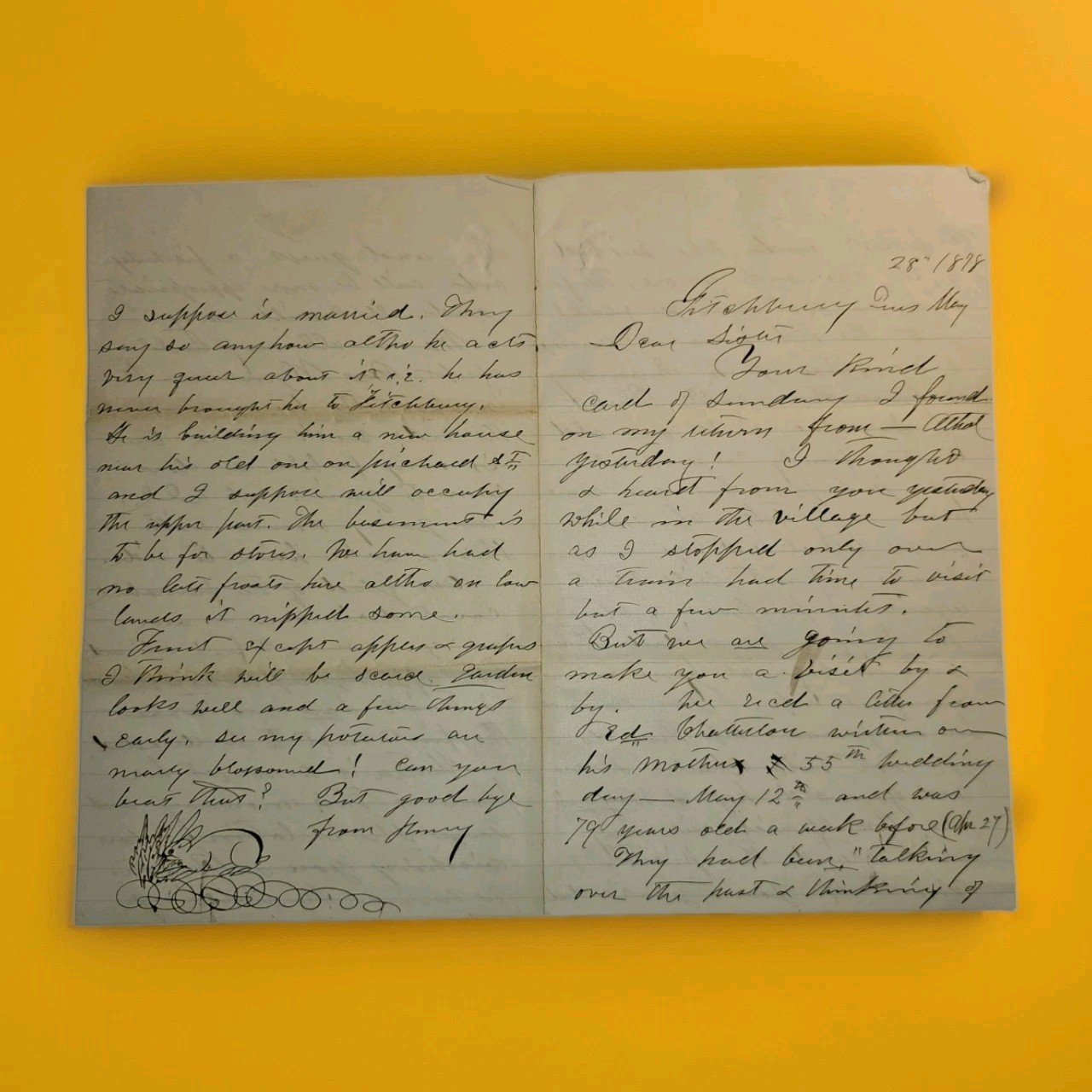
Henry writes after returning from Athol, Massachusetts, and discusses plans for an extended horse-and-carriage journey toward Swanzey, New Hampshire, where he expects to visit an elderly aunt and family.
He mentions receiving a letter from “Eld. Chatterton”, written on the occasion of Chatterton’s mother’s 55th wedding anniversary, May 12, 1878. Henry records that she had recently turned 79 years old, apparently around April 27, placing her birth at approximately April 27, 1799, and her marriage around May 12, 1823.
Henry writes that the elderly woman wished to see him “once more,” prompting the proposed family journey.
The letter includes the wonderfully colloquial passage:
“by & by I think we shall put the old horse in carriage & mosey up to Swanzey”
He plans to travel with or meet Philip and Lorenzo, who would accompany the party in visiting the “old Aunt & family.”
Jonathan Belding & Prichard Street, Fitchburg
One of the strongest local identifications in the manuscript is Mr. Belding, almost certainly Jonathan Belding, a documented Fitchburg resident associated with Prichard Street during the late 1870s.
Henry writes:
“Mr. Belding I suppose is married. They say so anyhow altho he acts very queer about it i.e. he has never brought her to Fitchburg.”
He then describes Belding’s current construction project:
“He is building him a new house near his old one on Prichard St. and I suppose will occupy the upper part. The basement is to be for stores.”
Period Fitchburg directories place Jonathan Belding on Prichard Street, including an address reported as 40 Prichard Street. The Belding family was also connected to Fitchburg commercial property through Belding & Dickinson’s Block on Main Street.
This makes the letter a particularly nice piece of Fitchburg architectural, neighborhood and commercial history, preserving an eyewitness comment about mixed residential/commercial construction on Prichard Street in 1878.
Elder Chatterton & the New Hampshire Connection
The reference to “Eld. Chatterton” is especially interesting.
The Chatterton family was established in the Acworth / Cheshire County / southwestern New Hampshire region, and the title “Elder” was used among Baptist and particularly Free Will Baptist ministers of the era.
A notable earlier member of this extended regional family was Elder Benjamin Chatterton (1778–1855), a documented Free Will Baptist minister associated with Acworth, New Hampshire.
The Elder Chatterton mentioned in this 1878 letter cannot be Benjamin himself, who had died decades earlier, but the terminology and geography place the correspondent within the same broader New Hampshire religious and family milieu.
Research is ongoing into the identity of the 79-year-old Chatterton mother mentioned in the letter. Her unusually precise biographical clues are:
Born: approximately April 27, 1799
Married: approximately May 12, 1823
Still living: May 1878
Son or close relative: styled “Elder Chatterton”
There is a strong possibility that this woman is also Henry’s “old Aunt” whom he intended to visit near Swanzey, although that relationship has not yet been proven and is presented here only as a research hypothesis.
Martha
Henry writes:
“Martha is amongst her flowers this morning and says she is calculating upon visiting you & Brother & John.”
Martha was clearly part of Henry’s immediate household or close domestic circle.
Her exact relationship to Henry is not yet established. She could have been his wife, mother, sister, or another close relative. This distinction is important because several Fitchburg men named Henry are presently being investigated.
One particularly interesting research avenue has involved Martha Ann (Upton) Curtis (1826–1894), a member of the prominent Fitchburg Upton family.
Martha Ann Upton was born in Fitchburg on February 27, 1826, daughter of Joseph Upton and Susan “Suky” Thurston. Her brother was Colonel Edwin Upton, a well-known Fitchburg civic figure and Civil War officer associated with the 25th Massachusetts Infantry.
Martha Ann later married into the Curtis family and had a son, Henry Clifford Curtis, born August 30, 1852, in Roxbury, Massachusetts, as well as a daughter Martha G. Curtis, born September 9, 1857.
At present there is not enough evidence to identify the writer as Henry Clifford Curtis, but the family is among the Fitchburg households being tested because it contains both a Henry and a Martha of appropriate age.
Other Fitchburg Henry Candidates
Several locally prominent men named Henry have also been investigated.
Henry Martin Francis (1836–1908) was one of Fitchburg’s important architects and designed numerous institutional, commercial and residential buildings in the city. He was born in nearby Lunenburg, Massachusetts, and became closely associated with Fitchburg architecture.
Francis worked on the historic Rollstone Congregational Church, where another candidate, Henry G. Morse, directed the carpentry.
Francis is presently considered an unlikely writer of this letter because his wife in 1878 was Emily Josephine Leighton, not Martha, and his documented sibling structure does not provide an obvious sister matching the recipient.
Henry G. Morse remains an interesting candidate. He was a prominent Fitchburg carpenter and contractor who directed the carpentry during the construction of Rollstone Congregational Church. Church history records him as a member of the congregation and notes that he traveled to Europe to study cathedral architecture.
His occupation makes Henry’s detailed knowledge of Belding’s new building especially plausible, although no attribution is presently claimed.
Another possible candidate is Henry G. Kittredge, who married Martha S. Hodges in Massachusetts in 1870 and was reportedly born in New Hampshire. The combination of Henry + Martha + New Hampshire origins makes him worthy of continued genealogical investigation, although his Fitchburg residence and Chatterton connections remain to be demonstrated.
“Bro. Wyman”
Henry reports on a seriously ill man:
“We are all very well except Bro. Wyman. He is about the house & on the side walk some but is very feeble & dont seem to gain at all.”
Henry says he intends to go down and ask Wyman to take a carriage ride.
The abbreviation “Bro.” may indicate a biological brother, but it may equally signify a church or fraternal brother, particularly given Fitchburg’s active Congregational, Baptist, Masonic and benevolent organizations.
Wyman therefore remains an important potential corroborating clue for eventually identifying Henry.
Court Case & Remarkable Period Humor
Henry congratulates his sister on what was evidently a recent legal victory:
“Am glad of the favorable court decision & am sure you must feel relieved”
He then offers one of the letter’s most memorable lines:
“for after hydrophobia, cancer, I think law, is about the first next to be dreaded.”
The underlying lawsuit has not yet been identified, but this reference provides another potentially searchable route to identifying Henry’s sister.
Agriculture & Everyday Fitchburg Life
Henry also reports on local weather and crops:
“We have had no late frosts here altho on low lands it nipped some.”
He comments that fruit other than apples and grapes may be scarce and proudly boasts of his garden:
“See my potatoes are many blossomed! Can you beat that?”
These small observations provide a vivid glimpse of everyday life in Fitchburg in the spring of 1878.
Original Rabbit Drawing
The final page is particularly attractive.
Below Henry’s closing appears an original pen-and-ink drawing of a rabbit or hare in grass, integrated into a large, sweeping calligraphic flourish.
This is not a printed decoration—it was drawn by the letter writer himself and gives the manuscript excellent folk-art and visual appeal in addition to its historical and genealogical interest.
Physical Description
Original manuscript letter.
Date: May 28, 1878
Place: Fitchburg, Massachusetts
Length: 4 handwritten pages
Writer: Signed “Henry”
Recipient: His sister, name presently unidentified
Additional feature: Original rabbit/hare pen-and-ink drawing and elaborate calligraphic flourish
Shows normal age toning, folds and handling consistent with a document nearly 150 years old. Please examine all photographs carefully for exact condition.
Historical Importance
This is much more than an ordinary Victorian family letter. It combines:
- Fitchburg, Massachusetts local history
- Jonathan Belding and Prichard Street real-estate development
- Swanzey, New Hampshire travel
- Chatterton family and religious history
- references to Athol, Massachusetts
- an unidentified 1878 court case
- period illness and family news
- contemporary agriculture and gardening
- an unusually appealing original rabbit folk-art drawing
- multiple unresolved genealogical clues offering substantial research potential
The manuscript is being sold with the writer identified only as Henry of Fitchburg, as the evidence does not yet justify attaching a surname. The Belding identification is considerably firmer, while the Chatterton, Curtis, Morse, Kittredge and other family connections described above are included as documented research context and clearly distinguished from a final author attribution.
A terrific original document for collectors of Fitchburg history, Worcester County manuscripts, New Hampshire genealogy, Victorian correspondence, 19th-century Americana, folk art, calligraphy, or antique family letters.