When you click on links to various merchants on this site and make a purchase, this can result in this site earning a commission. Affiliate programs and affiliations include, but are not limited to, the eBay Partner Network.
1874 - MARK TWAIN portrait & bio; Liberty Hall, ELIZABETH, NJ; Wm. LIVINGSTONAPPLETONS’ JOURNAL
July 4, 1874Mark TwainThis is an issue of the illustrated weekly publication, Appletons’ Journal, which was printed 152 years ago! It is 32 pages long, and measures 8 x 11 inches in size. The paper came from a bound volume and has some typical minor disbinding marks at the spine, but is otherwise in excellent and very attractive condition. It will be shipped in a clear report binder, to help keep it safe from deterioration in the future.The highlight of the issue is a feature on MARK TWAIN. This is an article spread over four pages, with over 500 lines of text in small print. It is illustrated with a great wood-engraved portrait of Twain, who was then 39 years old, and had not yet his most acclaimed works.Written by George Ferris, the article compares Twain to other famous American writers of the period. It tries to define the nature of humor, and analyze some of Twain’s strengths and weaknesses as an author.It says, in part:“. . . . There in mining-camp or squatter settlement we see the figures of Mark Twain, Bret Harte, or John Hay, casting long shadows. . . . we can hear them make merry over adventures and fancies, which, vitalized by the breath of genius, were soon to ripple the world's face with laughter. Such whimsical caprices never cease to haunt the students of the humorous in books with a sense of nearness and intimacy in their favorites. We are impertinently curious about them, make them mental bedfellows, as it were, because we love them. The laugh in literature is the ‘one touch of Nature’ (above all others) ‘which makes the whole world akin.’
“America has of late years bristled with humorous writers, as does the porcupine with quills. . . .
“Mark Twain and Bret Harte may, on the whole, be pronounced our most marked types of humorists. . . . .
“Mark Twain, on the other hand, rarely touches the latent springs of human sentiment, nor is his style more than narrative and descriptive. He strolls in the open, breezy sunshine, happy-go-lucky fashion, yet with a keenness of vision that allows nothing in his horizon to escape him. . . .
“. . . Let us briefly sketch the man, who was generally known to his little circle as Samuel Clemens, before the world coddled and petted him as Mark Twain.
“He was born in Missouri in 1835, and got but scanty gleanings of early education. He be came a printer's apprentice . . . by no means a bad school. After a few years, most of which were spent in itinerating from one country newspaper to another, young Cle mens became a pilot on a Mississippi steamboat running between St. Louis and New Orleans. The picturesque life which he saw in this new business seems to have stimulated his literary faculties, for we soon find him writing for the newspapers. . . .
“Nevada was just then beginning to swarm with.reckless and quaint people, who had shot off at a tangent from the established order of society. Bankrupt tradesmen, young college graduates who, tired of grubbing for Greek roots, would now grub for gold and silver, thieves and murderers escaped from justice these and a thousand other offscourings of life collided and made frontier society lively. The fashionable toilet consisted of an eight-inch Colt, an Arkansas toothpick, jackboots, and an ‘insectivorous’ shirt. The pet amusements were drinking bad whiskey, playing ‘draw-poker,’ and practising at human targets. Such paradisiacal conditions were surely enough to make any reasonable man happy. That our hero was so may be deduced from the fact that, what was originally projected as a pleasure-trip, lasted for seven years. . . .
“. . . The Innocents Abroad. . . . readers were made acquainted with the genesis of a Bunyan of a different type from the old Baptist dreamer. This publication justified the expectations of a public ever on the alert for something to laugh at, and Mark Twain rose on a flood-tide of popularity. . . . The confinement of office-work, however, did not suit his free Bohemian spirit, and the swelling results of his literary venture soon put it in his power to break loose from the slavery of the editor's desk and follow his own intellectual caprices. . . . Our author is now residing at Hartford, and is in the very prime of his life and power. Before dismissing the mere material facts of Mark Twain's life, some allusion to the very remarkable pecuniary success of his books will be of interest. . . . Though a large sale is by no means the only or even the best measure of literary excellence, the above-mentioned fact is so remarkable as to be almost unparalleled. . . .
“Of wit, we see next to none. Mark Twain, while lacking the subtlety and pathos of the other, has more breadth, variety, and ease. His sketches of life are arabesque in their strange combinations. Bits of bright, serious description, both of landscape and society, carry us along till suddenly we stumble on some master-stroke of grotesque and irresistible form. He understands the value of repose in art. . . . we like to be betrayed into laughter as much in books as in real life. It is the unconscious, easy, careless gait of Mark Twain that makes his most potent charm. He seems always to be catering as much to his own enjoyment as to that of the public. He strolls along like a great rollicking school-boy, bent on having a good time, and determined that his readers shall enjoy it with him. . . .
“In using exaggeration as a force in art, Mark Twain exaggerates not characters but circumstances. As a consequence, he is never a caricaturist. We recognize, even in his most extraordinary statements and descriptions, therefore, a flavor of reality, which takes strong hold of the imagination. Many of the unique people . . . seem to have stepped right out of life into the printed page, veritable photographs in large and showy settings. Mark Twain's latest book, ‘The Gilded Age’ . . . Some of the best detached descriptions which have ever emanated from Mark Twain's pen may be found in this book. They show that the author's powers are at their best working capacity, and that the world has a right to look for liberal fruits from them.”* * * * * * * * * * * * *
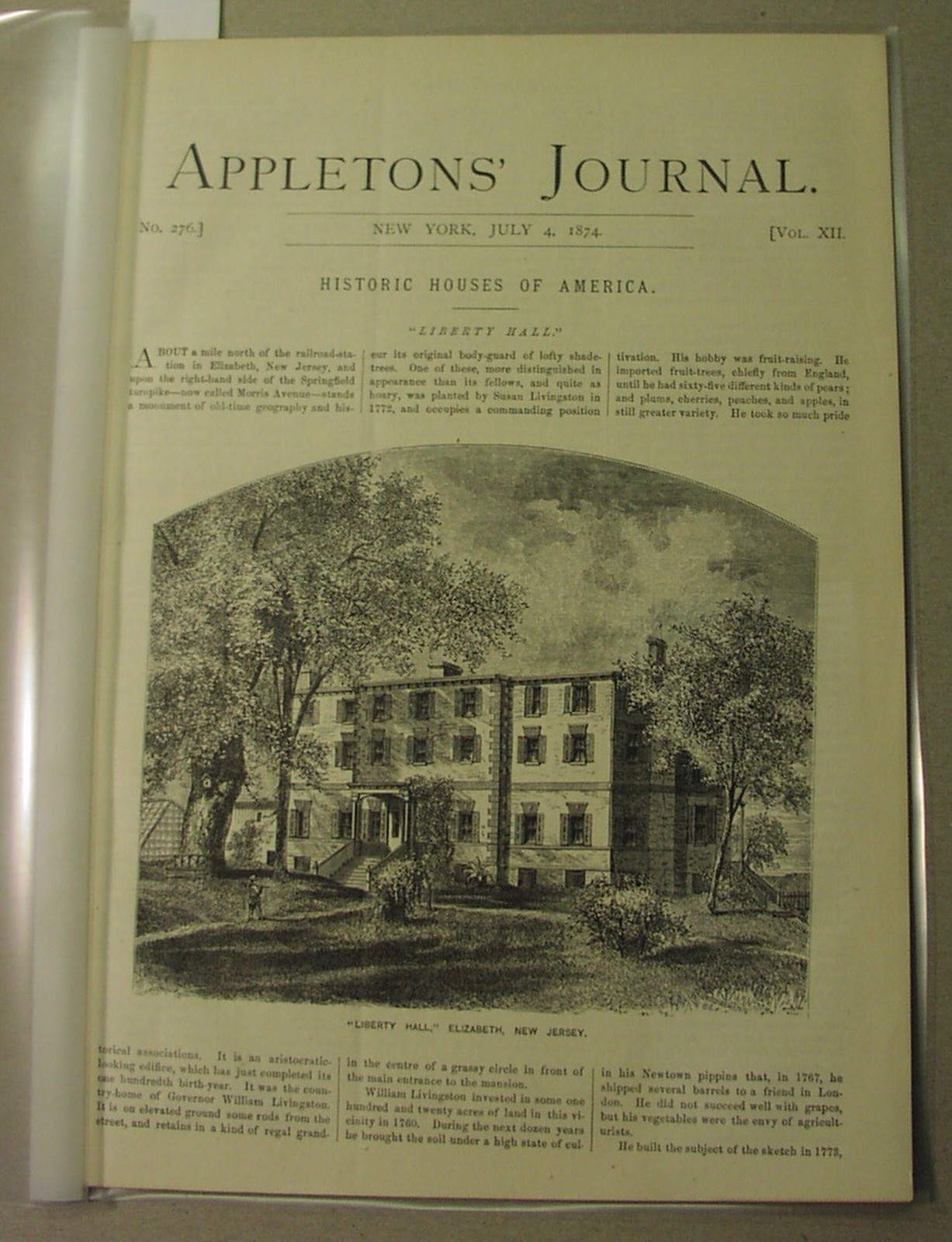
Also of interest is the front page article, which was part of a series on “Historical Houses of America.” It features an illustration on the cover, of “LIBERTY HALL, ELIZABETH, NEW JERSEY.” The text runs for over four pages, and mostly presents an extensive biography on the life of William Livingston (1723-1790), and his role as one of America’s Founding Fathers, as a signed of the U.S. Constitution, and the first governor of New Jersey.Before getting into the story of Livingston’s life, the article begins by describing his home in Elizabeth, N.J., this way:“About a mile north of the railroad-station in Elizabeth, New Jersey, and upon the right-hand side of the Springfield turnpike—now called Morris Avenue—stands a monument of old-time geography and historical associations. It is an aristocratic-looking edifice, which has just completed its one hundredth birth-year. It was the country-home of Governor William Livingston. It is on elevated ground some rods from the street, and retains in a kind of regal grandeur its original body-guard of lofty shade-trees. . . .
“William Livingston invested in some one hundred and twenty acres of land in this vicinity in 1760 . . . . He built the subject of the sketch in 1773, and gave it the pleasant-sounding name of ‘Liberty Hall.’ He removed his family to it late in November of the same year. ‘We are going into cloister seclusion,’ said Susan Livingston, as she bade adieu to her city friends. That winter—a century ago—was a long and very cold one for the climate; but there was cheery warmth, sweet song, and merry laughter, within the walls of the new homestead; and, notwithstanding the gloomy predictions of the four young ladies, that they should be ‘buried from society in that sequestered part of the globe,’ the toilsome and muddy way from New York was kept well trodden by brilliant and ever-welcome guests.
“The original structure remains intact, with its spacious apartments, high ceilings, narrow doors, and wide staircases. It has been raised one story, and enlarged in the rear, to meet the exigencies of later occupants . . . But the flavor and sacredness of antiquity are well preserved. . . .”
Etc., on this publication: Appleton’s Journal was an illustrated weekly paper published in New York. Its parent company was D. Appleton & Co., Publishers, which at the time was one of America’s leading book publishers. The paper was founded in 1869, and achieved a widespread, but shortlived national popularity during the next six years. It carried some serial fiction, but most of its content was devoted to essays on Americana subjects, plus the arts and sciences. Following several changes in editors, however, it began suffering a decline in circulation. It subsequently switched to monthly publication after 1876, and went out of business in 1881.276 [p]_gsrx_vers_1836 (GS 10.1 (1836))