When you click on links to various merchants on this site and make a purchase, this can result in this site earning a commission. Affiliate programs and affiliations include, but are not limited to, the eBay Partner Network.
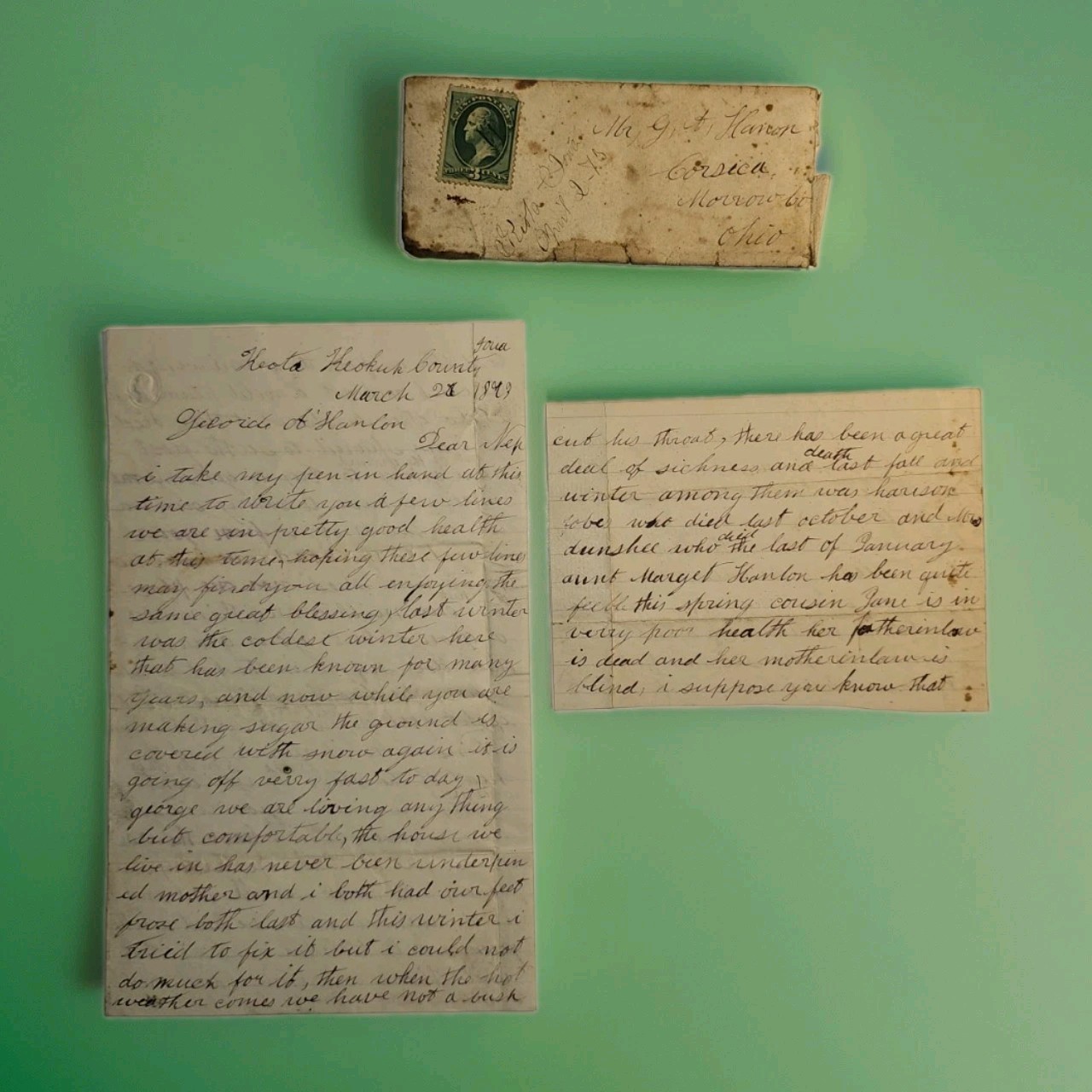
Dated March 26, 1873, with an additional entry of March 31, and mailed from Keota with an April 2, 1873 postmark. The cover bears a 3-cent green George Washington stamp, likely Scott #147 or #158 pending specialized identification.
This is an unusually rich piece of Iowa and Ohio social history, documenting the hardships of life in newly developing Keota, illness and mortality during the severe winter of 1872–73, family migration, and the rise of telegraph and railroad culture.
Among the most striking passages, T. J. Hanlon describes the family’s difficult living conditions:
“the house we live in has never been underpinned mother and i both had our feet froze both last and this winter”
The writer explains that the family had no cave or shed for food storage, had to carry water a considerable distance, and had virtually no shade around the house. He also gives a vivid description of George’s grandmother suffering from asthma in an eight-foot-square bedroom heated by the summer sun and nearby stove.
On March 31, Hanlon adds that he himself is suffering from erysipelas, then reports a remarkable series of recent deaths and illnesses in the surrounding community:
“uncle Thomas Morrison is dead and Dr Pile is dead. James Crawford cut his throat”
He further records the death of Harrison Fobes in October 1872, Mrs. Dunshee in late January, the poor health of Aunt Margaret Hanlon and Cousin Jane, and other family developments.
The identification of Mrs. Dunshee is particularly significant. She appears to have been Mary A. (Snodgrass) Dunshee, wife of pioneer settler Luke Dunshee, who died at Keota on January 30, 1873. That date closely matches Hanlon’s statement that she died “the last of January.” The Dunshee family had previously lived in Springfield Township, Richland County, Ohio, before relocating to Keokuk County, Iowa, illustrating the same Ohio-to-Iowa migration corridor reflected in this correspondence.
T. J. Hanlon
T. J. Hanlon was living in or near Keota, Iowa, shortly after the town’s establishment as a railroad-centered community. He addresses George as “Dear Nephew,” establishing that he was George’s uncle or aunt by blood or marriage. His letter provides a firsthand account of the physical difficulties faced by families settling in southeastern Iowa during the early 1870s.
Hanlon’s detailed reporting of deaths, illnesses, weather, farming, and family movements also makes the letter an important local chronicle of life in Keokuk County.
George A. Hanlon
George A. Hanlon, born about 1852 in Ohio, was living at Corsica, Morrow County, Ohio, when this letter was received. Corsica was a small village in the Morrow/Richland County border region, an area from which numerous families migrated westward into Iowa during the mid-19th century.
George’s placement in Ohio while his relatives were establishing themselves in Iowa makes this letter a particularly interesting record of family chain migration and continuing communication between the Midwest and the older Ohio settlements.
William Hanlon and Early Telegraphy
The letter also notes that:
“William is in burlington Iowa learning Telegraphing”
William is very likely a member of the same Hanlon family group. A strong candidate is William S. Hanlon (1849–1923), later associated with Keota and listed as a clerk there. At approximately 24 years old in 1873, he was of an ideal age to be training in the rapidly expanding telegraph industry.
Burlington, Iowa was a major railroad and communications center, while Crestline, Ohio, also mentioned in the letter, was one of Ohio’s most important railroad junctions. The reference provides an excellent glimpse into the way railroads and telegraphy connected migrating Midwestern families.
Mary A. Dunshee and the Ohio–Iowa Migration Connection
The “Mrs. Dunshee” whose death is recorded appears to be Mary A. Snodgrass Dunshee, wife of Luke Dunshee. The Dunshees had lived in Richland County, Ohio, close to the area where George Hanlon resided, before moving to Keokuk County, Iowa.
Her documented death on January 30, 1873 closely confirms the accuracy of Hanlon’s account and helps establish the letter as a reliable contemporary record of local mortality and family migration.
Historical Importance
This letter combines several highly collectible themes:
- Keota and Keokuk County, Iowa history
- Morrow and Richland County, Ohio genealogy
- 19th-century westward family migration
- Early railroad and telegraph history
- Frontier and pioneer living conditions
- Erysipelas and asthma in 19th-century medicine
- Winter hardship and frozen extremities
- Multiple contemporary death reports
- Reference to James Crawford cutting his throat
- Identifiable local families including Hanlon, Dunshee, Morrison, Fobes and Crawford
- Original stamped postal cover
A compelling and research-rich primary source documenting everyday life, suffering, death, migration, and technological change in the American Midwest during the early 1870s.
Condition: Original manuscript with expected age toning, folds, handling wear and postal wear. Please review photographs carefully for exact condition, completeness, handwriting, stamp and postmark.
Sold as an original 1873 manuscript letter and cover. Research and biographical identifications are included for historical context; some extended family relationships remain subjects for further genealogical study.