When you click on links to various merchants on this site and make a purchase, this can result in this site earning a commission. Affiliate programs and affiliations include, but are not limited to, the eBay Partner Network.
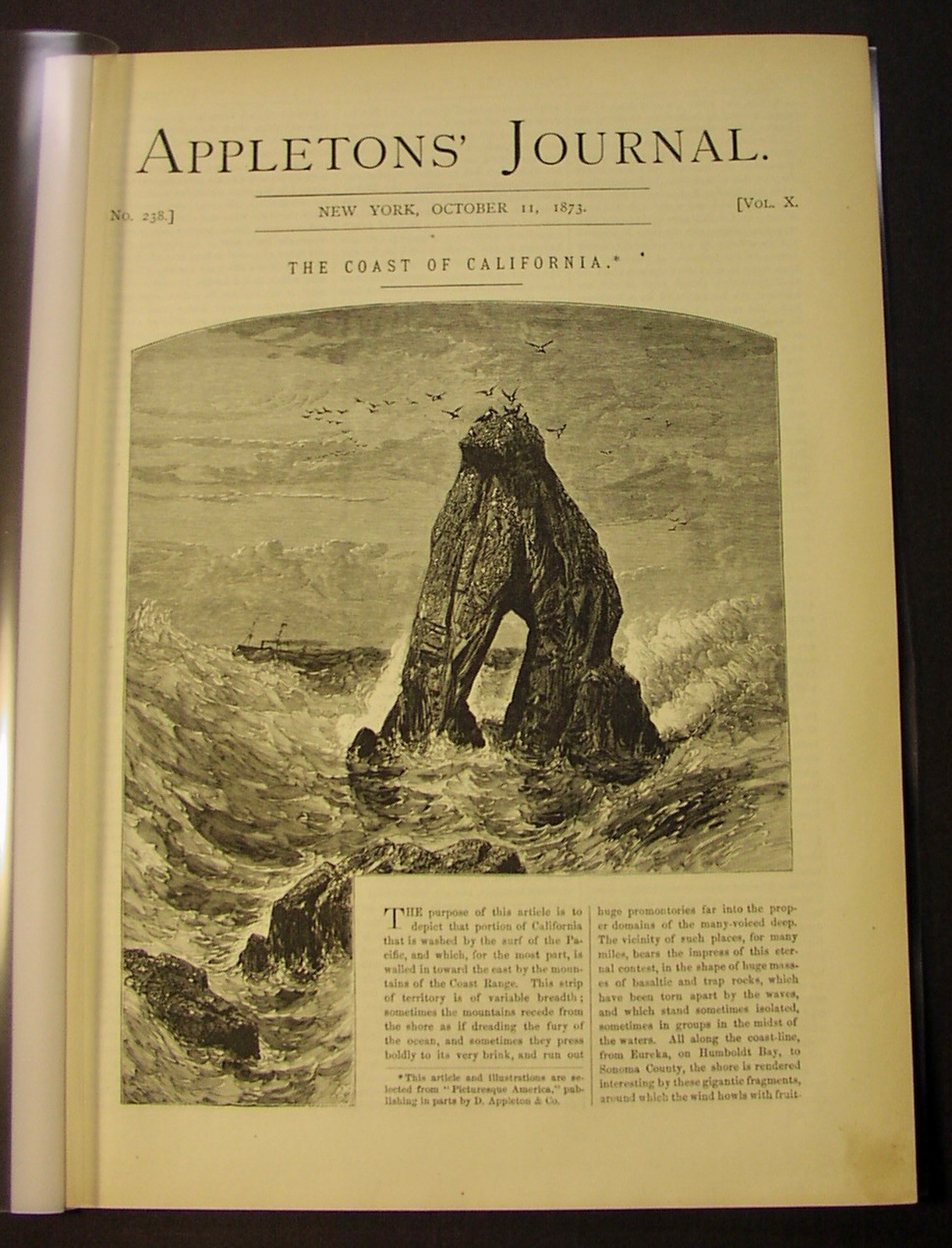
1873: CALIFORNIA Coast; Terra Cotta; Chesapeake; WATKINS YOSEMITE; San FranciscoAPPLETON’S JOURNAL
Oct. 11, 1873Coast of California
Carlton Watkins’ Yosemite photography
Chesapeake Bay steamer trip & waterfowl
terra cotta ceramic artThis is an issue of the illustrated weekly publication, Appleton’s Journal, which was printed over 150 years ago. It is 28 pages long, and measures 8 x 11 inches in size. The paper came from a bound volume and has some typical minor disbinding marks at the spine, but is otherwise in excellent and attractive condition. It will be shipped in a clear report binder, to help keep it safe from deterioration in the future.The lead article is on THE COAST OF CALIFORNIA. This is was adapted from a related chapter in the large volume published by Appleton & Co. on Picturesque America. It takes up the first four pages, and has two illustrations, while the text makes observations such as: “The purpose of this article is to depict that portion of California that is washed by the surf of the Pacific. . . . huge masses of basaltic and trap rocks . . . . All along the coast-line, from Eureka, on Humboldt Bay, to Sonoma County, the shore is rendered interesting by these gigantic fragments, around which the wind howls with fruitless fury, and where the wild birds of the ocean congregate in myriads, deafening the tourist with their tumultuous cries.
“The inhabitants of the coast are, for the most part, Americans, but there is a lingering remnant of the Spaniard, and a trace of the Russian . . . The means of traveling are twofold—the mud-wagon in summer and the stage in winter—the stage being of that ponderous variety known as the Concord. . . . The tourist will find little scenery of sufficient grandeur to interest him until he approaches Cape Mendocino. . . . The sides of Mount Pierce are positively covered with the famous red-wood; and the eye ranges over miles and miles of this magnificent tree without detecting any other kind. . . . Among the inhabitants of such rocks . . . occasionally there is a fowl called the murre, whose eggs are considered a great delicacy, and are sold by hundreds of thousands.
“Nothing can be more tumultuous or less pacific than the waters of the Pacific Ocean along the Mendocino coast. . . .
“The mountains press closer and closer to the sea until we arrive at the mouth of the Russian River . . . there are many saw-mills on its banks, and Bodega, the nearest town, does quite a lumber-business. . . . There are numbers of schooners and sloops laden with red-wood. . . .
“The native wine is called white Sonoma. . . . From Bodega a capital, fast-going stage runs to Petaluma. . . .
“. . . now that we have arrived in Marin County, take a schooner from the pretty little harbor of Oloma . . . and enter the famous bay . . . on the left the peak of Tamalpais shows grandly. . . . the splendid straits called the Golden Gate appear. Through them we can see the island-rock of Alcatraz . . . Angeles Island . . . Goat Island . . . Fort Point . . . the old Presidio. Beyond is the city—the glorious city that leaped full-born into existence. It rises up with numberless towers and spires, and great warehouses. . . .
“To the people of San Francisco there is no pleasure equal to the drive through the sand-hills, over a fine, hard road, to the Cliff House. This is emphatically the most picturesque part of San Francisco . . .
“About five miles . . . the Ocean House . . . . Here, indeed, is one of the stretches of ground where one can see the Pacific Ocean roll in with interrupted grandeur. Nothing can be conceived more majestic than this sight, especially in that part of the strand which gives a fair view of Point San Pedro. . .”
Etc.* * * * * * * * * * * * * * * * * * * * * * * * *
In an editorial section titled “Art Notes,” there is a lengthy review (18 column inches of text) praising a new exhibition of YOSEMITE PHOTOGRAPHY by the famed pioneer photographer, Carlton Watkins. The show featured 50 of Watkins’ photos, with the reviewer lauded their artistry, writing of their, “sense of size, power, and infinitely exquisite detail . . . their production is of very great aesthetic and poetical, as well as geographical value.”* * * * * * * * * * * * * * * * * * * * * * * * *
Another interesting article is two pages on “THE CERAMIC ART — TERRA COTTA,” which is illustrated with 5 small drawings.This is followed by a three-page article titled, “ON THE CHESAPEAKE.” This begins: “The stranger who leaves Baltimore on one of the comfortable steamers of the Old Bay Line for Norfolk, has a charming trip before him . . .” It describes the trip, and the Chesapeake Bay life encountered, including mentions of fishing-hawks, the osprey, the southerly or long-tailed duck, and the Chesapeake water-dog. It discusses at length the waterfowl shooting available on the Bay, and calls the snow-white swan the noblest bird adorning the Chesapeake waters.* * * * * * * * * * * * * * * * * * * * * * * * *
Also of interest in the issue is two full pages on “The London Post-Offices, New and Old.”
on this publication: Appleton’s Journal was an illustrated weekly paper published in New York. Its parent company was D. Appleton & Co., Publishers, which at the time was one of America’s leading book publishers. The paper was founded in 1869, and achieved a widespread, but shortlived national popularity during the next six years. It carried some serial fiction, but most of its content was devoted to essays on Americana subjects, plus the arts and sciences. Following several changes in editors, however, it began suffering a decline in circulation. It subsequently switched to monthly publication after 1876, and went out of business in 1881.238 [p2192]_gsrx_vers_1836 (GS 10.1 (1836))