When you click on links to various merchants on this site and make a purchase, this can result in this site earning a commission. Affiliate programs and affiliations include, but are not limited to, the eBay Partner Network.
1872- ST. LOUIS, article & 7 views: The Levee; United Methodist; Shaw\'s Gardens+APPLETONS’ JOURNAL,
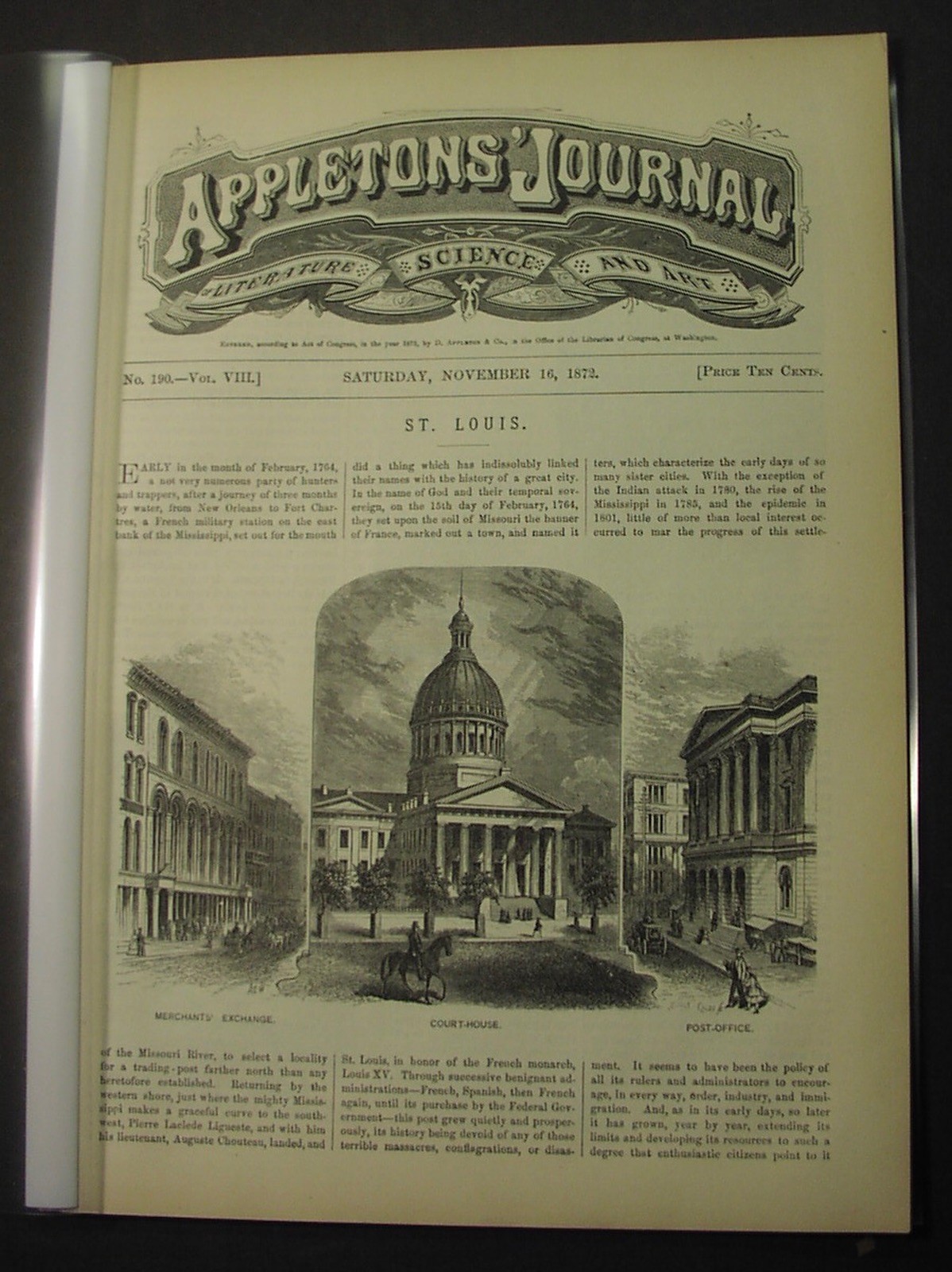
November 16, 1872St. LouisThis is an issue of the illustrated weekly publication, Appletons’ Journal, which was printed 154 years ago! It is 28 pages long, and measures 8 x 11 inches in size. The paper came from a bound volume and has some typical minor disbinding marks at the spine, but is otherwise in excellent and very attractive condition, with only a slight bit of browning from age (see photos). It will be shipped in a clear report binder, to help keep it safe from deterioration in the future.The cover story is on ST. LOUIS. This article is 7 pages long, and illustrated with seven nice woodcut engravings, with these captions:* Merchants’ Exchange/Court-House/Post-Office.
* Fifth Street.
* Fifth Street, Looking Up.
* The Levee.
* St. Louis, From the Illinois Shore. [full-page]
* Union Methodist Church.
* Shaw’s Garden.The accompanying text was written by C. H. Goodman, and begins by giving a short history of St. Louis, saying:“Early in the month of February, 1764, a not very numerous party of hunters and trappers . . . set out for the mouth of the Missouri River, to select a locality for a trading-post farther north than any heretofore established. . . and did a thing which has indissolubly linked their names with the history of a great city. . . marked out a town, and named it St. Louis. . . this post grew quietly and prosperously, its history being devoid of any of those terrible massacres, conflagrations, or disasters which characterize the early days of so many sister cities. . . . It seems to have been the policy of all its rulers and administrators to encourage, in every way, order, industry, and immigration. And, as in its early days, so later it has grown, year by year, extending its limits and developing its resources to such a degree that enthusiastic citizens point to it today as the “future great city of the world.”Goodman then gives a detailed description of the city in 1872, writing, in part:“. . . . The central portion of St. Louis is built upon four terraces and two ridges, running parallel with the river, the most western one being Grand Avenue, three and a half miles q from the levee. Between Fourth Street and the river lies the bulk of the business quarters of the city, the streets being narrow and ill suited to the wants of merchants . . . though there is hardly a block without its splendid stone front rearing itself from among its more humble neighbors. . . . but old structures are fast disappearing, and at no distant day will their places be filled by an array of buildings second to none in the country. . . . No city offers better, more substantial and permanent inducements for energetic and enterprising young men.
“As a centre of culture and education, St. Louis occupies today a foremost position among the cities of the West. Its free-school system is one of the most perfect, while its private sources of instruction are without number. Washington University, with its commodious buildings, active, intelligent, and accomplished corps of instructors, offers to the student all the advantages of an advanced collegiate education in every department of science and learning; while the St. Louis University, and other Catholic institutions, possessing large property, and fully equipped, afford further facilities for study. . . .
“It is largely due to the presence of this German element, that one sees so many Sunday entertainments placarded from every fence, corner, and advertising post, in the city; and the beer-garden is no less a feature of St. Louis than the excellence of its beer. To the strains of Beethoven, Verdi, Mendelssohn, and Strauss, the Teuton, with his wife and children about him, weekly pledges in draughts of foaming lager the health of his neighbor and friend, while picnics, excursions, balloon.ascensions, and sacred concerts, offer attractions in other quartcrs. . . . But with all the Sunday license, which has been the subject of much legislation to little effect, St. Louis is a notably orderly city, with a freedom from personal assault or aggression by night that more refined cities cannot claim. . . .
“The visitor, after a tour of the city, while impressed by its immense advantages, both natural and cultivated . . . its extensive manufacturing facilities and resources, will never know St. Louis or its chief attraction until he knows the people. Here mingle in the most delightful society the genuine Southerner, the cultivated Northerner, and the representative of the far West. . . . the Eastern element is rapidly filling up and absorbing the better and more cultivated portion of society, and has been productive of much in the eradication of war-feeling.
“. . . comparisons with other cities prove it to be one ot the healthiest in the Union. . . . At the foot of Washington Avenue is the west abutment of the bridge, spanning the broad levee, and three long blocks, with massive stone-work and ponderous arches . . . Its completion will afford not only a spectacle of one of the finest and most magnificent bridges in the world, but an advantage in a commercial view . . .
“Facing west, just back of the cemetery, rise the buildings of the Fair Grounds . . . With an ampitheatre capable of seating twenty thousand persons, an area of over forty acres filled with choice shrubbery, artificial lakes, fountains, rustic bowers, and numerous handsome structures for the accommodation of goods on exhibition, it is one of the institutions of which St. Louis is justly proud. Some idea may be formed of the magnitude of the exhibition, when it is known that over one hundred thousand people visited it during one day of last year.
“From this point south for twelve miles . . . runs Grand Avenue, now practically the western limit, but at no distant day destined to be the central boulevard of St. Louis . . . Between these points named and the river, the eye takes in a vast extent of territory crowded with churches, houses, and hotels.A little to the southwest of the Court-House, are the depots of the Atlantic and Pacific Railroads, whose tracks, stretching westward toward the setting sun, are soon to bring . . . a route which will supersede the northern one on its completion, and combine with all the advantages of quick transit an entire freedom from the dangers of the terrible snow-blockades of the Rocky Mountains.
“West of Grand Avenue lies a most beautiful rolling country, full of delightful drives and the choicest building-sites, on which are even now heard the sound of the hammer and trowel. Involuntarily the looker-on questions himself, Where is the limit of extent to St. Louis? Here . . . in a state unsurpassed for metal-wealth and agricultural resources, in direct communication with the great grain districts of the interior and Northwest, the coal-fields of Illinois, the products of the South and East, and soon to be with San Francisco, lies a city whose future, it takes no enthusiast to predict, is one of the most brilliant and enduring character, the realization of which will make it the metropolis of the on this publication: Appleton’s Journal was an illustrated weekly paper published in New York. Its parent company was D. Appleton & Co., Publishers, which at the time was one of America’s leading book publishers. The paper was founded in 1869, and achieved a widespread, but shortlived national popularity during the next six years. It carried some serial fiction, but most of its content was devoted to essays on Americana subjects, plus the arts and sciences. Following several changes in editors, however, it began suffering a decline in circulation. It subsequently switched to monthly publication after 1876, and went out of business in 1881.190 [p5286]_gsrx_vers_1736 (GS 9.9.5 (1736))