When you click on links to various merchants on this site and make a purchase, this can result in this site earning a commission. Affiliate programs and affiliations include, but are not limited to, the eBay Partner Network.
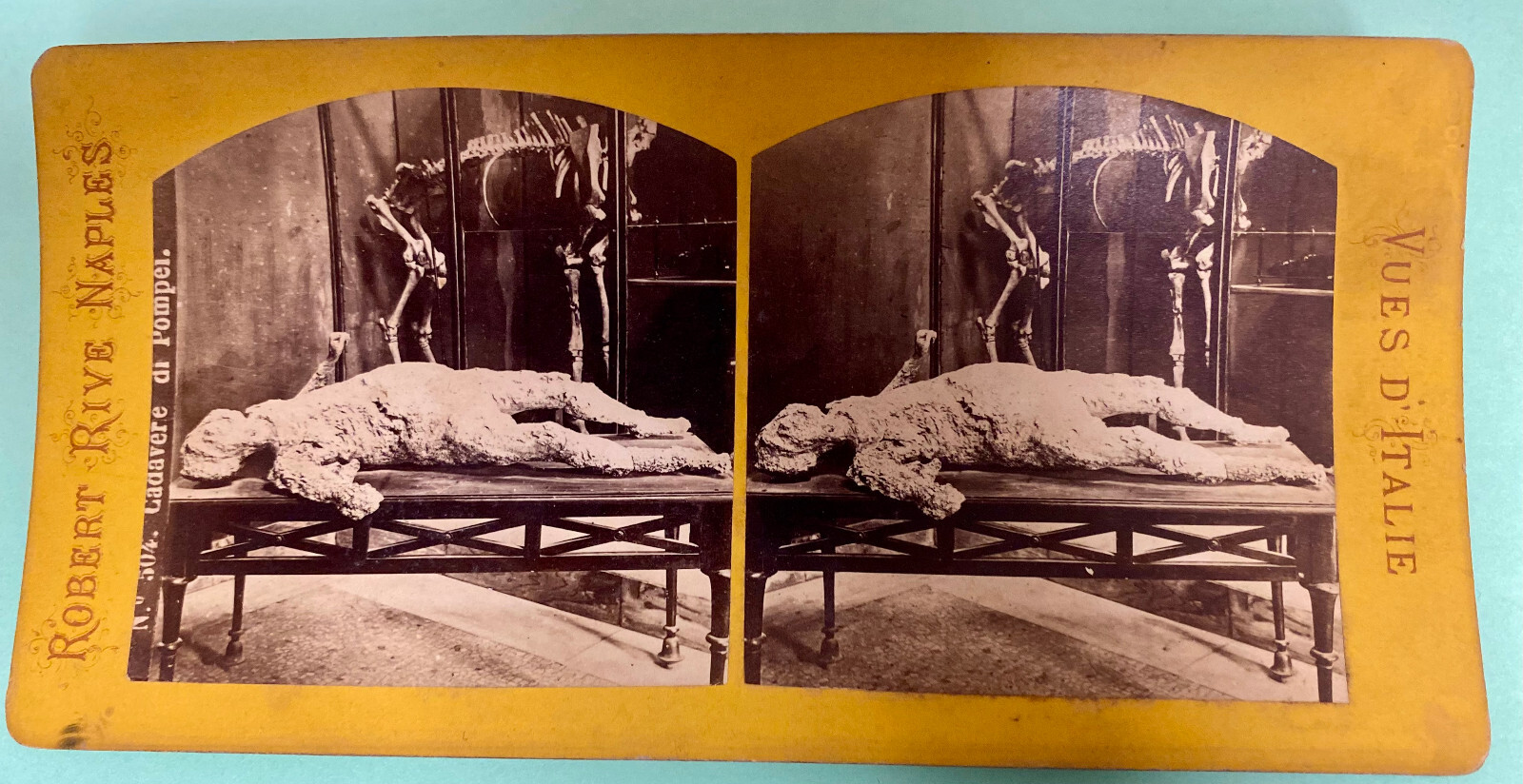
No. 504 – CADAVERE DI POMPEIIROBERT RIVES, Photographer NaplesVuew D' ItalieThis is the most beautiful stereoview from the excavation of Pompeii, in my opinion. Featuring Victim 4, whom was suspected as being pregnant due to the swollen abdomen. Behind her is a skeleon of a deer or elk. This was taken prior to the museum and is likely interim display room. Found a small distance from victims numbered 1, 2 and 3. Victim 4 is probably female aged over 20 years old. Said to have been found on 6th of February 1863 with victims 1 and 2, a small distance from victim 4.
The location of the other three victims found near no. 4 was not precisely reported, but it is understood that it was the same place as victim 2. In particular, victims 2 and 3 were 10 palms (about 2.5m) from the corner of insulae 10 and 13 of Regio VII, where lay victim 1.
In fact, no. 4 was located in the centre of the Vicolo degli Scheletri (Regio VII) about 25m from the crossroads with the vicolo della Maschera and victims 1, 2 and 3.
There is evidence of drapery on the upper part of the chest, which can perhaps be interpreted as a tunic.
Breton in 1869 had, due to her protruding belly, hypothesized that the woman was pregnant.
Robert Rive was a 19th-century photographer who was born in Great Britain but developed most of his work in Italy. After several years working in this country he changed his name to Roberto Rive. The main collections of his work are the photos from Pompei and Rome in the 1860s and 1870s. Rive exhibited at the "10th Annual Exhibition of the Photographie".One of Italy's "most important professional photographers… he took photographs of all the famous monuments in… Naples, Pompeii" and throughout Italy (Hannavy, Encyclopedia of 19th-Century Photography, 755, 1197). Rive photographed the ruins of Pompeii and Herculaneum in 1868, and his are among the first to show the stunning frescoes, sculpture and architectural remains of the cities buried and preserved by the eruption of Mount Vesuvius. The excavation of Pompeii was led by Giuseppe Fiorelli from 1863-75, and Rive's images capture many of Fiorelli's vivid castings. At the time "Pompeii was a prominent theme in the news and in European literature," and Marcel Proust was especially drawn to Rive's images—in particular that of "the beautiful woman facing down… a kind of ghostly white figure 'sleeping' and floating in dark space [herein "No. 168]… the shocking impact of these involuntarily cast bodies touched and fascinated Proust" (Hannavy, 96). His narrator, in Within a Budding Grove, observes: ""Nature, like the destruction of Pompeii… has arrested us in an unaccustomed movement."Keep an eye on my current and upcoming sales that will feature additional vintage museum quality items. a daguerreotype, tintype, real photo postcard and CDV collection. Pompeii was a city in what is now the municipality of Pompei, near Naples, in the Campania region of Italy. Along with Herculaneum, Stabiae, and many surrounding villas, the city was buried under 4 to 6m (13 to 20ft) of volcanic ash and pumice in the eruption of Mount Vesuvius in 79 AD.Largely preserved under the ash, Pompeii offers a unique snapshot of Roman life, frozen at the moment it was buried, as well as insight into ancient urban planning. It was a wealthy town of 10,000 to 20,000 residents at the time it was destroyed. It hosted many fine public buildings and luxurious private houses with lavish decorations, furnishings and artworks, which were the main attractions for early excavators; subsequent excavations have found hundreds of private homes and businesses reflecting various architectural styles and social classes, as well as numerous public buildings. Organic remains, including wooden objects and human bodies, were interred in the ash; their eventual decay allowed archaeologists to create moulds of figures in their final moments of life. The numerous graffiti carved on outside walls and inside rooms provide a wealth of examples of the largely lost Vulgar Latin spoken colloquially at the time, contrasting with the formal language of classical writers.Following its destruction, Pompeii remained largely undisturbed until its rediscovery in the late 16th century. Major excavations did not begin until the mid-18th century, which marked the emergence of modern archeology; initial efforts to unearth the city were haphazard or marred by looting, resulting in many items or sites being damaged or destroyed. By 1960, most of Pompeii had been uncovered but left in decay; further major excavations were banned or limited to targeted, prioritised areas. Since 2018, these efforts have led to new discoveries in some previously unexplored areas of the city, including a banquet hall adorned with rare well-preserved frescoes depicting various mythological scenes and figures.Pompeii is a UNESCO World Heritage Site, owing to its status as "the only archaeological site in the world that provides a complete picture of an ancient Roman city." It is among the most popular tourist attractions in Italy, with approximately 2.5million visitors annually.
Will ship domestically to the following states for $5.99: Alabama, Alaska, Arizona, Arkansas, California, Colorado, Connecticut, Delaware, Florida, Georgia, Hawaii, Idaho, Illinois, Indiana, Iowa, Kansas, Kentucky, Louisiana, Maine, Maryland, Massachusetts, Michigan, Minnesota, Mississippi, Missouri, Montana, Nebraska, Nevada, New Hampshire, New Jersey, New Mexico, New York, North Carolina, North Dakota, Ohio, Oklahoma, Oregon, Pennsylvania, Rhode Island, South Carolina, South Dakota, Tennessee, Texas, Utah, Vermont, Virginia, Washington, West Virginia, Wisconsin, Wyoming. International buyers feel free to ask for a shipping quote.