When you click on links to various merchants on this site and make a purchase, this can result in this site earning a commission. Affiliate programs and affiliations include, but are not limited to, the eBay Partner Network.
For sale hard to findplate print very old lettergood condition, nice to have for the collection or can be a great gift
from the research :
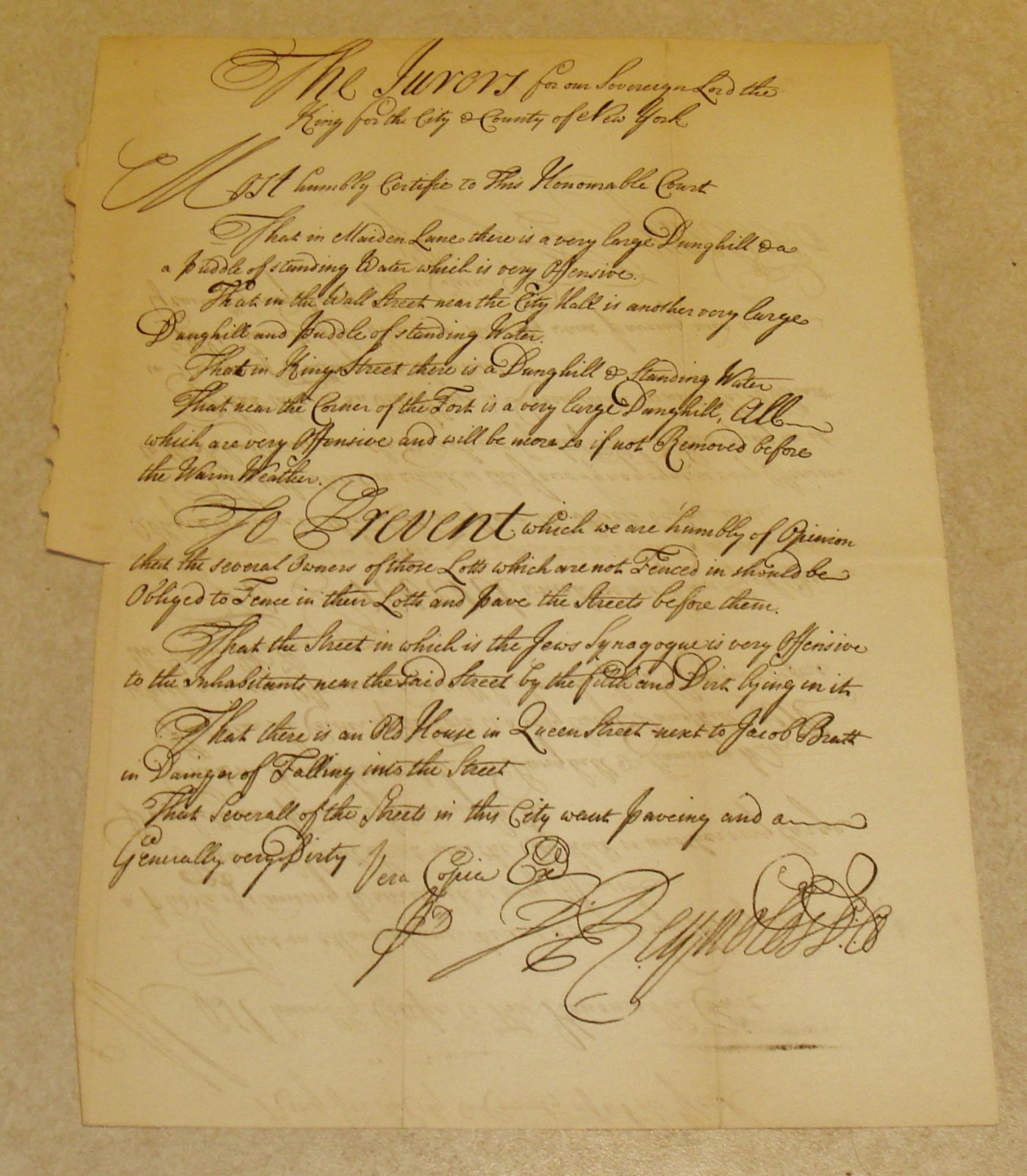
“The Jurors for our Sovereign Lord the King for the City & County of New York … humbly certify to this Honourable Court…”
The report makes these complaints:
Location or problemWhat the jurors are sayingMaiden LaneThere is a very large manure/rubbish heap and a pool of stagnant water causing an offensive nuisance.Wall Street, near City HallAnother large rubbish heap and pool of standing water need attention.King StreetThere is accumulated waste and stagnant water.Near the corner of the fortA large rubbish heap needs removal. The jurors warn that these conditions will become worse in warm weather.Unfenced lotsOwners should be required to fence their lots and pave the streets in front of them.The street containing the synagogueFilth and dirt lying in the street are offensive to nearby residents. The complaint concerns the street’s condition.Queen Street, next to Jacob BrattAn old house is in danger of falling into the street.
Several need paving, and the city’s streets are generally very dirty.
Who signed it?
At the bottom, I can clearly read “Vera Copia”, meaning “true copy.” This indicates that the underlying document was certified as a copy of another record.
My tentative reading of the ornate name is “S. Bayard,” possibly Samuel Bayard. This is not yet a confirmed identification. An archival inventory does document Samuel Bayard writing and signing New York court papers in 1713, making him a plausible candidate, but that record does not establish that he certified this particular document.
Your physical sheetLikely an original 1860 book plate, although photographs alone cannot exclude a later reproduction.The colonial report being reproducedApparently early eighteenth century, but its exact year remains unconfirmed. No clear date appears on the photographed face.
The phrase “our Sovereign Lord the King” refers to the colonial report,
Why the text on the back matters
I matched the earlier photographs to the section titled “Historical Minutes of the Times of the Dutch,” beginning on printed page 612. The identical letter illustration is inserted between printed pages 612 and 613 in the digitized 1860 volume.
That also explains an important detail: the backward historical text may be an offset impression transferred from an adjacent book page, rather than ordinary printing on the reverse. The photographed arrangement is consistent with that, though physical inspection would be needed to confirm the mechanism.
Print on the back, looks like transferred from the book, when that letter was between the pages of the book for so many years
Another photographed section includes these items:
- Dead hogs: The sheriff reports that dead pigs are lying around and says he will have them removed.
- Tanneries: Broad Street residents protest against tanneries as a nuisance—businesses that processed animal hides.
- Defense: “Preparations are made for defence, in anticipation of invasion.”
- Brewing: A line identifies Michael Jansen as the “first brewer at Pavonia.” The beginning of his name is partly obscured.
- Slavery: A passage says enslaved people were not to be harbored or helped to escape. This records a restriction imposed by the authorities.
- Trading: “No persons permitted to trade without being citizens.”
- Alcohol sellers: A line mentions twelve retail liquor dealers in the city.
- Land disputes: A city survey caused disputes among inhabitants over their lots.
- Shipping: “Freight on hogshead of tobacco from Virginia, $4.80.” A hogshead was a large shipping barrel.
- Isaac Allerton: He is identified as “the Mayflower immigrant” and described as frequently acting between Dutch and English merchants; the precise role is partly cut off.
- Beer: The bottom line appears to say, “Beer sold at $4 per barrel.”
Overall, the page is describing the everyday problems of a small colonial town: guards needing fuel, loose animals, sanitation, building rules, tavern licensing, land ownership, trade, and preparations for attack.