When you click on links to various merchants on this site and make a purchase, this can result in this site earning a commission. Affiliate programs and affiliations include, but are not limited to, the eBay Partner Network.
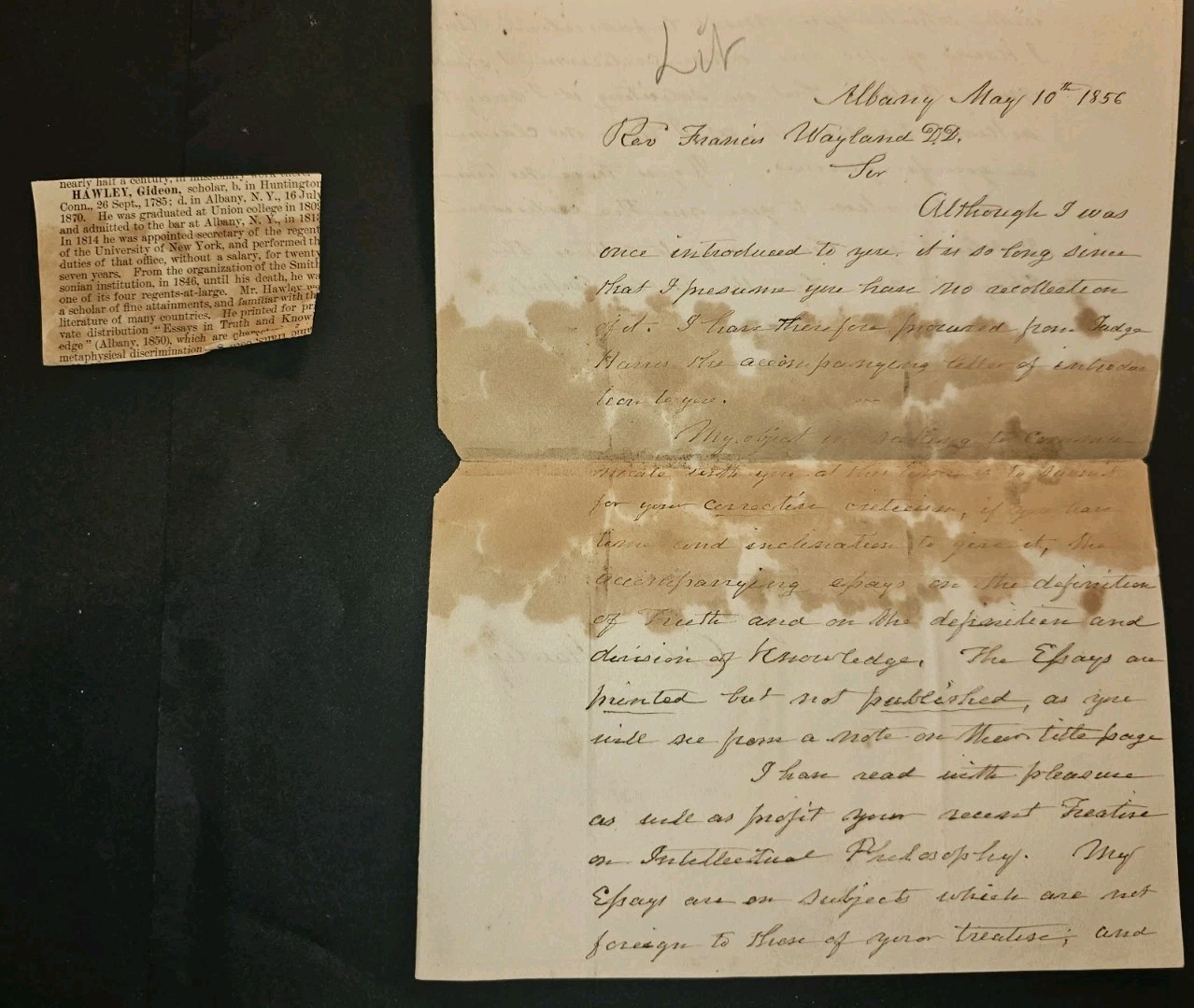
Original autograph letter signed “Gideon Hawley”, 2 pp (1 leaf, both sides), dated Albany, May 10, 1856, to Rev. Francis Wayland, D.D., President of Brown University. In this eloquent philosophical letter Hawley encloses and discusses his privately printed “Essays in Truth and Knowledge” (Albany 1850), requesting Wayland’s critical opinion. He praises Wayland’s Treatise on Intellectual Philosophy and writes with humility and admiration: “I know of no one whose criticism I should more value.”
Letter shows moderate toning and water staining at centerfold, not obscuring text; strong signature at close. Accompanied by a 19th-century printed biographical clipping on Hawley’s life and works.
Hawley (1785–1870) was Secretary of the Regents of the University of New York and later a Regent-at-Large of the Smithsonian Institution, remembered for his erudition and philosophical essays. Wayland (1796–1865) was one of the foremost American educators and ethicists of the 19th century.
A notable association letter linking two major American scholars, referencing a rare philosophical work of which very few copies survive.
Private collection, offered for the first time in over 70 years.
---
Estimated Value
Comparable 1850s American scholar ALS with strong philosophical or academic association typically range:
The biographical clipping and the autograph letter together form a highly desirable manuscript set relating to Gideon Hawley (1785–1870) — not the earlier missionary of the same name (1727–1807), but the Albany scholar and philosopher who served as Secretary of the Regents of the University of the State of New York and later as a Regent of the Smithsonian Institution.
The clipping you have appears to be taken from Appletons’ Cyclopaedia of American Biography (1887–89) or a similar 19th-century biographical dictionary. It provides Hawley’s major dates and career outline:
> “...b. in Huntington, Conn., 26 Sept. 1785; d. in Albany, N.Y., 16 July 1870... graduated at Union College in 1809... Secretary of the Regents of the University of New York... regent-at-large of the Smithsonian Institution... printed privately Essays in Truth and Knowledge (Albany, 1850)...”
That book title is precisely the work referenced in the letter.
---
Letter Description
Autograph Letter Signed by Gideon Hawley, 2 pages (1 leaf, both sides),
Albany, May 10, 1856, to Rev. Francis Wayland, D.D. (President of Brown University).
Water staining affects the lower section but text remains legible.
---
Content Summary
Hawley writes to Wayland in a deferential tone, enclosing a copy of his privately printed essays — “on the definition of truth, and on the definition and division of knowledge.”
He praises Wayland’s recent “Treatise on Intellectual Philosophy”, calling it both “a source of profit and pleasure,” and humbly requests Wayland’s criticism of his own unpublished writings:
> “I know of no one whose criticism I should more value... yet in soliciting it I may be asking too much, for I have no claim on you for favors.”
He references his 1850 privately printed Essays in Truth and Knowledge, confirming authorship and date. He notes they were “printed for private distribution, but not published,” and closes respectfully:
> “With great respect, your obedient serv’t,
Gideon Hawley.”
---
This is an exceptionally direct connection between a major early American educator–philosopher and one of the most influential moral philosophers of the 19th century (Francis Wayland, 1796–1865). It:
Confirms the limited circulation of Hawley’s Essays in Truth and Knowledge (Albany, 1850). Surviving copies are exceedingly scarce.
Provides primary evidence of intellectual correspondence between two leading 19th-century American thinkers on philosophy and education.
Demonstrates Hawley’s modesty and scholarly engagement shortly before his appointment as a Smithsonian regent.
---
Provenance Note
The accompanying clipping likely comes from the same family or file of papers preserving Hawley’s legacy and provides an ideal biographical supplement for presentation or display.