When you click on links to various merchants on this site and make a purchase, this can result in this site earning a commission. Affiliate programs and affiliations include, but are not limited to, the eBay Partner Network.
Hudson River steamboat disaster
Illustrated London News
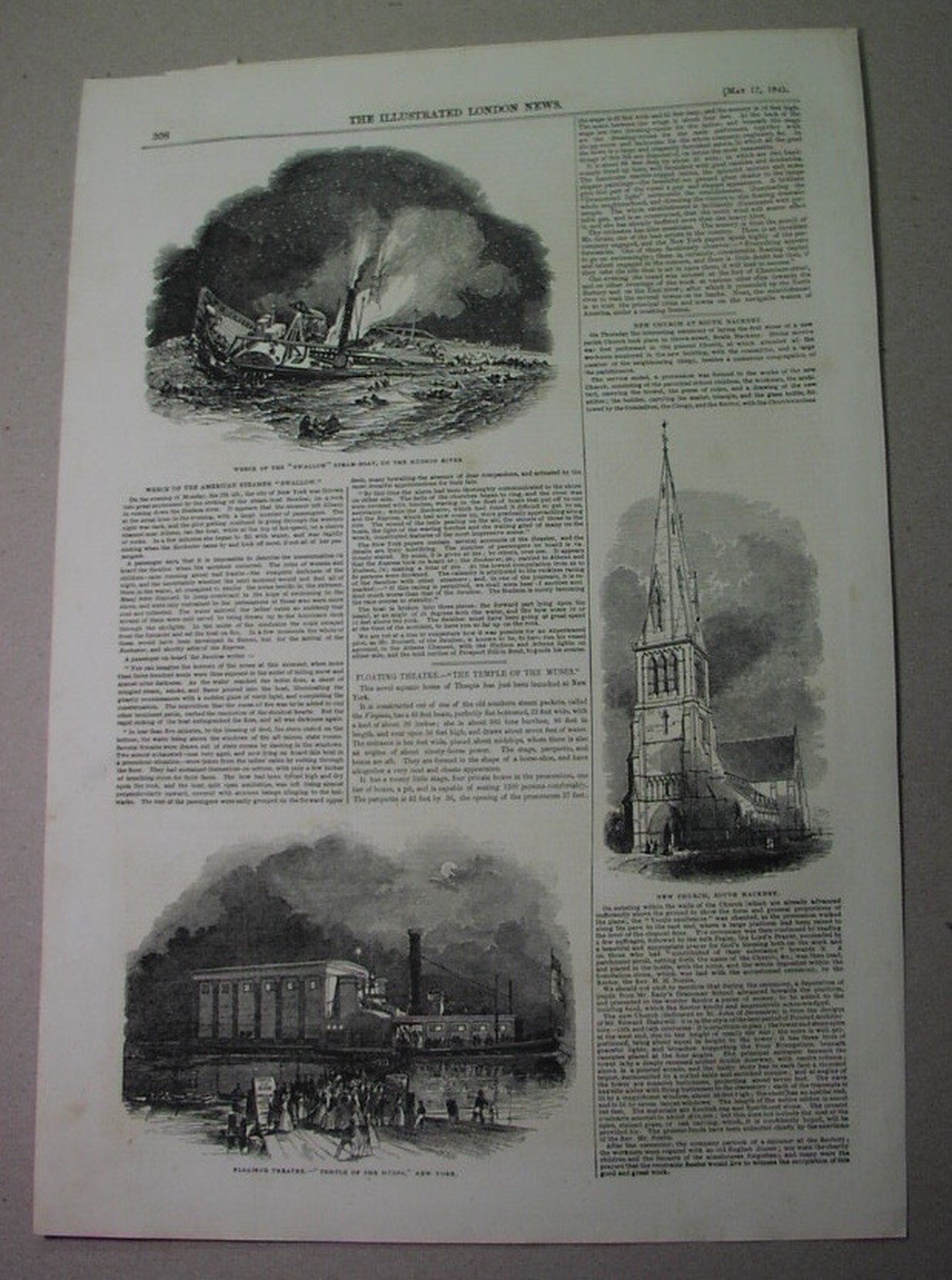
1845This is a single sheet only, which is over 180 years old. It was published in the May 17, 1845 issue of The Illustrated London News, a London weekly. It measures 11 x 16 inches in size, is in excellent, attractive condition.It presents a rare view of a steamboat catastrophe in America. Prior to the 1850s, there weren’t any such illustrated weekly periodicals published in the United States, and The Illustrated London News didn’t cover happenings in the United States often, so it was unusual to have a scene like this make the news in any pictorial form.The article of American interest consists of a 5x6-inch engraved illustration on the top left portion of the page. It shows a dramatic scene of a steamboat crashed upon a rock and on fire, with some passengers fleeing in lifeboats while others are jumping overboard into the water.The engraving is captioned, “WRECK OF THE ‘SWALLOW’ STEAM-BOAT, ON THE HUDSON RIVER.” In small print below this scene is an article about the tragedy. The story is 75 lines long, and takes up six column inches of space. The text says, in part:“On the evening of Monday, the 7th ult., the city of New York was thrown into great excitement by the striking of the steam-boat Swallow, on a rock in coming down the Hudson river. It appears that the steamer left Albany at the usual hour in the evening, with a large number of passengers. The night was dark, and the pilot getting confused in going through the western channel near Athens, ran the boat, while at the top of her speed, on a shelve of rocks. In a few minutes she began to fill with water, and was rapidly sinking . . .
“. . . it is impossible to describe the consternation on board the Swallow when the accident occurred. The cries of women and children—men running about half-frantic—the complete darkness of the night . . . all conspired to render the scene terrific in the extreme. Many were disposed to jump overboard in the hope of swimming to the shore. . . . The water entered the ladies’ cabin so suddenly that several of them were only saved by being drawn up to the hurricane deck through the skylights. In the midst of the confusion the coals escaped from the furnaces and set the boat on fire. . . .
“A passenger on board the Swallow writes:— ‘You can imagine the horrors of the scene at this moment, when more than three hundred souls were thus exposed in the midst of falling snow and almost utter darkness. . . . a sheet of mingled steam, smoke, and flame poured into the boat, illuminating the ghostly countenances with a sudden glare of vivid light. . . .
“. . . . ‘The bow had been forced high and dry upon the rock, and the boat, split open amidships, was left rising almost perpendicularly upward, covered with anxious beings clinging to the bulwarks. . . .’
“. . . . the details are horrifying. . . . from 40 to 60 persons were drowned. The calamity is attributed to the reckless racing of the Swallow with other steamers; and in one of the journals, it is remarked:— ‘If this racing is permitted, we shall soon hear of another accident much worse than that of the Swallow. The Hudson is surely becoming the race course to eternity.
“The boat is broken into three pieces: the forward part lying upon the island, at an angle of 35 degrees with the water, and the bow some 10 or 15 feet above the rock. The Swallow must have been going at great speed at the time of the accident, to have run so far up on the rock. . . .”
Etc.
_gsrx_vers_1736 (GS 9.9.5 (1736))