When you click on links to various merchants on this site and make a purchase, this can result in this site earning a commission. Affiliate programs and affiliations include, but are not limited to, the eBay Partner Network.
This is a fascinating piece of Michigan pioneer history. Interestingly, this isn't just a land deed; it is a Chattel Mortgage, meaning the Fultons were using their standing crops (wheat) as collateral for a $60 loan.
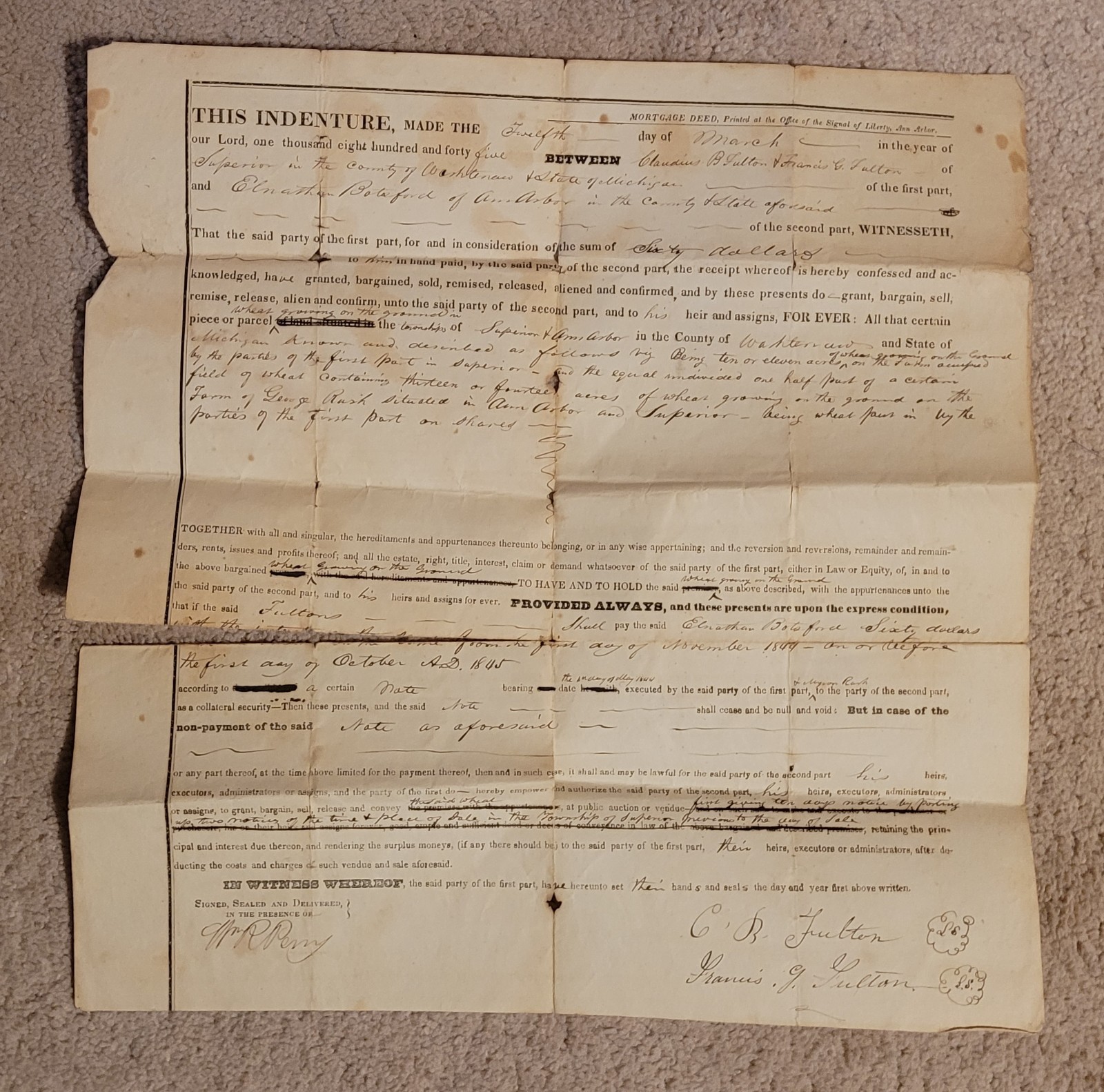
Rare 1845 Ann Arbor/Superior Township, Michigan Chattel Mortgage Indenture
Up for sale is a significant piece of pre-Civil War Washtenaw County history. This hand-inked legal document, dated March 12, 1845, represents a "Chattel Mortgage" between the Fulton family and Elnathan Botsford. Rather than just land, this document specifically mortgages "wheat growing on the ground" as collateral for a debt of sixty dollars.
Item Specifics:
Date: March 12, 1845
Location: Ann Arbor and Superior Township, Washtenaw County, Michigan.
Parties: Claudius B. Fulton & Francis G. Fulton (First Part) to Elnathan Botsford (Second Part).
Size: Approx. 13.5" x 13.5"
Paper: Original rag paper with printed form by the "Signal of Liberty" office (a famous Abolitionist newspaper in Ann Arbor).
Condition Report: Poor/Antique condition. The document is separating at the fold lines into several pieces. Typical age-toning and "finger soiling" from 180+ years of handling. Please see photos for a detailed look at the split seams.
Full Transcription
Front Side:
THIS INDENTURE, MADE THE Twelfth day of March in the year of our Lord, one thousand eight hundred and forty five BETWEEN Claudius B. Fulton & Francis G. Fulton of Superior in the County of Washtenaw & State of Michigan of the first part, and Elnathan Botsford of Ann Arbor in the County & State aforesaid of the second part, WITNESSETH,
That the said party of the first part, for and in consideration of the sum of Sixty Dollars to them in hand paid... have granted, bargained, sold... unto the said party of the second part... All that certain piece or parcel of wheat growing on the ground in the townships of Superior & Ann Arbor in the County of Washtenaw and State of Michigan known and described as follows viz: Being ten or eleven acres of wheat growing on the ground on the farm occupied by the parties of the first part in Superior—and the equal undivided one half part of a certain field of wheat containing thirteen or fourteen acres of wheat growing on the ground on the farm of George Rush situated in Ann Arbor and Superior—being wheat sown in by the parties of the first part on shares.
PROVIDED ALWAYS, and these presents are upon the express condition, that if the said Fultons shall pay the said Elnathan Botsford Sixty dollars with the interest on the same from the first day of November 1844—on or before the first day of October A.D. 1845 according to a certain Note bearing the 2nd day of May 1844 executed by the said party of the first part, to the party of the second part...
IN WITNESS WHEREOF, the said party of the first part, have hereunto set their hands and seals the day and year first above written.
Signed: C. B. Fulton, Francis G. Fulton In the Presence of: Wm. R. Perry
Back Side (Docketing Marks):
Fultons to Botsford Chattel Mortgage [Handwritten note:] Due on the within seventy three Dolls eighty two cts. [Calculations in pencil/ink:] 52.29 / 36.72 / 15.57
Historical Context & Biographies
The Printer (Signal of Liberty): The small text at the top reveals this form was printed at the "Office of the Signal of Liberty, Ann Arbor." This was a prominent anti-slavery/abolitionist newspaper edited by Guy Beckley and Theodore Foster.
Elnathan Botsford (1808–1881): A well-known early settler of Ann Arbor. He was a successful farmer and landowner. The Botsford name is synonymous with early Washtenaw County development.
Claudius B. Fulton: Recorded in early Michigan census records as a farmer in Superior Township. This document shows the "sharecropping" nature of early farming, where he was growing wheat on George Rush's land.
Geography: The land described straddles the border of Ann Arbor and Superior Township, specifically mentioning the "Farm of George Rush."
Keywords for Search Optimization: Washtenaw County History, Michigan Territory, Pioneer Ephemera, Abolitionist Movement, 19th Century Manuscript, Genealogy, Ypsilanti, Settlement, Farming History.
Fultons To Botsford Chattel Mortgage
Due on the within seventy three Dolls eighty two cts.
Calculations in Ink/Pencil: 52.29 36.72 ———— 15.57
The back of this document tells the "rest of the story" regarding the debt. While the original mortgage was for sixty dollars, the notations indicate a balance of $73.82 due, likely including accumulated interest from the original 1844 note.
Key Historical Details to add:
Farm of George Rush: The document notes the wheat was growing on George Rush's farm in Ann Arbor and Superior on shares. George Rush (1795–1868) was an early settler who migrated from New York to Washtenaw County in the 1830s.
Abolitionist Connection: This form was printed by the Signal of Liberty office. Based in Ann Arbor, this was the primary organ for the Michigan Anti-Slavery Society, making this paper a rare artifact from a press dedicated to the abolition of slavery.
Survival: The split seams seen in these close-up photos are typical for a document of this age that was folded and filed away in a lawyer's or clerk's "pigeonhole" for decades.
The Signal of Liberty was an anti-slavery newspaper published in the mid-19th century in Michigan.
HistoryThe decision to publish a newspaper was one of the outcomes of the founding meeting of the Michigan Anti-Slavery Society that met for several days beginning on November 10, 1836 in Ann Arbor of the Michigan Territory (1805–1837). In 1838, Nicholas and William Sullivan published Michigan's first antislavery newspaper, the American Freedmen in Jackson, Michigan. Seymour Treadwell published and was the editor of the Michigan Freeman in 1839. The papers did not have a regular printing schedule.The Signal of Liberty was published weekly from April 1841 to 1848 in Ann Arbor by Rev. Guy Beckley and Theodore Foster, who were co-editors. It was printed on Broadway Avenue on the second floor of Josiah Beckley's mercantile shop.
Key Aspects of the Signal of Liberty: Origins: Established by anti-slavery activists in Ann Arbor following a convention in 1836, it followed earlier, less successful abolitionist papers like the American Freeman.
Content: It featured emotionally charged stories about slavery, political debates, speeches, and local news, becoming a nationally recognized journal.
Editors: Rev. Guy Beckley, a prominent abolitionist and Underground Railroad figure, and Theodore Foster, a newspaper man, ran the paper for most of its existence.
Location: Published from the second floor of Josiah Beckley's mercantile shop on Broadway Avenue in Ann Arbor.
Impact: It was a vital mouthpiece for the Liberty Party and the abolitionist cause in Michigan, challenging slavery and political figures, notes the Ann Arbor Observer.
Legacy: The Signal of Liberty ceased publication in 1848 but was succeeded by the Michigan Liberty Press, with its digitized issues accessible through the Ann Arbor District Library (AADL).On November 10, 1836, delegates from southeast Michigan gathered at the First Presbyterian Church in Ann Arbor for an ‘Anti-Slavery State Convention.’ After two days, delegates established the Michigan State Anti-Slavery Society, adopted resolutions denouncing slavery, and decided to publish an antislavery newspaper. Purchasing a printing press and selling subscriptions in the Michigan Territory was challenging – and risky.In the fall of 1837, newspaper publisher Elijah Lovejoy was attacked by a pro-slavery mob in Alton, Illinois. Lovejoy was shot and killed when he refused to give up his printing press. Antislavery lecturers in Michigan faced angry crowds throughout the 1830s. In spite of the difficulties, brothers William and Nicholas Sullivan published the first antislavery newspaper, American Freeman, in 1838 in Jackson, Michigan. The following year, Seymour Treadwell agreed to act as the editor and publisher of the Michigan Freeman. Both newspapers were issued only sporadically.Theodore Foster and Rev. Guy Beckley launched the Signal of Liberty in April 1841 and managed to go to press nearly every week. The printing office was located on the second floor of Josiah Beckley’s mercantile shop on Broadway Avenue in Ann Arbor. Guy Beckley helped in his brother’s store and worked tirelessly to promote the newspaper. Theodore Foster was co-editor and publisher of the Signal of Liberty until 1848.Foster and Beckley were strong abolitionists who wrote in the Signal of Liberty of helping people escaping from slavery. The editors interviewed self-emancipated men and women, hoping to arouse sympathy for abolitionism. They published the story of Robert Coxe, helpless to stop the beatings of his sister and mother, grief-stricken as his family was sold and separated. The newspaper covered the “kidnapping outrages” of African Americans in Detroit, Marshall and Cass County, Michigan.The Signal of Liberty achieved its goal of bringing the issue of slavery into the hearts and minds of the people. Nearly every issue included an antislavery poem, national news, and local notices. Minutes from antislavery meetings reveal a proliferation of organizations across the state and a growing desire to see slavery end in America. The events and movements described in the Signal of Liberty help us understand the issues that led people to resist slavery, change their churches and political parties, and fight for freedom.The Signal of Liberty was an anti-slavery newspaper published in the mid-19th century in Michigan.
HistoryThe decision to publish a newspaper was one of the outcomes of the founding meeting of the Michigan Anti-Slavery Society that met for several days beginning on November 10, 1836 in Ann Arbor of the Michigan Territory (1805–1837).[1] In 1838, Nicholas and William Sullivan published Michigan's first antislavery newspaper, the American Freedmen in Jackson, Michigan. Seymour Treadwell published and was the editor of the Michigan Freeman in 1839. The papers did not have a regular printing schedule.[1]The Signal of Liberty was published weekly from April 1841 to 1848 in Ann Arbor by Rev. Guy Beckley and Theodore Foster, who were co-editors. It was printed on Broadway Avenue on the second floor of Josiah Beckley's mercantile shop.[1][2]
Content
Front page of the May 22, 1843 issueThe purpose of the newspaper was to encourage anti-slavery sentiment by sharing the stories of the lives of enslaved people. They interviewed freedom seekers who left their slaveholders and passed through or settled in Michigan. When African Americans escaped slavery, they were often pursued by slave catchers. The Signal of Liberty covered the stories of "kidnapping outrages" like the Kentucky raid in Cass County (1847), the Crosswhite Affair in Marshall, and raids that occurred in Detroit.[1]There were regular sections in the paper for national news, antislavery society news, and poetry. It announced antislavery societies that were established throughout Michigan.[1] The newspaper served its subscribers in Michigan and the Midwest. After the newspaper closed, Michigan Liberty Press was published.[3]Promoting antislavery messages could be dangerous. Throughout the 1830s, anti-slavery lecturers faced angry crowds. Abolitionist Elijah Parish Lovejoy was killed in Alton, Illinois, by a pro-slavery mob in the fall of 1837 after he refused to give up his printing press.[1]Chattel mortgage, sometimes abbreviated CM, is the legal term for a type of loan contract used in some states with legal systems derived from English law.Under a typical chattel mortgage, the purchaser borrows funds for the purchase of movable personal property (the chattel) from the lender. The lender then secures the loan with a mortgage over the chattel. Legal ownership of the chattel is transferred to the purchaser at the time of purchase, and the mortgage is removed once the loan has been repaid.Chattel mortgages may have more particular characteristics in different jurisdictions.
AustraliaIn Australia, chattel mortgages are commonly used by companies, partnerships and sole traders to fund the purchase of cars, commercial vehicles and other business equipment.Under Australian Taxation Office rules, businesses that account for GST on a cash basis are entitled to claim an Input Tax Credit for all of the GST contained in the purchase price of the chattel on their next Business Activity Statement.Repayment of chattel mortgages in most Australian states attract stamp duty.
England and WalesChattel mortgages in England and Wales are seen as a form of security interest (or "collateral") for lenders in certain financing scenarios. Individuals (broadly, non-incorporated legal persons) may give a chattel mortgage over their personal property; however, it must be in the statutory form prescribed by the Bills of Sale Act 1878 and the Bills of Sale Act (1878) Amendment Act 1882 for it to constitute valid security.Companies and other corporate entities may also give chattel mortgages over any tangible, movable property as security for a debt obligation. This type of security will usually fall under the category of registrable charges under the Companies Act 2006.For a chattel mortgage to be a legal mortgage, it must transfer legal title to the chattel (or chattels) to the secured party (typically the lender) and include an express or implied proviso that the legal title will be transferred back to the debtor upon repayment (known as the equity of redemption). (If the chattel mortgage does not meet the statutory requirements for a legal mortgage it may nevertheless be re-characterised as an equitable mortgage or fixed or floating charge.)Chattel mortgages over certain assets (such as ships and aircraft) are governed by more particular rules.[1]
United States
Main article: Secured transactions in the United States
A chattel mortgage from 1914 to 1915, in Gaston County, North CarolinaIn the United States, chattel mortgages are referred to as secured transactions. Article 9 of the Uniform Commercial Code governs such transactions in most states.However, later, some of the first laws on chattel mortgages in the Anglo-American world were passed.[2] These early laws differed from other early laws in that filings and witnesses were required to enforce the security interest to prevent the debtor from fraudulently using the pledged collateral as a security interest in another loan. The issue had been handled differently in Roman law, by allowing the lender to sue a fraudulent debtor, and in Napoleonic law, by banning the transactions.[2][3][4][full citation needed]Ann Arbor is a city in Washtenaw County, Michigan, United States, of which it is the county seat. It had a population of 123,851 in 2020, making it the fifth most populous in Michigan.The city is home to the University of Michigan, the oldest university in the state. Its economy is primarily focused on high technology, with numerous startup companies drawn to the area due to the university's robust research and development activities.[8]Founded in 1824 with American settlers from the East Coast, it was incorporated as a city in 1851. The city is located on the Huron River. It is the principal city of its metropolitan area, and it is also included in the Detroit–Warren–Ann Arbor combined statistical area as well as the Great Lakes megalopolis.
History
Main article: History of Ann Arbor, Michigan
Before founding as Ann ArborThe region was once inhabited by several Native American tribes, the most prominent being the Anishinaabe people of the Three Fires: the Odawa, Ojibwe, and Potawatomi. The Potawatomi founded two villages in the area of what is now Ann Arbor in about 1774.[9] Other tribes that inhabited the area included the Mechwaki, Wyandots, and Sauk.[10] These peoples established several trails that converged on present-day Ann Arbor. The land that included Washtenaw County was ceded to the U.S. by the Odawa, Ojibwe, Potawatomi, and Wyandot in the Treaty of Detroit of 1807.[11]
19th centuryAnn Arbor was founded in 1824 by land speculators John Allen and Elisha Walker Rumsey.[12][13] On May 25, 1824, the town plat was registered with Wayne County as the Village of Annarbour, the earliest known use of the town's name.[14][15] Allen and Rumsey decided to name it for their wives, both named Ann, and for the stands of bur oak in the 640 acres (260 ha) of land they purchased for $800 (equivalent to $23,000 in 2024[16]) from the federal government at $1.25 per acre.[17] The local Ojibwa named the settlement kaw-goosh-kaw-nick, after the sound of Allen's sawmill.[18]Ann Arbor became the seat of Washtenaw County in 1827[19] and was incorporated as a village in 1833.[20] The Ann Arbor Land Company, a group of speculators, set aside 40 acres (16 ha) of undeveloped land and offered it to the state of Michigan as the site of the state capitol, but lost the offer to Lansing. In 1837, the property was accepted instead as the site of the University of Michigan.[21]
A black-and-white photograph of Main Street in Ann Arbor
Main Street in Ann Arbor c. 1908
A black-and-white photograph of a crowd of men are standing in a semi-circle around Grover Cleveland. A train car is visible in the top-left corner of the photograph.
President Grover Cleveland at the Ann Arbor station in 1892, with a crowd that included Mayor William Doty and University President James B. AngellSince the university's establishment in the city in 1837, the histories of the University of Michigan and Ann Arbor have been closely linked.[22] The town became a regional transportation hub in 1839 with the arrival of the Michigan Central Railroad, and a north–south railway connecting Ann Arbor to Toledo and other markets to the south was established in 1878.[23] Throughout the 1840s and the 1850s settlers continued to come to Ann Arbor. While the earlier settlers were primarily of British ancestry, the newer settlers also consisted of Germans, Irish,[24] and Black people.[25] In 1851, Ann Arbor was chartered as a city,[26] though the city showed a drop in population during the Depression of 1873.[23] It was not until the early 1880s that Ann Arbor again saw robust growth,[27] with new immigrants from Greece, Italy, Russia, and Poland.[28]
20th centuryAnn Arbor saw increased growth in manufacturing, especially in milling.[28] Ann Arbor's Jewish community also grew after the turn of the 20th century, and its first and oldest synagogue, Beth Israel Congregation, was established in 1916.[29]Following a 1956 vote, the city of East Ann Arbor merged with Ann Arbor to encompass the eastern sections of the city.[30]In 1960, Ann Arbor voters approved a $2.3 million bond issue (equivalent to $19 million in 2024[31]) to build the current city hall, which was designed by architect Alden B. Dow. The City Hall opened in 1963. In 1995, the building was renamed the Guy C. Larcom Jr. Municipal Building in honor of the longtime city administrator who championed the building's construction.[32]During the 1960s and 1970s, the city gained a reputation as an important center for liberalism (liberal politics), and a locus for left-wing activism, anti-Vietnam War activism, and student activism. The first major meetings of the national left-wing campus group Students for a Democratic Society occurred in Ann Arbor in 1960; in 1965, the city was home to the first U.S. teach-in against the Vietnam War.[33] During the ensuing 15 years, many countercultural and New Left enterprises sprang up and developed large constituencies within the city.[34] These influences washed into municipal politics during the early and mid-1970s when three members of the Human Rights Party (HRP) won city council seats on the strength of the student vote. During their time on the council, HRP representatives fought for measures including pioneering antidiscrimination ordinances, measures decriminalizing marijuana possession, and a rent-control ordinance.[35]
A photograph of a train and several tracks of railroad in front of the Ann Arbor station.
Ann Arbor station in 1975Two religious-conservative institutions were created in Ann Arbor; the Word of God (established in 1967), a charismatic inter-denominational movement;[29] and the Thomas More Law Center (established in 1999).[36] Since 1998, Ann Arbor is also the home office of the Anthroposophical Society in the United States, an organization dedicated to supporting the community of those interested in the inner path of schooling known as anthroposophy, developed by Rudolf Steiner.[37]From 1967 to its closing in 1990, Ann Arbor hosted KMS Fusion, the world's first company to pursue fusion power via the inertial confinement fusion method.
21st centuryIn the past several decades, Ann Arbor has grappled with the effects of sharply rising land values, gentrification, and urban sprawl stretching into outlying countryside.[38] On November 4, 2003, voters approved a greenbelt plan under which the city government bought development rights on agricultural parcels of land adjacent to Ann Arbor to preserve them from sprawling development.[39] Since then, a vociferous local debate has hinged on how and whether to accommodate and guide development within city limits.[40] Ann Arbor consistently ranks in the "top places to live" lists published by various mainstream media outlets every year.[41]
See caption
ProQuest's headquarters on Eisenhower Parkway in Ann ArborIn 2016, the city changed mayoral terms from two years to four.[42] Until 2017, City Council held annual elections in which half of the seats (one from each ward) were elected to 2-year terms. These elections were staggered, with each ward having one of its seats up for election in odd years and its other seat up for election in even years. Beginning in 2018 the city council has had staggered elections to 4-year terms in even years. This means that half of the members (one from each ward) are elected in presidential election years, while the other half are elected in mid-term election years. To facilitate this change in scheduling, the 2017 election elected members to terms that lasted 3-years.[43]In 2020, partly as a response to the COVID-19 pandemic, the city government opened several downtown streets to pedestrians, limiting their use by motor vehicles to emergency vehicles during summertime weekends. In addition to providing a large pedestrian mall, these changes allow restaurants to use more of the sidewalks and part of the street for outdoor seating.[44] These changes were popular enough that in 2021 the city council extended the dates from March to November, continuing the schedule of cordoning off cars from Thursday evening until Monday morning.[45][46]
GeographyAnn Arbor is located along the Huron River, which flows southeast through the city on its way to Lake Erie. It is the central core of the Ann Arbor, MI Metropolitan Statistical Area, which consists of the whole of Washtenaw County, but is also a part of the Metro Detroit Combined Statistical Area designated by the U.S. Census Bureau.[47] While it borders only Townships, the built-up nature of the sections of Pittsfield and Ypsilanti townships between Ann Arbor and the city of Ypsilanti make the two effectively a single urban area.[48][49]
Landscape
A photograph of Huron River, with trees lining the banks of the river.
Huron RiverThe landscape of Ann Arbor consists of hills and valleys, with the terrain becoming steeper near the Huron River. The elevation ranges from about 750 feet (230 m) along the Huron River to 1,015 feet (309 m) on the city's west side, near the intersection of Maple Road and Pauline Blvd.[50] Ann Arbor Municipal Airport, which is south of the city at 42°13.38′N 83°44.74′W, has an elevation of 839 feet (256 m).[51] Ann Arbor is nicknamed "Tree Town", both due to its name and to the dense forestation of its parks and residential areas. The city contains more than 50,000 trees along its streets and an equal number in parks.[52] Into the early 2000s, the emerald ash borer has destroyed many of the city's approximately 10,500 ash trees.[53]The city contains over 160 municipal parks ranging from small neighborhood green spots to large recreation areas such as Buhr Park.[54] Several large city parks and a university park border sections of the Huron River.[55] Fuller Recreation Area, near the University Hospital complex, contains sports fields, pedestrian and bike paths, and swimming pools. Opened in the summer of 2014, the city-funded Ann Arbor Skatepark is a 30,000 sq ft (2,787.1 m2) skatepark located within Veterans Memorial Park.[56] The city is also home to the Washtenaw County-owned County Farm Park. The Nichols Arboretum, owned by the University of Michigan, is a 123-acre (50 ha) arboretum that contains hundreds of plant and tree species. It is on the city's east side, near the university's Central Campus.[57] Located across the Huron River just beyond the university's North Campus is the university's Matthaei Botanical Gardens, which contains 300 acres of gardens and a large tropical conservatory.[58] Several other green spaces around Ann Arbor are privately owned or owned by government agencies such as Ann Arbor Public Schools.[59][60]
Cityscape
A color photograph of the front facade of First Congregational Church
First Congregational ChurchThe cityscape of Ann Arbor is heavily influenced by the University of Michigan, with 22% of downtown and 9.4% of the total land owned by the university.[61][62] The downtown Central Campus contains some of the oldest extant structures in the city—including the President's House, built in 1840—and separates the South University District from the other three downtown commercial districts.[63][64] These other three districts, Kerrytown, State Street, and Main Street are contiguous near the northwestern corner of the university.[65]Major landmarks in downtown Ann Arbor include the Michigan Theater, The Diag, and Tower Plaza, a 26-story condominium building that is the city's tallest building.[66] Downtown is also home to several Fairy Doors and other public art installations.[67]Three commercial areas south of downtown include the areas near I-94 and Ann Arbor-Saline Road, Briarwood Mall, and the South Industrial area. Other commercial areas include the Arborland/Washtenaw Avenue and Packard Road merchants on the east side, the Plymouth Road area in the northeast, and the Westgate/West Stadium areas on the west side.[68] Downtown contains a mix of 19th- and early-20th-century structures and modern-style buildings, as well as a farmers' market in the Kerrytown district.[69] The city's commercial districts are composed mostly of two- to four-story structures, although downtown and the area near Briarwood Mall contain a small number of high-rise buildings.[70]Ann Arbor's residential neighborhoods contain architectural styles ranging from classic 19th- and early 20th-century designs to ranch-style houses. Among these homes are a number of kit houses built in the early 20th century. Contemporary-style houses are farther from the downtown district.[68] Surrounding the University of Michigan campus are houses and apartment complexes occupied primarily by student renters. The 19th-century buildings and streetscape of the Old West Side neighborhood have been preserved virtually intact; in 1972, the district was listed on the National Register of Historic Places (NRHP), and it is further protected by city ordinances and a nonprofit preservation group.[71]
ClimateAnn Arbor has a typically Midwestern humid continental climate (Köppen Dfa), which is influenced by the Great Lakes. There are four distinct seasons: winters are cold and snowy, with average highs around 34 °F (1 °C). Summers are warm to hot and humid, with average highs around 81 °F (27 °C) and with slightly more precipitation. Spring and autumn are transitional between the two. The area experiences lake effect weather, primarily in the form of increased cloudiness during late fall and early winter.[72] The monthly daily average temperature in July is 72.6 °F (22.6 °C), while the same figure for January is 24.5 °F (−4.2 °C). Temperatures reach or exceed 90 °F (32 °C) on 10 days, and drop to or below 0 °F (−18 °C) on 4.6 nights. Precipitation tends to be the heaviest during the summer months, but most frequent during winter. Snowfall, which normally occurs from November to April but occasionally starts in October, averages 58 inches (147 cm) per season. The lowest recorded temperature was −23 °F (−31 °C) on February 11, 1885, and the highest recorded temperature was 105 °F (41 °C) on July 24, 1934.[73]
Climate data for Ann Arbor, Michigan (UMich, 1991–2020 normals, extremes 1881–present)
Month Jan Feb Mar Apr May Jun Jul Aug Sep Oct Nov Dec Year
Record high °F (°C) 72
(22) 68
(20) 85
(29) 88
(31) 95
(35) 103
(39) 105
(41) 104
(40) 99
(37) 91
(33) 78
(26) 67
(19) 105
(41)
Mean maximum °F (°C) 51.7
(10.9) 53.7
(12.1) 68.2
(20.1) 78.0
(25.6) 86.4
(30.2) 91.7
(33.2) 92.7
(33.7) 91.4
(33.0) 88.7
(31.5) 80.5
(26.9) 65.5
(18.6) 54.3
(12.4) 94.3
(34.6)
Mean daily maximum °F (°C) 31.9
(−0.1) 35.4
(1.9) 46.2
(7.9) 59.7
(15.4) 71.4
(21.9) 80.1
(26.7) 83.7
(28.7) 81.7
(27.6) 75.1
(23.9) 62.2
(16.8) 48.0
(8.9) 36.3
(2.4) 59.3
(15.2)
Daily mean °F (°C) 24.0
(−4.4) 26.5
(−3.1) 35.7
(2.1) 47.6
(8.7) 59.0
(15.0) 68.0
(20.0) 71.9
(22.2) 70.3
(21.3) 63.3
(17.4) 51.4
(10.8) 39.2
(4.0) 29.2
(−1.6) 48.8
(9.3)
Mean daily minimum °F (°C) 16.2
(−8.8) 17.7
(−7.9) 25.2
(−3.8) 35.5
(1.9) 46.6
(8.1) 55.9
(13.3) 60.1
(15.6) 58.8
(14.9) 51.6
(10.9) 40.7
(4.8) 30.5
(−0.8) 22.1
(−5.5) 38.4
(3.6)
Mean minimum °F (°C) −1.5
(−18.6) 1.1
(−17.2) 8.5
(−13.1) 22.8
(−5.1) 33.9
(1.1) 43.7
(6.5) 50.3
(10.2) 49.5
(9.7) 38.4
(3.6) 28.6
(−1.9) 17.2
(−8.2) 6.2
(−14.3) −5.6
(−20.9)
Record low °F (°C) −22
(−30) −23
(−31) −8
(−22) 7
(−14) 20
(−7) 35
(2) 37
(3) 39
(4) 27
(−3) 19
(−7) −3
(−19) −20
(−29) −23
(−31)
Average precipitation inches (mm) 2.96
(75) 2.51
(64) 2.82
(72) 3.44
(87) 3.84
(98) 3.91
(99) 3.52
(89) 3.52
(89) 3.18
(81) 2.99
(76) 2.82
(72) 2.75
(70) 38.26
(972)
Average snowfall inches (cm) 18.3
(46) 15.3
(39) 8.3
(21) 2.6
(6.6) 0.0
(0.0) 0.0
(0.0) 0.0
(0.0) 0.0
(0.0) 0.0
(0.0) 0.1
(0.25) 4.1
(10) 12.7
(32) 61.4
(156)
Average precipitation days (≥ 0.01 in) 18.3 14.4 14.3 14.4 14.7 12.4 11.7 11.2 10.6 13.3 13.5 16.9 165.7
Average snowy days (≥ 0.1 in) 15.2 12.1 7.5 2.8 0.1 0.0 0.0 0.0 0.0 0.4 4.9 11.5 54.5
Source: population Census Pop. Note %±
1860 5,097 —
1870 7,363 44.5%
1880 8,061 9.5%
1890 9,431 17.0%
1900 14,509 53.8%
1910 14,817 2.1%
1920 19,516 31.7%
1930 26,944 38.1%
1940 29,815 10.7%
1950 48,251 61.8%
1960 67,340 39.6%
1970 100,035 48.6%
1980 107,969 7.9%
1990 109,592 1.5%
2000 114,024 4.0%
2010 113,934 −0.1%
2020 123,851 8.7%
2024 (est.) 122,925 −0.7%
Before 1860[25]
1900–2000[76]
U.S. Census Bureau[77][6]
Map of racial distribution in Ann Arbor, 2020 U.S. census. Each dot is one person: ⬤ White ⬤ Black ⬤ Asian ⬤ Hispanic ⬤ Multiracial ⬤ Native American/OtherAnn Arbor has seen consistent growth in population between all decennial censuses since 1860 with the exception of the 2010 census which reported almost no growth from the previous census. As of the 2020 U.S. census, there were 123,851 people and 49,337 households residing in the city, with a population density of 4,391.9 inhabitants per square mile (1,695.7/km2).[6] The racial makeup of the city including Hispanics in the racial categories was 67.6% White, 6.8% Black, 0.2% Native American, 15.7% Asian, 0.1% Native Hawaiian or Pacific Islander, 1.8% from other races, and 7.9% from two or more races. Hispanic or Latino residents of any race made up 5.5% of the population.[78] Ann Arbor has a small population of Arab Americans, including students as well as local Lebanese and Palestinians,[79] and a large community of Japanese nationals.[80]According to the 2022 American Community Survey estimates, out of 49,337 households, 33.8% were married-couple households, 9.8% were cohabiting couple households, 26.1% had a male householder with no spouse present, and 30.4% had a female householder with no spouse present. 18.4% of the households had individuals under the age of 18 living in them, and 20.1% had individuals over age 65 living in them. The average household size was 2.22 people and the average family size was 2.78 people.[81] The median age was 25.9; 12.2% of the population was under age 18, and 12.3% was age 65 or older.[82] The percentage of city residents age 25 years or older with at least a high school degree was 97.8% while 77.5% had a bachelor's degree or higher, which is higher than the U.S. national percentage of 89.1% for persons age 25 years or older with at least a high school degree and 34.3% with a bachelor's degree or higher.[6]The median household income in 2022 was $78,740 (versus the U.S. national figure of $75,149),[6] with family households having a median income of $126,292.[83] The per capita income for the city was $52,276, which is higher than the U.S. national per capita income of $41,261.[6] Males working full-time jobs had median earnings of $86,970 compared to $61,543 for females.[83] Out of the 109,973 people with a determined poverty status, 23.1% were below the poverty line compared to the U.S. national poverty rate of 11.1%;[6] the age group with the highest percentage below the poverty level was persons between 18 and 34 years at 43.0% while other age groups have percentages between 2.7% and 7.7%. Further, 3.5% of minors and 7.7% of seniors were below the poverty line.[84]
Historical racial composition 2020[78] 2010[85] 1990[86] 1970[86] 1940[86]
White 67.6% 73.0% 82.0% 91% 95.5%
—Non-Hispanic 65.9% 70.4% 80.4% - -
Black or African American 6.8% 7.7% 9.0% 6.7% 4.1%
Hispanic or Latino (of any race) 5.5% 4.1% 2.6% 1.3%[note 1] -
Asian 15.7% 14.4% 7.7% 1.5% 0.3%
CrimeAccording to the Uniform Crime Reporting (UCR) program in 2022, Ann Arbor had 371 reported violent crimes (which include homicide, rape, robbery, and aggravated assault) and 2069 reported property crimes (which include arson, burglary, larceny-theft, and motor vehicle theft). With a violent crime rate of 309.5 per 100,000 people, the city's violent crime rate is lower than Michigan's rate of 461 per 100,000 people and the U.S. national rate of 380.7 per 100,000 people. However, Ann Arbor's property crime rate, at 1726.0 per 100,000 people, is higher than Michigan's property crime rate of 1536.8 per 100,000 people and lower than the U.S. national property crime rate of 1954.4 per 100,000 people.[87][note 2]
Economy
Main article: Economy in Ann Arbor, Michigan
See caption
Nickels Arcade interiorThe University of Michigan shapes Ann Arbor's economy significantly. It employs about 30,000 workers which includes about 12,000 in the medical center. Other employers are drawn to the area by the university's research and development money, and by its graduates. High tech, health services and biotechnology are other major components of the city's economy; numerous medical offices, laboratories, and associated companies are located in the city.[89] Automobile manufacturers, such as General Motors and Visteon, also employ residents.[90]High tech companies have located in the area since the 1930s, when International Radio Corporation introduced the first mass-produced AC/DC radio (the Kadette, in 1931) as well as the first pocket radio (the Kadette Jr., in 1933).[91] Current firms include Arbor Networks (provider of Internet traffic engineering and security systems), Arbortext (provider of XML-based publishing software), JSTOR (the digital scholarly journal archive), Truven Health Analytics, and ProQuest, which includes UMI.[92] Duo Security, a cloud-based access security provider of two-factor authentication, is headquartered in Ann Arbor.[93] It was formerly a unicorn and continues to be headquartered in Ann Arbor after its acquisition by Cisco Systems.[94] In November 2021, semiconductor test equipment company KLA Corporation opened a new North American headquarters in Ann Arbor.[95]Ann Arbor is the home to Internet2 and the Merit Network, a not-for-profit research and education computer network. Both are located in the South State Commons 2 building on South State Street.[96] The city is also home to a secondary office of Google's AdWords program—the company's primary revenue stream.[97] As of 2022, Ann Arbor is home to more than twenty video game and XR studios of varying sizes.[98] The city plays host to a regional chapter of the International Game Developers Association (IGDA) which hosts monthly meetups, presentations, and educational events.[99]
See caption
Commercial buildings in Downtown Ann ArborThe city is the home of many research and engineering centers, including the Great Lakes Environmental Research Laboratory that is operated by NOAA and the Michigan Tech Research Institute.[100] Other research centers sited in the city are the United States Environmental Protection Agency's National Vehicle and Fuel Emissions Laboratory[101] and the Toyota Technical Center.[102] The city is also home to National Sanitation Foundation International (NSF International), the nonprofit non-governmental organization that develops generally accepted standards for a variety of public health related industries and subject areas.[103]Non-high tech companies in Ann Arbor include Domino's Pizza, headquartered on Domino's Farms, a 271-acre (110 ha) Frank Lloyd Wright-inspired complex just northeast of the city.[104] Another Ann Arbor-based company is Zingerman's Delicatessen, which serves sandwiches and has developed businesses under a variety of brand names.[105] Avfuel, a global supplier of aviation fuels and services, is headquartered in Ann Arbor[106] as is Pinkerton, a detective and private security firm.[107] Many cooperative enterprises were founded in the city; among those that remain are the People's Food Co-op and the Inter-Cooperative Council at the University of Michigan, a student housing cooperative founded in 1937.[108] There are also three cohousing communities—Sunward, Great Oak, and Touchstone—located immediately to the west of the city limits.[109]
Culture
Main article: Culture of Ann Arbor, Michigan
See caption
Michigan Theater is the location of the Ann Arbor Film Festival, the Ann Arbor Symphony, and the Ann Arbor Concert BandSeveral performing arts groups and facilities are on the University of Michigan's campus, as are museums dedicated to art, archaeology, and natural history and sciences. Founded in 1879, the University Musical Society is an independent performing arts organization that presents over 60 events each year, bringing international artists in music, dance, and theater. Since 2001 Shakespeare in the Arb has presented one play by Shakespeare each June, in a large park near downtown.[110] Regional and local performing arts groups not associated with the university include the Ann Arbor Civic Theatre, the Arbor Opera Theater, the Ann Arbor Symphony Orchestra, The Ark,[111] and Performance Network Theatre.[112] State Theatre and the adjacent Michigan Theater are a movie palace and a performing arts center, respectively.[111] Another unique piece of artistic expression in Ann Arbor is the fairy doors. These small portals are examples of installation art and can be found throughout the downtown area.[113]
A photograph of the front and side facade of the Weinmann Block
The Weinmann Block is listed on the NRHPThe Ann Arbor Hands-On Museum, an interactive science center, is located in a renovated and expanded historic downtown fire station.[114] The Ann Arbor Art Center is a nonprofit that organizes art activities and exhibitions.[115] Aside from the Ann Arbor District Library, which maintains four branch outlets in addition to its main downtown building, and being the home to the Gerald R. Ford Presidential Library,[116] Ann Arbor ranks first among U.S. cities in the number of booksellers and books sold per capita.[117]Several annual events—many of them centered on performing and visual arts—draw visitors to Ann Arbor. One such event is the Ann Arbor Art Fairs, a set of four concurrent juried fairs held on downtown streets. Scheduled on Thursday through Sunday of the third week of July, the fairs draw upward of half a million visitors.[118] Another is the Ann Arbor Film Festival, held during the third week of March, which receives more than 2,500 submissions annually from more than 40 countries and serves as one of a handful of Academy Award–qualifying festivals in the United States.[119]Ann Arbor has a long history of openness to marijuana, given Ann Arbor's decriminalization of cannabis, the large number of medical marijuana dispensaries in the city (one dispensary, called People's Co-op, was directly across the street from Michigan Stadium until zoning forced it to move one mile to the west), the large number of pro-marijuana residents, and the annual Hash Bash: an event that is held on the first Saturday of April. Until (at least) the successful passage of Michigan's medical marijuana law, the event had arguably strayed from its initial intent, although for years, a number of attendees have received serious legal responses due to marijuana use on University of Michigan property, which does not fall under the city's progressive and compassionate ticketing program.[120]A person from Ann Arbor is called an "Ann Arborite", and many long-time residents call themselves "townies". The city itself is often called "A²" ("A-squared") or "A2" ("A two") or "AA", "The Deuce" (mainly by Chicagoans), and "Tree Town".[121] With tongue-in-cheek reference to the city's liberal political leanings, some occasionally refer to Ann Arbor as "The People's Republic of Ann Arbor"[122] or "25 square miles surrounded by reality."[123] In A Prairie Home Companion broadcast from Ann Arbor, Garrison Keillor described Ann Arbor as "a city where people discuss socialism, but only in the fanciest restaurants."[124] Ann Arbor sometimes appears on citation indexes as an author, instead of a location, often with the academic degree MI, a misunderstanding of the abbreviation for Michigan.[125]
SportsAnn Arbor is a major center for college sports, most notably at the University of Michigan. Several well-known college sports facilities exist in the city, including Michigan Stadium, the largest American football stadium and the third-largest stadium of any kind in the world with a capacity of 107,601.[126][127] The stadium is colloquially known as "The Big House" due to its status as the largest American football stadium.[128] Crisler Center and Yost Ice Arena play host to the school's basketball (both men's and women's) and ice hockey teams, respectively.[129] Concordia University, a member of the NAIA, also fields sports teams.[130]In semi-professional sports Ann Arbor is represented in the NPSL by AFC Ann Arbor, a soccer club founded in 2014 who call themselves The Mighty Oak.[131]
Government
See also: List of mayors of Ann Arbor, Michigan
A photograph of the front facade of the Washtenaw County Courthouse
Washtenaw County CourthouseAs the county seat of Washtenaw County,[132] the Washtenaw County Trial Court (22nd Circuit Court) is located in Ann Arbor at the Washtenaw County Courthouse on Main Street. Seven judges serve on the court.[133] The 15th Michigan district court, which serves only the city itself, is located within the Ann Arbor Justice Center, immediately next to city hall. The U.S. District Court for the Eastern District of Michigan and Court of Appeals for the Sixth Circuit are also located in downtown Ann Arbor, at the federal building on Liberty Street.[134][135][136][137]In the Michigan Legislature, the city is split between Districts 23, 33, 47, and 48 in the Michigan House of Representatives. In the Michigan Senate, Ann Arbor is covered by Districts 14 and 15.[138] Ann Arbor is within the 6th congressional district, currently represented by Debbie Dingell.[139]
A photograph of the front facade of the Washtenaw County Administration Building
Washtenaw County Administration BuildingAnn Arbor has a council–manager form of government, with 11 voting members: the mayor and 10 city council members. Each of the city's five wards are represented by two council members, with the mayor elected at-large during midterm years. Half of the council members are elected in midterm years, with the other in general election years.[140] The mayor is the presiding officer of the city council and has the power to appoint all council committee members as well as board and commission members, with the approval of the city council. The current mayor of Ann Arbor is Christopher Taylor, a Democrat who was elected as mayor in 2014.[141] Day-to-day city operations are managed by a city administrator chosen by the city council.[142] While Democrats, as of 2024, hold the mayorship and all ten council seats,[143] Ann Arbor has two major political factions.[144] A major source of this local divide is differences in views on the city's growth.[145]
Current Ann Arbor City Council Members[146] Ward Council member Party Term
1 Lisa Disch Democrat 2024–2028
1 Cynthia Harrison Democrat 2022–2026
2 Jon Mallek Democrat 2024–2028
2 Chris Watson Democrat 2022–2026
3 Travis Radina Democrat 2024–2028
3 Ayesha Ghazi Edwin Democrat 2022–2026
4 Jen Eyer Democrat 2024–2028
4 Dharma Akmon Democrat 2022–2026
5 Erica Briggs Democrat 2024–2028
5 Jenn Cornell Democrat 2022–2026
Education
Primary and secondary education
Main article: Ann Arbor Public Schools
See caption
St. Thomas the Apostle Catholic SchoolPublic schools are part of the Ann Arbor Public Schools (AAPS) district. AAPS has one of the country's leading music programs. For the 2021–2022 school year, 17,070 students were enrolled in the Ann Arbor Public Schools.[147] Notable schools include Pioneer, Huron, Skyline, Community high schools, Pathways to Success Academic Campus, and Ann Arbor Open School.[148] The district has a preschool center with both free and tuition-based programs for preschoolers in the district.[149] The University High School, a "demonstration school" with teachers drawn from the University of Michigan's education program, was part of the school system from 1924 to 1968.[150]Ann Arbor is home to several private schools,[151] including Clonlara School, Michigan Islamic Academy, and Greenhills School, a prep school. The city is also home to several charter schools such as Central Academy (Michigan) (PreK–12) of the Global Educational Excellence (GEE) charter school company.[152]
Higher educationThe University of Michigan dominates the city of Ann Arbor, providing the city with its college town character. University buildings are located in the center of the city and the campus is directly adjacent to the State Street and South University downtown areas.[153]Other local colleges and universities include Concordia University Ann Arbor, a Lutheran liberal-arts institution. In 2000, the Ave Maria School of Law, a Roman Catholic law school established by Domino's Pizza founder Tom Monaghan, opened in northeastern Ann Arbor; the school moved to Ave Maria, Florida in 2009,[154] and the Thomas M. Cooley Law School acquired the former Ave Maria buildings for use as a branch campus.[155][156][157]
MediaThe Ann Arbor News, owned by the Michigan-based Booth Newspapers chain, was the major newspaper serving Ann Arbor and the rest of Washtenaw County. The newspaper ended its 174-year daily print run in 2009 due to economic difficulties, and began producing two printed editions a week under the name AnnArbor.com.[158] Ann Arbor has been said to be the first significant city to lose its only daily paper.[159] The publication resumed using its former name in 2013, and also produces a daily digital edition named MLive.com.[160] Another Ann Arbor-based publication that has ceased production was the Ann Arbor Paper, a free monthly.[161] The Ann Arbor Chronicle, an online newspaper, covered local news, including meetings of the library board, county commission, and DDA until September 3, 2014.[162]Current publications in the city include the Ann Arbor Journal (A2 Journal), a weekly community newspaper;[163] the Ann Arbor Observer, a free monthly local magazine; and Current, a free entertainment-focused alt-weekly.[164] The Ann Arbor Business Review covers local business in the area. Car and Driver[165] magazine and Automobile Magazine[166] are also based in Ann Arbor. The University of Michigan is served by many student publications, including the independent Michigan Daily student newspaper, which reports on local, state, and regional issues in addition to campus news.[167]Four major AM radio stations based in or near Ann Arbor are WAAM 1600, a conservative news and talk station; WLBY 1290, a business news and talk station; WDEO 990, Catholic radio; and WTKA 1050, which is primarily a sports station. The city's FM stations include NPR affiliate WUOM 91.7; country station WWWW 102.9; and adult-alternative station WQKL 107.1. Freeform station WCBN-FM 88.3 is a local community radio/college radio station operated by the students of the University of Michigan featuring noncommercial, eclectic music and public-affairs programming.[168] The city is also served by public and commercial radio broadcasters in Ypsilanti, the Lansing/Jackson area, Detroit, Windsor, and Toledo.[169]Ann Arbor is part of the Detroit television market. WPXD channel 31, the owned-and-operated Detroit outlet of the ION Television network, is licensed to the city. Until its sign-off on August 31, 2017, WHTV channel 18, a MyNetworkTV-affiliated station for the Lansing market, was broadcast from a transmitter in Lyndon Township, west of Ann Arbor. Community Television Network (CTN) is a city-provided cable television channel with production facilities open to city residents and nonprofit organizations.[170] Detroit and Toledo-area radio and television stations also serve Ann Arbor, and stations from Lansing and Windsor, Ontario, can be seen in parts of the caption
Barton Dam
See caption
Argo DamThe University of Michigan Health System (UMHS) includes University Hospital, C.S. Mott Children's Hospital and Women's Hospital in its core complex. UMHS also operates out-patient clinics and facilities throughout the city. The area's other major medical centers include a large facility operated by the Department of Veterans Affairs in Ann Arbor,[171] and Saint Joseph Mercy Hospital in nearby Superior Township.[172]
UtilitiesThe city provides sewage disposal and water supply services, with water coming from the Huron River and groundwater sources. There are two water-treatment plants, one main and three outlying reservoirs, four pump stations, and two water towers. These facilities serve the city, which is divided into five water districts. The city's water department also operates four dams along the Huron River—Argo, Barton, Geddes, and Superior—of which Barton and Superior provide hydroelectric power.[173][174]The city also offers waste management services, with Recycle Ann Arbor handling recycling service.[175] Other utilities are provided by private entities. Electrical power and gas are provided by DTE Energy. AT&T Inc. is the primary wired telephone service provider for the area. Cable TV service is primarily provided by Comcast.[176]A plume of the industrial solvent dioxane is migrating under the city from the contaminated Gelman Sciences, Inc. property on the westside of Ann Arbor.[177] As of 2021, the average measured concentration was found to be 201.19 ppb, with the maximum being 6.000 ppm.[note 3] While the United States Environmental Protection Agency does not impose a federal limit on the level of the contaminant allowed in drinking water, the World Health Organization suggests a limit of 35 ppb. The Gelman plume is a potential threat to one of the City of Ann Arbor's drinking water sources, the Huron River, which flows through downtown Ann Arbor.[179]
Transportation
Main article: Transportation in Ann Arbor, Michigan
See caption
Blake Transit CenterThe streets in downtown Ann Arbor conform to a grid pattern, though this pattern is less common in the surrounding areas. Major roads branch out from the downtown district to the highways surrounding the city. The city is belted by three freeways: Interstate 94 (I-94), which runs along the southern and western portion of the city; U.S. Highway 23 (US 23), which primarily runs along the eastern edge of Ann Arbor; and M-14, which runs along the northern edge of the city. Other nearby highways include US 12 (Michigan Avenue), M-17 (Washtenaw Avenue), and M-153 (Ford Road). Several of the major surface arteries lead to the I-94/M-14 interchange in the west, US 23 in the east, and the city's southern areas.[180] The Washtenaw County Border-to-Border Trail connects Ann Arbor to Ypsilanti, mostly along the Huron River, for pedestrians, bicycles and other non-motorized transportation.[181][182]The Ann Arbor Area Transportation Authority (AAATA), which brands itself as "TheRide", operates public bus services throughout the city and nearby Ypsilanti. The AAATA operates the Blake Transit Center on Fourth Ave. in downtown Ann Arbor, and the Ypsilanti Transit Center. A separate zero-fare bus service operates within and between the University of Michigan campuses. In 2019, 36% of trips in Ann Arbor were taken by walking, biking or transit.[183]Since April 2012, the "AirRide" connects to Detroit Metro Airport a dozen times a day.[184] The Michigan Flyer, a service operated by Indian Trails, cooperates with AAATA for their AirRide and additionally offers bus service to East Lansing.[185] Greyhound Lines provides intercity bus service.[186] Megabus has direct service to Chicago, Illinois,[187] while a bus service is provided by Amtrak Thruway for rail passengers making connections to services in East Lansing and Toledo, Ohio.[188]Amtrak, which provides service to the city at the Ann Arbor Train Station, operates the Wolverine train between Chicago and Pontiac via Detroit. The present-day train station neighbors the city's old Michigan Central Depot, which was renovated as a restaurant in 1970.[189] The Ann Arbor Railroad passes through the city and provides freight service but no passenger service.[190]Ann Arbor Municipal Airport is a small, city-run general aviation airport located just south of the city.[191]
Sister citiesAnn Arbor has eight sister cities:[192][193] Germany Tübingen, Baden-Württemberg, Germany (since 1965) The schools in Ann Arbor and Tübingen have regular exchanges.[194]
Belize Belize City, Belize (since 1967)
JapanHikone, Shiga, Japan (since 1969) The schools in Ann Arbor and Hikone have regular exchanges.[195][196]
Canada Peterborough, Ontario, Canada (since 1983)
Nicaragua Juigalpa, Chontales, Nicaragua (since 1986)
Senegal Dakar, Senegal (since 1997)
Cuba Remedios, Cuba (since 2003)