When you click on links to various merchants on this site and make a purchase, this can result in this site earning a commission. Affiliate programs and affiliations include, but are not limited to, the eBay Partner Network.
All sales final.
Look at pictures for condition and measurements.
Other items listed and remember to follow, so you don\'t miss out on new listings.
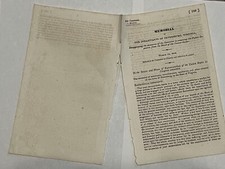
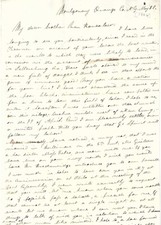
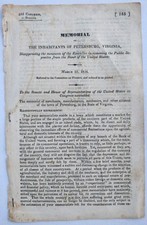
Antique Scarce Rare 1834 Petersburg, Virginia Memorial Document \"Suddenly Arrested By An dir=\"ltr\" style=\"margin-top:0; margin-bottom:0;\">MEMORIAL of THE INHABITANTS OF PETERSBURG, VIRGINIA, Disapproving the measures of the Executive in removing the Public De-posites from the Bank of the United States: MARCH 12, 1834.
Petersburg, VA
The product is a historical document from 1834 Petersburg, Virginia, titled \"Suddenly Arrested By An Experiment.\" This unique piece of ephemera is a rare find from the United States, providing a glimpse into the historical events and experiences of that time period. Perfect for collectors or history enthusiasts looking to add a piece of American history to their collection.
History
Petersburg is an independent city in the Commonwealth of Virginia in the United States. As of the 2020 census, the population was 33,458 with a majority black American population.[4] The Bureau of Economic Analysis combines Petersburg (along with the city of Colonial Heights) with Dinwiddie County for statistical purposes. The city is 21 miles (34 km) south of the commonwealth (state) capital city of Richmond.
Petersburg, Virginia
Independent city
Downtown Petersburg
Downtown Petersburg
Flag of Petersburg, Virginia
Flag
Official seal of Petersburg, Virginia
Seal
Nickname: \"The Cockade City\"
Map
Wikimedia | © OpenStreetMap
Coordinates: 37.23°N 77.405°W
Country
United States
State
Commonwealth of Virginia
County
None
(Independent city)
Founded
December 17, 1748
Named after
Peter Jones
Government
• Mayor
Sam Parham
Area[3]
• Total
22.94 sq mi (59.42 km2)
• Land
22.72 sq mi (58.85 km2)
• Water
0.22 sq mi (0.58 km2)
Elevation
134 ft (40 m)
Population (2020)
• Total
33,458
• Density
1,500/sq mi (560/km2)
Time zone
UTC-05:00 (EST)
• Summer (DST)
UTC-04:00 (EDT)
ZIP codes
Area code(s)
804 and 686
FIPS code
51-61832[1]
GNIS ID
1497087[2]
Website
It is located at the fall line (the head of navigation of rivers on the U.S. East Coast) of the Appomattox River (a tributary of the longer larger James River which flows east to meet the southern mouth of the Chesapeake Bay at the Hampton Roads harbor and the Atlantic Ocean). In 1645, the Virginia House of Burgesses ordered Fort Henry built, which attracted both traders and settlers to the area. The Town of Petersburg, chartered by the Virginia legislature in 1748, incorporated three early settlements, and in 1850 the legislature elevated it to city status.[5]
Petersburg grew as a transportation hub and also developed industry. It was the final destination on the Upper Appomattox Canal Navigation System, which opened in 1816, to a city mostly rebuilt after a devastating 1815 fire. When its Appomattox River port silted up, investors built an 8-mile railroad to City Point on the James River, which opened in 1838 (and was acquired by the city and renamed the Appomattox Railroad in 1847). As discussed below, that became one of four railroads built (some with government subsidies) constructed (with separated terminals to the advantage of local freight haulers) before the American Civil War. In 1860, the city\'s industries and transportation combined to make it the state\'s second largest city (after Richmond). It connected commerce as far inland as Farmville, Virginia at the foothills of the Blue Ridge and the Appalachian Mountains chain, to shipping further east into the Chesapeake Bay and North Atlantic Ocean.[6] During the American Civil War (1861–1865), because of this railroad network, Petersburg became critical to Union plans to capture the Confederate States national capital established early in the war at Richmond. The 1864–65 Siege of Petersburg, which included the Battle of the Crater and nine months of trench warfare devastated the city. Battlefield sites are partly preserved as Petersburg National Battlefield by the National Park Service of the U.S. Department of the Interior. Petersburg rebuilt its railroads, including a connecting terminal by 1866, although it never quite regained its economic position because much shipping traffic would continue to the Norfolk seaport. After the consolidations of smaller railroads, both the CSX and Norfolk Southern railway networks serve Petersburg.
Petersburg has the oldest free black settlements in the state at Pocahontas Island. Two Baptist churches in the city, whose congregations were founded in the late 18th century, are among the oldest black congregations and churches in the United States.[7] In the post-bellum period, a historically black college which later developed as the Virginia State University was established nearby in Ettrick in Chesterfield County. In the 20th century, these and other black churches were leaders in the national Civil Rights Movement of the 1950s-1960s. Richard Bland College has two campus. West Campus located Dinwiddie, VA, and East Campus located in Prince George, VA now a junior college, was originally established as a branch of Williamsburg\'s famed College of William and Mary.
Petersburg remains a transportation hub. Area highways include Interstate Highways 85, 95, and U.S. Route highways with 1, 301, and 460. Both CSX and Norfolk Southern rail systems maintain transportation centers at Petersburg. Amtrak serves the city with daily Northeast Regional passenger trains to Norfolk, Virginia, and long-distance routes from states to the South.[8]
In the early 21st century, Petersburg civic leaders promote the city\'s historical attractions for heritage tourism, as well as industrial sites reachable by the transportation infrastructure.[not verified in body] The federal government is also a major employer, with nearby Fort Gregg-Adams, as home of the United States Army\'s Sustainment Center of Excellence, and the Army\'s Logistics Branch, Ordnance, Quartermaster, and Transportation Corps.
History
edit
Main article: History of Petersburg, Virginia
Petersburg, Va., from Duns Hill, c. 1880
The Civil War headquarters staff of the Army of the Potomac\'s 5th Corps at the home of Col. Isaac E. Avery near Petersburg, photographed by Matthew Brady in June 1864; the following month, on July 3, Avery was killed in the Battle of Gettysburg.
Indigenous peoples
edit
Archaeological excavations at Pocahontas Island found evidence of a prehistoric Native American settlement dated to 6,500 BCE, the early third of the Archaic Period (8,000 to 1,000 BCE). Succeeding cultures of indigenous peoples lived in the area for thousands of years before European exploration and colonization.
When the English arrived in Virginia in 1607, the region was occupied by the Appamatuck, a significant tribe of the Powhatan Confederacy. They were governed by a weroance, King Coquonosum, and by his sister, Queen Oppussoquionuske. This Algonquian-speaking people later had a town at Rohoic Creek (formerly known as Rohowick or Indian Towne Run). Present-day Petersburg developed to the east.
Founding
edit
Petersburg was founded at a strategic point at the fall line of the Appomattox River and settled by English colonists. By 1635 they had patented land along the south bank of the Appomattox River as far west as present-day Sycamore Street, and about 1 mile (1.6 km) inland. In 1646, the Virginia Colony established Fort Henry a short distance from the Appamatuck town, near the falls. It provided waterpower for mills and later industrialization. Col. Abraham Wood sent several famous expeditions out from here in the following years to explore points to the west, as far as the Appalachian Mountains.
Around 1675, Wood\'s son-in-law, Peter Jones, who then commanded the fort and traded with the Indians, opened a trading post nearby, known as Peter\'s Point. The Kennon and Bolling families, prominent tobacco planters and traders, also lived in the area and engaged in local politics. In 1733, Col. William Byrd II (who founded Richmond at the same time) conceived plans for a city at Peter\'s Point, to be renamed Petersburgh. The Virginia General Assembly formally incorporated both Petersburg and adjacent Blandford on December 17, 1748. Wittontown, north of the river, was settled in 1749, and became incorporated as Pocahontas in 1752. Petersburg was enlarged slightly in 1762, adding 28 acres (110,000 m2) to \"Old Town\".[9]
Revolutionary War Period
edit
During the American Revolutionary War (1775–1783), the final British drive to regain control of the colony led to the Battle of Blanford in April 1781, which started just east of Petersburg. As Virginia militia retreated north across the Appomattox River, they took up the planks of the wooden Pocahontas bridge to delay the enemy. Although the British captured Blanford and Petersburg, they did not regain the strategic advantage. Lord Cornwallis\' forces coming up from the Carolinas into Virginia occupied Yorktown on the York River, waiting to meet a Royal Navy fleet. But a larger combined American-French army soon surrounded and besieged them. Cornwallis and his troops found themselves trapped and isolated when the French Navy\'s West Indies fleet under Admiral de Grasse sailed north and won the offshore naval Battle of the Capes at the mouth of the Chesapeake Bay, forcing the British resupply and evacuation fleet to withdraw. In October 1781, Lord Cornwallis surrendered to the superior allied Continental Army\'s General George Washington and French General comte de Rochambeau. After two further years of infrequent conflict and many treaty parleys, the Revolutionary War ended with Britain formally recognizing the new United States.
After the war, in 1784 Petersburg annexed the adjacent towns of Blandford (also called Blanford), Pocahontas and the outlying town of Ravenscroft, which became neighborhoods of the larger city. An area known as Gillfield was annexed in 1798.[10] Residents\' devotion to the cause of America two decades later during the War of 1812 (1812–1815) led to the formation of the militia unit of the Petersburg Volunteers—who distinguished themselves in action at the Siege of Fort Meigs on the Great Lakes frontier on May 5, 1813. Fourth President James Madison called Petersburg \"Cockade of the Union\" (which later was applied to the town as a nickname \"Cockade City\"), in honor of the cockades which Volunteers wore on their caps.[11]
Petersburg\'s Free Black Community
edit
Petersburg Blacks established the First Baptist (1774) and Gillfield Baptist Church (1797), the first and second oldest black congregations in the city and two of the oldest in the nation.[12][13] These black churches were the first Baptist churches established in Petersburg.[7] The Gillfield Baptist Church obtained title to its land in 1818 and in 1859 completed a $7000 brick structure; the Petersburg African Baptist Church also owned its own sanctuary and the community also organized burial and other benevolent societies.[14]
Many free blacks in Virginia migrated to the growing urban community, despite increasing legislative restrictions. Until 1860 Petersburg was a majority black American city, although the enslaved population had few legal rights. Between 1850 and 1860, Petersburg\'s free black community increased 24%, although industrial growth fueled an even greater increase in the white population. Of the 18,366 people counted in Petersburg by federal census takers in 1860, 9,342 were white, 5,680 were slaves, and 3,244 free blacks. Thus in 1860, nearly 26% of all free persons were black, the highest proportion in any Southern city.[15] Free Black men worked as tobacco twisters, in iron foundries, and as draymen, boatmen and cabdrivers, or in the skilled trades of mason, wheelwright, coopers and blacksmiths. Free Black women worked in tobacco factories as stemmers, or as washerwomen or seamstresses or laborers. Plantation owners also brought slaves for hire into the city. As in many other upper South cities, many white households had slaves, but more than 40% were enslaving just one servant.[16]
Pocahontas Island (actually usually a peninsula on the north shore of the Appomattox River) became the area\'s free black residential area. With access to waterways and a population sympathetic to refugee slaves, this neighborhood was an important site on the Underground Railroad.[citation needed]
Antebellum Period
edit
During the Antebellum period Petersburg became the slave states\' eleventh largest city, and 49th among all American cities in industrial development.[17] Commission merchants (39 firms by 1860) bought agricultural products from nearby Dinwiddie County as well as points to the north, south and west and sold supplies. Petersburg\'s industrialists processed cotton, tobacco and metal, then shipped the resulting products out of the region. Richmond and Petersburg became the two largest tobacco towns in the world, with Richmond selling 61% of the state\'s tobacco in 1861, and Petersburg 23%. Petersburg\'s cotton industry relied on waterpower since its inception in the 1830s, and by 1860 towns had developed around the Lynch and Callender mills at Ettick and Matoaca and Battersea across the Appomattox river, and the Merchant\'s Manufacturing Company had another mill at Campbell Bridge near Ettrick. Together those cotton mills constituted approximately a third of that industry in the state. The town also had three water-powered flour mills by 1860, and five iron foundries.[18]
The city became an important industrial center in a mostly agricultural state with few major cities. Starting in 1813, the city paved its streets, which helped attract business. In 1816 the Upper Appomattox Canal Company completed the Upper Appomattox Canal Navigation System to bypass the Appomattox Falls, which facilitated traffic up and down river to Farmville as well as powered cotton and flour mills. Petersburg responded to the silting-up of its Appomattox River port by building the 8 mile long City Point Railroad, which linked the city to City Point on the James River, reachable by larger Chesapeake Bay and Norfolk-bound ships. During the same decade Petersburg became a railroad center. The Virginia and North Carolina legislatures authorized the 65-mile long Petersburg and Weldon Railroad, in 1830 (three years after the first American railway, the B.& O.) and its \"Southern depot\" began handling (mostly freight) traffic to Weldon, North Carolina in 1833. The Virginia legislature authorized the Richmond and Petersburg Railroad in 1835, and three years later it opened between Petersburg\'s Pocahontas neighborhood and Richmond\'s Manchester neighborhood, proving a more convenient and cheaper link than the Manchester Turnpike. The legislature in 1846 chartered Southside Railroad to Farmville and Lynchburg to the west. It would run 124 miles westward and supersede the technologically outdated Upper Appomattox Canal and acquire the Appomattox Railroad in 1854. Petersburg business interests for years managed to block a charter for the last major line, the Norfolk and Petersburg Railroad, which was completed in 1858. It connected Petersburg to the Atlantic Ocean port of Norfolk and would foster more growth in that city than Petersburg itself.[19]
In 1851 the city introduced gaslights and by 1857 installed a new municipal water system. All these civic improvements helped attract and hold a substantial business community, based on manufacture of tobacco products, cotton and flour and banking.
American Civil War
edit
U.S. Engineer Battalion, during the Siege of Petersburg, August 1864
At the time of the American Civil War, Petersburg was the second-largest city in Virginia after the capital, Richmond, and the seventh-largest city in the Confederacy. Petersburg\'s population had the highest percentage of free black Americans of any city in the Confederacy and the largest number of free blacks in the Mid-Atlantic region.[20]
When the Civil War began in 1861, Petersburg was strategic in supporting the Confederate effort. The city provided several infantry companies and artillery units to the Confederate Army, along with three troops of cavalry. In April 1861 more than 300 free black Americans of Petersburg volunteered to work on the fortifications of Norfolk, Virginia under their own leader. Slaveholders also contributed the labor of numerous black slaves.[21]
Siege of Petersburg
edit
In 1864, Petersburg became a target during the Overland Campaign of Union General Ulysses S. Grant. Its numerous railroads made the city a lifeline for Richmond, the Confederate capital. After his defeat at the Battle of Cold Harbor, Grant remained east of Richmond, crossed the James River and moved south to Petersburg. Grant intended to cut the rail lines into Petersburg, stopping Richmond\'s supplies. On June 9, troops led by William F. \"Baldy\" Smith of the 18th Corps, attacked the Dimmock Line, a series of defensive breastworks constructed to protect Petersburg.
General Robert E. Lee arrived with his Army of Northern Virginia, and the 292-day Siege of Petersburg began. Due to botched Union leadership and arrival of Confederate General William Mahone, the Union forces suffered a disastrous defeat at the Battle of the Crater, suffering over 4,000 casualties. In early April 1865, Union troops finally managed to push their left flank to the railroad to Weldon, North Carolina and the Southside Railroad. With the loss of Petersburg\'s crucial railroad lines, the Confederate forces had to retreat, ending the siege in a victory for the Union Army. The fall of Petersburg meant that Richmond could no longer be defended. Lee attempted to lead his men south to join up with Confederate forces in North Carolina. Hopelessly outnumbered, he was surrounded and forced to surrender at Appomattox Court House, Virginia, on April 9, 1865.
Reconstruction era
edit
South Side Railroad Depot on Rock Street which served as the office of William Mahone when his Readjustor Party dominated Virginia politics.
In the years after the Civil War, many freedmen migrated to Petersburg, founding numerous churches, businesses and institutions. The Freedmen\'s Bureau established new facilities for freedmen, including a mental health hospital in December 1869, at Howard\'s Grove Hospital, a former Confederate unit. The U.S. Federal Government and the railroad companies repaired the damaged railroads to the city.[22][23] Saint John\'s Episcopal Church was founded in Petersburg in 1868.
In 1870 the General Assembly incorporated the Central Lunatic Asylum as an organized state institution, as part of an effort by the bi-racial Reconstruction-era legislature to increase public institutions for general welfare. The legislature also founded the state\'s first system of free public education.
Readjuster era
edit
During the 1880s, a coalition of black Republicans and white Populists held power for several years in the state legislature. This resulted in two major public institutions in Petersburg, as the legislature invested for education and welfare. In 1882, the legislature founded Virginia State University in nearby Ettrick as Virginia Normal and Collegiate Institute. It was one of the first public (fully state-supported) four-year historically black colleges and universities (HBCU) in the Mid-Atlantic. This was part of a drive to improve public education that started with the Reconstruction legislature.[24] In 1888, its first president, John Mercer Langston, was elected to the US Congress on the Republican ticket, the first black American to be elected to Congress from Virginia.
In 1882, the state legislature also authorized moving the mental asylum facility to the Mayfield Farm and developing a new campus there. This is the site of the present-day Central State Hospital, which provides a variety of mental health services.
In 1894 a fireworks factory exploded killing eleven people.[25]
20th century to present
edit
Learn more
This section does not cite any sources. (August 2024)
The limitations of Petersburg\'s small geographic area and proximity to Richmond are structural problems that have hampered it in adapting to major economic changes in the 20th century. Other forces in the mid-20th century, such as industrial and railroad restructuring, reduced the number of jobs in the city. In addition, suburban development attracted people to newer housing outside the city.
World wars led to major federal institutions being constructed near Petersburg, which created local jobs. Soon after World War I started, the US Army established Camp Lee just outside of Petersburg in Prince George County for training draftees. The facility was used again during World War II. In 1950 the camp was designated as Fort Lee, and additional buildings were constructed to house the U.S. Army Quartermaster Corps
The history of Petersburg, Virginia, United States as a modern settlement begins in the 17th century when it was first settled. The city was incorporated in 1748. It was occupied by the British during the American Revolutionary War, and Major-General William Phillips died of fever at Blandford (later a neighborhood of Petersburg) during bombardment from the Marquis de Lafayette\'s positions north of the river. After the war, it became a destination for many free blacks in Virginia, as well as a growing hub for railroads. By 1860, it was the second largest city in Virginia. For nine months in 1864 and 1865 it was the subject of the Siege of Petersburg; the fall of the city unleashed a chain of events over the following two weeks that resulted in the end of the American Civil War. After the war, it again flourished as a destination for Freedmen. Petersburg was a notable focal point in the organization of the Civil Rights Movement in the mid-20th century. In the late 20th century, the city suffered significant economic decline.[clarification needed]
Indigenous people
edit
In 2006 archaeological excavations at Pocahontas Island found evidence of prehistoric Native American settlement dated to 6500 B.C. This is in the early third of the Archaic Period (8000 to 1000 BC). Varying cultures of indigenous peoples lived in the area for thousands of years.
When the English arrived in Virginia in 1607, the region was occupied by the Appamatuck, a significant tribe of the Powhatan Confederacy. They were governed by a weroance, King Coquonosum, and by his sister, Queen Opossunoquonuske. This Algonquian-speaking people later had a town at Rohoic Creek (formerly Rohowick or Indian Towne Run), on the western edge of present-day Petersburg.
Colonial period
edit
Archaeological excavation at the site of the 18th-century Golden Ball Tavern
Petersburg was founded and settled by English colonists. By 1635 they had patented land along the south bank of the Appomattox River as far west as present-day Sycamore Street, and about 1 mile (1.6 km) inland. In 1646, the Virginia Colony established Fort Henry a short distance from the Appamatuck town, near the falls. Col. Abraham Wood sent several famous expeditions out from here in the following years to explore points to the west, as far as the Appalachian Mountains.
Some time around 1675, Wood\'s son-in-law, Peter Jones, who then commanded the fort and traded with the Indians, opened a trading post nearby, known as Peter\'s Point. The Bolling family, prominent tobacco planters and traders, also lived in the area from the early 18th century. In 1733, Col. William Byrd II (who founded Richmond at the same time) conceived plans for a city at Peter\'s Point, to be renamed Petersburgh. The Virginia General Assembly formally incorporated both Petersburg and adjacent Blandford on December 17, 1748. Wittontown, north of the river, was settled in 1749, and became incorporated as Pocahontas in 1752. Petersburg was enlarged slightly in 1762, adding 28 acres (110,000 m2) to \"Old Town\".[1]
During the American Revolutionary War, the British drive to regain control erupted in the Battle of Blanford in 1781, which started just east of Petersburg. As the Americans retreated north across the Appomattox River, they took up the planks of the Pocahontas bridge to delay the enemy. Although the British drove the Americans from Blanford and Petersburg, they did not regain a strategic advantage in the war. Cornwallis\' forces surrendered at Yorktown soon after this battle.
Antebellum period
edit
After the Revolutionary War, in 1784 Petersburg annexed the adjacent towns of Blandford (also called Blanford) and Pocahontas and the suburb of Ravenscroft, which became neighborhoods of the city. In 1790 its population totaled 2,828, making it one of the largest settlements in the country.[2] An area known as Gillfield was annexed in 1798.[3]
In the first two decades after the war, inspired by the Revolution\'s principles of equality, numerous Virginia slaveholders manumitted their slaves. Some of those freed were the mixed-race \"natural children\" of white planters, born to enslaved mothers outside of legal marriage. The number of free blacks in Virginia rose markedly between 1782 and 1810. Because of the availability of jobs in Petersburg, many free people of color in Virginia migrated to the growing urban community. They established First Baptist (1774) and Gillfield Baptist Church (1797), the first and second oldest black congregations in the city and two of the oldest in the nation.[4][5] The black churches were the first Baptist churches established in Petersburg.[6]
For years the center of the free black residential area was Pocahontas Island, a peninsula on the north shore of the Appomattox River. With access to waterways and a sympathetic population, this neighborhood was an important site on the Underground Railroad. One surviving house in the Pocahontas Island Historic District is associated with it.[7]
The Pocahontas Island Historic District was listed on the National Register of Historic Places on November 3, 2006. The Pocahontas Island Black History Museum, established in 2003 by Richard Stewart, is located on Pocahontas Island. It was once a stop on the Underground Railroad, and features artifacts and other historical items from over 200 years of black history.[8]
The Port of Petersburg became renowned as a commercial center for processing cotton, tobacco and metal, then shipping products out of the region. The city became an important industrial center in a mostly agricultural state with few major cities.
Residents\' devotion to the cause during the War of 1812 led to the formation of the Petersburg Volunteers—who distinguished themselves in action at the Siege of Fort Meigs on May 5, 1813. President James Madison called Petersburg \"Cockade of the Union\" (or \"Cockade City\"), in honor of the cockades which Volunteers wore on their caps.[9]
In 1815, a fire destroyed much of the business district.
Flourishing businesses helped the city make improvements. Starting in 1813, the city paved its streets. A development company created a canal to bypass the Appomattox Falls. Next came railroad lines to link the city to all points of the compass. As travel technology developed in the mid-19th century, Petersburg became established as a railroad center, with lines completed to Richmond to the north, Farmville and Lynchburg to the west, and Weldon, North Carolina to the south. The last major line was completed in 1858 to the east, with the Norfolk and Petersburg Railroad connecting to an ocean port.
In 1851 the city introduced gas lighting and by 1857 installed a new municipal water system. All these civic improvements helped attract and hold a substantial business community, based on manufacture of tobacco products, but also including cotton and flour mills, and banking.[citation needed]
Civil War
edit
Further information: Siege of Petersburg
Christ Church in Petersburg, 1865
At the time of the American Civil War, Petersburg was the second largest city in Virginia, and the seventh-largest city in the Confederacy. Its 1860 population was 18,266, half of whom were black. Free blacks numbered 3,224 (one-third) and had been attracted to the city for the opportunities in industries and trades.[10] Petersburg\'s population had the highest percentage of free African Americans of any city in the Confederacy and the largest number of free blacks in the Mid-Atlantic.[7] Many had settled on Pocahontas Island.[7] Because of its significant past and prehistoric archaeological evidence, the Pocahontas Island Historic District is listed on the National Register of Historic Places. Ninety percent of the population are native Virginians, as most of their ancestors had been in the state since the 17th and 18th centuries.
When the Civil War began in 1861, Petersburg was strategic. The city provided several infantry companies and artillery units to the Confederate Army, along three troops of cavalry. In April 1861 more than 300 free Petersburg African Americans volunteered to work on the fortifications of Norfolk, Virginia under their own leader. Slaveholders also contributed the labor of numerous black slaves.[11]
In 1864, Petersburg became a target during the Overland Campaign of Union General Ulysses S. Grant. The numerous railroads made Petersburg a lifeline for Richmond, the Confederate capital. The depot at Pocahontas Island, built for the Richmond & Petersburg rail line, was a transit point for Confederate troops and supplies.
Ruins of pre-war slave quarters on the Petersburg Battlefield
Petersburg was the headquarters of the Confederate Army\'s Second Regiment of Engineers, whose members included Benjamin Morgan Harrod, a Harvard-trained civil engineer who later designed the water and sewer systems of his native New Orleans, Louisiana.[12]
After his defeat at the Battle of Cold Harbor, Grant remained east of Richmond and moved south to Petersburg. Grant intended to cut the rail lines into Petersburg, stopping Richmond\'s supplies. On June 9, troops led by William F. \"Baldy\" Smith of the 18th Corps, attacked the Dimmock Line, a series of defensive breastworks constructed in 1861 and 1862 to protect Petersburg against the Army of the Potomac under General George McClellan during the Peninsula Campaign. The Confederate troops numbered only 2,000, but Smith and Winfield S. Hancock were hesitant to attack the fortified line. Confederate General P.G.T. Beauregard informed Lee that he was facing virtually the entire the Army of the Potomac with his few defenders at Petersburg. Lee arrived with the fabled Army of Northern Virginia, and the 292-day Siege of Petersburg began. Lee himself admitted that the South could not win a siege war.
The trench lines on the east of Petersburg were close together. A soldier in the 48th Pennsylvania Infantry of the Union Army IX Corp, a coal miner in civilian life, remarked, \"We could blow that battery into oblivion if we could dig a mine underneath it.\" Colonel Henry Pleasants, his division commander, liked the idea and forwarded it up the chain of command. Grant gave his approval. On July 30, the explosives in the tunnel were detonated. Due to botched Union leadership and arrival of Confederate General William Mahone, the Union forces suffered a disastrous defeat at the Battle of the Crater, suffering over 4,000 casualties. The battle was portrayed in the film Cold Mountain (2003). By the end of the war, the city was ringed with a series of fortifications.
In early April 1865, Union troops finally managed to push their left flank to the railroad to Weldon, North Carolina and the Southside Railroad. With the loss of Petersburg\'s crucial lifelines, the Confederate forces had to retreat, ending the siege in a victory for the Union Army.
The fall of Petersburg meant that Richmond could no longer be defended, Lee attempted to lead his men south to join up with Confederate forces in North Carolina. Hopelessly outnumbered, he was surrounded and forced to surrender at Appomattox Court House, Virginia, on April 9, 1865. Confederate General Ambrose P. (A.P.) Hill died on the last day the Confederates held the Petersburg trenches. Petersburg established a warfare precedent. During World War I the armies on both sides used trenches extensively in Europe (q.v. trench warfare).
Skyline of Petersburg at the end of the American Civil War in 1865
Reconstruction era
edit
South Side Railroad Depot on Rock Street which served as the office of William Mahone when his Readjustor Party dominated Virginia politics
The Freedmen\'s Bureau established new facilities for freedmen, including a mental health hospital in December 1869, at Howard\'s Grove Hospital, a former Confederate unit. In 1870 the General Assembly incorporated the Central Lunatic Asylum as an organized state institution, as part of an effort by the Reconstruction-era legislature to increase public institutions for general welfare. The legislature also founded the state\'s first system of free public education.
In the years after the Civil War, many freedmen migrated to Petersburg for rebuilding, work on the river, and to escape the white control prevalent in more rural areas. They found numerous churches, businesses and institutions founded by free blacks, and added new energy to the community. In 1874 James M. Wilkerson Sr. founded the Wilkerson Undertaking Company. It continues to operate as the James M. Wilkerson Funeral Establishment, Inc. [1] and is one of the oldest black-owned firms in the United States. Although in the 1870s, conservative whites took power in the state and began to legislate racial segregation, African Americans continued to create their own businesses and community organizations in Petersburg.
During the 1880s, a coalition of black Republicans and white Populists held power for several years in the state legislature. This resulted in two major public institutions in Petersburg, as the legislature invested in education and welfare. In 1882, the legislature founded Virginia State University in nearby Ettrick as Virginia Normal and Collegiate Institute. It was one of the first public (fully state-supported) four-year historically black colleges and universities (HBCU) in the Mid-Atlantic. This was part of a drive to improve public education that started with the Reconstruction legislature.[13] John Mercer Langston, a national political leader and former dean of Howard University\'s law department, was selected as the college\'s first president.[14] An Oberlin College graduate, he was an accomplished attorney who had been a leader of abolitionists in Ohio and held national appointments. In 1888, Langston was elected to the US Congress on the Republican ticket, the first African American to be elected to Congress from Virginia. He was also the last for nearly a century.[14]
Also in 1882, the state legislature authorized moving the asylum facility to the Mayfield Farm and developing a new campus there. This is the site of the present-day Central State Hospital, which provides a variety of mental health services.
20th century
edit
The limitations of Petersburg\'s small geographic area and proximity to Richmond were structural problems that hampered it in adapting to major economic changes in the 20th century. Other forces in the mid-20th century acted to pull people and jobs from the city. It suffered from competition with nearby Richmond, which grew to dominate the region in a changing economy as industries restructured.
World wars led to major federal institutions being constructed at Petersburg, which created local jobs. Soon after World War I started, the US Army established Camp Lee for training draftees. The facility was used again during World War II. In 1950 the camp was designated Fort Lee, and additional buildings were constructed to house the U.S. Army Quartermaster Corps Center and School.
In the late 19th and early 20th century, Virginia\'s Democratic Party–dominated legislature instituted Jim Crow laws, including imposing racial segregation. It also approved constitutional changes that effectively disfranchised most blacks and many poor whites. Those disfranchised suffered major losses in the ability to exercise their rights as citizens. For instance, without being able to vote, they could not serve on juries or be appointed to certain offices. The white legislature consistently underfunded services and schools for blacks.
With many African Americans having served the nation and cause of freedom in WWII, in the postwar years they pressed for social justice, an end to segregation, and restoration of voting power. Even after the Great Migration of blacks to northern jobs and cities, Petersburg was 40 percent black in 1960. Those citizens were barred from free use of public spaces and facilities.[15] Major black churches, such as First Baptist and Gillfield Baptist, formed the moral center of the Civil Rights Movement in Petersburg, which gained strength in mid-century and was a major center of action.
Dr. Wyatt Tee Walker, the pastor of Gillfield Baptist Church, had become friends with Dr. Martin Luther King Jr. in the early 1950s when they were both in divinity school. In 1957 they co-founded the Southern Christian Leadership Conference (SCLC), an important force for leadership of the movement in the South. Walker also founded the Petersburg Improvement Association (PIA), modeled on the Montgomery Improvement Association in Alabama.[16] According to Walker and other close associates of King, Petersburg had played an important role, a kind of blueprint for the national civil rights struggle. King spent time in the city on several occasions in the 1950s and 60s, and several of his top lieutenants were recruited from the local movement. Civil War Lincoln
African Americans in Petersburg struggled, with federal government support, to desegregate public schools and facilities. Through sit-ins in the bus terminal in 1960, the PIA gained agreement by the president of the Bus Terminal Restaurants to desegregate lunch counters in Petersburg and several other cities.[18] Virginia officials at the top levels resisted school integration and initiated the program of Massive Resistance. For instance, rather than integrate, the school board of neighboring Prince Edward County closed public schools for five years, starting in 1959.
In the 1950s, Petersburg became the southern terminus of the Richmond-Petersburg Turnpike, predating the U.S. Interstate Highway System.
In 1958 Petersburg was named an \"All American City\" for its quality of life. In 1970, Carrie E. Miles, from Ward One-Blandford, became the first African-American Women to hold a seat on the Petersburg Public Schools Board of Education since Reconstruction. Retail and industry prospered there until about the early 1980s. De-industrialization and structural economic changes cost many jobs in the city, as happened in numerous older industrial cities across the North and Midwest. The postwar national movement of highway construction and suburbanization added to problems. Many middle-class families moved to newer housing in the suburbs and to nearby Richmond, where the economy was expanding with jobs in fields of financial and retail services. Some companies moved industrial jobs to states further south, where wages were lower, or out of the country altogether. Without sufficient jobs and decreasing middle-class population, city progress slowed.
The declining economy increased the pressure of competition and racial tensions. These flared from 1968 to 1980. Following the assassination of King in 1968, Petersburg was the first city to designate his birthday as a holiday, an observance that is now a national holiday.[19] Regional tensions were heightened by the city\'s two large annexations of adjacent portions of Dinwiddie and Prince George Counties in the early 1970s. Despite the large addition of suburban school-age children, a downward trend in public school enrollment continued. Projected industrial development of large tracts of vacant land in the annexed areas did not materialize. In 1985 city leaders were unable to keep Brown & Williamson tobacco company, a top employer, from relocating to Macon, Georgia. The company, disappointed in the city council\'s vote to raise taxes on tools and machinery, relocated to a market with lower taxes.
Partially due to the vacant land still available for potential industrial development, which had been used as justification for the earlier annexations, in 1986 the city failed in its attempt to annex a large section of neighboring Prince George County. It had hoped to enlarge its area for schools and tax base.
When negotiations soured in 1989 to build a new regional mall in Petersburg, the city suffered an economic setback. Numerous remaining retail merchants relocated to the new Southpark Mall area in adjacent Colonial Heights. In a typical postwa