When you click on links to various merchants on this site and make a purchase, this can result in this site earning a commission. Affiliate programs and affiliations include, but are not limited to, the eBay Partner Network.
An Exceptional 1827 George IV English Schoolgirl Needlework Sampler
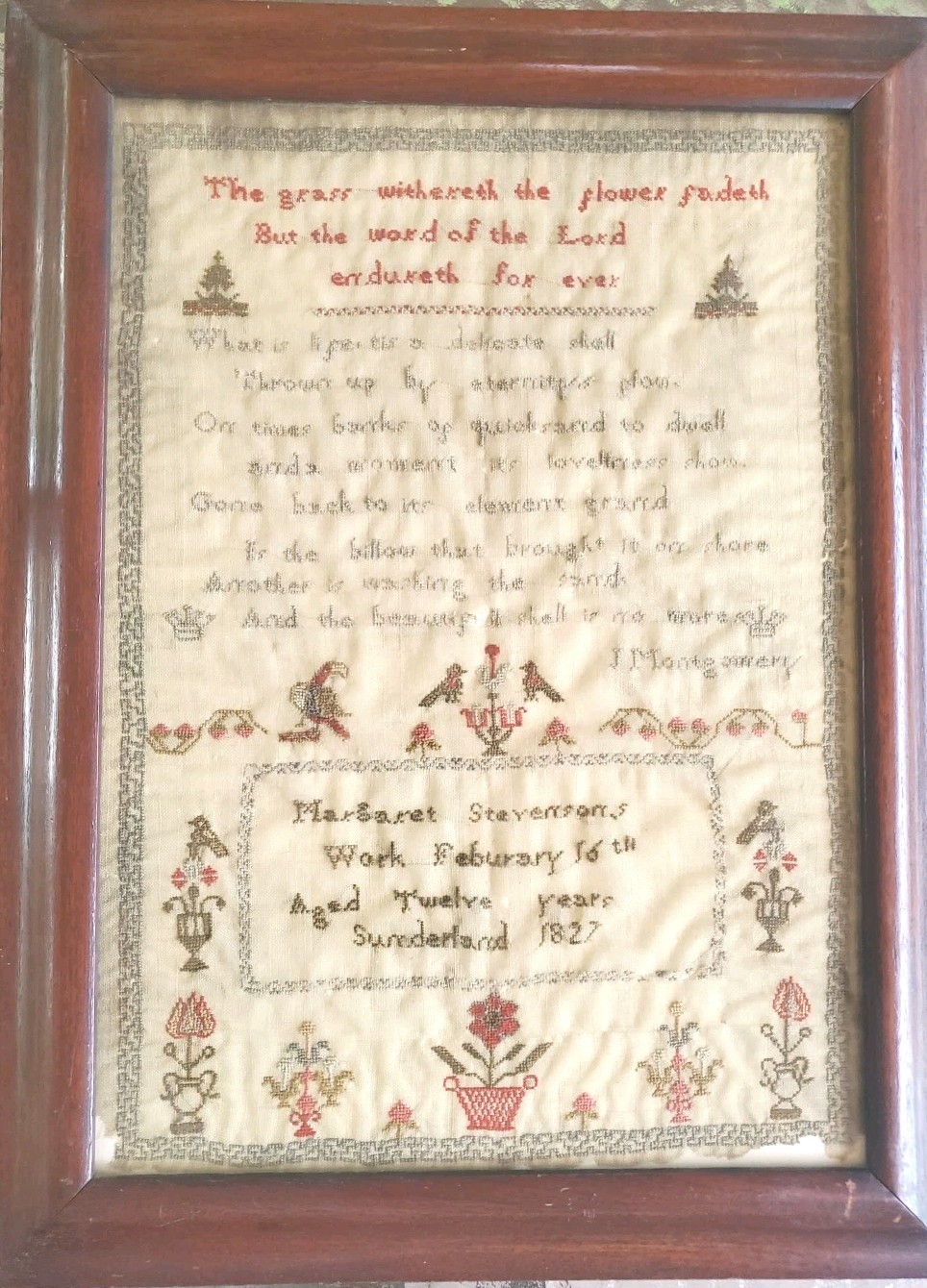
This authentic, museum-quality textile piece was hand-stitched in 1827 by 12-year-old Margaret in Sunderland, England. Housed in a beautiful frame, this sampler is a prime example of early 19th-century British needlework and folk art.
Item Details & Key Features:
- Date / Origin: Dated 1827, Sunderland, England (George IV Period)
- Iconography: Symmetrical floral urns, stylized birds, and an elaborate decorative border.
- Charming Characteristic: Features a beautifully quaint period misspelling of the month, adding incredible character and verifying its authentic schoolgirl origin.
- Text: Features a beautifully executed, long moral poem/verse.
Notes:
Museum-Quality 1827 Schoolgirl Needlework Sampler Margaret Stevenson, Sunderland, England A stunning, highly documented piece of early 19th-century British textile folk art featuring exceptionally bright, vibrant colors and a rare literary verse.
📌 ITEM OVERVIEW & SIGNIFICANCE:
Artisan: Margaret Stevenson (Stitched at Age 12) Date of Completion: February 16, 1827.
Origin: Sunderland, County Durham, North East England.
Primary Motifs: Vibrant polychrome birds, floral baskets, crowns, potted trees, and an intricate geometric Greek Key border.
Literary Feature: A beautifully rendered religious verse explicitly credited on the fabric to the famous Scottish-born poet and abolitionist James Montgomery (1771 - 1854), quoting lines from his celebrated work, \"The Grave.\"
EXTRAORDINARY GENEALOGICAL PROVENANCE:
Unlike most anonymous textiles of this era, this sampler is accompanied by extensive historical research that traces Margarets entire life, transforming it into a fully verified social artifact:
The Maker: Margaret Stevenson, born circa 1815 in Sunderland.
Family Heritage: Daughter of John and Eleanor. Her father worked as a Mariner. She likely attended The Methodist Sunday School / Day Academies in Sunderland.
Adulthood & Legacy:
Margaret married William Blackett on July 14, 1828 at Holy Trinity Parish Church in Sunderland. Together, they raised at least three children named; Margaret, Thomas, and, Hannah.
The census of 1841 indicates her occupation as \"Dressmaker\".
🔍 COMPOSITION & TEXT VISIBLE:
The top portion features Isaiah 40:8:
\"The grass withereth the flower fadeth, But the word of the Lord endureth for ever.\"
Below it features Montgomerys evocative verse:
\"What is life? tis a delicate shell / Thrown up by eternitys flow...\"
The bottom inscription reads perfectly clearly in crisp stitching:
\"Margaret Stevenson\'s Work Feburary 16th Aged Twelve years Sunderland 1827\"
Note:
Margaret uniquely misspelled \"February\" as \"Feburary,\" adding a very charming and human authenticity to this schoolgirl piece.
More in detail:
A vibrantly colored antique 1827 sampler signed needlework by Margaret Stevenson of Sunderland, England , aged 12. And, specifically, she stitched the date: \"Febuary 16, 1827\".
This is a beautiful piece of English folk art featuring intricate designs of birds and flowers and other designs that are stylized. Especially uncommon all-together are; the two Royal crowns on the top and the Greek Key boarder, the thistles and the floral urns, and, a charming central candleabra, also flanked by stylized birds.
Over-all in excellent condition. Superb color preservation indicates that this has been kept away from direct sunlight for these 199 years.
The backing appears to be a more modern acid free preservation feature. See Pictures, Please. This large work measuring approximately 17 inches by 12 inches showcases the popular artistry and craftsmanship of the era.
The Bible verse at the top: \"The grass withereth and the flowers fadeth, but the Word of the Lord endureth for ever\" (taken from Isaiah 40:8).
Underneath that is a long part of a popular poem of the day and the author\'s attrribution is stitched underneath, \" J. Montgomery\" (James) (1813)). Montgomey was a Christian poet, hymn writer, and ardent abolitionist.
The poem stitched reads, in part:
\"What is life \'tis a delicate shell thrown up by eternity\'s glow, on times banks of quicksand to dwell and a moment its loveliness show\".
And she stiched even more from this very fitting poem and profound thought.
The juxtaposition of the \"flowers fadeth\" in the text from Isaiah with the artistry of rendering many actual flowers and birds is particularly complex and is profoundly thought-provoking.
Genealogical records show Margaret married very young, maybe around 14 years-of-age, which was allowed at the time with parental consent, in the same church of her baptism which took place at Holy Trinity Church in Sunderland on June 4, 1815.
Her parents were John and Eleanor, and her father\'s occupation was listed as \"Mariner\".
The shipping industry there was in a boom-time, which can help to account for the family\'s ability to afford Margaret\'s education, likely she graduated from the Methodist Sunday School / Day Academies in Sunderland. An Anglican school would likely not have taught students to mix poetry from a living and a non-Anglican poet, especially not put together with a text from the Old Testament prophet Isaiah.
This type of high quality and intricate sampler, done in winter months, was not made only just for \"sewing practice\" but often these were done as a school graduation project to demonstrate a young woman\'s literacy, piety, and meticulous skill.
Margarate married very young, July 14, 1828, to William Blackett, and they had at least three children; Thomas, Margaret, and, Hannah. The 1841 census serms to show her occupation as \"Dressmaker\", using her skills already so advanced at her age of twelve as we see here in her work in 1827.
Perfect for collectors of samplers and textiles, this unique piece would make a distinctly charming addition to your own home decor or vintage collection.
The dark reds and the cream silk embroidery remains remarkably bold and legible.
This is being sold just as it was found,
In a gorgeous historic dark wood frame that beautifully compliments this dated and signed early 19th Century aesthetic artifact.